Santa Cruz has a new mayor, and her name is Martine Watkins.
Watkins, who just wrapped up her one-year term as vice mayor this week, began her new role at the end of Tuesday nightโs meeting. Also at the Dec. 11 meeting, the Santa Cruz City Council voted to make newly elected City Councilmember Justin Cummings the townโs new vice mayor.
Councilmember Chris Krohn, who supported Cummingsโ campaign, made the nomination, behind a newly minted City Council majority. The change marks first time in two decades that a newly elected City Council candidate has transitioned right from his swearing in into the vice mayor seat. By conventional wisdom, the post puts Cummings next in line to be mayor.
He could not be reached for comment by deadline, but in his remarks Tuesday night, Cummings said he was looking forward to working collaboratively with colleagues and staff.
At the same meeting, City Clerk Bonnie Bush swore in the two other new councilmembersโDonna Meyers, who finished second, and Drew Glover, who ran on a slate with Cummings. Cummings and Glover are the first African American men to serve on the council. Meyers is the cityโs first openly lesbian councilmember.
The council unanimously confirmed Krohnโs vice mayor nomination of Cummings.
Customarily, the top two vote-getters from each election each serve a one-year term as vice mayor and another as mayor, although the actual decision is left up to the council. Meyers nominated Councilmember Cynthia Mathews, the second-leading vote getter in the 2016 election, to be vice mayor. Meyers cited Mathewsโ years of service and her work protecting womenโs health.
Mathews withdrew the nomination, signaling a desire to move forward, adding that she enjoyed getting to know Cummings in recent months and that she did not want to further a perception that politics in Santa Cruz is divisive. (Under a majority led by Krohn, Mathewsโ nomination would likely not have had the votes to pass.)
The shift in order marks the first disruption to the mayoral norm since 1998, at the beginning of the last term Krohn served on the council. Thatโs when Krohn and his newly elected fellow councilmembers Keith Sugar and Tim Fitzmaurice shook up the rotation for mayor. The specifics were different, but the council voted to appoint Katherine Beiers to the mayorship, in lieu of then-Vice Mayor Mike Rotkin, who had been the top vote-getter two years prior, and customarily would have been next in line. Sugar became the vice mayor.
Over the course of their shared four-year council term, Sugar, Fitzmaurice and Krohn would each serve a year as mayor.
Beiers says many activists told her at the time that they felt she should be mayor, and that Rotkin shouldnโt. Rotkin, she says, had just gotten caught ripping down a campaign sign for Fitzmaurice. She also says that one of her colleagues had also disrupted the chain, stepping in line in front of her a few years earlier. Rotkin says that the campaign sign was just a misunderstanding. The property owner, he says, had asked him to take down the sign and put up a different political one. He claims Beiers had asked him if he would be willing to simply let her serve her term as mayor first for personal reasons, and that thatโs the reason he went along with it, not realizing he would miss out on his chance.
With three new councilmembers on the dais in 2018, local politicos are now looking forward. Krohn says his decision to nominate Cummings wasnโt just about politics, but also about his leadership style. โRight person, right time,โ he says.
After the election results confirmed earlier this month that Meyers came in second at the polls, many voters thought that she would end up serving a year as vice mayor and another as mayor during her time on the council. Krohn isnโt ready to say who he might support for vice mayor at the end of 2019.
โI wonโt go there yet,โ he says. โLetโs just get this year done first and see how it goes.โ
Ah, Christmas. A time for Santa, presents and the music of horror-punk band the Misfits. OK, maybe that last one pertains only to Santa Cruz. After all, where else can one go to experience Christmas With the Misfits, the annual holiday benefit concert featuring local and regional bands covering Misfits songs?
โIt really is a big party,โ says founder Nick Anchorheart. โWe have a Christmas tree on stage, everything is decorated, and some of the bands even throw a Christmas song into their set.โ
For its sixth incarnation, this ghoulโs night out will feature performances by made-up Santa Cruz bands 831 (members of Stellar Corpses and Hayride to Hell), 5:25 (members of Get Married) and Midnight Mass (members of Requiem) along with Face For Radio (Fresno), and 12 Steps To Nothing (San Jose). Anchorheartโs band, the Sea Wolves, will also be performing under the moniker Fiend Wolves.
โI love mixing up the genres and getting bands that arenโt necessarily the same style as the Misfits,โ he chuckles. โOne year we did a doo-wop version of one of the songs.โ
So, how did Misfits, a band who wrote โMommy, Can I Go Out And Kill Tonight?โ and โDie, Die My Darlingโ become associated with the holiday season?
It began in 2011, when Anchorheart threw a Misfits-themed show around Halloween. He tried to repeat it the following year, but there were no open dates. His wife, Samantha, suggested he instead do a tongue-in-cheek Christmas show. It was a surprise hit.
Since its inception, the holiday concert has operated as a benefit show and raised money for Grind Out Hunger and Imagine Supported Living. This year, all proceeds will benefit the Santa Cruz County Animal Shelter. Patrons can also donate through buying raffle tickets and gift certificates donated by Streetlight Records, Black Pearl Tattoo and Starving Musician. Attendees can bring a new toy, to be donated to the childrenโs ward at Natividad Hospital in Salinas, for five raffle tickets.
โI want to get the community as involved as possible, and keep everything local,โ Anchorheart says.ย
This is a big year for one of the areaโs most iconic childrenโs theater groups, and not just because itโs the 30th anniversary of the Willow Glen Children’s Theatre. Itโs also because this is the first year that WGCTโs holiday performancesโwhich run Friday, Dec. 14 through Sunday, Dec. 16โwonโt be overseen by founding director Gavin Coffing, who started the organization three decades ago and wrote an original play for each season.
This season, that responsibility fell to the replacement Coffing handpicked, Jordan Collier. The 28-year-old Collier has been involved with WGCT for almost 20 years, and a staff member for 13 years. She still remembers her very first day at WGCT, when she was 9 years old.
โMy mom just kind of signed me up,โ says Collier. โThat first day I made a little friend, and I just loved it. My first play, I had two lines. The whole environment was so much fun.โ
One of the things that makes WGCT unusual is that all of the kids who sign up for a season of WGCT get lines in the play. In fact, the lines are sort of written for them, as the groupโs director observes the seasonโs participants from the very first Saturday morning meeting, over the course of a few weeks. The weekly gatherings start out with improv and other acting games for the kids, who generally range from age 7 through older teens. As the director begins to write the play, parts are handed out and rehearsals begin, culminating in the weekend of performances. The whole process takes just over two months, and allows the kids to see the whole process of production.
This year, the task of writing the play has fallen to Collier. โItโs definitely a little intimidating,โ she admits. โBut Iโm really very honored that Gavin trusted me to continue this program that he put his blood, sweat and tears into. Iโm just trying to honor what heโs created, because I think itโs important. We really want to make every participant feel like they have their time to shine.โ
Collierโs first play is called Here, There, Everywhere, and follows two friends as they investigate the disappearance of a wealthy, eccentric old man from their neighborhood. Various clues lead them to encounter a number of characters over the course of the story.
โI do love mysteries. I always have,โ she admits. And despite the many challenges sheโs run into, she also loves working with the more than two dozen kids who are involved this season. Sheโs not surprised to see them bonding, as she did with the kids she first performed withโmany of whom are her fellow SGCT staff members now, and some of whom now have nieces and nephews who are currently in the program.
โItโs always been such a close group,โ she says.
Looking for something fabulous for your Christmas table? The 2017 Merlot made by Brandon Armitage is a winner.
Entering the portals of Armitage Winesโ Aptos tasting room recently, I was thrilled to find that Armitage is now making Merlot and Chardonnay along with the wine heโs most known for, Pinot Noir. โI branched out,โ Armitage laughed as he served wine at a recent event for wine club members. Tasting room manager Jeanne Earley busily prepared delicious-looking appetizers to serve to the packed house.
Armitageโs expertly made wines are in high demandโand they sell out quickly. The 2017 Merlot ($60) is a crimson wonder, made with grapes harvested from Fowl Play Vineyard in Scotts Valley. The property falls under the Santa Cruz Mountains AVA and is just down the road from the old Alfred Hitchcock estate where Armitage farms Pinot Noir grapes.
Fewer than 100 cases were produced of this exceptional Merlot, which overflows with aromas of plum and chocolate and deep flavors of vanilla, coffee and red fruits.
Armitage says the 2017 is very European in styleโโFrench, evenโโbecause of the low-alcohol content of only 12 percent. โHe calls it a โwinemakerโs wine,โโ says Earley. โHe strives to keep the alcohol level down, which is hard to do as the world gets hotter.โ
Armitage pours his heart and soul into winemakingโand one can feel the love in every bottle. โThe only thing that inherently exists within all things is Love,โ his label declares.
Armitage Tasting Room, 105C Post Office Drive, Aptos. 708-2874, armitagewines.com. Open weekly Wednesday-Sunday.
Companion Bakeshop
Iโm absolutely nuts about Companion Bakeshopโs buckwheat blueberry scone ($3). Devilishly dark and delicious, youโd never know this crunchy-round-the-edges treat is gluten-free. Everything they make is top notch, including their freshly baked bread.
At the end of November, Companion opened a new outpost in Aptos Center at 7486 Soquel Driveโand theyโre serving Cat & Cloud coffee, too. My cup runneth over.
Visit companionbakeshop.com for locations, including farmers markets, or call 252-2253.
The mainstream media did everything it could to avoid acknowledging votersโ repudiation of Donald Trump in this last election, rushing out a thousand headlines that were some variation on โBlue Wave Turns Out to Be Nothing More Than a Blue Ripple.โ Only after weeks of taking in the final results, with Democrats piling up 40 flipped seats in the House, did we start to see headlines like CNNโs โLatest House Results Confirm 2018 Wasnโt a Blue Wave, It Was a Blue Tsunami.โ
Here in California, it was a different storyโabsolutely no one was disputing the victory of progressive politics across the state (even in Orange County!) But many pundits still acted like this result came out of nowhere. Guess what, talking heads, it didnโt! In fact, there have been progressive politicians working hard for years to bring those values back to government. This week, Geoffrey Dunn profiles one of the leaders of that movement, our own State Senator Bill Monning. His story provides the context that has been sorely lacking in the mainstream coverage about the election and the state of the stateโs politics.
A few other important things to mention: as always, weโre doing a story every week about one of the local nonprofits you can support through Santa Cruz Gives. Read this weekโs story by Georgia Johnson about Watsonville Wetlands Watch in the news section, and then go to santacruzgives.org and give to the group or groups doing the work that is most important to you. Also, voting for the Best of Santa Cruz County 2019 awards begins this week! Go to goodtimes.sc to find the ballot and get your results in early! And another thing you can find this week at goodtimes.sc are the answers to your big questions about Santa Cruz, as researched by UCSCโs Science Communication program students. Weโre posting them one at a time, and itโs interesting stuff. Check it out!
I loved the profile of Martha Hudson (โChange Maker,โ GT 12/5) for many reasons. As a lifelong rule-follower (albeit grudgingly), it allowed me to live vicariously through someone who has chosen a very different lifestyle from my own. And, yes, Iโm a bit envious. I also admire her determination to empower other women and non-binary folks to chart their own courses.
As a girl growing up in the Midwest in the โ60s and โ70s, I wasnโt allowed to wear pants to my (public) school until the rules were changed in third grade. Besides severely restricting my playground activities, this incensed my 6-year-old sense of fairness. At my summer camp, girls were forbidden from wearing Speedo swimsuits, because they were deemed too arousing for the boys.
Someday, the body-shaming cultural messages and norms that Ms. Hudson and others are working so hard to counteract will seem as ridiculous as the rules girls of my era were subjected to.
Lizanne Reynolds
Aptos
CEQA Abuse
I was trained in CEQA at Cal State Hayward. The Geography Department established a class to learn and practice the law back in the early โ80s. We each had to work up an actual project. I was able to write over 80 pages of comments for a TV transmission tower in the Bay Area. It was obvious to us twentysomethings that the implementation of the law was going to become riddled with abuse. It needs to be reformed, but how? You canโt take away peopleโs right to use the law and litigation as a means toward the end of stopping a project they do not like or want.
I worked as an environmental protection specialist for a good portion of my career. I observed the gradual expansion of the implementation process, and the increasing abuse that came as part of the deal. Government was looking for more work and revenue. Neighbors were looking to kill projects by a thousand paper cuts and financial extractions. Opportunistic lawyers were looking for an easy mark. I believe CEQA lawsuits are now the number one tool used by project opposition to stop work across the state.
A lot of the abuse happens behind the scenes. Confidentiality and non-disclosure are certainly part of the litigation. It would be interesting to know not only how many projects have been shaken down in public litigation, but also in confidential settlements, and what the ultimate cost is. I had written a comment back in October about โlitigation aheadโ for the Ocean Street project. I was excoriated for that comment.
Frankly, the majority opinion I see expressed over and over by residents in the county is a desire to chase away any change. We want our exclusive paradise all to ourselves. The City of Santa Cruz is the poster child for this attitude, where the main battle is now a battle to crush rental property owners. The students think they are going to get cheap rent. The jokeโs on them. Property values and rents will continue their upward climb, interrupted by the inevitable economic downturns, and a dribble of public money will continue to go toward homelessness, rent subsidies, road expansion, and the other social ills created by the abuse of law to stop any meaningful building of housing.
Michael Cox
Soquel
PHOTO CONTEST WINNER
Submit to ph****@*******es.sc. Include information (location, etc.) and your name. Photos may be cropped. Preferably, photos should be 4 inches by 4 inches and minimum 250dpi.
GOOD IDEA
The annual Homeless Memorial will gather at 10 a.m. on Thursday, Dec. 20 at Homeless Services Center (HSC) to honor the homeless who have died in the past year. This year marks the 20th ceremony remembering less fortunate residents who have passed. From HSC, guests will walk to nearby Evergreen Cemetery to look at a proposed permanent homeless memorial site. There is overflow parking at the Tannery, although guests are encouraged to bike, carpool, bus or walk. For more information, visit santacruzhsc.org.
GOOD WORK
If the holidays are all about generosity, warmth and spreading cheer, a group of local Girl Scouts has certainly risen to the occasion. As a part of its holiday charity project, Girl Scout Troop 10213 of Aptos donated more than 50 jackets to Dominican Hospital over the weekend. The 10- and 11-year-olds collected the coats through donation drives at elementary schools. The jackets went in the hospitalโs โpatient closet.โ Theyโll be given to any patient who needs a coat when they leave.
Ice skating at the beach is one of Santa Cruzโs most iconic holiday events. The ice skating rink is open to all ages and ability levelsโwhether you can barely stand or youโre the next Tonya Harding, all are welcome. It does get chilly with all of the coastal snow flurries, so be sure to cozy up next to the fire pits with some hot cocoa after. Open rain or shine, online reservations recommended.
INFO: Runs through Jan. 6. Santa Cruz Beach Boardwalk, 400 Beach St., Santa Cruz. 423-5590, beachboardwalk.com. One-hour session includes $15 ice skate rental.
Art Seen
Prison Arts Project Art Poetry
Because of the limited amount of materials local art teacher Tripura Anand could bring into the Santa Cruz County Main Jail, she had to improvise. She developed a college art program for the inmates using torn paper. Inmates would create images out of the paper, and Anand says that art classes have been particularly relaxing for her students while also fostering better communication between correctional officers and inmates. A selection of art and poetry by inmates in the Santa Cruz County Main Jail is on display at the Resource Center for Nonviolence until the end of this month only.
INFO: Show runs through Jan. 24. Resource Center for Nonviolence, 612 Ocean St., Santa Cruz. 423-1626. rcnv.org. Free.
Sunday 12/16
Breakfast with Santa Claus
Santa always goes above and beyond during the most wonderful time of the year. This season, Santa and his elves will be serving pancakes, eggs, sausage, fruit and beverages, accompanied by youth singers and dancers. There will be free kidsโ holiday games and build-a-gift activities, plus a raffle with local prizes and photographs with Santa. All proceeds support recreation activities for Watsonville youth. Those in need of financial support to attend the event can email in**@*****************es.org.
INFO: 8 a.m.-noon. Watsonville Senior Center, 114 E. Fifth St., Watsonville. $6 adults, $5 children.
Sunday 12/16
Kuumbwa Journey of 1,000 Lights
The Kuumbwa Jazz Centerโs annual benefit concert combines music of different styles and ethnicities that speak to the immigrant experience from which democracy evolved. Featuring local musicians like Keshav Batish and Laurie Tanenbaum, this annual benefit supports Chadeish Yameinu Jewish Renewal Community of Santa Cruz.
INFO: 3-5:30 p.m. Kuumbwa Jazz Center, 320 Cedar St., Santa Cruz. 427-2227, kuumbwajazz.org. $20-$35.
Saturday 12/15
Pine Needle Basket Making Workshop
Join docent Cheryl VanDeVeer in learning how to make a woven basket from local ponderosa pine needles. No experience is necessary, though all of you expert pine needle basket weavers are welcome to join. Children 10 and older may attend if accompanied by an adult.
INFO: 10 a.m.-noon. Henry Cowell Redwood State Park. 101 N Big Trees Park Road, Felton. 335-4598. Free.
THU 12/13- SAT 12/15
โTHE CURIOUS SAVAGEโ
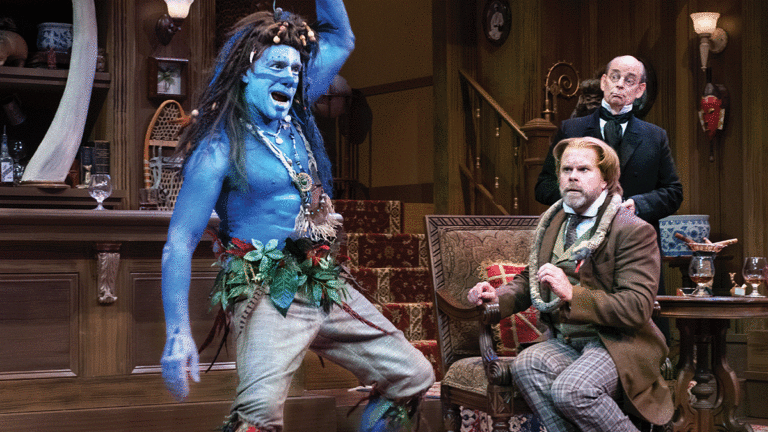
Scotts Valley High School presents a new production of The Curious Savage, a play by John Patrick about an elderly woman named Mrs. Savage whose husband has left her $10 million. But a fight over the fortuneโand the schemes of her stepchildrenโbring an unexpected turn to Mrs. Savageโs life, and a surprising new outlook on family.
7 p.m., Scotts Valley High School, 555 Glenwood Dr., Scotts Valley. $10, $8 students. Tix4u.com.
A little over two years ago, the U.S. Food and Drug Administration (FDA) announced its intention to redefine the word โhealthy,โ and exactly which foods can be labeled as such.
Especially shocking in the ever-changing world of nutrition, the FDAโs current regulatory definition of the term has not been updated since it was first established in 1993. For perspective, this is the same year that Bill Clinton started his first term as U.S. president, cell phones and the internet were both in their technological infancy, Michael Jackson was crushing the Super Bowl halftime show, and this articleโs author was 10 years old. In other words, a long time ago.
Back then, the low-fat diet craze was in full swing, and the prevailing nutrition ideology was basically to scapegoat and paint the fat molecule with too broad a brush. Sugar-laden, yet low-fat foods like sweetened cereals, SpaghettiOs and fat-free puddings could be labeled as โhealthy,โ but not foods like avocados, nuts and salmon. As nutrition recommendations can be prone to do, this antiquated notion in recent years has become essentially obsolete and done a 180-degree about-face. Nutrition professionals now recognize and make an important distinction between โgood fatsโ and โbad fatsโ and also focus on the importance of limiting sugar in the diet.
Two years into the process of revamping their archaic โhealthyโ designation, the FDA continues to struggle to even propose a new definition, let alone decide on one and turn it into law. They have received over 1,000 letters from health professionals, industry advocates and others. In the meantime, companies that sell things like bottled water, sugar-free gum and โmini-mealsโ want to be able to label their products as healthy. The longer the process continues, the more it feels like the FDA is headed farther down the rabbit hole.
But stepping back and taking a more macro view, many nutrition professionals think that it is inherently misleading and overly reductive to label any one food as โhealthy.โ Jocelyn Dubin, a registered dietitian and co-founder of Nourish Wellness Center in Santa Cruz, says that the term โhealthyโ is more accurately used when describing a whole diet. Itโs also a concept based on each individualโs unique situation; what is healthy for one person may not be for another.
โThe FDAโs impetus to try and create a definition of โhealthyโ is flawed,โ says Dubin, adding that itโs very arbitrary to single out certain ingredients and nutrient levels. โHealthy foods are foods that help that body to flourish and reduce the risk of chronic disease and illness,โ she says. โIs it full of things that promote life?โ She says examples of foods that do this are produce, seeds, nuts, and unprocessed plant oils, the latter three of which would not be considered โhealthy,โ according to the FDAโs outdated definition.
The controversial and often-complicated nature of the debate over the redefinition shows just how challenging it is to say without equivocation what exactly โhealthyโ means nowadays. Not only are there multiple popular diets out there based around specific foods and ingredientsโpaleo, keto, gluten-free, veganโbut what about artificial ingredients, genetically modified food and organic food? Should these all be factored in to the new definition?
โNo,โ says Dubin. โThere is so much nutrition noise out there already; we donโt want to create further confusion.โ Dubin emphasizes the individual, and how important it is consider the whole diet in context. She does say that in general, when considering a single foodโs health status, to look for two simple attributes: a small ingredient list, and a quick expiration date. If a food meets both of those criteria, then it is probably โhealthyโโwhatever that means.
Most days, Melinda Harrower begins baking at Melindaโs Gluten Free Bakery at 4 a.m.
Sheโs gotten used to the schedule, and has grown to like it. She returns home for the day around the time her teenage kids get back from school. โI might need a nap, but Iโm good to go,โ she says. Harrower, who has celiac disease, has seen a range of gluten sensitivities over the yearsโstretching from the rare and extreme cases of people who get anaphylaxis when thereโs flour in the air to others who simply feel bloated after eating too much bread.
She wants even the most sensitive customers to be safe in her 41st Avenue shop. I talked to Harrower at her bakery, which is around the corner from the Capitola branch of the Department of Motor Vehicles, as jazz music played quietly in the background.
I see โGFโ a lot as an abbreviation for โgluten-free.โ Do you remember, like, 15 years ago, when โGFโ was an abbreviation for โgirlfriend?โ
MELINDA HARROWER: [Laughs] When I first started my website, I got the weirdest people knocking on my door, messaging me. I was like, โNo, no, no! Iโm not trying to be your girlfriend.โ It was so uncomfortable. No, Melindaโs not your girlfriend. Melindaโs is gluten-free.
Do people ever come in here after waiting in line at the nearby DMV for six hours, and how famished do they look when they arrive?
I had to sit in the line once, and I had my staff bring doughnuts over. We get a lot of people who just got their license. Itโs really cute. But yeah, theyโre pretty famished. And angry! So we try to make their life a little easier.
โCroissantโ is one of those words that, whenever I say it, I either feel like a simple-minded American or a worldly snob. How do you say it?
โCraw-saunt.โ I say it like an American. Itโs funny because we use Amazon Alexa as our timer, and she says โcrwuh-sahn.โ We started calling them โcrescent rollsโ just to get her to stop saying โcrwuh-sahn.โ Itโs funny, we actually got a negative Yelp review, because we kept โyelling at this poor girl in the backโโAlexa, stop!โโ [Music stops playing suddenly during our interview.] Oh, she heard me. Oopsies โฆ
Live music highlights for the week of Dec. 12, 2018
WEDNESDAY 12/12
FOLK
JEREMY CLYDE
If you were to describe the filmography of Wes Anderson in a single song, a good pick would be the impossible twee of โA Summer Songโ by British Invasion duo Chad & Jeremy. Everything about it radiates with the corduroy warmth of โ60s AM pop, from the quiet vocals and dampened drums to the mellow strings and soft trumpets. Chad & Jeremy broke up in 1968. Now, 50 years after the release of โA Summer Song,โ Clyde returns to music with his first solo album, The Bottom Drawer Sessions No. 1. The vocals are as hushed as ever. MIKE HUGUENOR ย
One of Casey Neillโs talents as an indie-rocker is the way he takes the better elements of offbeat rock icons of yore (think R.E.M. without the college radio pretension, the Flaming Lips without their carefully curated obnoxiousness) and repurposes them in a simple, genuine manner. Having Portland indie all-stars the Norway Rats as a backup band doesnโt hurt. Thereโs an ease to Neillโs songwriting, even if he accurately describes the genre of his latest album Subterrene as โdystopian romance.โ AMY BEE
If youโre curious about trap and mumble rap, I suggest you start with up-and-coming Atlanta rapper Yung Bans. He takes everything about the whole Soundcloud rap subgenreโbouncy beats, sing-songy flow, strong pop hooksโand creates music thatโs a little bit avant-garde, surprisingly emotional and unbelievably catchy. AARON CARNES
The multi-talented Norwegian singer Bernhoft has a new band, the Fashion Bruises, and a new album, Humanoid, to show them off on. Together, band and auteur leave behind computer-based sounds for the more organic landscapes of guitars, drums and bass. Bernhoftโs already impressive R&B flavor and catchy pop hooks thrive in this live-band atmosphere. And his soulful vocals are at their peakโjust listen to his funky R&B song โLookalike,โ on which Bernhoft channels the charming, whimsical vocal stylings of Macy Gray. They really could have named that one โSoundalike.โ AB
For the past few decades, Mac Powell has been huge with Christian audiences and hardcore lovers of country music (which have a huge overlap). His band Third Day was more in the category of โSouthern rock,โ meaning country was a prominent element, but not the only one. Now as a solo artist, heโs getting even more country. And weโre talking roots country, not this modern country-pop stuff. Heโs bringing his music to the Rio via a Christmas party, where youโll get to hear new original tunes as well as sing along to classic Yuletide songs. AC
INFO: 8 p.m. Rio Theatre, 1205 Soquel Ave., Santa Cruz. $35. 423-8209.
SUNDAY 12/16
METAL
NIGHT OF THE BLUE SWAN IV
Formed in 2013 by Dance Gavin Dance guitarist Will Swan, Blue Swan Records specializes in post-rock, math rock and hardcore. This Christmas, theyโre taking their bands on the road for three select shows, and Santa Cruz is lucky enough to be on their โniceโ list. So start practicing those windmill kicks and karate chops as Icarus the Owl, Fall of Troy, Hail the Sun, Royal Coda, Wolf & Bear, Adventurer, and Ghost Spirit rain screamo and hardcore through a mix of time changes, melodies and intense headbanging. MAT WEIR
This fantastic four-piece blends rock, blues and bluegrass behind band leader Rebecca Roudmanโs cello. Along with an arsenal of originals, Dirty Cello is also known for their unlike-the-original cover versions of songs like โBlack Dogโ by Led Zeppelin and โThe Devil Went Down To Georgiaโ by Charlie Daniels. Just make sure you watch the clock as this toe-tapping quartet goes on at 2 p.m. MW
INFO: 2 p.m. Michaelโs on Main, 2591 Main St., Soquel. $20. 479-9777.
MONDAY 12/17
INDIE-POP
BRIDAL PARTY
Bridal Party are not here to kick ass. Theyโre not here to take names. Plus, they have plenty of bubblegum, so donโt even ask. The Canadian West Coasters might rock the same chorus-pedal cool as Frankie Cosmos and Dogbreth, but on 2017 EP Negative Space, they lean further into pop territory than most of their contemporaries dare. Thereโs still a good amount of slacker in the rock (plus no small amount of bossa nova), but on songs like โFruitlessโ and โMan of One of My Dreams,โ they show just how close indie rock can come to Steely Dan. MH
Guitarist Charlie Hunter decamped from the East Bay to the East Coast two decades ago, but the seven-string guitar wizard has never neglected his local homies. Heโs performing around the region with Oakland-reared drummer Derek Phillips and Los Angeles vocalist Lucy Woodward. A capriciously talented artist with extensive credits in jazz, pop, rock and soul, Woodward made a memorable appearance on Snarky Puppyโs Grammy Award-winning Family Dinner – Volume 1. Sheโs also toured with Pink Martini, and released four albums under her own name. Fierce and fun-loving, she sounds utterly at home in this stripped-down setting. ANDREW GILBERT
INFO: 7 and 9 p.m. Kuumbwa Jazz, 320-2 Cedar St., Santa Cruz. $28.35-$44.10. 427-2227.
Itโs a quiet early morning on the weekend before Election Day. In a working-class neighborhood on the outskirts of Merced, one of the most powerful members of the California State LegislatureโSenate Majority Leader Bill Monning, who represents Santa Cruz and the Central Coastโis engaging voters on behalf of his friend and longtime political ally, Anna Caballero, a candidate for the sprawling State Senate District 12 seat.
A clear cerulean sky stretches out in all directions as Monning treks along the nondescript series of tract homes seeking out voters in support of Caballero. Itโs a surprisingly hot day for early November, and temperatures will climb into the high 80s later in the afternoon. Dressed in blue jeans, a short-sleeved blue polo shirt and a well-worn University of California baseball cap (Monning is a proud Cal alum), the sandy-haired senator walks from house to house.
What he discovers is a fascinating cross-section of Californiaโone family from El Salvador, a young single mother and waitress raised in nearby Ceres, three generations of a Vietnamese family in the midst of celebrating an ornate ceremony welcoming a newborn baby into their home.
Precincts like this one represent the deep trenches of California politics. The party or candidate with the best field operation generally has an edge in any given election. But itโs hard to get a sense of the political landscape in this neighborhood. Thereโs not a single campaign yard sign anywhere in sight, and the residents who answer the doors seem, for the most part, disengaged from the process.
In certain respects, the 12th State Senate district represents Ground Zero in California legislative politics. A cadre of state senatorsโincluding Nancy Skinner (Berkeley), Steve Glazer (Orinda), Henry Stern (Los Angeles), Bob Wieckowski (Fremont) and Senate President pro tempore Toni Atkins (San Diego)โjoined Monning on a three-day bus tour to rustle up votes for targeted Democratic Party candidates. Their goal: to secure so-called โsupermajoritiesโ in both houses of the California Legislature.
The work in the trenches paid off for Monning and his Democratic Senate colleagues. Caballeroโa popular former mayor of Salinasโeked out a narrow win in the 12th Senate District, as did Melissa Hurtado in the bordering 14th, giving Dems a supermajority in the Senate, 29 to 11, reflecting the blue tidal wave that quietly but surely swept the country on Election Day last month.
For those of us in Santa Cruz and the Bay Area, itโs easy to forget how close those bright red pockets of Trumpism are to us. The precinct in which Monning is walking is little more than two hours away.
MONEY MATTERS
As the sun climbs over the San Joaquin Valley, Monning beats on into the neighborhood. Heโs warm and genuine with everyone he encounters. It seems there might be a better way for someone at his station in life to spend a golden weekend. I canโt help but ask him why he does it.
โI have a defective gene,โ he jokes with a wry smile. A few steps later, he clarifies, as if to make sure his humor is not misinterpreted: โYou know, Iโve been walking precincts my entire adult life, all the way back to my days with the farm workersโ movement [in the 1970s]. You meet people, connect with people, you take them out of their political isolation. Itโs a real and practical way to stem the tide of all the corporate money thatโs being pumped into these races. I tell people, โDonโt be demoralized. Vote, get engaged.โโ
Ever since he was elected to represent the Central Coast in the California legislatureโfirst as a member of the Assembly in 2008, then as a State Senator beginning in 2012โMonning has waged a steady war in Sacramento on behalf of progressive causes: a soda tax or warning labels to support public health, farm worker protections, clean water, sustainable seafood, the End of Life Option Act, an economic assessment for the shutdown of the Diablo Canyon nuclear power plant, financial protections for the victims of domestic violence, eliminating plastic refuse in the oceans.
In each of these battles, Monning has taken on big-money interests that he believes warp Californiaโs democratic institutions. For him, California politics has a David-versus-Goliath dynamic, and he refuses to give ground to insurance companies, the soft drink industry, the gas and oil lobby, agribusiness, the trucking industry, energy giants, or polluters.
โOne of the most admirable elements about Bill is his willingness to tackle large issues, even in the face of strong opposition,โ says Santa Cruz County Supervisor Zach Friend. โThat is missing too much in politics today, and we could use more people like him that are guided by whatโs right rather than whatโs expedient.โ
CAMPAIGN MODE Monning knocks on doors in the Central Valley this fall in support of incoming District 12 State Sen. Anna Caballero.
The legendary California Assembly Speaker Jesse โBig Daddyโ Unruh once famously proclaimed that โmoney is the motherโs milk of California politics.โ Ever since its founding in the aftermath of the Gold Rush, California has been dominated by special interest money. The โBig Fourโ railroad magnates of the Central Pacific Railroad (Stanford, Hopkins, Crocker and Huntington) essentially owned the legislature in Sacramento for the latter half of the 19th century.
โIt was true then, and itโs still true today,โ Monning declares. โIn fact, the lobby money today is on steroids.โ
As an example, he points to this yearโs battle in San Luis Obispo County to pass Measure G, which would have prohibited fracking and further oil exploration in the county. โChevron alone spent $4 million-plus to defeat the measure,โ Monning notes. The measure went down in defeat, 56 to 44 percent.
Near the end of Monningโs walk, he meets up with his colleague, Toni Atkins of San Diego. There is a clear warmth between them. She and I chat a while about her district, and then she explains why, as president of the State Senate, she has appointed Monning to top leadership roles.
โBill has a real calming effect on most of us,โ she says. โHe is very principled and trustworthy. Heโs passionate about his beliefs, but he also has a practical approach to this work.โ
PROGRESSIVE ROOTS
Born in Culver City in 1951, William โBillโ Wheeler Monning grew up largely in Pasadena, where he was a star athlete at Flintridge Prep, participating in football, basketball, baseball and swimming.
Monning acknowledges that he was sheltered from the poverty and social turbulence during those post-war years of economic growth and tension in Southern Californiaโin particular, the Watts Riots of 1965โbut recalls an incident during his childhood that he says shaped his mindset.
It was during the Christmas season that he saw a beat-up station wagon pull into a parking lot. The driver, a Mexican immigrant with what appeared to be his entire family and all of their belongings in tow, rolled down his window and said to Monningโs father, an engineer for the city of Los Angeles, that he didnโt have money for gas. Without drawing attention to himself, Monningโs dad walked over to the station wagon and handed the driver a $20 bill. ย
โNot everybody has the same good fortune that we do,โ Monning recalls his father telling him. Those words left a profound, lifelong impression on his son. โMy family had a deep commitment to public serviceโyou give to othersโand watching how my father handled that situation had a huge impact on my life.โ
After graduating from Flintridge in 1969 (his father had died from a heart attack when Monning was still in high school), Monning headed off to Berkeley, where the free speech movement was on fire and radical activism defined the times.
One of his mentors at Berkeley was Tom Haydenโthe famed author of the Port Huron Statement (the 1962 manifesto of Students for a Democratic Society), a Freedom Rider in the Deep South, a member of the Chicago Seven, and later, like Monning, elected to both houses of the California Legislature. During the early โ70s, Hayden lived in Berkeley as a member of the so-called Red Family, a brand of political activism to which Monning found himself attracted.
By the time he graduated from Berkeley, Monning had been fully radicalized. He entered law school at the University of San Francisco and came out committed to working on behalf of migrant workers. His first job as an attorney was for the United Farm Workers union; he later worked for the Migrant Farm Worker Project at California Rural Legal Assistance, the Salvadoran Medical Relief Fund, and International Physicians for the Prevention of Nuclear War. It was a legal career steeped in progressive causes, working on behalf of the disenfranchised and dispossessed.
While working for the UFW in 1976, Monning met a young graduate from Radcliffe, Dana Kent, who had worked for the union as an organizer in Delano, then as a clinic worker and a paralegal. They married soon thereafter and raised two daughters.
Kent became a bilingual teacherโs aide in San Juan Bautista, then went into the medical profession as a nurse before enrolling at Harvard Medical School, where she graduated at the top of her class in 1991. She currently serves as a practicing physician and medical director for health promotion and education at the Natividad Foundation, where she focuses on diabetes among the underserved in Monterey County.
Itโs easy to see why a good deal of Monningโs work in Sacramento has focused on public health. โDana and I work as a team,โ Monning says. โSheโs played a critical role in my political career, but more importantly, my sense of activism.โ
READY TO RUN
ย It was in 1993 that Monning decided to jump with both feet into the political arena. With the election of Bill Clinton to the presidency and the ascendance of Monterey congressmember Leon Panetta to Clintonโs cabinet (first as Director of the Office of Management and Budget), Monning decided to seek what had been Panettaโs congressional seat since the mid-1970s.
Monningโs decision to run irked more than a few members of the regional Democratic party establishment who had already lined up behind Carmel-based Assemblymember Sam Farr. Monning bristles at the longstanding narrative (that still exists to this day) that he ran against Farr.
โRemember, this was an open seat,โ Monning says. โSam wasnโt an incumbent. This was a special election. I was running on a progressive agendaโcampaign finance reform, single-payer health insurance and opposition to NAFTA (the North American Free Trade Agreement). We disagreed on the first two issues, but Sam said he was against NAFTA, too.โ
POLITICS OF PERSISTENCE After unsuccessful bids for office in the 90s, Monning made his way to Sacramento when voters sent him to the State Assembly in 2008.
Monningโs candidacy brought together a large grassroots campaign in Santa Cruz, which included a remarkable group of progressive elders who brought a unique spirit and energy to the primary campaign that included 25 candidates.
When the first dust settled in the April 1993 primary, Farr garnered 25 percent of the vote, while Monning surprised many local pundits by coming in a strong second, with 18 percent. In a runoff, Farr beat his Republican opponent, Bill McCampbell, 52 to 43 percent.
The next year, Monning decided to take on then-incumbent Bruce McPherson for the State Assembly. It was a historic race in California history. The Democratic Party establishmentโmost notably the late State Sen. Henry Mello of Watsonvilleโsabotaged Monningโs campaign. Dan Walters, the longtime Sacramento columnist for McClatchy News Service, published an exposรฉ of how Mello, who Walters described as โan autocratic, old-style politician who โฆ fancies himself the political boss of Santa Cruz and Monterey counties,โ iced Monning because he had beaten Melloโs longtime aide Cathy OโBoyle in the Democratic primary for the Assembly.
Mello and Monning were polar opposites. Mello had PAC money running through his veins; he had long favored Salinas and Pajaro Valley agribusiness interests over Cesar Chavez and the UFW.
Mello refused to endorse Monning for Assembly, and Democratic kingpin Speaker of the Assembly Willie Brown waited until the last second to offer Monning some campaign crumbs. It was too little, too late. McPherson (who has since left the Republican Party) squeaked by in the race by just 2,500 votes (51 to 49 percent), and went on to a lengthy career in the State Senate, served as Secretary of State, and now serves as a Santa Cruz County supervisor.
Monning had been outspent by $500,000 in the race, in a district that had been considered a Democratic lock. While he was โfrustratedโ and โdisappointedโ by the outcome, he had not compromised his principles, refusing special interest money. He had fought the good fightโand had lost a legislative bid for the second time in two years.
‘UNFINISHED BUSINESS’
Cut to a decade-and-a-half later. By 2008, a lot of water had flowed under many a political bridge on the Central Coast. When John Laird, the popular Democratic Assemblyman from Santa Cruz (now secretary of the California Resources Agency), termed out in the 27th District, Monningโthen teaching law in Montereyโdecided to make another run for it.
โI had been a recovering politician for nearly 15 years,โ he muses. โI felt like there was some unfinished business. I didnโt want to have any regrets.โ
Monning suited up for another electoral battle. He ran on the same progressive platform that had defined his previous campaignsโhealth care, campaign finance reform, workersโ rights, environmental protection. This time around, he won the race with a whopping 67 percent of the vote, defeating Republican Robert Murray and Libertarian Mark Hinkle.
โI have great gratitude and respect for all those who have worked in my campaign teams over the years,โ Monning says. โItโs all about love and respect for each other, and the shared vision of what we want for each other and our communities.โ
Monning ran for and won re-election in 2010, and then for State Senate in 2012 and 2016. In each instance, he won with roughly two-thirds of the vote. Monning hadnโt changed since his losses in the 1990s, when many Democrats refused to back his candidacies. Rather, the State Democratic Party had come around on embracing Monningโs principled, non-transactional brand of politics.
In 2014, Monningโs longtime ally, State Senate president pro tempore Kevin de Leรณn (who lost his U.S. Senate bid last month to Dianne Feinstein) selected Monning to serve as Senate Majority Leader, elevating him to one of the most prominent roles in California government.
There is no small amount of irony that Monning has assumed the positionโand, indeed, the actual officeโthat his antagonist Henry Mello had once held. I was a bit surprised to discover that Monning, who is a trained mediator, never patched things up with Mello, who died in 2004.
โI called him once to schedule a meeting,โ Monning recalls. โI went over to his office in the hope of making peace, to unify. It was a vicious, insulting exchange.โ Monning says he walked out of that meeting and never looked back.
When Monning ran for office the second time around, there was skepticism among local Democrats about how well Monning might fare in the dog-eat-dog atmosphere of Sacramento. Monningโs late friend and mentor Haydenโwho served nearly two decades in the Legislatureโdied in 2016 at the age of 76. I once asked Hayden how he thought Monning would handle the state capital; he was a little skeptical. โIโm not sure heโs going to like it there,โ Hayden told me. He thought there might be too much horse-trading, too much money influence for his friendโs high ethical standards.
ABOVE THE MUCK
Shortly after the November election, I told Monning about Haydenโs prognostication. He says heโs not surprised. โYeah, itโs been a mixed bag,โ he says. โBut when I look at what you can do when you grit your teeth, the trade-off is being able to accomplish important policy. Iโve been able to maintain my integrity and moral compass and not get sucked into the sludge.โ
Monning recalled his first trip to Sacramento, when he was working for the United Farm Workers. โItโs alluring, the fancy architecture and the glitter and gold, and all the power,โ Monning remembers, โbut I was also turned off by it, and couldnโt wait to get away. I developed a love-hate relationship with it then, and I still have it. I donโt think youโre really grounded unless you have a love-hate relationship with the place. I still feel the tug both ways.โ
There was speculation that Monning would run again for Congress when Sam Farr retired in 2016โthe same seat heโd run for and lost 22 years earlierโand Monning made news when he announced that he was instead going to stick with his leadership role in Sacramento.
Monning, now 67, will be termed out of office in 2020. With his two daughters now grown (and with three grandchildren), he says heโs looking forward to his final two years in the Senate, where he remains Majority Leader. ย
โIโm hooked on it,โ he says. โI thrive on engaging the art of the possible. Yes, there are disappointments and much that disappoints. But it all makes the victories that much sweeter when youโve navigated through all the muck.โ
Once the legislative session opens in 2019, he says heโs going to work on getting his Safe and Affordable Drinking Water Fund legislation passed. He has been in negotiations with various agribusiness organizations and environmental justice groups (totaling 90 in all) and says he will refocus his efforts with a handful of legislators who were afraid of voting for a tax bill in advance of the 2018 election.
And he will continue to wage battle against the soft drink industry. After three unsuccessful attempts at levying taxes on sugar-sweetened beverages (twice in the Assembly and once in the Senate), Monning is hoping that the supermajorities garnered in both houses last month will enable him to push through his proposed tax in the next legislative session.
Monning views the End of Life Option Act passed in 2015, which allows an adult diagnosed with a terminal disease to request aid-in-dying drugs from their attending physician, as one of his greatest legislative achievements. The process was especially moving for him. Many people confronting terminal illnesses at the time came to Sacramento to testify and lobby on behalf of the trailblazing legislation.
โThey knew that they werenโt going to be able to benefit from it,โ Monning says. โAnd yet they still came, facing their terminal conditions, making sure that those who followed them would have options that they didnโt have. These are life and death issues. Sure, you see people at times only acting in their own self-interest, but you also see the best in people, tooโpeople who are strong, who are there for others. Their courage was very moving. When itโs all said and done, those will be the lasting memories.โ