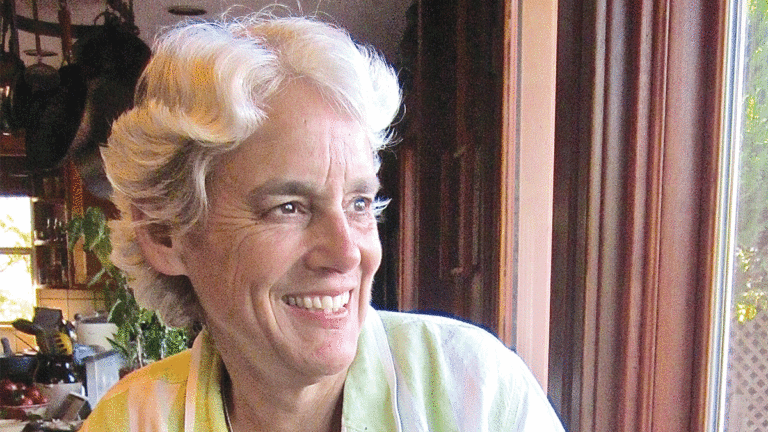
Sunday is Mother’s Day. The moon is in Virgo—ultimate sign of the perfect organized mother.
It’s also the sign ruled by Mercury, so communication with mother is most important on Mother’s Day. It’s good to offer in whatever ways we can words of kindness, recognition, gratitude, and to also offer nurturing to our mothers. Although my mother is in heaven, I tell her every day, “You did a good job, Mother. A great job, in fact.”
All mothers are constantly learning how to be mothers. The task of mothering is demanding, arduous, daunting, difficult, confusing, filled with suffering and paradox. Mothering is an initiation, actually. Some (adult) children are estranged from their mothers. Such sadness! It’s good in this case to remember the prayer of St. Francis of Assisi, saint of Right Human Relations: “Lord, make me an instrument of your peace. Where there is hatred, let me sow love; where there is injury, pardon; where there is doubt, faith; where there is despair, hope; where there is darkness, light; and where there is sadness, joy.”
In our mothers’ later years, they will need to look to us for guidance. Let us promise this to them, safeguarding our mothers with understanding, compassion and love.
ARIES: Careful how you interact with others. Do not rely only on possessions and monetary realities (though tending them is important). Rely also on instinct, and then intuition, to direct and guide you into knowing the quality of a person, event, resource, choice, and investment. You will be called to act and speak with courage, a virtue of the heart. Allow a deep calmness to rest within.
TAURUS: Be aware that you make impressions on many, leading them to follow your every thought, idea, action, and move. Therefore, it’s important to act always with ethics and complete all plans, agreements, promises, and agendas. You’re attempting to initiate new projects impacting life far into the future. You may be one of the few able to accomplish this. The future of humanity awaits. Carry on through any obstacles or hindrances. Call forth Mary to untie any knots (barriers) keeping you from spiritual work.
GEMINI: You may feel a sense of tiredness, exhaustion and needing rest. You may also be dreaming at night with your head in the clouds during the day. Both are important. Have you begun your Esoteric Journal, Dream Journal or Retrograde Journal to record your experiences each day? Over time, messages concerning your life direction emerge. Maintain a light, fresh diet, eliminate anything excess, drink pure water, love more, and look to the stars each night for direction.
CANCER: It’s important to maintain close connections with like-minded friends who share the values you find important. See all interactions, even uncomfortable ones, as opportunities, and attempt to understand what the hopes, wishes and needs of others are. Know that no matter how life is now, greater community will be available to you and your family later. Careful while walking, lest you stumble.
LEO: Career matters assume new dimensions, co-workers need more care, you want to improve your health, create new work methods and tend to the necessities of your life. Big jobs! You realize this takes balance, so you go slower than usual, foregoing adventure in order to create a long-term plan of practical goals. Your greatest success is acceptance of everything present in your life. Then everything harmonizes.
VIRGO: You may be traveling to teach and/or to study far away this summer. You may be planning meetings, conferences, classrooms and/or curriculum. You will definitely be communicating with others on a large scale, either personally or through writing, speaking, teleconferencing, conference-calling. Some or all of these will occur, and all the while you gain knowledge, happiness and goodness. You have an adventure.
LIBRA: Are you harboring a secret, perhaps more than one? Are there money or resources you share with another? Is everything clear and above-board in this area? It is time to arrange your finances so that debts are paid quickly. These times call you to be frugal, economically prudent, thrifty, and careful, thus able to conserve resources with confidence. Be prepared to teach others very soon in these ways. You will be efficient, informative and illuminating. Your smile lights up dark places.
SCORPIO: Relationships are primary now, so listen very carefully to what others are communicating and have the intentions to respond with deep listening, care, interest, and emotional equilibrium. Should you be uncooperative, imbalance will ensue and you will feel you have neglected a responsibility. Direct attention toward others now. Because only from you can they feel a special care, nurturance, love, and safety. Then it’s all returned.
SAGITTARIUS: You may be creating many various lists consisting of tasks and errands: cars that need tending, accounts that need reckoning, travels that need considering, responsibilities that need completing, and problems that need easing. Spending time alone will help you complete incomplete projects. You may dream more at night as you travel about in the ethers. Record all dreams. Over time, dreams offer a clear message of your direction in life.
CAPRICORN: Setting out each day’s agenda and assessing priorities allows you to have more control, more wisdom, and brings a clarity and focus to all that you do. Try not to criticize yourself or anyone. Compassion tells us everyone’s doing their very best while at different stages of development. New opportunities appear at first as philosophical ideas. Then they become goals. Rest more so you can imagine more. And then create more. Life is magic.
AQUARIUS: Home, family, property, community, and parents become very important. Give them attention, attempting to improve relationships with family while also improving the beauty and organization of the environments you find yourself in. Do nothing that unsettles your safety or security, challenge no one, and calm tensions with exercise, prayer, vitamins, minerals, and herbs. No storing them!
PISCES: It’s best to set time aside to gain better health. A new sense of feeling better and self-identity results. Often you work with the shadow side of your health (things hidden). As well as your Sun side (things apparent). You feel the need for better health, clear direction and resources that provide stabilization, constancy and the right sense of home. Sometimes there’s simply the need for silence. Inner and outer silence. Then we hear these words, “Rest for a while, O Pilgrim along the Way.”
ARIES (March 21-April 19): Time to shake things up! In the next three weeks, I invite you to try at least three of the following experiments: 1. See unusual sights in familiar situations; 2. Seek out new music that both calms you and excites you; 3. Get an inspiring statue or image of a favorite deity or hero; 4. Ask for a message from the person you will be three years from now; 5. Use your hands and tongue in ways you don’t usually use them; 6. Go in quest of a cathartic release that purges frustration and rouses holy passion; 7. Locate the sweet spot where deep feeling and deep thinking overlap.
TAURUS (April 20-May 20): According to science writer Sarah Zielinski in Smithsonian magazine, fireflies produce the most efficient light on planet Earth. Nearly 100% of the energy produced by the chemical reaction inside the insect’s body is emitted as a brilliant glow. With that in mind, I propose that you regard the firefly as your spirit creature in the coming weeks. According to my reading of the astrological omens, you too will be a dynamic and proficient generator of luminosity. For best results, don’t tone down your brilliance, even if it illuminates shadows people are trying to hide.
GEMINI (May 21-June 20): Here’s a message from author Susan J. Elliott: “This is not your week to run the Universe. Next week is not looking so good either.” Now here’s a message from me: Elliott’s revelation is very good news! Since you won’t have to worry about trying to manage and fine-tune the Universe, you can focus all your efforts on your own self-care. And the coming weeks will be a favorable time to do just that. You’re due to dramatically upgrade your understanding of what you need to feel healthy and happy, and then take the appropriate measures to put your new insights into action.
CANCER (June 21-July 22): The next three weeks will be an excellent time to serve as your own visionary prophet and dynamic fortune-teller. The predictions and conjectures you make about your future destiny will have an 85% likelihood of being accurate. They will also be relatively free of fear and worries. So I urge you to give your imagination permission to engage in fun fantasies about what’s ahead for you. Be daringly optimistic and exuberantly hopeful and brazenly self-celebratory.
LEO (July 23-Aug. 22): Leo poet Stanley Kunitz told his students, “You must be very careful not to deprive the poem of its wild origin.” That’s useful advice for anyone who spawns anything, not just poets. There’s something unruly and unpredictable about every creative idea or fresh perspective that rises up in us. Do you remember when you first felt the urge to look for a new job or move to a new city or search for a new kind of relationship? Wildness was there at the inception. And you needed to stay in touch with the wildness so as to follow through with practical action. That’s what I encourage you to do now. Reconnect with the wild origins of the important changes you’re nurturing.
VIRGO (Aug. 23-Sept. 22): I have no complaints about the measures you’ve taken recently to push past unnecessary limits and to break outworn taboos. In fact, I celebrate them. Keep going! You’ll be better off without those decaying constraints. Soon you’ll begin using all the energy you have liberated and the spaciousness you have made available. But I do have one concern: I wonder if part of you is worried that you have been too bold and have gone too far. To that part of you I say: No! You haven’t been too bold. You haven’t gone too far.
LIBRA (Sept. 23-Oct. 22): “Dreamt of a past that frees its prisoners.” So wrote Meena Alexander in her poem Question Time. I’d love for you to have that experience in the coming weeks. I’d love for you be released from the karma of your history so that you no longer have to repeat old patterns or feel weighed down by what happened to you once upon a time. I’d love for you to no longer have to answer to decayed traditions and outmoded commitments and lost causes. I’d love for you to escape the pull of memories that tend to drag you back toward things that can’t be changed and don’t matter anymore.
SCORPIO (Oct. 23-Nov. 21): “Desire is a profoundly upsetting force,” writes author Elspeth Probyn. “It may totally rearrange what we think we want. Desire skews plans and sets forth unthought-of possibilities.” In my opinion, Probyn’s statements are half-true. The other half of the truth is that desire can also be a profoundly healing and rejuvenating force, and for the same reasons; it rearranges what we think we want, alters plans and unleashes un-thought-of possibilities. How does all this relate to you? From what I can tell, you are now on the cusp of desire’s two overlapping powers. What happens next could be upsetting or healing, disorienting or rejuvenating. If you’d like to emphasize the healing and rejuvenating, I suggest you treat desire as a sacred gift and a blessing.
SAGITTARIUS (Nov. 22-Dec. 21): “So much of what we learn about love is taught by people who never really loved us.” My Sagittarian friend Ellen made that sad observation. Is it true for you? Ellen added the following thoughts: so much of what we learn about love is taught by people who were too narcissistic or wounded to be able to love very well. And by people who didn’t have many listening skills and therefore didn’t know enough about us to love us for who we really are. And by people who love themselves poorly, and so of course find it hard to love anyone else. Is any of this applicable to what you have experienced, Sagittarius? If so, here’s an antidote that I think you’ll find effective during the next seven weeks: identify the people who have loved you well and the people who might love you well in the future—and then vow to learn all you can from them.
CAPRICORN (Dec. 22-Jan. 19): Capricorn fantasy novelist Laini Taylor creates imaginary worlds where heroines use magic and wiles to follow their bliss while wrangling with gods and rascals. In describing her writing process, she says, “Like a magpie, I am a scavenger of shiny things: fairy tales, dead languages, weird folk beliefs, and fascinating religions.” She adds, “I have plundered tidbits of history and lore to build something new, using only the parts that light my mind on fire.” I encourage you to adopt her strategies for your own use in the coming weeks. Be alert for gleaming goodies and tricky delicacies and alluring treats. Use them to create new experiences that thrill your imagination. I believe the coming weeks will be an excellent time to use your magic and wiles to follow your bliss while wrangling with gods and rascals.
AQUARIUS (Jan. 20-Feb. 18): “I was always asking for the specific thing that wasn’t mine,” wrote poet Joanne Kyger. “I wanted a haven that wasn’t my own.” If there is any part of you that resonates with that defeatist perspective, Aquarius, now is an excellent time to begin outgrowing or transforming it. I guarantee you that you’ll have the potency you need to retrain yourself—so that you will more and more ask for specific things that can potentially be yours, so that you will more and more want a haven that can be your own.
PISCES (Feb. 19-March 20): I’m not a fan of nagging. I don’t like to be nagged, and I scrupulously avoid nagging others. And yet now I will break my own rules so as to provide you with your most accurate and helpful horoscope. According to my analysis of the astrological omens, you aren’t likely to get what you truly need and deserve in the coming days unless you engage in some polite, diplomatic nagging. So see what you can do to employ nagging as a graceful, even charming art. For best results, infuse it with humor and playfulness.
Nietzsche said, “One must have chaos within oneself if one is to be a dancing star.” Are you a dancing star? Comment at freewillastrology.com.
Once they started, the waves that thrashed the coast of Santa Cruz County during the winter of 2016—one of the most extreme El Niño seasons on record—didn’t stop. Huge swells crashed into the shores of the Monterey Bay, pulling tons of sand back out to sea, and a 40-foot sinkhole opened near New Brighton State Beach. In South County, beaches eroded an average of 150 feet.
A year later, it sounded like a bad stoner joke when meteorologists warned that Santa Cruz was once again in line to be hit by a series of “Pineapple Express” storms moving east from Hawaii. Heavy rains were welcomed after severe drought, but then everything came unglued again. At Rio del Mar, parts of the cement ship once used as a Prohibition-era casino were ripped off in rough surf. Roads wiped out by mudslides cost the county tens of millions of dollars.
“Greetings from beautiful Santa Cruz County!” local officials wrote on postcards with photos of collapsed pavement and cars eaten by sinkholes, which they sent to Sacramento to lobby for disaster dollars.
As crews worked overtime to keep major arteries like Highway 17 open, a much smaller local thoroughfare quietly fell into disrepair. High surf swept out the base of a staircase that had long led surfers, fishermen and other beachgoers down to the sand at Manresa State Beach. The stairs themselves weren’t much to look at, just rough cement, but the sweeping views of white sand, turquoise waves and lush greenery that lined the path to the beach seemed like something from another time.
The stairs are perched on a bluff at the end of Oceanview Drive, just off San Andreas Road in the part of South County where the big houses of La Selva Beach begin to bleed into the vast agricultural fields of Watsonville. During the summer of 2017, those who knew the stairs mostly steered clear of the sketchy sections hit by the storm, and found their way down the way they always had.
“I’ve been using that area for more than 40 years,” says Mike Watson, a Santa Cruz resident and board member of the Santa Cruz Longboard Union, who grew up in Aptos. “That’s where I learned to surf.”
STAIRWAY TO HEAVEN The view from the stairs at Oceanview Drive.
It was around October 2017 when Watson and others discovered that the barbed-wire gate at the top of the stairs had been locked. “Temporary closure of the public access stairway to the public beach,” read the 60-day county permit posted outside.
A year and a half later, the stairway at Oceanview Drive is still closed, making it one of many coastal access points in Santa Cruz County stuck in limbo at a time when coastal real estate is more cutthroat than ever. In some cases, private owners have deliberately blocked public access. In others, government agencies contending with lower budgets and a backlog of infrastructure repairs have been slow to make repairs. Sometimes, it’s a combination of both.
After years-long legal battles, gated access points at Opal Cliffs and Rio del Mar’s Beach Island have recently been re-opened to the public—for now. From a former nude beach in Davenport to secluded coves in Pleasure Point, Live Oak and Aptos to other stretches of South County near Manresa and Sunset state parks, more isolated disputes have also bubbled up.
“There’s a lot at stake. You’re talking about a strip of real estate that’s really important to a lot of people,” says Dan Carl, a Santa Cruz native who now runs the Central and North Central Coast districts for the California Coastal Commission. “It’s just ratcheted up.”
The politics of beach access are also changing. In recent years, local and state officials have gained more power to levy annual fees or fines for non-compliance with access laws. Just up the coast at Martin’s Beach, near Half Moon Bay, the case of Silicon Valley venture capitalist Vinod Khosla’s attempt to privatize the beach near his $32.5 million property was argued all the way up to the Supreme Court last year—Khosla felt “coerced and extorted” by the ordeal, he wrote in a blog post—before a tenuous deal to allow surfers back in.
On busy days at Oceanview Drive, two dozen cars or more in would pack the dirt shoulder of the road wedged between a gated community and a Spanish-style mansion. Smashed windows had always been a risk in the secluded area, but finding a spot meant that groups toting surfboards, coolers and tents didn’t have to pay the $10 parking fee at the lot down the street for Manresa State Beach.
Whether that option will exist this summer—or even sorting out who has the right to make that call—are questions with ripple effects far beyond one staircase.
“That’s what towns like this are about, you know? For people to be able to walk to the beach,” says Jeff Gaffney, a Gilroy native who oversees Santa Cruz County’s parks department and grew up visiting his grandparents in town. “That’s what we all want. That’s why we live here.”
CLAIMING THE COAST
For much of recorded history, the beaches of present-day Santa Cruz County were an afterthought for generations of residents more concerned with hunting, ranching and staking claim to fertile ground farther inland.
The Ohlone used to burn old growth from the Santa Cruz Mountains to the edge of the Monterey Bay each year to grow grass and attract deer, according to John Hibble of the Aptos History Museum. When Sebastian Viscaino stumbled ashore and claimed the Central Coast for Spain in 1602, he set in motion a period of brutal colonization that revolved more around inland mission-building than the pristine waters the conquistadors sailed in on.
It wasn’t until the 1800s, when California was still part of Mexico, that people even started to divvy up beachfront property, according to local historian Allen Collins in his book Rio del Mar: A Sedate Residential Community. Property records didn’t exist, and land squatting was the norm.
“Understandably,” Collins writes, “there would be conflicts down the road.”
The first real estate heavyweight in what is now Santa Cruz County was the family of Mexican general-turned-cattle-rancher Don Rafael de Jesus Castro, who in the 1830s received land grants from the Mexican government for more than 20,000 acres stretching from today’s Capitola to Sunset State Beach. Castro finally put the beach to use in 1850, when he built a 500-foot wharf to ship livestock, hides and grain as part of a booming Mexican-American trade network that also involved private wharfs in Watsonville, Santa Cruz and other nearby towns.
It’s only fitting that a California divorce between Don Castro and his wife would set in motion the subdividing of coastal land that still makes it hard to determine who has rights to what today.
“People think the beaches are all public, and they really aren’t,” Carl says. “If it’s not a state park in this area, it’s likely to be privately owned beach that is used by the public.”
WASHED OUT The cement staircase at Manresa State Beach is one of several public coastal access points that has been knocked out by strong storms in recent years.
Under the modern system of beach access overseen by the Coastal Commission, and frequently fought in court, public access is established by a track record of people using a path or stairway or section of beach—a standard known in planning jargon as “prescriptive rights.” In uncontested areas, routes to the water often ebb and flow with little formal documentation. If there’s a dispute, landowners or citizens can sue to sort out public access for a specific location.
But none of those concepts existed when Santa Cruz County really started to develop.
Claus “The Sugar King” Spreckles was among the first to seize the opportunity to develop the Central Coast in the 1870s. An industrialist who amassed much of his wealth from the Hawaiian sugar trade, Spreckles bought Castro’s Rancho Aptos and built a luxurious hotel in present-day Rio del Mar, then fenced off the beach for guests. After he moved his dominion inland, near the beet sugar plant he built in a Monterey County town given the name Spreckles, the coastal land was sold to developers who started planning single-family homes, beach clubs, polo fields and a general Prohibition-era playground.
“It all started in the early ’20s. This was a time for people to have second homes, visit the beach, get liquor—you know, party hardy,” says Hibble. “In Rio del Mar, the idea was to make it so exclusive that the only way you could use the beach was to be a member.”
The Great Depression and World War II stunted the original plans to develop the rest of the coast, but the rush to the suburbs in the 1950s and 1960s filled out the area with more housing. Some swaths of land were dedicated back to the government by private owners, and there would be flare ups like the battle over the Seascape resort, but the end result was a patchwork of property rights and dated surveying that can make it difficult to answer what may seem like black and white questions about access.
“This used to all be chicken coops and ag land, and people could walk literally down through some orchard and be at the beach,” Gaffney says. “Progress or development or whatever you want to call it over the last 60 years has really changed the way we do beach access.”
Part of what’s changed, Carl says, is more glaring tension between the state Coastal Act that calls for “maximum access” and homeowners now paying much higher prices for private estates along the coast. With property on the sand or the bluffs of Santa Cruz County routinely trading in the millions of dollars, public access can become a nuisance.
“That’s their private Shangri-La,” Carl says. “They don’t wanna see the unwashed masses near their Shangri-La.”
DO NOT ENTER
In 35 years, Watsonville native Felix Alfaro doesn’t remember a time when the stairs at Oceanview Drive have been blocked off like they are today.
“Have you seen the fence?” Alfaro asks as he finishes a fix on a weathered teal surfboard at his Sand Dollar Quality Surfboard Repair business across the street.
It was early this year, months after the emergency county permit posted at the top of the stairs was set to expire, that a black iron fence was installed. The change was made after a chain link fence was repeatedly cut and wired back shut last year. Weaving in and out of both fences is a chaotic graveyard of padlocks, cables, wires and signs that blare warnings like “Stairs Closed,” “No Trespassing” and “Danger Do Not Enter.”
Exactly how it all got there—or who sliced, patched and repatched the fence—is unclear. Who should decide whether it gets dismantled and re-opened to the public depends on who you ask.
“I’m now very interested in us figuring out how we can open that up, and what we need to do to get it there,” Gaffney says. “If the land is owned by individuals or private property owners, that still doesn’t change the fact that there was a public easement there.”
“There is not a county easement on that property,” says William Hansen, the local businessman who owns the 7,100-square-foot beachfront lot last sold in 2009. He thinks it could be a prime location for a single-family home. “It’s inventory,” Hansen says. “We’re developers.”
The most likely answer, property records show, is some combination of both public easements and private property—a fairly common predicament that is usually resolved through either negotiations or the court system.
“Talk about peeling the onion,” Carl says. “You’d really have to get into it to figure out all the stuff for that place.”
Originally part of the plans for a neighboring gated community called Place de Mer, a 1963 map on file with the County Assessor’s office shows at least one county easement just off Oceanview Drive and 5 feet “reserved for path,” but the map only shows a corner of the property. Hansen says it’s “a complex discussion,” but he contends that the county only has rights to a pump at the top of the stairs. Both the county’s parks and public works departments say that part of the staircase and a drain pipe underneath traverse private property, but the path appears to have long been a public access point. The Coastal Commission’s website also lists the staircase and “informal” parking on its access page.
ALL FOR KNOT A chain-link fence has been cut and stitched shut repeatedly at Oceanview Drive near a staircase to Manresa State Beach.
Watson, who in addition to being a regular at the South County surf spot is also a planner for the Coastal Commission, says the area is one of many in the county where he’s seen gradual restrictions put on parking or paths to the beach.
“It seems that, you know, over time the ability to access the coast has slowly been eroding—no pun intended,” Watson says.
The stairs at Oceanview Drive have also been disputed before. About 15 years ago, Carl says the Coastal Commission blocked an attempt by nearby homeowners who have at times maintained the stairs to secure a permit to close the path to the public. More recently, around 2012, the five-bedroom mansion with a lap pool on the lot next door was listed for sale at $9.75 million and advertised as “completely fenced and private with private beach path.”
Today, the sliver of beachfront land that includes the staircase is one of many lots or buildings owned in Watsonville by Hansen, who is the chairman of the board of Santa Cruz County Bank, and runs both Hansen Insurance and a real estate firm called Pacific Coast Development. He says that Oceanview Drive is “a great location” for a house, and that people who relied on the stairs for access are “just kind of evading the fact that the park system charges for parking” down the street at the official lot for Manresa State Beach.
“Obviously it has to be a situation where you protect the property rights,” Hansen says. “It’s really disruptive to that whole residential community.”
Watson contends that the path helps ease crowding at surf breaks along the coast, especially since other public staircases like the nearby Manresa Uplands Campground have also been washed out by storms.
“It’s a super important access spot for surfers and beachgoers alike,” Watson says. “It’s overflow parking, essentially, for Manresa.”
On a recent road trip to Southern California, Alfaro says he was struck by the number of barricades up and down the coast.
“Access is a funny thing,” Alfaro says. “The business to be in is fences.”
POLICING ACCESS
Private security guards. Fake no parking signs. In the case of music mogul David Geffen, efforts to block public access to a stretch of Malibu coastline nicknamed “Billionaires’ Beach” included building an elaborate fake garage to discourage people from parking in front of his property.
“People just do outrageous things to block public access,” says Pat Veesart, who oversees enforcement for the Coastal Commission in Northern California. “I’ve caught people out there painting their curbs red. Up and down the coast, there are people who just can’t accept that the coast has special status in California.”
Most coastal observers agree that Santa Cruz’s access issues aren’t as severe as Southern California’s wealthiest enclaves, but they also aren’t taking any chances. In recent years, the Coastal Commission was authorized to levy new administrative penalties up to $11,250 per violation, per day, which have already been used locally—or at least threatened.
In December, county officials demolished a fence and 6-foot wall blocking off an esplanade outside 29 waterfront homes in Rio del Mar known as “Beach Island” after violation notices were sent to all 29 property owners. The Rio Del Mar Beach Island Homeowners Association sued the county in November, arguing that there is not a public easement on the property, and that the government had not previously shown an interest in maintaining the area.
“We got their attention with these notification-of-violation letters,” Veesart says of the case, which is still working its way through the courts. “We entered into negotiations with them and their attorneys … We’ll see where that goes.”
MIXED MESSAGES Both a private property owner and Santa Cruz County agencies have laid claim to the staircase at Oceanview Drive.
Though property lines for houses built on the waterfront often technically extend out on the beach to the high-tide mark, Carl says that it’s usually routes down to the beach that are more contested than what happens on the sand.
Take the case of Privates beach, the Opal Cliffs park and surf break where residents have since the ’60s charged up to $100 a year for a key, and paid for a gate attendant to police access. For years, residents argued that paid access should be allowed because of better maintenance made possible by fees. A judge last year ordered the gate open after the county and the Coastal Commission challenged the permitting of the 9-foot fence, and homeowners are now due to submit a plan for long-term free access and a smaller fence.
“In the case of Opal Cliffs, it’s the only access way where the public’s charged a fee to access the beach in the state,” Carl says. “So it’s a big deal.”
At the county, Gaffney has also spearheaded a new “coastal encroachment” permit program approved by the Board of Supervisors last June. In response to complaints about public parking and access being curtailed on streets that lead to the water, the county will now charge homeowners whose landscaping, mailboxes or other property stretch into the public right of way an application cost of $1,080, plus an “annual exclusive encroachment fee” of $16.50 per square foot or a “non-exclusive encroachment fee” of $6.50 per foot, capped at $5,000 per property per year.
Revenue generated by the new permits will be allocated for maintaining coastal areas. The county is implementing the program through “passive” enforcement, Gaffney says, which means that homeowners are asked to apply if they believe their properties are in violation.
“We don’t want people to feel like they’re criminals,” Gaffney says. “We want them to come forward.”
STORM AHEAD
As April turned to May, the signs of struggle in the mangled fence at Oceanview Drive were obscured by knee-high weeds and wildflowers. At the base of the stairs, near a red danger sign, a broken window sat in the ice plants just above the sand, and trash like a surgical mask could be seen off the overgrown walkway. Stickers with surf shop logos or sayings like “Good Vibes Only” had started to fade on nearby signs and railings.
After questions from GT, the county says that they plan to reopen the stairs by as soon as this summer, after repairs projected to cost $50,000-100,000 are made to drainage infrastructure.
“My goal would be to have all that communication as far as permits and property access completed over the next month,” says Steve Wiesner, the county’s assistant director of public works for roads and transportation. “The repairs would begin to be implemented within the next 4-6 weeks, and then we would be complete early summer.”
Hansen, however, says he hasn’t been approached about reopening the stairs.
“No comment,” he says when asked about the prospect. He adds, “It’s amazing how people like to put up their different signs and feel that somehow establishes some type of legal residence … somehow you’re going to reflect some type of access. It’s kind of comical.”
HANGING ON A few hundred yards down the beach from Oceanview Drive, a public staircase near the Manresa Uplands campground has been closed since storms washed out a bottom section in 2016.
While pitched battles over development are nothing new in coastal California, there’s also the matter of how Mother Nature might play into the debate.
“Access ways disappear for a lot of reasons,” Carl says. “One of the more important reasons is because they’re right at the coast, where it’s inherently dangerous.”
Henry Bose and his neighbors at the Cañon del Sol subdivision on the edge of Manresa State Beach have found themselves caught in the middle of such a situation. Just a few hundred yards down the beach from the stairs at Oceanview Drive, the public wooden stairs that once led down to the beach near the Manresa Uplands Campground have been closed since a large section was destroyed in the storms of 2016.
With no re-open date given by local or state officials, Bose and his neighbors are considering a GoFundMe campaign to raise donations. While he knows that easy beach access is a nice selling point for homeowners, Bose says he’s more concerned about public access.
“Obviously I would have to recuse myself because it is of interest to me and my property value,” says Bose, a former real estate lawyer who retired to the area to be close to some of his 17 grandchildren. “But if you believe in California beaches being open to the public, this is a spot that was developed just for that.”
After years of budget cuts, state and county agencies are currently seeking funding from FEMA and many other sources to address a backlog of coastal maintenance estimated at $30-40 million in Santa Cruz County alone, Gaffney says.
“As every day goes by, things are costing more,” Gaffney says, due to limited local contractors willing to navigate coastal red tape. “Even numbers that we were using last year have gone up by 20%.”
And that’s if the climate cooperates. Scientists who study the coast also warn that a combination of more frequent strong storms and sea-level rise could add to the bottleneck.
“Because of the urban infrastructure pinning the location of the beaches, we’re going to lose 50% of the beaches,” says Patrick Barnard, a Santa Cruz-based coastal geologist with the U.S. Geologic Survey. “These beach access issues are going to become more and more complicated.”
Matthew Van Nuys feels he owes a debt to Santa Cruz.
He was a meth addict who “ran amok in the streets of Santa Cruz” for 12 years, as he describes it. One of the stops on his road to recovery was Janus of Santa Cruz, a nonprofit that provides addiction treatment services. Every time he went into a recovery program somewhere, he built on the foundation he established at Janus, he says. Van Nuys eventually beat his addiction and now works at Janus as an intensive outpatient services counselor and DUI educator.
“I can do the most good here, and it is my way of giving back to the community,” he says.
But making ends meet as a nonprofit worker in Santa Cruz isn’t easy, as Van Nuys can attest. He’s currently homeless, living in a van-sized RV in the backyard of a friend’s house with his wife, their 7-month-old child and their dog. He makes enough money that he does not qualify for many types of aid, but there have been several times when his bank account was at $5 for the whole week.
The Human Care Alliance, a collaborative of more than 27 Santa Cruz County nonprofits, is aiming to better understand the living conditions of nonprofit workers like Van Nuys through a new survey. Nonprofit leaders hope the results from the survey, which is currently underway, can serve as a springboard for discussions with county officials about two realities they face: Their budgets are already strapped as they try to pay workers enough to survive with the high cost of living locally, and big budget gaps loom with the state’s minimum wage set to continue increasing until it reaches $15 an hour in 2023. Now, nonprofit directors are wondering whether they’ll be able to find enough additional funding to close the gap, or if they’ll have to cut back on some of the services they provide on behalf of the county.
Penny Time
The new survey results aren’t expected to be released until later this month, but a previous Human Care Alliance survey in 2016 provided some solid numbers on the issue. That survey found that 35% of nonprofit workers had an income that fell below the state’s poverty line. More than 70% of workers surveyed said they had more than one job at least some of the time to support themselves and their families.
The survey also revealed a vicious cycle: Some 61% of nonprofit employees said they required public assistance programs such as Medi-Cal, food banks or food stamps at some point in the previous year to survive.
Raymon Cancino, CEO of the nonprofit group Community Bridges, says he’s on a personal mission to end that cycle.
“I cannot, as a leader, sit back and be complacent to a system that perpetuates poverty,” he says. “If we are alleviating poverty, we cannot be a mechanism that continues to perpetuate it by providing lower wages to our employees.”
Though the Santa Cruz County government has a living wage of $16.65 per hour for its contractors, nonprofits are exempt from the requirement.
Still, given the state’s move toward a $15-an-hour minimum wage, many nonprofits, including Community Bridges, have started putting any new fundraising and revenue toward bringing workers closer to $15 an hour, Cancino says. Community Bridges plans to pay all of its more than 190 workers at least $15 an hour by July 2020. At the same time, it must also increase wages for salaried workers, since state law requires that they make at least double the minimum wage.
In total, those wage increases will create a $200,000 annual budget gap for Community Bridges if its funding levels remain the same, says Cancino.
“So the question is not ‘Do we need more?’ It is ‘Where do we need to invest the dollars that people are willing to invest?” Cancino says.
Coin Together
Finding more dollars may involve asking the county for increased funding.
The county government funds nonprofits in two ways, through one pot of what’s known as “core” funding and through contracts with county departments for specific services.
Core funding for community programs rose from $3.7 million in the county’s 2014-2015 fiscal year to around $4.4 million for the current fiscal year, an increase of 17%. The county also pays tens of millions of dollars each year to nonprofits through contracts, according to county Communications Manager Jason Hoppin, but the exact dollar amount is difficult to tally because the contracts are spread across departments such as the sheriff’s office, health services and mental health.
In addition to increasing funding for nonprofits, the county tried to offer more financial stability by moving from annual funding to a multi-year funding cycle. The county’s also trying to help nonprofits by training them on how to receive more federal and state money, says Santa Cruz County Supervisor Ryan Coonerty. Policymakers see the stress that nonprofits are under, he says.
“Like many other sectors of our economy, they are feeling strained, because while there have been increases in funding, those increases haven’t kept up with the costs of housing and healthcare,” Coonerty says.
The costs of services currently provided by the nonprofits would be much higher, he adds, if the county tried to provide those services itself. “Our nonprofits, by and large, do a really good job of taking small amounts of money and leveraging them and providing excellent services to our community,” Coonerty says.
For nonprofit leaders, that’s part of the issue. That reduced cost for the county comes at the expense of the nonprofit workers, Cancino says, and they end up getting paid less.
Talk is already turning to whether increasing wages for nonprofit workers will mean cutting back on the services they provide.
Coonerty says the world of increasingly limited budgets poses serious challenges without easy answers. Everyone agrees there’s a problem, he explains, but then it becomes a matter of “which services do you cut” to make the numbers pencil out.
For his part, Cancino wants the discussions to ultimately lead to a reframing of the conversation around nonprofit work. “My hope is people start seeing them as not only nonprofit workers but public servants,” Cancino says.
Some of the workers are highly educated employees, Cancino notes, serving as social workers, doctors, clinical therapists, and behavioral therapists. Cancino has heard suggestions that nonprofit workers could enter the private sector in order to make more money. In response, Cancino says that wouldn’t allow many of these workers to fulfill their passion for serving the community’s needs.
Plus, Cancino says, “working in the nonprofit sector should not equal a lifetime of poverty.”
California dispensaries have had to navigate a number of systematic changes since voters approved the good green for recreational use more than a year ago. But for most, one thing that hasn’t changed is their cash-only status—most cannabis-related businesses can’t accept electronic card payments because banks still refuse to do business with them.
Among the regional marijuana manufacturers and licensed cannabis retailers in Santa Cruz County lucky enough to have a bank account is edibles brand Big Pete’s Treats. For the past several years, Santa Cruz Community Credit Union welcomed local ganjapreneurs like Big Pete’s with open arms, enabling them to minimize cash transactions. According to Jim Coffis, deputy director of the cannabis organization Green Trade, it “was the first financial institution that I knew of in the county that accepted cannabis businesses as clients.”
But that seems to have changed. Big Pete’s CEO Pete Feurtado Jr. says that he just received a letter from the local credit union “basically kicking us out of the bank” after an established business relationship of several years. His company has until the end of the month to find a new banking establishment—if they can even find one willing to accommodate them.
“It’s very difficult for a new (cannabis) business to get into a banking situation,” Coffis says. “When you open an account, you have all kinds of documents showing you’re the owner of the account, and your sources of cash, to prevent money laundering. The first sign of money laundering is a lot of cash, and they’re treated exactly like a terrorist organization in terms of the scrutiny which the government has—and they have put that onto the banks.”
Feurtado says that while it’s been good to have a bank, his business has faced a number of hassles that others don’t. “They ask for more compliance and information than the state,” Feurtado said. “They’re asking about every little wire transfer.”
Most banks are still hesitant to accept cannabis businesses due to fears of running afoul of federal law. State lawmakers tried unsuccessfully last year to develop a banking system for the marijuana industry, but state Sen. Bob Hertzberg (D-Van Nuys) hasn’t given up on the issue. He recently revived the failed bill as SB 51, which would basically mirror his original SB 930 and create a framework so private banks or credit unions could issue checks to dispensaries for paying taxes, rent and other business expenses. Dispensaries could also buy state and local bonds to help earn interest on their deposits.
Although SCCCU did not reply to a request for comment, its apparent rejection of Big Pete’s isn’t new in the formerly maverick marijuana industry. Dispensaries, farmers and manufacturers from around California have all reported being shut out from traditional banking institutions, or forced to constantly switch places.
Running a cash-only business can be a serious inconvenience—a fact even the state admits. Last year, former California Treasurer John Chiang said the statutory “stalemate” was making cannabis businesses “targets for violent crimes and putting the general public in danger” by forcing them to handle large quantities of cash.
Chiang also noted that it “created a nightmare for state and local government revenue-collecting agencies.” The California Department of Tax and Fee Administration does not accept cash payment unless an exemption is requested. One concentrates manufacturer said he has to schedule an in-person appointment to pay Uncle Sam.
Feurtado says that, “It’s absolutely a security risk” to deal with bags of cash every day. “We’re the top-selling baked good in the state right now, and 95% of our customers pay us with cash,” he says. “It’s not fun having to deal with all of that cash. We love checks, or at least we did when we had a bank account.”
Cannabis companies also pay indirectly for working only with cash; ATM machines are a liability that can drive up dispensary insurance rates, and some businesses hire armed security. Then there’s the steep fees levied by banks that take on marijuana businesses.
“They’ve basically charged us around $1,000 a month for the last few years just to put money in the bank,” Feurtado said about his account with SCCCU. “We don’t get anything like a line of credit, things a normal business would be able to get. We just deposit our cash.”
Coffis likened such fees “to an additional tax on their operating costs, as well as a major pain in terms of having to deal with all the ever-changing compliance issues.” Because so few banks will accept the cannabis industry, those who do are “reaping the benefits of significant fees that they’re collecting” at the expense of a captive audience.
“They do have additional costs themselves in terms of handling all that cash,” Coffis says. “Some fees are legitimate, but if the federal credit union were to get into it, or another credit union, there is the opportunity for some competition to keep the lid on the financial costs.”
Being accepted by mainstream banks may take years, but Congress did recently introduce HR 1595, which aims to create protections for banks working with legitimate marijuana businesses. Whether the Democrats’ bill makes it through the GOP-controlled Senate, however, remains to be seen.
“Something about Brian seemed off. I couldn’t tell precisely what—perhaps the angle of his lanky body as he hunched over the counter? Or maybe the erratic way he was chopping shallots for tonight’s bearnaise sauce, making a series of slow, methodical slices followed by a barrage of rapid-fire strokes.”
So begins Murder from Scratch, the fourth book in Santa Cruz author Leslie Karst’s mystery series featuring the escapades of restaurateur Sally Solari. Set in Santa Cruz and laced with piquant details of our local scene, from bike rides along the coast to shopping the downtown farmers’ market and pouring Venus gin, Karst’s latest caper offers enough local color to delight her fanbase.
In Murder from Scratch, we meet Solari’s young cousin Evelyn, whose mother has just died under mysterious (duh!) circumstances. Clues point to suicide, but Evelyn—whose sensory awareness is particularly acute due to her blindness—thinks otherwise. Using her heightened sense of touch, Evelyn quickly notices that items in her mother’s house have been moved and removed in ways that wouldn’t happen if her mom had taken her own life. Sally becomes suspicious enough to begin her own search for possible leads once she installs Evelyn in her guest room for a few weeks.
Karst wisely keeps her protagonist’s immediate surroundings front and center throughout the mystery series. We become reacquainted with Eric, Sally’s former boyfriend, who has now become a good buddy. Sally’s dad, who owns an Italian restaurant on the Santa Cruz wharf, returns, and is now speed dating a babe he’s met through an online service. Sally is still cooking the specials at Gauguin, her own restaurant, but has recently drawn up legal documents that will make her skilled sous chef Javier a full partner in the popular dinner house.
But the book is also populated with a few new cooks with trending pop-up eateries—cooks who were close to Evelyn’s mom—until they weren’t. Suspects who might have wanted Evelyn’s mom out of the way start popping up (sorry) everywhere. Occasionally I found myself wondering how a busy restaurant owner and cook like Solari always has time to investigate clues or take her cousin shopping. But hey, that’s why it’s called fiction, right?
Foodies will love the back-of-the-house kitchen details seasoning this mystery, as Karst adds the down and dirty realities of restaurant chauvinism to her growing list of suspect motives. As with past Sally Solari books, these pages are filled with tantalizing food details, terrific attention to aromas, textures and sophisticated ingredient combos. Reading the mouthwatering prep notes for Nonna Sophia’s Homemade Egg Pasta or Singapore Noodles with Roast Pork and Broccolini had me salivating for some of these seductive comfort foods. Karst knows her readers will all be doing the same, which is why she so graciously provides easy to follow, step-by-step recipes for these and a few other dishes at the back of her latest work of fiction.
Will Eric and Sally get back together romantically? Does Evelyn win Javier’s heart by teaching him the secret to tender pasta? Can Solari herself stay one step ahead of Detective Vargas? In Murder from Scratch, the menu of plot twists is good enough to eat.
Leslie Karst will read from and sign her new Sally Solari mystery ‘Murder from Scratch’ at 7 p.m. on Thursday, May 9, at Bookshop Santa Cruz, 1520 Pacific Ave., Santa Cruz. Free.
Steve Kilbey of the Church has good days and bad days. Most people, of course, you hope to catch on their good days. But if you have a chance to catch Kilbey on a bad day, I highly recommend it.
“In my childish world, it’s all going up and down all the time,” says the vocalist, bassist and primary songwriter of the celebrated Australian band, who come to the Rio on Friday, May 10. “On one level, we’ve had an amazing run. We’ve made over 30 albums, we can still tour the world, people still like us. On another level, I turn up last night at this gig in good faith and I got my ears blown off. They’re still ringing—more permanent damage. So I’m just feeling like, ‘What am I doing this for?’”
But misery loves company, and get Kilbey going on one of these bad days, and he can go off on some hilariously entertaining tangents.
For instance, although the band is continuing its tour celebrating the 30th anniversary of megahit 1988 album Starfish, which broke them to an international audience, he’s doesn’t really have much to say about it at the moment, except that it never stood out to him in the Church’s catalogue, and he certainly never expected it to define the band’s career to most of the world.
“It was just, like, another record,” he says. “I thought it would probably do the same as all the others.”
Even the details on the band’s biggest hit, “Under the Milky Way,” are a bit vague after all these years, other than the fact that the band wasn’t really that into it—including him.
“Nobody really wanted to do it,” he says. “I had done a demo of it, and gave it to our then-drummer, who ironically didn’t actually play on it. He gave it to our manager, and our manager insisted that we record it. It was probably the only good idea he ever had.”
It isn’t really until the subject of Peter Murphy comes up that Kilbey really gets wound up. Murphy, the lead singer of the goth band Bauhaus, had gone solo by the time he was opening for the Church on their Starfish tour in the late ’80s, and was famously petulant over the fact that he was not the headliner. Kilbey definitely remembers their time together.
“I remember Peter Murphy was a fucking imbecile, and he still is,” says Kilbey. “I’m still baffled by what anyone would see in him. I love to watch the video of the Swedish guys beating him up. Have you seen that on YouTube?”
When I say I haven’t, Kilbey declares it a must-watch. “Oh, go on YouTube and google ‘Peter Murphy gets beaten up in Sweden.’ You’ll have a lot of fun with that.”
Turns out the video comes from last December, when Murphy was thrown out of his own Bauhaus gig for throwing things at the audience, according to reports. The video was taken on the street outside the club afterward and shows Murphy cussing out and taking a swing at a security guard, which results in him being taken down hard by a couple members of the security team. Just talking about it makes Kilbey’s day a little better.
“He really needs a good kicking. He really does,” says a brightened Kilbey. He suggests I put up a link to the video with the headline, “A Complete Fuck-Knuckle Gets His Comeuppance At Last in Sweden.’’
Truth be told, though, his other memories about that time period aren’t that great, either. It was definitely full of record-label pressures, permanent damage to his hearing and touring that dragged on beyond the point of exhaustion.
But he’s carried on with the Church for three decades since, putting out a slew of excellent albums that have carried on the band’s slightly mystical brand of guitar rock. Can it really be that unfulfilling?
“Today I feel unfulfilled. Tomorrow I might feel fulfilled. One day I’m happy, one day I’m sad. It’s like a marriage, I suppose,” he says.
It’s too late for misery now though. He’s laughing as he asks me to deliver a message.
“Just say: I live to come back to Santa Cruz. I live to come back there and walk down the beachfront and have one of those tacos. So I’m just living for that, that will be my medicine. There’s a great hat shop there, a couple of great vegan restaurants. So I reckon Santa Cruz is going to totally sort me out.”
The Church performs at 8 p.m. on Friday, May 10, at the Rio Theatre, 1205 Soquel Ave., Santa Cruz. $31.50. folkyeah.com.
An avant garde master of whatever’s next in viticulture, Bonny Doon Vineyard founder Randall Grahm has been rhôning around the world wine stage for decades. And now he’s returning to his roots as an educator, raconteur and mentor for anyone with an inquiring taste bud. Hence this Saturday’s rare Master Class with Randall Grahm, to be held May 11 from 1-3:30 p.m. at Soif Wine Bar. If you’ve ever wanted the lowdown on Grahm’s devotion to the spectacular grapes of the Rhône or his esoteric wisdom on the subject of terroir, this is your chance.
RG tells me that he’ll be bringing, “a slew of oddball wines” with him to Soif this Saturday, and will, “probably talk for a couple of hours about terroir, Popelouchum [Grahm’s San Juan Bautista estate vineyard] and the deeper meaning of vinous qi.” Possibly a few other topics as well.
The winemaker’s appearance kicks off Soif’s new series of Master Class wine tastings designed to spotlight individuals with notable depth of knowledge and experience in the wine industry. In addition to waxing loquacious about Rhône grape varietals, Grahm will discuss and critique not only his own wines, but also other wines he’s chosen from Soif’s wine shop. Special cheeses and a selection from Chef Tom McNary’s charcuterie will add counterpoint to the flavor ambience of the event.
Tastings at the will include: 2014 Bonny Doon Bien Nacido Syrah, 2012 Bonny Doon Le Cigare Volant, 2011 Bonny Doon Le Cigare Blanc, 2015 Domaine Chambeyron-Manin Côte-Rôtie, 2018 Bonny Doon Vin Gris Normale, and the legendary 2016 Vieux Telegraphe “La Crau” Châteauneuf-du-Pape.
Saturday, May 11. Tasting begins promptly at 1p.m. Soif, 105 Walnut Ave., Santa Cruz. $100 general/$80 for Soif Wine Club members. 423-2020, soifwine.com/new-events.
Mothers Love Avanti
Under the lively new ownership of Jonathan and Tatiana Glass, the Westside tradition that is Ristorante Avanti at 1917 Mission St. will be offering a special Mother’s Day Brunch menu on Sunday, May 12, from 10 a.m.-3 p.m. I’m a fool for Avanti’s ultra-creamy polenta and would personally walk a mile for polenta with poached eggs, morel mushrooms and asparagus. The menu also lists an earthy fried egg, pancetta and avocado sandwich on house-made focaccia. There’s strawberry french toast for those who like it sweet, as well as ricotta ravioli with artichokes, green garlic and mint. And don’t worry, they will be running their wildly popular pappardelle with meatballs on Mom’s Day as well. Delicious ideas, as well as many attractive and comfortable new interior decor changes. Make reservations soon! ristoranteavanti.com.
Farmers Markets Spring Up
Opening this week, the Scotts Valley Farmers Market is back every Saturday 9 a.m.-1 p.m. at the SV Community Center parking lot. That means organic veggies, fruits, herbs, pasture-raised eggs and meats, fresh flowers (the ultimate sign of spring!), breads, pastries, and cooked-on-the-spot cuisine. Watch for this summer’s schedule of pop-up breakfasts and a farm-to-table, multi-course meal starting on June 29 and created by Kenny Woods of 1440 Multiversity. Check the Scotts Valley Farmers Market facebook page for reservations and details.
Felton’s Farmers Market also starts this week, running every Tuesday from 2:30-6:30 p.m. in the heart of town through October. Fresh berries, DIY workshops from Mountain Feed & Farm Supply, fresh fish from H&H, and new this season, authentic street tacos from Tacos El Chuy, all reasons to soak up some redwood atmosphere on Tuesday afternoons. santacruzfarmersmarket.org.
Coming Soon
It’s almost time to say hello to the urgently awaited Bad Animal at 1011 Cedar St. in downtown Santa Cruz. A truly postmodern enterprise with the hybrid, hyphenated subtitle to prove it. The bookstore-restaurant-winebar is currently enjoying its final gauntlet of inspections. Stay tuned.
It sounds like a classic “what if” premise: What if poet Emily Dickinson, the Belle of Amherst, long-famed as a reclusive, unworldly spinster, nurtured a secret love affair with another woman throughout her life?
But it’s not such idle speculation. That the poet had a long-term love relationship from their teenage years on with Susan Gilbert, the woman who would eventually become her brother’s wife, has been increasingly well-documented in recent years. It was a story too delicious to pass up for playwright/filmmaker Madeleine Olnek. In 1999, she wrote a stage play celebrating this newly discovered aspect of Dickinson’s life, which she now adapts in the film Wild Nights With Emily.
Olnek decided that Dickinson’s love poetry made no sense if she’d lived all her life as a timid, untouched spinster. When she read an article describing the technology by which it was now possible to read words that had been erased from old letters and manuscripts—in Dickinson’s case, dedications to “Sue” or “Susie”—Olnek was inspired. Despite its tongue-in-cheek title, there’s nothing lurid in Olnek’s film, which portrays Dickinson’s surprising double life with plenty of dry humor and tenderness.
Molly Shannon stars as an outwardly drab, but emotionally frisky Emily, who lives all her life in her parents’ Amherst house that she eventually inherits. Her days are occupied writing the nearly 1,800 poems that few will ever read (only a dozen were published in her lifetime), but which consume her. Asked why she always wears the same plain white dress, she says it’s because she doesn’t want to waste time and energy deciding what to wear every day.
As a teenager at school in the Ladies Shakespeare Society (the film unfolds in three different time periods), young Emily meets young Susan as they are reading aloud one of the love duels from Much Ado About Nothing. Their first kiss soon follows, and a flirty, passionate and soulful relationship continues undisturbed after Susan (played as an adult by Susan Ziegler) eventually marries Emily’s brother, Austin (Kevin Seal), and they move into the house next door.
The movie’s comic tone is odd at times (especially around the third Dickinson sibling, Lavinia, the designated dingbat). But it’s smart in exploring the depth of the bond Emily shared with the woman basically excised from history for 180 years. While careful to keep their physical intimacy secret, they pour out their hearts and intellect to each other in hundreds of notes passed between the two houses for the rest of Emily’s life.
It’s Susan who encourages Emily’s (mostly futile) attempts to get published (magazine editors complain that her verses don’t rhyme), and commiserates with her over the editors’ lack of vision. But the movie is much too playful to be taken for a feminist rant. If there is a villain—besides the male literary establishment, which refuses to accept a female into its sacred old boy’s club (except for its token female, the bombastic Helen Hunt Jackson, deftly skewered in one funny aside)—it is Mabel Todd (Amy Seimetz).
Hired to provide mood music on the piano while Emily writes upstairs, Mabel becomes Austin’s mistress. Determined to capitalize on her three degrees of separation from the famous poet (whom the film suggests she never actually met), Mabel becomes the self-appointed executor of Dickinson’s literary legacy after the poet’s death—which includes personally erasing all those “Susies” from Emily’s love poems. She also takes it upon herself to provide titles for what few of Emily’s intentionally untitled poems see print in her lifetime. (When one of these appended, spoiler-providing titles appears on her poem in the newspaper, Emily is appalled. “It’s like calling Romeo and Juliet ‘They Both Die In the End,’” she cracks.)
Despite her uneven narrative, Olnek often hits the mark, as when the sound of Mabel’s dogged erasing plays over Susan’s tender administrations at Emily’s deathbed. This eloquent shot speaks volumes.
Wild Nights With Emily
*** (out of four)
With Molly Shannon and Susan Ziegler. Written and directed by Madeleine Olnek. A Greenwich Entertainment release. Rated PG-13. 84 minutes.
Michael Sones is an expert when it comes to making wine.
The former head winemaker at Bargetto Winery now acts as consultant winemaker at prestigious producers in the industry, such as Loma Prieta Winery. Under his own label, Sones Cellars, he’s making some splendid wines, including a 2015 Petite Sirah ($28) with plenty of backbone. It won a gold medal at this year’s San Francisco Chronicle Wine Competition.
Grapes are harvested from Saveria Vineyard in the Santa Cruz Mountains “in a mild and sheltered valley … and a superb example of the effects of terroir, or unique sense of place,” says Sones. “This vineyard produces a surprisingly elegant Petite with lovely aromas followed by notes of spiced cherry.”
Sones’ Petite Sirah is a full-throttle red with rich fruit, including blackberries and blueberries. Inky-dark and bursting with big flavors, this wine goes well with barbecue. It clocks in at 14.2% alcohol.
When you go to Sones Cellars tasting room, check out his Hedgehog brand. The bottle of Hedgehog wine is endlessly refillable and very reasonably priced. Sones has garnered a hefty collection of hedgehogs … mostly brought in by wine club members.
Santa Cruz Shakespeare supporter Sones, who hails from England, also makes another wine called Sack, and donates a portion of sales to SCS. He explains that Shakespeare extolled the virtues of “sack”—a sweet white wine, nutty and darkened by exposure to air while in the barrel.
Michael and his wife Lois met at sea, and their interesting wine label depicts the bow of a ship with a female masthead holding a bunch of grapes. All she needs by her side is Dionysus.
Sones Cellars, 334-B Ingalls St., Santa Cruz. 420-1552, sonescellars.com.
Downtown Santa Cruz Wine Walk
Organized by the Downtown Association of Santa Cruz, the next Wine Walk will take place Sunday, May 12, from 3-6 p.m.. Tickets are $35 in advance and $40 day-of. Check in at Soif on Walnut Avenue and you’ll get a map of all the locations hosting wineries of the Santa Cruz Mountains. Visit downtownsantacruz.com for more info.