We asked you to send in your questions about the weird, wild world of Santa Cruz County, so that the grad students of UCSC’s Science Communication program could answer them. You did, and now they have. Sit back and let the SciCom sleuths explore the answer to our readers’ most intriguing questions
What is the likelihood of encountering a shark in Santa Cruz?
Worldwide, shark attacks are rare. Typically there are fewer than 100 attacks each year, 5 to 15 percent of which are fatal. However, you’re more likely to meet a shark here than in most other parts of the world.
In July 2017, for example, a great white shark chomped a kayak near Steamer Lane, leaving a 12-inch-wide bite mark. Officials closed nearby beaches for four days. And in June 2018, people spotted dozens of white sharks off New Brighton State Beach.
The reason: We live in their territory. Santa Cruz sits within the so-called Red Triangle, a stretch of water from Bodega Bay north of San Francisco to Big Sur and out to the Farallon Islands. The Red Triangle is a cruising ground for the great white shark, one of nature’s most feared predators. Biologists estimate that 38 percent of all great white shark attacks in the U.S. happen in this zone.
Sean Van Sommeran, who heads the Santa Cruz-based Pelagic Shark Research Foundation, has tracked the uptick in sightings. “There has never been a better time to see white sharks in Monterey Bay,” he says.
However, he argues that there is no good data to suggest that white shark numbers are increasing. “The population of sharks is not exploding,” he says. Rather, they are following their main prey—elephant seals, harbor seals and sea lions. Over the past few decades, these marine mammals have thrived here, bringing sharks closer to the coast and increasing the probability of human-shark interactions.
Even so, shark attacks on people are usually cases of mistaken identity, scientists emphasize. Sharks are cautious and elusive hunters. From below, surfers and kayakers might resemble their main meals. If you’re ever a target, try to strike the shark on its sensitive nose, eyes or gills, then call for help and get to shore quickly.
—Tom Garlinghouse
What are the most endangered species in the Santa Cruz County ecosystem?
Bad news: according to a couple of ecological databases, three or four dozen species and subspecies with ranges overlapping the land or nearshore waters of Santa Cruz County are endangered. Some, such as the California condor and the blue whale, are high-profile wildlife celebrities that used to live here or might pass through the neighborhood, but they don’t call Santa Cruz home.
To narrow the question, let’s consider which of these endangered creatures are the Santa Cruz-iest.
Some endangered species are true locals, right down to their names. The Santa Cruz wallflower and the Ben Lomond spineflower grow only in the Santa Cruz sandhills, a unique sandy habitat scattered throughout central Santa Cruz County. Sand mining and housing developments threaten their homes, although conservationists have managed to protect patches of their territory.
Dwindling habitats are also the biggest threat to the Santa Cruz long-toed salamander, says wildlife biologist Christopher Caris at the Ellicott Slough National Wildlife Refuge. The 5-inch-long salamanders need ponds, where they breed and lay eggs, as well as oak chaparral forests, where they live when it’s not breeding season.
But human-built structures can get in the way of their commute between habitats—or replace their refuges entirely. “You put out a housing development or a golf course, and that’s not habitat,” says Caris. “So the salamanders are stuck in the ponds.”
This endangered animal is unique to Santa Cruz and Monterey counties. Orange spots along its back mark distinguish this subspecies from other long-toed salamander cousins north of the Santa Cruz Mountains. We don’t know how many of the salamanders remain, Caris says, but there are just two dozen breeding ponds. As amphibians around the globe face shrinking territories and new diseases, this quirky critter is a Santa Cruz gem we’d hate to lose.
— Erika K. Carlson
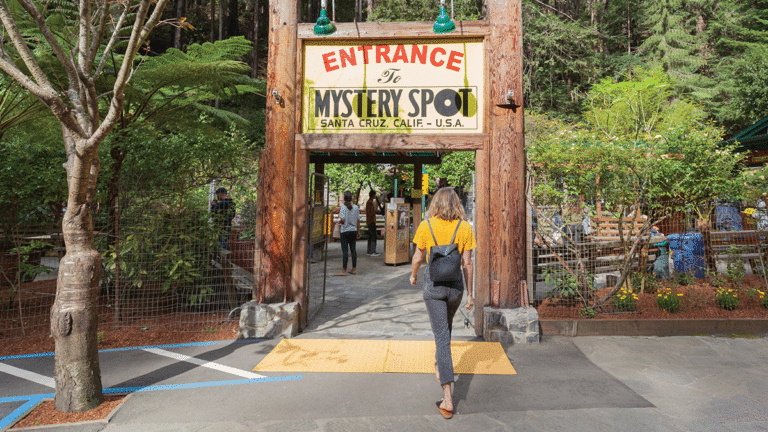
What happens to a visitor’s senses at the Mystery Spot?
The short answer is that you can’t always believe your eyes.
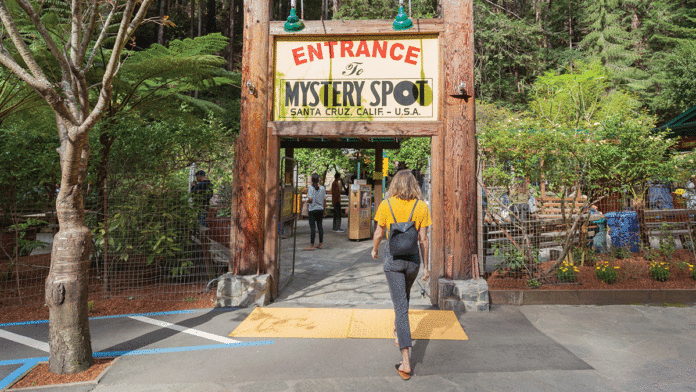
At the Mystery Spot, which opened to tourists in 1941, your eyes tell you strange things. Balls roll uphill, people seem to shrink, and gravity-defying poses suddenly become possible. Jovial tour guides offer several explanations, such as gas-induced hallucinations or gravitational distortions from a magma vortex. Or a buried alien spaceship.
But since shadowy government agents haven’t overrun the Mystery Spot, perhaps the “mystery” is that your brain doesn’t trust your sixth sense—or your seventh.
Your sixth sense is proprioception, or how your brain unconsciously knows where your body parts are and how difficult it is to move an object. Your seventh sense, the vestibular sense, is how you detect your physical orientation.
The vestibular sense detects the tilted ground of the Mystery Spot. But your mind trusts your eyes more, so it only partially corrects for the deceptive visual cues, explains UC Santa Cruz psychologist Nicolas Davidenko. The Spot’s crooked trees and slanted walls deceive your eyes, confusing your judgment of what is “down” and the relative heights of people nearby.
Your eyes can also override your proprioception. Something can seem more difficult to move if it looks difficult to move. When a hanging ball appears attracted to a corner inside the Spot’s famously askew cabin, your brain is tricked into “feeling” more resistance when you push against that direction.
Walking around the cabin with your eyes closed puts the experience in a different light, Davidenko suggests. “You become much more aware of how sloped everything is, and specifically how the floor is sloped,” he says. “You can actually stop yourself from falling better than if you open your eyes.”
So enjoy the tales from your tour guide, but be aware that your eyes are deceiving you.
— Bailey Bedford
Is planting milkweed good or bad for monarch butterflies, and why?
It may seem that our orange-and-black annual visitors would appreciate local gardens dotted with their favorite plants. But based on the timing of the monarchs’ life cycle and their migration needs, it’s actually not a good idea.
Monarch butterflies migrate in the fall to Natural Bridges State Beach in Santa Cruz and other coastal California areas to escape cold winters. They are not here to breed. Rather, they seek sugary meals to build up the body fats that fuel their spring migration.
Each February, monarchs return to their breeding sites scattered west of the Rocky Mountains. There, milkweed is essential. It’s the only kind of plant on which adult monarchs will lay their eggs, and which their caterpillars will eat after hatching.
But if monarchs stumble upon milkweed in the winter planted by well-meaning Santa Cruz homeowners, it could switch the butterflies from their non-reproductive winter state to a reproductive one. If they breed, they are no longer obligated to migrate, disrupting their natural cycle.
The typical year-round surviving milkweed varieties available to gardeners are tropical and African, both non-native exotics. These plants pass on parasites to caterpillars that feed on their leaves. The emerging monarchs can develop wing deformities or die.
Native counterparts, such as narrow-leaf and showy milkweed, die in October. Monarchs encounter these varieties briefly, if at all, and historic records indicate that they didn’t naturally occur here until recently.
“Planting milkweed is a bit like putting a Band-Aid on a really big wound,” says conservation biologist Emma Pelton of the Xerces Society in Portland. “It will make you feel good, but I don’t think it’s that important, especially close to the coast.”
Instead, says Pelton, monarch supporters should beautify their backyards with flowers to provide nectar for adult butterflies, giving them energy for their long flights ahead.
— Priyanka Runwal
Are redwoods in Santa Cruz in danger of extinction because of climate change?
Our iconic trees are fine for now, experts say—but some are beginning to show signs of stress after years of drought.
California coast redwoods, the tallest trees on Earth, tower up to 380 feet high and live 1,800 years or longer. They grow only in a cool, moist and narrow zone near the California shore, from the southern part of Monterey County to the southwestern border of Oregon.
With those redwood-nurturing climate conditions now changing in parts of the state, scientists are studying whether some of the wooden skyscrapers near Santa Cruz are at risk of dying out.
The threat isn’t immediate, says redwoods ecologist Anthony Ambrose of UC Berkeley. “These trees are incredibly resilient,” he says. “They’re tough.” The species––Sequoia sempervirens, meaning “evergreen sequoia”––arose in the Jurassic period, at least 120 million years ago. The trees have dealt with many environmental changes over the eons. “The redwoods in Santa Cruz will be okay … at least in the short term,” Ambrose says.
Still, every species has its limits. For redwoods, water is the most important resource; they need lots of it. Winter rains and summer fog nourish the trees in their coastal habitats. Their needles absorb water from the fog, an adaptation that allows them to withstand droughts. Climate change will probably affect the amount and duration of coastal fog, but researchers don’t yet know how—or how that might affect the giant trees.
The state’s rainfall patterns are also shifting, with stronger storms possible in winter and more extreme droughts in summer. Dryness already has made the needles of some Santa Cruz redwoods turn a shade of yellowish-brown. Foliage turnover is natural every year, says Ambrose, but stressed trees shed more foliage than usual. A warmer and drier climate will only intensify this trend.
The future of redwoods here depends on how society deals with carbon emissions globally, says Ambrose—“and whether we start to take this issue seriously or not.”
— Rodrigo Pérez Ortega
Could Santa Cruz ever be hit by a tsunami as bad as the recent one in Indonesia?
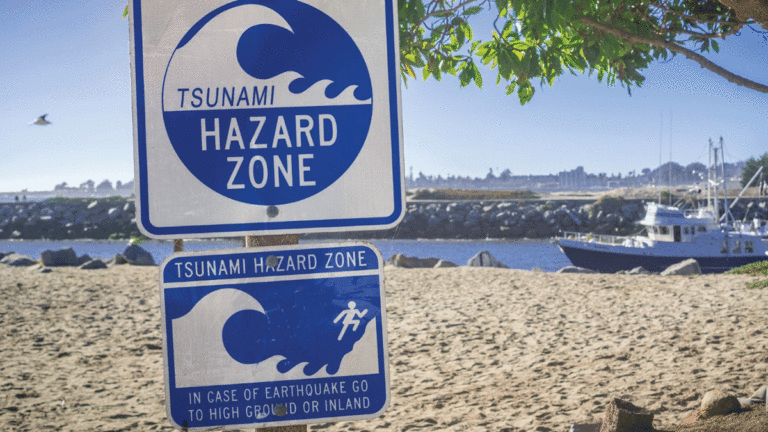
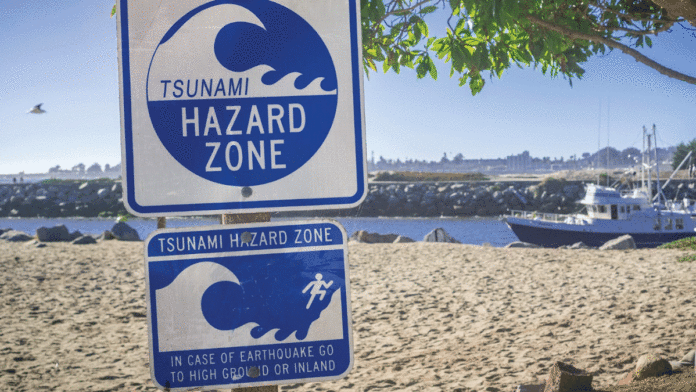
Tsunamis can happen in Monterey Bay, usually from massive earthquakes that drive waves across the Pacific Ocean. But the likelihood that a tsunami could kill thousands of people here is vanishingly small.
Tsunamis arise when underwater earthquakes, landslides or volcanic eruptions suddenly displace huge amounts of water. Energetic waves radiate out in all directions, marching through the ocean until they inundate shorelines. The damage they cause depends on the size and direction of the most powerful waves, as well as the preparedness of coastal communities.
The worst tsunamis happen where lurching slabs of Earth’s crust sink into the planet in “subduction zones” where tectonic plates meet. These huge motions can trigger earthquakes of magnitude 9.0 or higher, quickly unleashing large surges of seawater. In contrast, offshore earthquakes here come from “strike-slip” faults, where the plates slide past each other without displacing much water, lowering tsunami risks.
Giant earthquakes in Alaska or Japan, though, can propel tsunamis across the entire Pacific basin. When they approach shore, these surges grow higher as the seafloor gets shallower, pushing water farther inland.
The curve of Monterey Bay’s coastline also amplifies tsunamis. “When waves come into confined shores or harbors, they tend to grow, because all the energy gets squeezed together,” says UCSC geophysicist Steven Ward, who creates computer models of tsunamis. This phenomenon was magnified during the most recent tsunami here, in March 2011. Powerful waves from a catastrophic earthquake near Japan surged into the Santa Cruz Yacht Harbor and caused more than $20 million in damage.
Massive marine landslides within Monterey Canyon, which bisects the bay, also pose a local tsunami risk. But those are rare, Ward says. He advises worrying about other things: “By and large, I put tsunamis low on my hazard list here in Santa Cruz compared to a terrorist attack or a wildfire or landslides in the winter. I wouldn’t lose any sleep over them.”
— Katie Brown
Is the bat population in Santa Cruz declining?
Unfortunately, there’s no clear answer. But in Santa Cruz, don’t be surprised if you find a bat in your garden umbrella.
Bats enjoy enclosed spaces where they are protected from the weather, according to Elise McCandless, co-founder of Santa Cruz Bats, a volunteer rescue organization. “They can be in trees, crevices, under eaves, shingles, barns, or dead trees,” she says.
Locals have asked McCandless whether our bats are disappearing. “People are saying the bats they used to have are not there anymore,” she says, and her group has fielded fewer bat calls over the last seven years.
However, researchers don’t actually know how many bats live here. The animals are elusive, and tracking their numbers is time-consuming and expensive. The California Department of Fish and Wildlife doesn’t monitor bats in Santa Cruz County, although the agency has some details about which types live where. The California myotis, for example, is found along rivers and streams. In one ongoing study, biologists found four bat species to add to a previous list of 11 recorded at Quail Hollow County Park in Felton, but the data isn’t yet confirmed.
UC Santa Cruz ecologist Winifred Frick said in an email that scientists have not documented declines in the county’s one dozen recognized bat species, but more research is needed. Our flying mammals are fortunate in one respect, Frick notes. White-nose syndrome, a fungal disease that has devastated colonies of hibernating bats in the eastern U.S., is spreading but has not yet reached California. Researchers are trying to slow the outbreak, which had killed an estimated 6 million bats as of 2016.
Bats might leave an area for many reasons, such as migration or habitat loss. Residents can help sustain local populations by building bat houses for them to roost and checking for bats before doing major house projects.
— Erin I. Garcia de Jesus
Will steelhead salmon return to the San Lorenzo River?
As recently as the 1960s, tens of thousands of steelhead salmon migrated up the San Lorenzo River each year to spawn. Locals could spot the glittering silvery scales of the 2-foot-long fish from the river’s sandy banks, a sign of healthy waters.
Today, steelhead are few and far between in the Santa Cruz area, but they haven’t left entirely. A 2015 survey counted less than 20 of the protected fish per 100 feet of river, down from an average of 80 fish per 100 feet in 1997. Biologists attribute the steady decline to several factors, including lower water levels, loss of spawning habitat and rising water temperatures.
Each year, adult steelhead migrate upstream from the ocean to lay their eggs. Once born, the juvenile fish remain in freshwater streams for up to three years before traveling to the sea. Unlike their salmon cousins, steelhead can spawn multiple times in their birth rivers before they die. But even with such resiliency, their numbers are dropping all over California.
There’s no easy fix for steelhead in the San Lorenzo, says Jennifer Michelson, environmental programs manager for the San Lorenzo Valley Water District. Instead, residents must view steelhead restoration as a collective effort and start taking small actions in their backyards. She emphasizes limiting fertilizer use, leaving fallen trees in the river, maintaining vegetation along the riverbank and covering loose soil during storms to prevent erosion.
“If we don’t have a healthy habitat for the animals, we don’t have a healthy habitat for humans, either,” says Michelson.
Water District staffers work with local agencies to raise awareness and complete key watershed projects, such as a large wood installation in Zayante Creek set for next summer. The logs will help steelhead hide from predators and create the cool pockets of water they like.
“If the community really takes action to protect the streams, I think there is hope,” says Michelson.
— Helen Santoro
Can we still see any impacts today from the historic lime industry in Santa Cruz?
From exposed quarries at UCSC to fern-covered kilns in Felton, the county’s bustling lime industry left imprints all around us. Some impacts are more recent than you might realize.
Fall Creek State Park is the perfect place to time travel back to 1904, a peak era for lime quarrying in the county. Here, the kilns that once turned limestone into quicklime at 900 degrees are now overgrown with moss, ivy and ferns. Other remnants still stand: a water trough where workers soaked barrels before they were dried and filled with lime; a cellar where men stored dynamite powder; some wood stacks ready for the kilns.
Quarrying operations stripped large swaths of land and old-growth redwoods, leaving open scars including the two large quarries at UCSC. But Frank Perry, a local naturalist and author of Lime Kiln Legacies, says the industry also had some positive impacts. “A lot of these tracts ended up becoming parks and open spaces,” he says. “So while the industry was environmentally destructive, in the long run it preserved a lot of natural environments,” including parts of the Pogonip, Henry Cowell Redwoods State Park and Wilder Ranch.
Routine limestone mining in the county still occurred as recently as 2009 at the Bonny Doon quarry. Chris Berry, watershed manager for the City of Santa Cruz, says these blasts clouded the water from Liddell Spring, a major source for the city. Today, Berry says the spring’s water is safe to drink, but nitrate levels are still higher than normal.
Quarrying in Bonny Doon also led to invasions by nonnative species, Berry adds. “You’re turning [the land] into a moonscape, totally destroying soil seed bank and turning soil upside down,” he notes. Invasive plants such as Portuguese, Spanish and French Broom hitchhiked onto truck tires and now frequent the landscape in Bonny Doon.
–Hannah Hagemann
What would happen to Monterey Bay if global temperatures rise 2 degrees Celsius?
On land, we’ve adjusted to temperature swings. We experience a shift larger than 2 degrees Celsius, or 3.6 degrees Fahrenheit, almost every morning when the coastal fog burns off.
But ocean temperatures are fairly constant, and marine organisms live comfortably within specific ranges. So as temperatures rise, life at sea may face bigger impacts. The ecological consequence of climate change “is much more dramatic in the ocean than it is on land,” says UCSC marine ecologist Mark Carr.
Marine species have three options when their homes get warmer: move, adapt or die. In the short term, many fish, marine mammals, and invertebrates would likely move north to escape warming waters and shifting habitats. If species leave Monterey Bay, we could see an influx of southern transplants taking their place.
Key habitats like kelp forests would also decline, Carr says. Warmer waters contain fewer nutrients, like nitrates, that kelp needs to survive. While waters in the Monterey Bay now range from 12-14 degrees Celsius, the productivity of kelp forests will decrease if ocean temperatures reach 15 degrees, scientists predict. Scarcer kelp would mean less food for sea urchins that munch on kelp, less food for sea otters that eat urchins, plus other ripple effects up the food chain.
Nutrient-poor warmer waters could also diminish populations of tiny, photosynthesizing cells called phytoplankton. Many fish and whales chow down on the zooplankton that eat phytoplankton. As plankton numbers fall, local fisheries and the whale-watching industry could suffer.
In the long term, our marine species might cope. But climate change could alter their habitats faster than they can adapt, threatening many beloved Monterey Bay National Marine Sanctuary locals. “That’s why it’s important to protect large numbers within each species so they have the genetic diversity to adapt,” says Carr.
— Sofie Bates