

I drink coffee every day, but I don’t identify as a “coffee person.” I remain devoted to dark roasts and think that brewing contraptions, thermometers and precise measurements are far too much to ask of someone before they’ve caffeinated with the coffee they’re trying to brew. While I can appreciate a great cup of coffee, I can also happily drink mug after mug of burnt sludge at the local diner on a weekend morning. Which is to say: I’m not fussy.
I’m wary of trends that might over complicate something that I enjoy as a simple pleasure, so I wasn’t sure how much I would enjoy Steeped Coffee, a local company that sells coffee in a tea-bag-like single serving. It turns out we are on the same page as far as keeping things easy.
As I tore open their fully compostable packaging, the smell of freshly ground coffee filled my nose—the nitro-sealed bag keeps the coffee, which is roasted and packaged locally, as fresh as if it was ground moments ago. Normally when I grind my coffee, the noise triggers my cat’s “fight or flight” response and she sprints from the kitchen in terror, but not today. Already, it’s Steeped Coffee: 1, conventional: 0.
I slipped the little bag of coffee into a mug and poured hot water over it, dunking it a few times as a crema formed in the bag. Five minutes later, I took a sip and tasted a delicious, fresh, aromatic cup of coffee. No mess to clean up, no fancy glass carafe to wash by hand and maybe break in the sink.
How could such a simple concept be so cutting edge, I wondered. According to CEO and Founder Josh Wilbur, “Some of the simplest ideas are the most difficult to achieve. The more you try to simplify something, the more effort goes into it.” Everything from the quality of the coffee to the filter that lets flavor out but keeps grounds in, to the proportion of coffee to water, has been painstakingly perfected and Specialty Coffee Association-approved. “Is this good enough for coffee snobs? Absolutely. Is it as good as going into a coffee shop? Yes,” asserts Wilbur.
While other single-serving options can be highly wasteful, Steeped Coffee is a B-Corp certified business. “We’re legally allowed to worry about purpose and not just profit as a company and do things different,” says Wilbur. “We’re trying to do business without compromise.”
“The more you make it your state of mind, the more it becomes a reality. People are always going to have differing opinions.”
Brandon Bailey
Santa Cruz
Bike Messenger/Business Owner
“Your state of mind is influenced by reality, so I think it’s a bit of both.”
Jacob Davis
Santa Cruz
QA Engineer
“Polarization is real. Yin and yang.”
Cliff Hacker
Bonny Doon
Contractor
“It’s certainly a state of mind. I think that if we don’t feel connected to each other, it’s from an ancient wound we haven’t healed. It really doesn’t matter what the subject is.”
Kitty Lions
Santa Cruz
Badass Skier/Artist/Mountain Biker/Surfer Girl
“We get separated over issues, but the reality of the situation is that we are all one people. ”
If you’re a lover of Chardonnay, then Wrights Station is the place to go. Right now, they carry three different Chardonnays, including their superb 2014 Chardonnay Estate No. 9 – Santa Cruz Mountains. Owner and winemaker Dan Lokteff takes great care of his lush vineyards, and the result is voluptuous fruit and excellent wines.
The 2014 Estate Chardonnay ($30) is exceptional, with aromas of tropical fruit and touches of apple and lemon. The flavors bring out yet more tropical fruit—banana and pineapple particularly—and nuances of toast, hazelnut and aromatic vanilla. But if you prefer a completely unoaked Chardonnay, then the 2015 Santa Cruz Mountains ($25) is for you.
Wrights Station tasting room is in the original 1947 farmhouse, now completely remodeled, and there’s a beautiful patio area to sit and relax. Lokteff calls his estate his “dream property.” You’ll see why when you go there for a tasting—and don’t miss Lokteff’s impressive Pinots.
Wrights Station, 24250 Loma Prieta Ave., Los Gatos, 408-560-9343. wrightsstation.com. Open 11 a.m. to 5 p.m. Friday-Sunday.
Passport Day—April 21
Passport Day is a great time to go wine tasting in the Santa Cruz Mountains. Tasting is complimentary if you have a Passport, and it’s also an opportunity to taste at wineries not usually open to the public. Passports are valid for one year and can be used all year round during winery hours. They can be purchased for $65 from the Santa Cruz Mountains Winegrowers Association (SCMWA) and at most participating wineries. The next Passport event is noon to 5 p.m. Saturday, April 21. There is more information on SCMWA’s website regarding Passport, local wineries, and upcoming events. Visit scmwa.com. Wrights Station participates in Passport events.
Dinner at Burrell School Vineyards
Burrell School is doing special events now and again, including holding dinners in their tasting room and historic school house. A wine and food soiree I attended recently came with a marvelous dinner prepared by Nicole Fischer of Depaysement Supper Club. Fischer, who hails from Canada, made four delicious courses—all paired with Burrell School’s outstanding wines. Visit her on Instagram at @depaysement.sc or email de*******************@***il.com for info.
Aging actresses don’t fade away in the British film industry—they just keep getting better parts. Case in point is Finding Your Feet, a comedy in which a woman of a certain age is slapped upside the head by Fate, and has to try to reinvent herself, with the help of her estranged, Bohemian sister and her plucky friends. Plot-wise, it all sounds terribly formulaic, but a terrific cast of veteran players, some genuine laughs and moments of unexpected poignancy turn it into a surprisingly effective crowd-pleaser.
Written by Meg Leonard (racking up her first screenplay credit after years as a producer and casting director) and Nick Moorcroft, the movie was directed by Richard Loncraine (My One and Only). The story begins at a lavish party at a stately English country home presided over by perfect wife Sandra (Imelda Staunton), to celebrate the retirement of Mike (John Sessions), her politician husband of 35 years. But her own plans for their idyllic new life together out of the public eye are dashed when Mike is discovered in an anteroom canoodling with his longtime mistress.
Furious, Sandra storms off unannounced to the cluttered London flat of her older sister, Bif (Celia Imrie), an artsy type given to progressive political causes. The sisters haven’t seen each other in 10 years, but Bif is ready to provide moral support for her distraught sib—even though Sandra insults her friends, her messy flat, and her working-class neighborhood, and insists on being addressed as Lady Abbott. “She used to be fun,” Bif laments to her friend, Charlie (Timothy Spall).
You don’t need GPS to tell you where we go from here. Bif (so named from a childhood mispronunciation of the name “Elizabeth”) is determined to thaw her uptight sister and put Sandra back in touch with her fun, youthful self. Inspired by an old home movie of the child Sandra in a ballroom dancing competition, Bif persuaded her reluctant sister to come to the seniors dance class she attends every week.
There, Sandra meets Bif’s pals, including shy, sweet Ted (David Hayman), and much-married Jackie—a part tailor-made for the great Joanna Lumley, tossing off wisecracks with her usual aplomb. (Her last marriage ended because of “religious reasons,” Jackie says. “He thought he was God. I didn’t.”) Sandra does start to loosen up, although her grandiose airs have made a particularly bad impression on Charlie, a handyman who makes house calls in his dilapidated van, and lives on a barge at the edge of the river.
Yes, the story is predictable, but these veteran players provide unexpected emotional depth in even the simplest encounters. Imrie and Staunton (who’s played everything from sympathetic abortionist Vera Drake to an evil headmistress in the Harry Potter series to one of Sleeping Beauty’s fairies) revel in playing grown-ups with a long history of life lived; they’ve earned every wrinkle in their faces, and the camera dotes on them. And Spall (last seen as the befuddled, errant husband in The Party), that most unlikely of romantic heroes with his shambling gait and weary good cheer, infuses Charlie with soulful presence as he quietly endures his own unfolding tragedy.
There are some suspect plot choices, particularly a crucial bit of information that Charlie chooses to withhold from Sandra (although the viewer is led to believe she already knows about it). And while it’s very moving when Bif relates a tale of her own early, lost love, the effect she claims it’s had on her life ever since is so contrary to the way her life-embracing character has been developed, it just feels like a plot device. Invited to perform onstage at a dance fest in Rome, the class’s humble street routine acquires an almost silly degree of Vegas polish (although the shout-out to “Sisters” from White Christmas is fun).
Still, this is a frisky charmer of a movie, with a stunning final image that will leave you cheering.
FINDING YOUR FEET
*** (out of four)
With Imelda Staunton, Celia Imrie, Timothy Spall, and Joanna Lumley. Written by Meg Leonard and Nick Moorcroft. Directed by Richard Loncraine. A Roadside Attractions release. Rated PG-13. 110 minutes.
Propelled by one of the most high-profile sexual assault cases in California history and the momentum of the #MeToo juggernaut, the campaign to recall Santa Clara County Superior Court Judge Aaron Persky has become a well-funded referendum on sexual misconduct in modern society.
Whether that’s fair—not to mention whether voters actually understand how the June 5 election process works—is a much bigger question with implications for courts both inside and outside the area.
“It’s going to have a profound effect,” says Margaret Russell, a law professor at Santa Clara University and one of Persky’s supporters. “This is a campaign that is being talked about nationwide.”
Whether to recall Persky is just one of two questions voters will decide this spring. On the same ballot, Santa Clara County residents will be asked to pick a successor in the event that Persky is recalled—a vote that will count whether or not voters support the recall.
If successful, it would mark the first recall of a California judge in 86 years.
The campaign to depose Persky is rooted in the backlash to the penalty he imposed in the 2016 sexual assault trial of Brock Turner, a former Stanford swimmer convicted of three felony charges after two graduate students discovered Turner using his fingers to penetrate an unconscious woman near a dumpster after a frat party on campus. He faced up to a decade in state prison for the assault, but prosecutors asked for six years.
Instead, Persky went with a probation officer’s recommendation and sentenced then-20-year-old Turner to a six-month stay in county jail, three years of supervised release and lifetime registration as a sex offender.
The outrage was immediate, but it was too late to prevent an unopposed Persky from coasting to re-election five days after the sentencing hearing.
Still, everything changed for Persky. That summer, at least 10 prospective jurors refused to take part in a misdemeanor theft trial because of his ruling in the Turner case. A week later, Santa Clara County District Attorney Jeff Rosen, in what he called “a rare and carefully considered step” for his office, pulled the embattled judge off a sexual assault case. Finally, at Persky’s request, the courts reassigned him to the civil division.
Turner, for his part, walked out of San Jose’s Main Jail after serving half his time for good behavior.
The recall campaign has since devolved into a war of tweets, TV jabs and general campaign warfare. In some instances, the vitriol has turned into physical intimidation, like when the pro-recall campaign in February received an envelope of white powder, or when armed protesters periodically gathered outside Turner’s Ohio family home.
Through it all, Persky himself has issued just one public comment. Last summer, before the recall measure qualified for the ballot with more than 100,000 petition signatures in January, the judge submitted a statement to the county defending his record—saying that he “fought vigorously for victims” as a prosecutor and that, as a judge, he has been “required to consider both sides.”
At the forefront of the campaign to channel outrage about the Turner verdict into a successful recall is Stanford law professor Michele Landis Dauber, who now chairs the Committee to Recall Judge Persky. The committee has raked in more than $800,000 from Silicon Valley tech executives, women’s rights advocates and other donors in both the Bay Area and big cities like New York and Boston, Dauber says.
Among those to endorse the recall campaign are national figures like Anita Hill and U.S. Sen. Kirsten Gillibrand of New York. Adding to the momentum, Dauber says, was a letter from the victim in the Turner case that went viral just months before the #MeToo movement exploded following allegations of rampant rape and sexual assault in the entertainment industry.
The parallel to broader backlash against sexual assault doesn’t square, however, for some critics of the recall effort, who contend that kicking Persky off the bench for unpopular sentences would amount to judicial intimidation and represents an existential threat to independent courts.
“They’d rather have judges that respond to the mob,” says former Santa Clara County Superior Court Judge LaDoris Cordell, who retired from the bench in 2001 and is now one of Persky’s most vocal supporters.
As of the latest campaign filing deadline at the end of 2017, the anti-recall committee formally had raised more than $450,000. The donor list is a who’s who of the local legal community and judiciary.
“The fact that judges are more or less aligned behind their colleague is a powerful incentive for lawyers,” Dauber says. “It’s not surprising, but it is disappointing. I think the message that it is sending to women in particular is extremely tone-deaf.”
The furor over the future of the county’s judicial bench comes amid a wave of criminal justice changes positioned as ways to combat disparities in how poor people and people of color interact with cops and courts.
Now, Cordell says, the question is whether recalling Persky would encourage judges to dole out harsher sentences across the board, negating any sentencing or bail reforms that could help minority defendants in particular.
“The term ‘Persky’d’ is now being used by judges,” she says. As in, if a judge approves a potentially controversial plea deal or shows what could be perceived as leniency toward any type of defendant, that judge, too, could be subject to recall. Recall supporters argue that such political calculus is already part of the drill in a system where judges are elected by the public, but Cordell says the precedent would erode insulation judges are historically granted compared with other elected officials such as mayors or city council members.
One complicating factor is that both sides see themselves as progressive.
Dauber contends that the justice system is not “zero-sum,” and that mass incarceration can be overhauled while also increasing penalties for sex offenders.
Though Cordell told CBS News at the time of the Turner verdict that sentencing language deferential to the defendant was “basically code for white privilege,” she says the recall goes too far and that campaigners have distorted Persky’s record.
“Especially to women who think this is about #MeToo and white privilege; it’s not,” Cordell says. “It has been co-opted.”
Live music highlights for the week of April 18, 2018.
WEDNESDAY 4/18
ROCK
LOS LONELY BOYS
Purveyors of “Texican rock ’n’ roll,” three brothers from San Angelo, Texas—Henry, Jojo and Ringo Garza—emerged on the local music scene in the 1990s. Since then, they’ve slowly but steadily established their band Los Lonely Boys as one of the premier American Chicano rock outfits. Blending rock, country, blues, Tejano and brown-eyed soul, the group has carved a unique place for itself in pop music and gone from a small Texas family band to a Grammy-winning international sensation. CAT JOHNSON
INFO: 8 p.m. Rio Theatre, 1205 Soquel Ave., Santa Cruz. $28/gen, $43/gold. 423-8209.
WEDNESDAY 4/18
FUNK & SOUL
DIRTY REVIVAL
With cool grooves, impeccable instrumentation, and soul for days, Dirty Revival is a rising star of the underground funk and roots scene. Hailing from Portland, Oregon, the seven-piece has gone from a basement party band to one of the city’s standout acts. Led by vocalist and frontwoman extraordinaire Sarah Clark, Dirty Revival reworks classics and drops irresistibly funky originals driven by horns, tight percussion and Clark’s powerful, engaging voice. Also on the bill: Post Street Rhythm Peddlers. CJ
Although their brand-spanking-new album is called The Nothing They Need, Dead Meadow’s two-decade-spanning career testifies to the fact that they are definitely something. Formed in the indie rock scene of D.C. in 1998, the psych-rock trio (sometimes quartet) has rocketed listeners into twistedly dizzying dimensions of sight and sound. No strangers to Santa Cruz, Dead Meadow requires you to be prepared for a mind-melting show that will leave you wondering just exactly what that bartender put in your drink. MAT WEIR
The members of Tropa Magica describe the band’s recent single, “LSD Roma,” as “psychedelic Norteño.” It’s not hard to see how this description fits with what the East L.A. group is pulling off in their music. It’s got the authentic Norteño rhythms driving the songs, but also sounds like they’ve been beamed straight from outer space. The group is new, but the members have been messing with traditional forms of Mexican music for a while, most notably with their band Thee Commons, which can best be described as “punk cumbia.” With Tropa Magica, they seem to be stretching the limits even further. AARON CARNES
Back in the early ’80s, the line between punk rock and New Wave could be a very thin one. But as New Wave bands veered toward pop, you could hear a heavier embracing of synthesizers and pop hooks. New Tampa, Florida quartet Glove seems to have traveled back in time to find that crack that barely distinguished the genres and planted themselves there. They pile ’80s synth onto punky guitars, then add poppy vocals and a punk rock sneer. AC
A music journalist once described the Robert Cray Band as “blues-like,” and although this may seem like a dis, it really is one of the best ways to describe them. Cray has had an illustrious, 40-year career, and has played alongside blues greats like Lee Hooker, Buddy Guy and even Stevie Ray Vaughan the night of his tragic death. However, the RCB blends a cocktail that is equal parts blues, soul, gospel and jazz, shaken up and served chilled with a twist that’s all their own. MW
INFO: 7:30 p.m. Rio Theatre, 1205 Soquel Ave., Santa Cruz. $49. 423-8209.
SATURDAY 4/21
PSYCHEDELIC
WOODEN SHJIPS
For the past decade, San Francisco’s Wooden Shjips has been bringing experimental, droning sounds to the psych scene. But as out-there as the group can get, there’s always an easygoing, laid-back charm to its music that feels like cracking open a beer and watching the sun rise on a lonely, contemplative Sunday morning. The latest record, the aptly titled V (yes, their fifth album), goes for an even easier-feeling sound that’s almost folk-rock. The double meaning of the album title V. is that it’s a graphic rendering of the peace symbol, something the band feels is needed in today’s negativite environment—and the music fully embodies that philosophy. AC
INFO: 8 p.m. Michael’s on Main, 2591 S. Main, Soquel. $20. 479-9777.
MONDAY 4/23
JAZZ
WILLIE JONES III QUINTET
A drummer who combines impeccable taste with irrepressible joy, Willie Jones III has spent the past 25 years carving out a stellar career as a sideman with jazz greats (Milt Jackson, Horace Silver, Michael Brecker, and Sonny Rollins, for starters) and a bandleader in his own right. More than an all-star ensemble, Jones’ quintet brings together a cast of fellow bandleaders, including trumpeter Jeremy Pelt, a fellow Los Angeles native, pianist Eric Reed, bassist Gerald Cannon, and saxophonist Ralph Moore, one of the definitive players of the 1980s who’s been gaining visibility after 15 years in the band for The Tonight Show with Jay Leno.
INFO: 7 p.m. Kuumbwa Jazz, 320-2 Cedar St., Santa Cruz. $30/adv, $35/door. 427-2227.
TUESDAY 4/24
INTERNATIONAL
VIEUX FARKA TOURE
As the story goes, legendary Malian singer and multi-instrumentalist Ali Farka Touré didn’t want his son to follow his footsteps into the music business. But the elder Touré didn’t get his way. His son Vieux Farka Touré followed his father’s lead and has become the torchbearer of the family’s musical tradition. Nicknamed the “Hendrix of the Sahara,” Touré honors his father’s legacy and keeps Malian music alive while blending it with rock, Latin music, and other African influences to create something timely and relevant for today’s international music scene. CJ
INFO: 7 p.m. Kuumbwa Jazz, 320-2 Cedar St., Santa Cruz. $30/adv, $40/door. 427-2227.
IN THE QUEUE
JOE KAPLOW
Bay Area by-way-of New Jersey singer-songwriter. Wednesday at Crepe Place
BASTARD SONS OF JOHNNY CASH
Alt-country standout. Thursday at Michael’s on Main
HOUSE OF FLOYD
Mind-melting Pink Floyd tribute. Friday at Rio Theatre
URIAH HEEP
Pioneering prog-rock band out of the U.K.. Saturday at Catalyst
BLACK UHURU
Legendary reggae group. Tuesday at Flynn’s Cabaret
Described as a “conscious revolutionary lyricist,” award-winning artist Kabaka Pyramid blends reggae and hip-hop to present messages of spiritual evolution, positivity and global unity. Hailing from Kingston, Jamaica, Kabaka—which is Ugandan for “king”—acts as a bridge between roots reggae and African music, and the contemporary and future pop and underground styles.
INFO: 9 p.m. Wednesday, May 2. Moe’s Alley, 1535 Commercial Way, Santa Cruz. $20/adv, $25/door. 479-1854. WANT TO GO? Go to santacruz.com/giveaways before 11 a.m. on Tuesday, April 24, to find out how you could win a pair of tickets to the show.
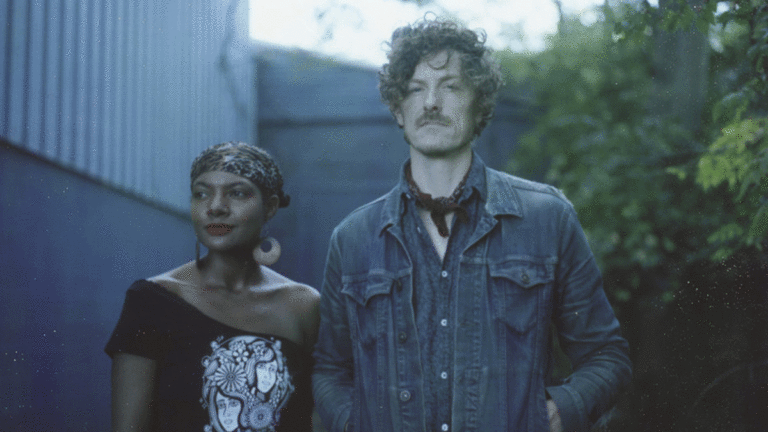
Some bands are organized through ads and auditions. Others are formed by friends who have known each other for years. But sometimes fate steps in for a once-in-a-lifetime opportunity—like randomly meeting the person you will write music with for the next five years at a convenience store.
“It was Kong’s Market, off 26th Avenue,” remembers Wild Iris guitarist Bryan Shelton of the day in 2013 that he met singer and lyricist Kate Mullikin. “I used to work there before it closed.”
“Bryan was playing this old guitar outside, I had some lyrics, and they kind of went together,” says Mullikin.
Despite an age difference between them of “a couple decades,” Mullikin and Shelton quickly hit it off.
“We have a very organic way of doing things,” says Mullikin of their writing process. “Some songs we’ll get to right away, while others will be on the back burner for months and months.”
Wild Iris’ music is an earthy mix of Delta blues, acoustic folk and bluegrass, with the tiniest bits of country and rock. Last year, the band released their second full-length album, Covers. Not your typical cover album, it consists of songs chosen by fans who donated a certain amount of money to the band’s Kickstarter campaign when they were raising funds for their debut LP. It includes covers of everything from John Prine’s “Paradise” to Otis Redding’s “Blue Bayou” to Bessie Smith’s “St. Louis Blues” to Consuelo Velazquez’s “Besame Mucho.”
“Bessie Smith was a lot of fun to learn, and I got to sing in Spanish [on “Besame Mucho”],” says Mullikin, who is bilingual.
Even if you can’t make the band’s April 18 show at the Crepe Place with Joe Kaplow and Ladies of Sound for the Do It Ourselves Fest, Wild Iris says to look out for new music blossoming later this year.
INFO: 9 p.m. Wednesday, April 18. Crepe Place, 1134 Soquel Ave., Santa Cruz. $10. 429-6994.
At the Santa Cruz County Outdoor Science School in Corralitos, aka “Science Camp,” fifth and sixth graders spend four to five days living in the Santa Cruz Mountains among the redwoods and learning about science and the environment. No classrooms necessary, and hiking shoes are mandatory. Unfortunately, many families cannot afford to send their kids to camp, and that’s where Every Child Outdoors (ECO) comes in. ECO awards grants to local elementary schools to sponsor and promote the outdoor education program. Help them help others during their third annual fundraiser for kids outdoor education and get a delicious dinner in the process.
INFO: 6-9 p.m. Saturday, April 21. Santa Cruz Food Lounge. 1001 Center St. #1, Santa Cruz. everychildoutdoors.org. $20 general admission, plus sliding scale donations. Tickets online at brownpapertickets.com.
Art Seen
‘Many Roads: An Evening of Short Plays’
Artistic Director Sarah Albertson spent months collaborating with a variety of Cabrillo College students to create a series of 10-minute theatrical pieces. Each short play was directed by students from Albertson’s class, and though each piece is unique, she says there is a common thread of unusual life paths and circumstances—hence the title Many Roads. Cabrillo students were also responsible for facilitating the lighting, sound, costumes and props for the production.
INFO: 7:30 p.m. Fridays and Saturdays, 2 p.m. Sundays. Runs Friday, April 13-Sunday, April 29. Cabrillo College, 6500 Soquel Drive, Aptos. 479-6154. cabrillovapa.com. $17 general admission, $15 students and seniors.
Through Sunday 5/27
‘The Art of Nature’
Cell phone cameras don’t capture everything, and they certainly won’t do when every leaf vein and feather tuft matters. Sure, people buy fancy cameras, but what happens if they lose their memory card or something malfunctions? Or what if the animal is extinct? Despite its centuries-old history, scientific illustration is still a very relevant and accurate art form—and the latest exhibit at the Museum of Natural History proves it. The annual exhibit features longtime local illustrators and UCSC art students’ work that will make you go “there is no way someone drew that!” The collection of watercolors and sketches in this exhibit proves that scientific illustration is just as awe-inspiring as ever.
INFO: 5-7 p.m. Friday, May 4, Free First Friday Scientific Illustration Demos. Santa Cruz Museum of Natural History. 1305 East Cliff Drive, Santa Cruz. 420-6115. santacruzmuseum.org. $4 general admission, $2 seniors and students. Image artwork: “Cicada” by Martha Iserman.
Every day should be Earth Day, theoretically, but for some reason we limit it to a single day. In celebration of water, air and living things, get outside, ride a bike, pack your trash, and maybe even put the house spider outside instead of squishing it—it deserves to live, especially today. Join the rest of the community in celebration of this beautiful planet. There will be a climbing wall, river clean up, compost workshop and tons of live music. Show Mama Earth a little extra love and affection; she definitely doesn’t get enough.
INFO: San Lorenzo River clean up 10 a.m.-noon at the Pedestrian Bridge. 11 a.m.-4 p.m. event. 137 Dakota St., Santa Cruz. scearthday.org. Free.
Thursday 4/19-Friday 4/28
11th Annual Dance Week
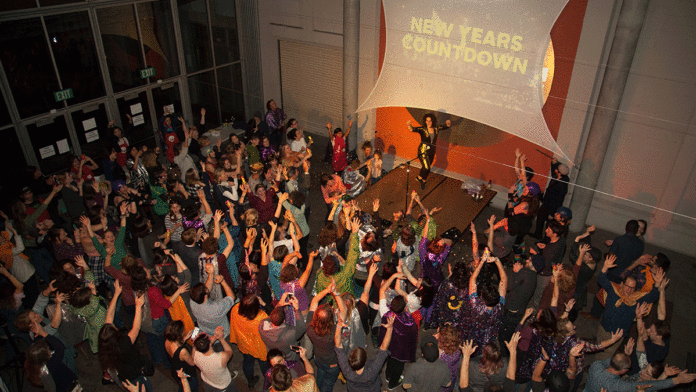
There are few events that draw thousands of people to downtown Santa Cruz, and Dance Week is one of them. Presented by Motion Pacific dance studio, the event is comprised of more than 300 free dance events, including classes, performances, open rehearsals and lecture demonstrations. The annual “Dancing in the Streets” event features three hours of dance across three stages downtown. To keep things extra interesting, “Dance in Unlikely Places” will pop up anywhere. There are a few new additions this year, including a country square dance, samba dance lesson and improvisational movement along West Cliff.
INFO: Dancing in the Streets: April 19, at 5:20 p.m. on Pacific and Cooper street intersection. Dance in Unlikely Places: April 20-22.
Open dance classes: April 21-28. Varying levels, types and locations. $10 week pass.
Other times and locations vary, check scdanceweek.com for full details. Free. Photo by Crystal Birns.
[dropcap]A[/dropcap]s he walks down Seabright’s railroad tracks, Miles Reiter steps over discarded potato chip bags and paper cups. He turns to face me under a eucalyptus grove hanging overhead in the narrow valley that is Santa Cruz County’s rail corridor—perhaps the most contested piece of real estate in the entire Monterey Bay.
Not far from the steel truss bridge over the San Lorenzo River, we near East Cliff Drive’s overpass, as cars zoom overhead. Reiter says the fifth-of-a-mile ravine where we’re standing isn’t wide enough to accommodate both a train and an adequate bike/pedestrian trail, like the one the Santa Cruz Regional Transportation Commission (RTC) has planned in its “rail trail” project that’s decades in the making.
“Because look at this—what’re you going to do with this?” says Reiter, gesturing around at graffiti-tagged concrete walls that hug the tracks rather tightly. “This is one of the narrowest spots, but it’s not all that unique. Every segment has issues. Pick your segment, and we’ll go see trouble.”
Reiter, an opponent of passenger rail service in the county, is pointing with his head more than his hands, as he’s holding a 22-and-a-half-foot rod that he brought to demonstrate how tight the corridor is and what problems engineers may run into should they really try to squeeze in adequate space for cyclists along the tracks.
This much-debated rail trail would be Santa Cruz County’s portion of the Monterey Bay Sanctuary Scenic Trail (MBSST). The accepted status quo was once a 22-or-so-mile train line running from South County to Santa Cruz, with a 12-to-16 foot-wide trail alongside it.
But Reiter and a group of like-minded activists had a different idea. They decided the train would never work—given the environmental cost of carving out space for it, the financial cost of building and maintaining it, and the estimated ridership, which they felt was too small to justify the project. They also felt that bicycles are the future. The question they asked themselves was: “What if we could just build a better trail?”
However, not everyone who’s tracked the developments is on the same platform.
On the other side of the issue is Barry Scott. A train lover with a graying curly beard, Scott says he keeps railroad studies with him at all times. They’re on his MacBook, in his side bag, on his iPhone, in his head.
He keeps an eye on the big picture, too. On a recent drive up to Marin County, Scott tells me that all the squabbling over the corridor has gotten out of hand, with activists seeking out only the perspectives they want.
“There’s a lot of confirmation bias—[thinking] ‘this is what I want,’ and then going and looking for information that supports it,” Scott explains to our driver, environmentalist Bill LeBon, who’s taking us up to San Rafael, where we’ll all board the Sonoma Marin Area Rapid Transit (SMART) train for a Saturday afternoon ride. “[Rail opponents] show all the train projects that come in over budget. I do it, too—I look for trains that came in under budget. I go onto Google and type in ‘train projects that came in under budget.’”
Beyond confessing to cherry picking his data, Scott is summarizing a chief reason the fight over the rail corridor has become so contentious. There are two camps, and both groups have been developing their own sets of facts in a scorching-hot debate—with each side fanning the flames, like a 19th century train conductor shoveling coal into his engine’s firebox to make the locomotive go faster.
Drawing the Lines
[dropcap]I[/dropcap]n the years before the RTC even voted to approve a purchase of the 142-year-old freight rail line withstate money from Proposition 116, arguments have simmered about the corridor’s future. The commission first began exploring a purchase in 2001, with locals chirping in—either about whether or not it was wide enough to accommodate a trail, or more recently, whether or not it’s wide enough for a train. Escrow on the purchase finally closed in 2012.
Reiter started the Great Santa Cruz Trail Group in 2016 with venture capitalist Bud Colligan, a former rail trail supporter who once had a Friends of the Rail Trail (FORT) bumper sticker on his Prius Plug-in. Nearly a year ago, Great Santa Cruz Trail Group morphed into Greenway, a nonprofit that counts both Reiter and Colligan as board members and advocates for a trail-only approach to the corridor. Reiter, the former CEO of the berry company Driscoll’s, says that even if train-friendly planners can dig out enough of the corridor’s hillside to make room for a trail alongside the tracks, the combined trail and train project will never see enough use to justify the cost.
TRAINING DAY Mark Mesiti-Miller, a retired engineer, says commuters could one day hop on and off trains at Depot Park, which is at the edge of downtown Santa Cruz. PHOTO: KEANA PARKER
The MBSST Master Plan is ambiguous about where exactly the trail would go on this sliver of Seabright’s segment nine—one of three segments I’m surveying firsthand with Reiter during our three-hour Sunday morning stroll. (There are 20 segments total on the proposed trail.) The map shows a trail on the inland side of the tracks, but the plan’s text is more ambiguous, making it sound like the trail would get diverted up onto Murray Street without detailing the exact route. It’s one of a few confusing passages in the 2013 plan.
Reiter, who was skeptical of the train early on, first invited Colligan to walk part of the corridor with him three-and-a-halfyears ago. After they finished, Colligan—who’s out of the country until September—decided he and Reiter had to do something to change the conversation. He also ripped the FORT sticker off his car’s bumper.
They decided what the corridor needed was a better trail.
“This would be just a gorgeous trail, really functional,” says Reiter, swiveling his head, taking in the canopy around us. “By keeping the rail in place, this trail loses so much functionality. Our big interest is active transportation and reducing congestion and making people healthier, and it’s a better way to live and a better way for the community to be. But the element of creating a renowned, really fabulous, really safe beautiful bike trail that goes from Davenport to Pacific Grove—60, 70 miles. I’ve looked at all the most popular trails in the Western United States. This one would be the number one trail in the Western United States. It is wide enough. It’s wider than most trails. This would get so much use.”
In some places, their trail would be a slightly wider version of what the RTC already proposed, giving more room for speedy cyclists to pass those going for a jog or pushing a baby stroller through what Greenway supporters sometimes call “a linear park.” In other areas, there would be separated bike and pedestrian paths. This way, they say, the trail can get more use from all groups—both from those looking for leisure and those trying to commute to work or school more quickly.
Reiter periodically pauses to put one end of his yellow pole against the railroad ties and places the rod’s other end down, leaning it against the tree-covered slope.Every cubic foot of hillside and each tree that falls into the pole’s path would theoretically need to come out in the RTC’s plan. Reiter says the rod gives a sense of what the “physical capacity” of the corridor is, and to him every inch matters.
Colligan and Reiter argue that the future of transportation will take a much different path than that of previous generations. The flexibility of self-driving cars and ride-sharing will make commuters less interested in transit, they say, and electric bicycles will allow ordinary cyclists to travel longer distances on bike trails than ever before. A presentation that Colligan sent me this past fall argued that Watsonville’s working poor would have a difficult time affording train fares anyway.
One thing is certain: The discussion, both for and against the train, is being driven by wealthy, retired white men who say they want to get people moving—building a happier, healthier, more vibrant county.
Full Steam Ahead
[dropcap]I[/dropcap]t’s a hot autumn day on Santa Cruz’s upper Westside. Retired engineer Mark Mesiti-Miller, who’s given voice to train supporters with his high-profile campaigning on the issue, is sitting in his backyard, which overlooks Santa Cruz. From his patio, we can almost see segment eight of the tracks, where they pass in front of the Santa Cruz Beach Boardwalk. He’s cracked open a Rail Trail IPA, which Santa Cruz Mountain Brewing had crafted over the summer to raise money for FORT. The brew flew off the shelves, with 200 cases selling out the first weekend, but Mesiti-Miller still has a small stash going in his refrigerator months later.
A Santa Cruz planning commissioner disheartened about rampant inequality, he isn’t buying the notion that a wider trail is helpful for the county’s poorest families, and certainly doesn’t think it would be any better than a train.
“It’s wrong. Bud need look no further than his own private study, the study funded by the Great Santa Cruz Trail Group. He can look at the ridership estimates for his trail-only solution, and he could see that only 147 new recreational or utilitarian cyclists will shift from other modes in traveling from Watsonville to La Selva,” says Mesiti-Miller, a former cyclist who’s broken a sweat riding from Santa Cruz to Watsonville on two-hour Saturday morning rides. “And I think those are optimistic numbers. And so to argue that is somehow equitable is wrong, when there are thousands of people that would use the rail. It’s not even close. That he makes that argument is laughable. It’s wrong. It’s delusional. He can say it, and he does. And he says it very convincingly. It’s a zero-entry point. It’s like, ‘OK, yeah, you can buy a bicycle for very little money. But it doesn’t get you anywhere, to buy a bicycle for people who can’t ride a bike.’”
Ride of Passage
[dropcap]B[/dropcap]ack inthe Ford Bronco, which runs on half gasoline and half alcohol, LeBon is taking us up Highway 1 on our way to the SMART train. His blue pickup truck rumbles through a foggy, overcast mist, with Scott riding shotgun as I sit bunched up in the compact backseat, scribbling down notes.
It was LeBon, a fossil fuel-hating transportation activist, who first pitched the idea for the field trip to a few fellow environmentalists from the local Sierra Club, which has supported the rail trail proposal. LeBon invited me along as well. In 1991, he rollerbladed across the country to raise $10,000 for theRails to Trails Conservancy. He also co-founded local environmental operations like the Hub for Sustainable Transportation, the PedX bicycle couriersand the Green Station. Although he’s an avid cyclist, he says trains are a great way to move people sustainably.
In the coming decades, according to Mesiti-Miller, trains will become a regular part of the county’s transportation ecosystem. Caltrans’ recent draft State Rail Plan has outlined billionsof dollars for train projects across the state, and the county’s share of that could bring in hundreds of thousands of dollars, enough for “super-deluxe passenger rail systems—fully electric, quiet crossings, the whole nine yards,” he says. Travelers and commuters, Mesiti-Miller explains, will be able to transfer in Pajaro Valley and head up to Silicon Valley. The rail plan’s executive summary maps out rail lines around the state that could be active by 2040 and includes Santa Cruz County.
Skeptical of promises of state money, Gail McNulty, Greenway’s executive director, doesn’t think the county will see a dime of that without passing a sales tax measure. Such a tax would come on top of Measure D, which, after passing in 2016, is providing cash across five transportation sectors—including for the rail trail, as well as rail corridor repairs and train analysis.
Using some of that Measure D cash, the RTC is currently studying how to improve transportation via its Unified Corridor Study, with findings on track to come out by the end of the year. The commission is studying the best use for three major corridors, Highway 1, Soquel Drive and the rail corridor. Along the corridor, RTC staff is putting four ideas forward, and each of them includes a trail in some capacity: passenger rail service, freight rail service, bus rapid transit along segments of the corridor, and a wider bike and pedestrian trail with no tracks.
Open to alternatives, Greenway supporters have been floating the bus rapid transit idea as a different approach for the corridor. Depending on the routes, the buses could allow riders to take the bus to the exact stop where they want to go, instead of being stuck on the tracks.
As LeBon’s Bronco putters up a 19th Street hill in San Francisco, I bring up the idea of bus rapid transit—asking if it provides all the benefits of trains and then some. “People love trains. We’re not riding all the way up to Sonoma to go ride on a bus,” says LeBon, who’s wearing a faded blue Kona Big Wave Golden Ale shirt. “People love trains, and that’s exciting. That’s fun. [Buses] don’t have that sex appeal, and if you want to get people out of their cars, buses aren’t very sexy, but trains are. People go all the way up to Sonoma just to ride the train because it’s fun.”
The RTC estimates the rail trail will come out to $127 million and the train could be anywhere from an estimated $93 million to $176 million, depending on the specifics of the chosen scenario. That total doesn’t include yearly operational costs. Greenway’s consultants have said their plan would come out to $50-$70 million.
Both camps castigate their opponents’ estimates as laughably optimistic.
DRAWN OUT A rendering from the Monterey Bay Sanctuary Scenic Trail Master Plan shows an eight-food-wide path beside the train tracks in Aptos. Exactly how engineers can make this a reality is the subject of controversy.
Designer Dreams
[dropcap]“W[/dropcap]hat the fuck are they talking about?!” yells Reiter, smacking his copy of the MBSST plan with the backside of his hand.
We’re standing in Aptos Village staring at the corridor—both in front of us and via the renderings on the page. Reiter didn’t even bother to bring his measuring rod with him out of the car for this segment, and he doesn’t have to.
It appears obvious enough to me that the scene before us looks nothing like the plan’s drawing, an image that resembles a high school art project more than it does a professional rendering.
The illustration shows Soquel Drive on the left, along with ample parking on both sides of the trail and tracks and a tree that was left untouched. In the actual scene, those are all in much closer proximity, leaving the impression that something’s got to give. Even if a trail does fit, it looks like the parking and trees will be history. It all strikes Reiter as deceptive.
“They just went and drew something that had nothing to do with [reality], and they put the name of the street and the existing parking,” says Reiter, who believes the design groups that drew these images should be sued.
There’s another element that has got him steaming mad. Mesiti-Miller likes to say that most of the rail trail will be 16 feet wide and the rest will be 12. It’s an interpretation that Reiter takes issue with. He notes that the 2013 MBSST plan, after all, shows an 8- to 12-foot-wide trail with two-foot shoulders on each side. However, since then, I later learn, the RTC has signaled that it will do a 12- to 16-foot trail with no shoulders.
Still, given the narrowness of many corridor segments, Reiter says the RTC would end up diverting much of its bike path down local roads near the corridor. When Greenway hiredAlta Planning + Design, out of San Jose, to do an analysis, consultants found that needed diversions from the route between Seacliff and Live Oak would lead to a 35 percent drop in bike ridership along that stretch.
Mesiti-Miller, who notes that the plan won a series of planning awards, doesn’t see renderings like this one as deceptive. The retired engineer says in essence that the concepts are beyond Reiter’s pay grade—and mine, for that matter.
“I would describe that phenomenon as the difference between an engineer and everyone else. And I don’t mean that in any kind of negative way. It’s just a reality. When people like myself or train professionals, or the people who put together Monterey Bay Sanctuary Scenic Trail Plan—when they prepare a master plan, they have the ability to look at that same drawing and say, ‘I see how this can work.’ And I’m not bragging. It’s just a fact. It’s a gift that people in my profession have,” says Mesiti-Miller, who also acknowledges that the items depicted in the image—the trees, the parking—very well may not end up in the final picture, once the project’s done.
Get SMART?
[dropcap]T[/dropcap]he green SMART train makes seven stops as it rolls smoothly from San Rafael to the Sonoma County Airport, passing pastures dotted with sheep and cattle along the way. A café sells coffee, tea, beer, wine, and a few light meals. Casey Beyer, executive director of the Chamber of Commerce, says the chamber will be taking a trip of its own on SMART next month so its members can take in the whole experience for themselves.
Many rows of the train’s special-grade vinyl seats face forward, but each car has a few tables for groups to chat. LeBon, Scott and Keresha Durham, who serves on the local Sierra Club’s executive committee, and I manage to find a free one.
“You know what I notice about the train?” LeBon tells us. “Listen to all the people talking, all the conversations. This doesn’t happen in cars or even on buses. I hear more conversation on trains than on buses.”
Earlier that day, a group of Santa Cruzans, including LeBon and Durham, had gotten off the train early to ride the trail that goes down the corridor, while Scott and I stayed and took the train all the way to the end of the line. The cyclists met us on the way back after riding several miles, during which they only saw a couple pedestrians and a couple cyclists. LeBon and Durham say there was more than enough room. “There was no traffic. It was great,” LeBon says. “It’s no big deal. There’s a train track. There’s a trail. It’s a no-brainer.”
More than six months in, the train’s ridership has lived up to expectations—something SMART managers have lauded as a great success, given how October’s fires ravaged and displaced so much of Sonoma County and caused the population of some regions to drop. Managers have had to add extra cars to accommodate a surprisingly large cycling community.
But the whole day’s round trip fare comes out to $23 per person, hardly affordable for a working family, I can’t help but mention. Scott says a better model for Santa Cruz’s possible train may be the Sprinter, a 22-mile rail line that runs through North County San Diego. “SMART’s not representative of necessarily what we would have,” Scott says. “It’s going further distances. It’s a bigger train. It’s more expensive and faster.”
Looking out the window a few months prior,McNulty had a different view on that same ride. She took SMART the entire length of the tracks herself, and says she noticed the Marin-Sonoma’s corridor is much more open than Santa Cruz County’s. “They have two tracks in lots of locations,” says McNulty. “Their stations tend to be very wide. Also, look at their parking. Look at the types of things they’ve had room to build. I don’t know what we would do to build that here.”
At its current juncture, Greenway’s leaders don’t know exactly what path their organization will be taking next.
The next major stop for enthusiasts is more than six months away, as Greenway awaits results from the Unified Corridor Study, says Manu Koenig, an independent contractor and canvasser for the nonprofit. “And then we’re going to have the plan to move forward, and it’s a time to engage the public,” he says.
Koenig gathers signatures from locals in support of Greenway. He also manages a team of fellow independent contractors, each of whom gets paid per signature for petitioning county residents and convincing them to sign onto the proposal. These signatures show support for the plan but aren’t legally binding and could not be used to submit a ballot measure. Still, Koenig says that if he can show an elected official that “there are 2,000 people in your district that support the Greenway plan, that changes their minds a little bit.”
There had been chatter about gathering signatures for an actual ballot initiative, but McNulty says that Greenway will “probably not” pursue a measure for the November election. The deadline to file is Aug. 10, and a countywide measure requires that a group submit more than 7,000 signatures.
Bruising Battle
[dropcap]T[/dropcap]he California Coastal Commission rolled into quarrelsome territory this past February when it wrote a letter to Association of Monterey Bay Area Governments, weighing in on transportation planning. The letter expressed firm support for passenger rail service in the region, including through Santa Cruz County.
The letter got bandied about by train enthusiasts, with Mesiti-Miller confidently sharing it with GT and repeatedly calling the Coastal Commission an “immovable object,” proclaiming that if Greenway ever wanted to rip up tracks, they would have to go through the notoriously powerful body first.
After the SMART train ride, on our walk back to the car,Scott went one step further, telling me that he wanted to hold the Coastal Commission’s letter up to the Greenway folks and say, “This is the death of you.”
But only a couple days later, it became clear that the commission had no interest in being the nail in any organization’s proverbial coffin. In a letter to the RTC, the Coastal Commission clarified that it would not take a position on whether or not to implement passenger rail service—but rather feels that local leaders should keep options open for buses or trains along the corridor.
“We’re not an immovable force,” Susan Craig, the Coastal Commission’s deputy director for the Central Coast, explains to GT, “and we’re willing to listen to different perspectives and modify our position.”
The saga is but a glimpse into how, when a group of stakeholders gets an inch, they’ll try and take a mile.
As for Greenway, Reiter concedes that he’s heard people say, “There’s so much lying on both sides, I don’t know what to believe.”
He also knows that Brian Peoples, the anti-train executive director of Trail Now, which predates Greenway, sometimes comes off as abrasive in public meetings and on social media. “Brian gets a little extreme now and then,” says Reiter, although he’s also donated $5,000 to Trail Now and believes that Peoples has ultimately helped move the anti-rail discussion forward.
Peoples admits that he’s impatient when it comes to improving the corridor, and says he likes holding politicians accountable. He explains that he even encouraged Reiter and Colligan to start their own separate organization, one that would be more palatable to those who didn’t want to stoop to Trail Now’s level.
Before Greenway launched, Peoples, a strategic and missile defense engineer, says he told Colligan and Reiter that their mutual anti-rail cause could benefit from a friendlier ally. A separate coalition, he suggested, could appeal to a different demographic: business owners, folks with political connections and those who “don’t want to get into the mud.”
“Because in a pig fight,” Peoples says, “everyone gets muddy.”
Santa Cruz County is a community that prides itself on shared values. However, when it comes to what to do with this old freight line, the tone sometimes manages to mirror the rancorous partisanship happening in Washington D.C.—if not even make it look a little tame.
Ron Goodman spent the mid-1990s as the director of People Power, now called Bike Santa Cruz County, and he says he hasn’t seen such an unsightly fight since the early days of Arana Gulch Multi-Use Trail debate, which he calls “similarly ugly” for how it pitted groups of environmentalists against each other as it dragged on for 20 years.
After years of hearing from both sides and studying the issue closely, Goodman thinks the rail corridor would work best as a thoroughfare for buses, alongside a multi-use trail. And although he doesn’t think a train will ever happen in Santa Cruz, he says there has been misinformation from both sides.
Greenway’s yard signs, for instance, promise there will be “no trees axed,” a platitude that sounds unrealistic to me—especially if Greenway commits to separate trails for pedestrians and cyclists for any appreciable stretch of the corridor. I mention my confusion about that detail to Goodman.
“All sides have stories that don’t add up,” Goodman says, laughing at the perplexity of the face off. In a perfect world, he feels the messy discussion could get decided by a government subcommittee.
“It’s crazy!” he adds. “So it’s really hard to have conversations with everyone, and they don’t think they have to be held down by reality.”
Update 4/18/18 11:12 a.m.: This story was changed to clarify details about Ron Goodman’s statements.