

Point Market’s Cali Burrito On Pointe

What doesn’t the Point Market have, I ask myself, scanning the shelves and other surfaces brimming with goods. My field of vision is filled with everything from sunscreen, toiletries and Sex Wax to Marianne’s ice cream, bottles of local wine and countless snacks. There’s also all of the candy I loved as a kid, the kombuchas and jun tonics I love as an adult and—no joke—at least 50 varieties of hot sauce. There’s an espresso machine and gluten-free cookies and—well, you get the picture.

But I’m here at this charming little market on East Cliff Drive, in the heart of the Pleasure Point neighborhood, for the burritos. Specifically, the Cali burrito, which I can never resist despite a long list of other burrito options sharing menu space with breakfast, tacos, burgers, sandwiches, poutine, quesadillas and smoothies—all extremely tempting.

But wrapped within the Cali burrito’s warm tortilla are zesty seasoned french fries, carne asada, beans, rice, creamy avocado, sour cream and melty cheese. It’s everything my California heart wants in a burrito, our unofficial state food. The friendly cashier behind the counter rattles off a list of salsa options that blur together, but gives me an insider’s tip: “You gotta get the spicy green.” I do, and I do not regret it.

One of the things I appreciate about the burritos at the Point is that I can choose a smaller burrito size. Yes, the large is only one dollar more and substantially more food, but I have moved on from the stage of my life where calories mean nothing. I want the joy of a burrito without the waste or reheating. A day-old burrito can simply not be revived, and I would rather not carry around a food baby that feels like a literal baby. For me, the small burrito is just enough.

The joys of the Point Market are many, and they’re spreading to Live Oak. Sister store Black Point Market on the corner of 14th Avenue and East Cliff Drive will offer similar products with a local vibe, with hopes to open in June.


Holy Wow Wow

Those who love the cult favorite sandwich will be happy to know that the new owners of Day’s Market reached out to say that the Tuna Wow Wow will live on, and Day himself has taught them its secret ways.

Rob Brezsny’s Astrology May 30-June 5

Free Will Astrology for the week of May 30, 2018

ARIES (March 21-April 19): A critic described Leonardo da Vinci’s painting the Mona Lisa as “the most visited, most written about, most sung about, most parodied work of art in the world.” It hasn’t been sold recently, but is estimated to be worth hundreds of millions of dollars. Today it’s kept in the world-renowned Louvre museum in Paris, where it’s viewed by millions of art-lovers. But for years after its creator’s death, it enjoyed little fanfare while hanging in the bathroom of the French King Francois. I’d love to see a similar evolution in your own efforts, Aries: a rise from humble placement and modest appreciation to a more interesting fate and greater approval. The astrological omens suggest that you have more power than usual to make this happen in the coming weeks and months.


TAURUS (April 20-May 20): These days, many films use CGI, computer generated imagery. The technology is sophisticated and efficient. But in the early days of its use, producing such realistic fantasies was painstaking and time-intensive. For example, Steven Spielberg’s 1993 film Jurassic Park featured four minutes of CGI that required a year to create. I hope that in the coming weeks, you will summon equivalent levels of old-school tenacity and persistence and attention to detail as you devote yourself to a valuable task that you love. Your passion needs an infusion of discipline. Don’t be shy about grunting.


GEMINI (May 21-June 20): On February 17, 1869, Russian chemist Dmitri Mendeleyev had an appointment with a local cheese-making company to provide his expert consultation. But he never made it. A blast of inspiration overtook him soon after he awoke, and he stayed home to tend to the blessed intrusion. He spent that day as well as the next two perfecting his vision of the periodic table of the elements, which he had researched and thought about for a long time. Science was forever transformed by Mendeleyev’s breakthrough. I doubt your epiphanies in the coming weeks will have a similar power to remake the whole world, Gemini. But they could very well remake your world. When they arrive, honor them. Feed them. Give them enough room to show you everything they’ve got.


CANCER (June 21-July 22): Ninety-five percent of your fears have little or no objective validity. Some are delusions generated by the neurotic parts of your imagination. Others are delusions you’ve absorbed from the neurotic spew of other people’s imaginations. What I’ve just told you is both bad news and good news. On the one hand, it’s a damn shame you feel so much irrational and unfounded anxiety. On the other hand, hearing my assertion that so much of it is irrational and unfounded might mobilize you to free yourself from its grip. I’m pleased to inform you that the coming weeks will be an excellent time to wage a campaign to do just that. June can and should be Fighting for Your Freedom from Fear Month.


LEO (July 23-Aug. 22): During the next four weeks, I’ll celebrate if you search for and locate experiences that will heal the part of your heart that’s still a bit broken. My sleep at night will be extra deep and my dreams extra sweet if I know you’re drumming up practical support for your feisty ideals. I’ll literally jump for joy if you hunt down new teachings that will ultimately ensure you start making a daring dream come true in 2019. And my soul will soar if you gravitate toward the mind-expanding kind of hedonism rather than the mind-shrinking variety.


VIRGO (Aug. 23-Sept. 22): Everyone has a unique fate that’s interesting enough to write a book about. Each of us has at least one epic story to tell that would make people cry and laugh and adjust their thoughts about the meaning of life. What would your saga be like? Think about what’s unfolding right now, because I bet that would be a ripe place to start your meditations. The core themes of your destiny are currently on vivid display, with new plot twists taking your drama in novel directions. Want to get started? Compose the first two sentences of your memoir.


LIBRA (Sept. 23-Oct. 22): “Dear Oracle: I find myself in the weird position of trying to decide between doing the good thing and doing the right thing. If I opt to emphasize sympathy and kindness, I may look like an eager-to-please wimp with shaky principles. But if I push hard for justice and truth, I may seem rude and insensitive. Why is it so challenging to have integrity? – Vexed Libra.” Dear Libra: My advice is to avoid the all-or-nothing approach. Be willing to be half-good and half-right. Sometimes the highest forms of integrity require you to accept imperfect solutions.


SCORPIO (Oct. 23-Nov. 21): You have waited long enough to retaliate against your adversaries. It’s high time to stop simmering with frustration and resentment. Take direct action! I suggest you arrange to have a box of elephant poop shipped to their addresses. You can order it here: tinyurl.com/ElephantManure. JUST KIDDING! I misled you with the preceding statements. It would in fact be a mistake for you to express such vulgar revenge. Here’s the truth: Now is an excellent time to seek retribution against those who have opposed you, but the best ways to do that would be by proving them wrong, surpassing their accomplishments, and totally forgiving them.


SAGITTARIUS (Nov. 22-Dec. 21): Marketing experts say that motivating a person to say yes to a big question is more likely if you first build momentum by asking them smaller questions to which it’s easy to say yes. I encourage you to adopt this slant for your own purposes in the coming weeks. It’s prime time to extend invitations and make requests that you’ve been waiting for the right moment to risk. People whom you need on your side will, I suspect, be more receptive than usual—and with good reasons—but you may still have to be smoothly strategic in your approach.


CAPRICORN (Dec. 22-Jan. 19): I bet you’ll be offered at least one valuable gift, and possibly more. But I’m concerned that you may not recognize them for their true nature. So I’ve created an exercise to enhance your ability to identify and claim these gifts-in-disguise. Please ruminate on the following concepts: 1. a pain that can heal; 2. a shadow that illuminates; 3. an unknown or anonymous ally; 4. a secret that nurtures intimacy; 5. a power akin to underground lightning; 6. an invigorating boost disguised as tough love.


AQUARIUS (Jan. 20-Feb. 18): When I was a kid attending elementary schools in the American Midwest, recess was a core part of my educational experience. For 45 minutes each day, we were excused from our studies so we could indulge in free-form play—outdoors, if the weather was nice, or else in the gymnasium. But in recent years, schools in the U.S. have shrunk the time allotted for recess. Many schools have eliminated it altogether. Don’t they understand this is harmful to the social, emotional, and physical health of their students? In any case, Aquarius, I hope you move in the opposite direction during the coming weeks. You need more than your usual quota of time away from the grind. More fun and games, please! More messing around and merriment! More recess!


PISCES (Feb. 19-March 20): For many years, actor Mel Blanc provided the voice for Bugs Bunny, a cartoon character who regularly chowed down on raw carrots. But Blanc himself did not like raw carrots. In a related matter, actor John Wayne, who pretended to be a cowboy and horseman in many movies, did not like horses. And according to his leading ladies, charismatic macho film hunk Harrison Ford is not even close to being an expert kisser. What about you, Pisces? Is your public image in alignment with your true self? If there are discrepancies, the coming weeks will be an excellent time to make corrections.


Homework: Each of us has a secret ignorance. Can you guess what yours is? What could you do about it? Freewillastrology.com.

Gemini – Bright Shiny One: Risa’s Stars May 30-June 5

Gemini, the third sign in the zodiac, is an air (mental) sign. Their minds are their strength. Ruled by Mercury who creates duality—and then Venus, synthesizing that duality—Gemini is endlessly curious, aware of the latest everything, like a breeze flowing through a meadow, chasing butterflies, a forked tongue, sometimes, who knows what will grab their fancy next time? Geminis are quick witted, expressive, and two personalities in one. Fun loving and restless, we never know where they are.

Gemini personifies duality (their spiritual task). One minute they’re here; the next moment, we can’t find them. Everything is done is at the speed of light—making friends with strangers, hopping here and there, gathering information with a possibility of superficiality and/or inauthenticity at times. A quick mind, followed by boredom, Gemini must always be involved in the study of something, anything, including music, art, dance, theater and writing. Finally, one day, when Gemini slows down, they study astrology, find their true selves, and become “white magicians.”

Gemini is about the hands and arms (dexterity). Geminis loves sports, games, films, books and everything social. They hear what others can’t hear. Geminis are ruled by Mercury; thus, they are communicative and clever, spontaneous, quick witted, and sometimes they gossip. They are always out and about in the world. Their task is to bring down to earth, in simple terms, what’s occurring in the popular culture so the masses of humanity can understand.

Gemini touches both heaven and earth, probing both. Never landing in one place for long. We love their intelligence. If we’re lucky, we’ll catch a glimpse of the “love that underlies their intelligence.” Just for a moment, though. Geminis are like the devas (bright & shining ones).


ARIES: A revolution, revelation, idea, dream or vision held long in your heart and mind, perhaps for years, comes more and more into form and matter, manifesting through using your creative imagination, creating visualizations. The next seven years—which seems like a long time, but is really only a blink in God’s eyes—brings forth what you’ve longed for, hoped for, and through your persistence you will love into existence. Then it must be shared.

TAURUS: You never lose sight of your vision or of the tasks you are to perform. No matter what occurs – surprising events, losses, people, ideas and hopes falling away – you know “love underlies all happenings of the times.” That love emerges from heavenly beings and stars and angels guiding our lives. Focus now only on what’s in front of you. Know choices, plans and events made during this time will slowly move forward.

GEMINI: Many thoughts, ideas, events and communications from the past return. This last month there was a need to externalize thoughts and be understood. This will continue as Mercury remains behind the scenes (in Taurus). Later, misinterpretations will turn around, lost friends may call. Much remains obscure so you can spiritualize all actions. Write each day’s events in your Esoteric Journal.

CANCER: You think about, ponder upon and consider goals for the coming months. You have expectations and ideals. Up to this point the goals and ideals of the past have served you. However, in the last several years, life has changed so radically that newer points of view are forming. This is also due to influences of health, and by friends, colleagues and family. You have been “reconstructed.”

LEO: Your creative life, art, photography and writing especially, are most important now. These constitute your real vocation, as they are closest to your heart. They define the gifts through which you can best assist others. It is through beauty. Pursuing your talents improves them more and more. What studies have you put off in recent years? Subscribe to an art magazine.

VIRGO: You think deeply so you can have clear perspective. Mortality (the idea and meaning of death, the reality of life after death) is something you will think about in the coming months. This is a healthy response to the changes occurring on our planet as the Pisces Age ends. There’s an underground river of communication between you and others. It’s not verbal or externalized. Fill that river with love.

LIBRA: This is a special time of connecting with other cultures and communicating with them. Share your heart with others and they, in turn, share with you. You might begin a monthly Conversation and Dinner Group, a Salon, or a Book and Dinner Club—gathering and discussing for greater perspectives. You like and need partnerships; they accomplish more than one person alone. Discuss everything with loved ones. You need love and care; this comes from open loving communication.

SCORPIO: We think we have free will—and we do, to an extent. We can choose what we do each day, somewhat. We can choose how we behave, sometimes. We can think about where we live, sometimes. But there’s a greater plan. It’s best to be more fluid and discover what that greater reality is that hovers over, influences, surrounds and penetrates our little wills and lives. It is the Soul. Make its acquaintance.

SAGITTARIUS: Great opportunities move toward you in their own time and place. You become more and more aware of this. Listen to all communications, from yourself and others, assessing carefully intent, purpose behind everything, everyone and all events. Messages can heal, wound, uplift, destroy, create, deny or be a refuge. Refuge (sangha) is greatly needed by you and everyone at this time. You are to offer it.

CAPRICORN: In your daily (successful, ambitious, up the ladder of) life, you find yourself needed in two places at once. Your mind is here, your body over there somewhere. This is the Gemini experience in the daily life of a Capricorn. You will attempt to bring a harmony and synthesis to this duality. Amidst constant changing vicissitudes and instability, you find poise, balance and harmony. And a field of bright orange flowers. This is the Soul. Call upon it each moment.

AQUARIUS: It’s best to be among the young, playful, innocent and childlike, romantic and creative. Then you will become these, too, discovering new outlets of art and creativity. You will see things in a newer, more golden light and your imagination will flow outward making your life filled with days of happiness and joy. Often you are toiling among life’s questions. At this time, just be the artist and futurist you’re meant to be.

PISCES: Know that everyone and everything in your environments love, care for and support you. Offer gratitude to them for being in your life at this very moment and all the future moments to come. Something’s ending. A new life will be built from the old, phoenix-like – a new community creating the foundation for newer and greater achievements. Bid the old realities adieu. They served their purposes well. You now have new promises to keep.

Allegretto Vineyards’ Rosé of Tannat

Tannat is a red wine grape historically grown in the Basque region of France. Not surprisingly, Basque settlers in Uruguay started making Tannat, and it is now one of the country’s major wine exports. Thankfully, Tannat is also produced in the United States, and Allegretto Vineyards makes one of the best.

We enjoyed a superb flight of Allegretto wines at Allegretto Resort & Spa in Paso Robles, which included a marvelous 2016 Rosé of Tannat ($25). Grapes are harvested from the estate vineyards on the resort’s property and made into this light-copper-colored Tannat Rosé—a gorgeous elixir with notes of anise, cinnamon and a smidgen of red cherries. Allegretto also makes two full-on Tannats ($55 and $80) as well as other reds, including Cabernet Sauvignon, Malbec and Zinfandel. Allegretto’s whites include Chardonnay, Viognier and white-blend Duetto.

As well as Allegretto wines, the resort’s Cello Ristorante & Bar serves wines from across the globe—with many choices to pair with Cello’s rustic northern Italian cuisine and locally sourced ingredients. The Mediterranean-inspired décor is bright and casual, with friendly service to match. Cello is open for breakfast, lunch and dinner, and offers a daily Happy Hour from 3-6 p.m. It’s a marvelous place to dine after a day of wine tasting in Paso Robles. We shared a bottle of Allegretto Viognier over dinner, and it was the perfect pairing for our bountiful entrees of Frutti di Mare and Risotto del Giorno. Viognier is one of my favorites, and Allegretto makes such a good one (heady, perfumed and redolent with notes of peaches and flowers), that I was in Viognier heaven.

Surrounded by lush vineyards and manicured gardens, including a mesmerizing sound-emitting labyrinth, Allegretto Resort is an incredible place to stay. Owner Doug Ayres has gone to great lengths to make this a haven of beauty, harmony and tranquility, mingled with stunning artwork from the world over. He and winemaker Alan Kinne are turning out truly awesome wines—intense and impressive. A tasting at the resort is about $25 (refunded with a purchase) and wines can also be shipped.


Allegretto Vineyards and Wines, 2700 Buena Vista Drive, Paso Robles (just off Hwy. 46 East). 805-369-2526, allegrettowines.com.

Film Review: ‘Beast’

0

If a “thriller” doesn’t have a lot of action, it had better come up with some other way to keep its audience riveted. The dark, edgy drama Beast manages this, big time—it has thrills to spare, but they come from a deft accumulation of detail. For his impressive debut feature, writer-director Michael Pearce crafts an eerie mood of unspecified menace in which anything might happen, and anyone might be capable of the most heinous actions. Trying to figure out whodunit—that weary cliché—is a puzzle that keeps us on the edge of our seats in Pearce’s capable hands.

There is no lack of candidates in the film’s contemporary village community on the isle of Jersey, off the southern coast of England. The town is on edge over a series of murders of young women. The serial-killer-on-the-loose motif is standard for the genre, but Pearce uses it as a launching pad to examine the tensions (emotional, psychological and cultural) already at work beneath the placid surface of this middle-class community.

At the heart of the story is twentysomething Moll, skillfully played with both presence and vulnerability by Irish singer and actress Jessie Buckley. Employed as a tour guide on one of the “granny buses” that cart visitors on holiday around the island, Moll’s demeanor is affable, yet reserved, under her mop of flame-red curls.

Her reservation is understandable when we see her at home within the family unit. Moll’s ferociously passive-aggressive Mum (Geraldine James) is the church choir mistress, determined to control Moll’s every thought, word, and deed with the same iron-fisted precision. She won’t tolerate any false notes in her daughter’s behavior, due to some transgression in Moll’s past to which her Mum makes dire allusions. And once Moll has been sufficiently berated, Mum insistently renews the fiction that they are now “friends” again.

In flight from her own suffocating birthday party one evening, Moll heads for the local dance club, parties all night, and ends up at dawn wandering the grassy cliffs above the seacoast with a man she barely knows. Who knows what might happen next, if not for the timely appearance of Pascal Renouf (Johnny Flynn, unsettling yet dynamic) with a shotgun, a Jeep, and a basketful of illegally poached rabbits.

Pascal is a reclusive young handyman living in an old stone cottage inherited from his parents far out on the edge of town. Despite, or perhaps because of, her mum’s stern objections, Moll begins a tentative flirtation with Pascal (she hires him to do some repair work around the house) that erupts into something much more intense. She admires his indifference to what other people think, and the freedom that comes with it. He responds to something wild inside her that everyone else has been trying to suppress for years.

Of course, as Moll parades Pascal around on the fringe of her mother’s elite circle, it develops that the handyman is a prime suspect in the murders. But it takes all the rest of the movie to unravel Pearce’s intricate layers. Clifford (Trystan Gravelle), a policeman investigating the killings, has an ulterior motive; he has a crush on Moll. What about that other guy picking up women at the club? In a bracing riff on the good-cop/bad-cop scene, the silver-haired police woman (Olwen Fouéré) in charge of the investigation, dismisses Clifford from the room to grill Moll with alarming intensity.

And what are we to make of the disturbing visions of home invaders in hoodies who terrorize Moll? Not every question is neatly wrapped up in Beast, but the stylish look of the movie, its dark heart, and the fascinating complexity of leads Buckley and Flynn make for a highly satisfying thriller.

Beast

*** (out of four)

With Jessie Buckley, Johnny Flynn, and Geraldine James. Written and directed by Michael Pearce. A Roadside Attractions release. Rated R. 107 minutes.


Why Cheryl Anderson is Santa Cruz Artist of the Year

Cheryl Anderson knows how to work a room. Rehearsals of Cabrillo’s Symphonic Chorus plunge her singers into a full-body workout that can include whoops, cries, shrieks, yoga poses, neck rolls, clapping, counting, jumping, swaying, stomping, and endless solfège drilling. To sing with her is to engage in an emotional contact sport that borders on the aerobic. Years of singing with her can change a performer’s life.

Anderson is known for her charismatic smile and firm directing style—and for her eye-catching footwear, be it the spiky 4-inch heels she favors for conducting, or the more sensible pointy-toed stilettos she wears to rehearsal.

First coming to Cabrillo College in 1991 as conductor of the Cabrillo Symphonic Chorus, Anderson has been the school’s Director of Choral and Vocal Studies for 27 years. Even after nearly three decades, the passionate teacher has kept her attitude fresh.

“I love it so much—making sound that’s beautiful, and building relationships in music,” she says. “It’s what drives me.”

Also the director of music at Santa Cruz’s Peace United Church, she recently served as president of the Western Division of the American Choral Directors Association. And on June 1, Anderson will be honored as Santa Cruz Artist of the Year.

No one who has sung with her doubts that she deserves it.

Her success as a director is directly linked to her success as a teacher,” says Sherrie DeWitt, who has sung with her since the beginning of Anderson’s Cabrillo career. “She believes she can learn and she can teach almost anyone how to sing and interpret music—and I have watched her do it.”

Infectious Energy

In rehearsal, Anderson never raises her voice. Her signature sparkle is usually enough to grab everyone’s attention, and those pointy shoes probably pack some magic of their own. If more is required, Anderson invites the group to “put buttissimos in seats.” Sitting at the piano, she begins a series of exuberant warm-up exercises that amount to a boot camp of growls, buzzes, trills, and arpeggios—up and up the scale, then down and down again—until the entire room is vibrating with kinetic energy. No one is having more fun than Anderson herself—and it’s infectious.

Full disclosure: I sing with the Symphonic Chorus. In a recent rehearsal, at the end of almost four hours of work, Anderson passed around a sheaf of new music. Before we even had time to groan, she had the group working through complex rhythm and key changes. When things didn’t work, she stopped us, made us clap the timing, then try singing through it again on a single vowel. If we didn’t get it one way, she tried another. By the second run-through of the music, it was almost perfect. I was watching nothing short of magic by a teacher who enjoyed the results as much as we did.

Strict enunciation of consonants, especially at the end of a word, is expected—and astonishingly, Anderson gets results early in rehearsal schedules. Notes and text are learned by the second rehearsal, and then the detailing begins. Nuanced volume control, exact timing, are all cultivated in the service of her favored musical goals—joy, love, and when possible, redemption. Swooping is not tolerated and every note is given respect. Vocal dynamics—the loudness or softness of a musical phrase—those dynamics are rehearsed, again and again, until merely by raising her eyebrows she can work a roomful of singers through a flawless crescendo, from extreme pianissimo to full-on triple forté.

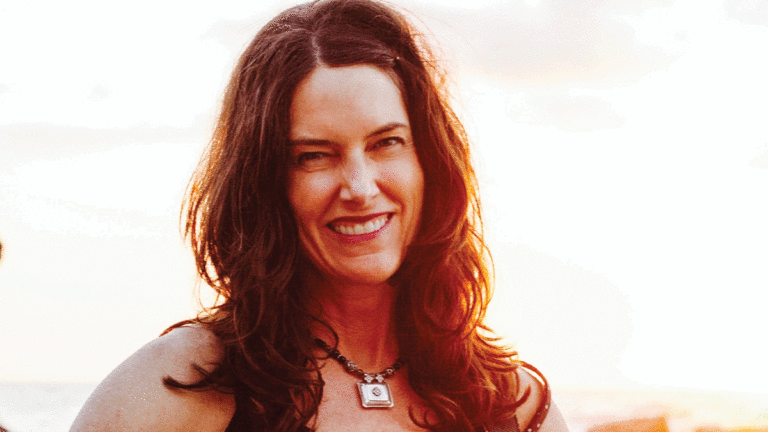
JOYFUL NOISEMAKER Cheryl Anderson has been Cabrillo's Director of Choral and Vocal Studies for 27 years. She will be honored on June 1 as Santa Cruz Artist of the Year. PHOTO: KEANA PARKER
JOYFUL NOISEMAKER Cheryl Anderson has been Cabrillo’s Director of Choral and Vocal Studies for 27 years. She will be honored on June 1 as Santa Cruz Artist of the Year. PHOTO: KEANA PARKER

Raising Her Voice

When I ask her about her famously coordinated look, she admits, “I just love shoes.” Her clothes are chosen to match them, be they the jewel-toned sweaters and skirts—plus sparkly earrings and necklaces—she favors for rehearsal, or the long Oscar-worthy gowns she wears for concerts.

And she is candid about a deeper aspect of her celebrated dress code.

“I was raised really poor,” she says. “And when you were out in public, you always had to represent your family. So it was important to look my best.”

Anderson grew up in a large Pennsylvania family without the expectation of going to college.

“It wasn’t encouraged,” she admits. “There was never an expectation of anything. It became clear to me that I needed a career if I was going to go anywhere.”

Singing with an honor choir in high school opened her eyes. “I realized that you could do music as a career. What an incredible insight. And I just never looked back.”

Her choral music career was nurtured as an undergraduate at West Liberty University in West Virginia, where she met her mentor and friend Alfred deJaager.

“He taught me to be meticulous, patient, and unrelentingly tenacious,” she says. “His work with vowels and phrasing formed the basis of my choices when preparing choirs.”

The pivotal moment in Anderson’s career came thanks to legendary chorale director Robert Shaw. “I was doing doctoral work at the University of Cincinnati. My teacher was a protegé of Shaw’s, and we went to Atlanta to sing with him. It was a life-changing experience,” she says.

Shaw’s legacy is alive and well with Anderson. “I’ve gotten copies of his masterwork scores. I have notes, I have all of his books. Many of us who sang with him still collaborate on Mr. Shaw’s legacy. There was nothing like him,” she recalls with something close to reverence. Her rehearsal techniques—count singing, the refinement of pitch, rhythm drills, emphasis on enunciation—“that’s all Shaw,” she freely admits.

Another key strategy was derived from Shaw, who would move singers around like pieces on a chessboard, not according to vocal parts or height, but in terms of the quality of vocal timbres. In essence “tuning” the chorus to enhance the overall mix. This technique produces distinct and often powerful results, as many of Anderson’s veteran choral members will testify.

Meri Pezzoni, longtime director of Choral Activities at Aptos High School, has performed with Anderson’s Cantiamo group over the past 25 years. “How she trains and mentors her teaching assistants always impressed me. Many of them go on to become choral directors, soloists, and music industry people,” says Pezzoni. “She has an incredible knowledge of choral repertoire and its historical significance.”

Anderson has a clear and supple soprano voice, but insists that she did not have ambitions to be a solo performer. “I always loved to sing, and I did a lot of solo singing, but when I began at the colleges my job was to teach, to prepare others to sing,” she says. Solo singing was “not something I burned to do. I just thought that we were doing this together. And I got to be the one who made the opportunity for the singers.” She considers this work to be an honor and a sacred trust.

“She is a model of very professional behavior,” says DeWitt. “She is always very prepared, courteous to everyone—and she remembers names and faces.”


The Miracle Worker

Music weaves its way into the heart of Cheryl Anderson’s private life as well. Anderson met her husband while she was teaching in Virginia Beach.  “He was Commandant of the Army School of Music based at Norfolk’s Navy Amphibious Base. And they needed a soprano for a production of the HMS Pinafore. So we met singing Gilbert and Sullivan,” she says with a chuckle. “We dated for a long time. I had a lot of projects and he was busy with his job.”

After three years, they married. When he moved back to Los Angeles for graduate work at UCLA, Cheryl went with him.

“It took one concert for me to realize that Cheryl was extraordinary,” says her husband, John Anderson, who is now artistic director of Ensemble Monterey. “When we were first dating, it was her first year of teaching at Shelton Park Elementary School in Virginia Beach. She had these little elementary school children singing in three-part harmony and it was wonderfully musical. That’s just about impossible, and that’s when I knew.”

Calling him “a great husband,” Cheryl describes him as the most resilient human being she can imagine. “There’s no friction,” says John, who also heads up Creative Arts at Monterey Peninsula College. “As a team, I think we are our best critics and best teachers. Cheryl is definitely a brilliant and gifted conductor, but what sets her apart from all the rest is her spirit of kindness, empathy, good humor and love both for the music and the people who make it. Groups sense this immediately—they know at once that they are singing with a one-of-a-kind master.

BELIEVE EVERYTHING YOU HEAR Anderson in rehearsal with Cabrillo Symphonic Chorus. She has been roundly praised for her precise but personable directing style, and her ability to teach and mentor. PHOTO KEANA PARKER

Master Class

Those who have sung with her for years know that Anderson always favors the classical masterworks. “I try to program music with deep integrity,” she says. “If it’s fluffy and has integrity, that’s okay. If it’s just fluffy, then I hate it.”

And she does have favorites. “Bach. Always Bach,” she admits. “The St. Matthew Passion. The B Minor Mass. And The Messiah—it always works. Haydn’s Creation. Monteverdi Vespers. Everything emanates from the great masters. They have it all—structure, harmony, passion, harmonic resonance, the essence of storytelling. You never get tired of it.”

Once they are trained and fine-tuned, Anderson’s choirs have toured all over the world from Cuba to Russia, performed at Carnegie Hall, and collaborated on operatic works at the Carmel Bach Festival. Each season, the community joins her choirs and Ensemble Monterey orchestra members in a not-to-miss performance of Handel’s Messiah, which she describes as “bone-chilling.” Earlier this month, Anderson’s Symphonic Chorus joined the Santa Cruz County Symphony performing Symphony No. 2 by Gustav Mahler.

Anderson also selects contemporary masterworks, and is known for highlighting expressionistic choral pieces by composer Morten Lauridsen, whose friendship with Anderson has brought him for workshops with her students and appearances in Cabrillo concerts. She fearlessly forges into the most ambitious modern repertoire—a new Eric Whitacre opera, Hindemith’s setting of Walt Whitman, Bernstein’s Chichester Psalms, Britten’s War Requiem. All guaranteed game-changers, as she would put it.

Working the Room

One might think the transition from singing with Robert Shaw to working with community members and beginning students could prove frustrating to even the most patient educator. But Anderson won’t hear of it.

“One of my undergraduate teachers taught me that a student failure is a teacher failure,” she says. “It’s my responsibility to get them there. It challenges me to figure out ways to work the interior language of the music.” She arms her choral groups with fundamental musical principles, harmonic language, historical context, and concert etiquette—everything that distinguishes a polished choral ensemble from a collection of enthusiasts.

“She loves the challenge of performing masterworks and brings these works to the chorus with a passion,” says tenor Tom Ellison, who’s sung with the Cabrillo Symphonic Chorus for 21 years. “She expects every choral member to understand the text and story being told. Her standards are very high and she is willing to spend the time to do what needs to be done.”

Toward that end, Anderson can turn herself, and her choral groups inside out learning exact foreign language pronunciations. No vocal sloppiness allowed.

“She dreams big, and then goes for it,” says Deborah Bronstein, a 20-year Anderson veteran. “She has a knack for inspiring people to believe in her vision, and do the work needed to make the vision happen, be it Carnegie Hall or singing in the Vatican or creating a Children’s Choir program.  She also has a strong commitment to developing people to be better singers, teachers, and people.”


Game Changing

Anderson’s goal is to shape a memorable performance. To her, that is “the one that moves the singers, and moves the audiences.” She fiercely believes that “the arts change the world.”

The music director is easily moved just recounting a musical experience—such as her recent visit to LA’s Disney Hall to listen to a choir made up of local homeless singers.

“There wasn’t a dry eye in the house,” she says, blinking back her own tears. She also remembers a Mozart Requiem she led to commemorate 9/11.

“We’d never practiced for it,” she remembers. “I just put out a call for singers to come with their music and we all sang. At the end, no on applauded. There was silence. And tears.”

Anderson attributes her success to her unlimited belief in what her students are capable of. “I believe in people more than they believe in themselves,” she says “I want everybody to continue to grow.”

And if they don’t, she’ll teach them how it’s done.


In a box: Santa Cruz Artist of the Year

To honor Cheryl Anderson as Santa Cruz Artist of the Year, the public is invited to a free gala Profile Performance of Anderson’s favorite music, performed by six of her choral groups: Cabrillo Symphonic Chorus, Cabrillo Chorale, Cantiamo!, Cabrillo Youth Choruses, Il Dolce Suono and Peace Chancel Choir. The performance will be presented at 7-9 p.m. on Friday, June 1, at Cabrillo College, Samper Recital Hall. For more information, go to scparks.com/Home/ArtsCulturalPrograms/ArtistoftheYear.

How Craniosacral Therapy Activates the Body’s Self-Healing

Craniosacral therapist Inna Dagman places her hands around my Achilles tendons and heels, and I am immediately aware of how warm her hands are. In less than a minute the room falls away, along with an avalanche of adult worries. It’s safe to say that I spend the rest of my first-ever craniosacral therapy session on the edge of sleep. My breathing slows and my mind, settling into the cushions of hypnagogia, puts its feet up to watch whatever images and thought segments are offered up by the alpha and theta brain waves that have taken over. I’m in my garden, mostly, and then on the rugged coast above Pablo Neruda’s Chilean home Isla Negra—a place I visited more than a decade ago and had not thought about in years.

Starting and finishing at the ankles, Dagman moves her hand placements, in long intervals of gentle pressure, through various points of the spine, neck and head. There are moments of scalp-tingling pleasure, sure, and the feeling of tension melting away, but make no mistake about it: craniosacral therapy is not massage (though Dagman is a certified massage therapist, specializing in Thai floor massage.) It’s more like a nervous system reboot, if you will, with its hands-on healing roots in antiquity.

“There is such a thing as a craniosacral rhythm, which is separate from the breathing rhythm, separate from the heart rate. And that rhythm is the flow of the cerebrospinal fluid throughout the craniosacral system,” says Dagman. Encompassing various membranes and soft tissues, cerebrospinal fluid, and the bony structures of the spine, cranial bones and sacrum, the craniosacral system is the primary system in our body that encases and protects the central nervous system—whose function is vital to our overall health.

Trained at the Upledger Institute, Dagman has been practicing craniosacral therapy for three years now, and working out of the Westside Healing Arts Center for two. Blockages and “energy cysts,” which we can carry around for years, occur when the body encapsulates accumulations of foreign energy or traumas—physical or emotional—to protect itself. “Those areas in our being have a very different quality to the touch of the craniosacral therapist. So we can find them and then we can hopefully release them,” she says.

Dagman was born in Siberia, where, if a healer was called to a rich household and a poor one simultaneously, the healer would attend to the poorer one first. With that ethos, she often shares her gift for healing pro-bono. Among others, she’s worked with women at the Walnut Avenue Women’s Center who have experienced abusive relationships and addiction cycles, and she traveled to India in 2015 with the nonprofit New Light India to share craniosacral therapy as well as belly dance instruction with women and girls in forced sex work. Her dream next step is to bring craniosacral therapy into prisons.

Dagman sees the body, mind and spirit as inseparable. And while she’s passionate about the modality’s potential for healing spiritual and emotional traumas‚ traversing those realms depends fully on the intent of the client, she says. While craniosacral therapy can address a variety of symptoms and conditions, including pain brought by injury, surgery, and the accumulated stresses of modern day life, it’s also a valuable way to stay healthy, as it nudges the body into a self-healing state. “As practitioner, I guide you, but I am not the one doing it. It is your own wisdom that leads the session, your own innate doctor,” she says.

Placebo or not, the days following my first session are marked by a shift in perception. In an acupuncture appointment the day after, I drop into a relaxed dream state of rest much quicker than normal—and Dagman explains that acupuncture and craniosacral therapy are a common combination. “Because acupuncture works with our energy system,” says Dagman. “Craniosacral therapy in a way makes our energy system more accessible, more open, more ready, so then the acupuncture can be even more potent.”

For those on a healing path, this gentle yet effective technique works well in conjunction with other healing modalities, including talk therapy and other forms of bodywork. “Every human being is perfect wherever they are on their unique journey,” says Dagman. “I’m just there to meet them and see what is there to release. With love—it’s not a personal love, but a complete lack of judgement, complete presence.”


For more information on Inna Dagman’s work, visit wildcreekhealingarts.com.

Satanic Temple’s Santa Cruz Chapter to March in Pride

1

Lana Navalia is used to people asking her about animal sacrifice—in fact, she says, it’s usually the first thing they ask her about. That kind of comes with the territory when you’re connected to a group that goes by the name “Satanic Temple,” and Navalia is one of the leaders of the new Santa Cruz chapter.

For the record, Satanic Temple members don’t sacrifice animals, and they don’t believe in Satan as an actual entity, but as a symbol.

“For us, Satan is a metaphor for the ultimate rebel,” says Sadie Satanas, head of the Satanic Temple of Santa Cruz (TSTSC).

The Satanic Temple is also very different from the Anton LaVey “Church of Satan” that many people associate with Satanism. Rather than LaVey’s message of autocratic, self-indulgent narcissism, the Satanic Temple promotes equal rights for all people and social justice. Established in 2012 in Salem, Massachusetts, Satanic Temple founder Lucien Greaves describes the group next evolutionary step from what LaVey started. The Temple’s embrace of Satan as a symbol seems to come out of its innate sense of pranksterism, as well as its members’ passionate activism around the separation of church and state—like when they trolled Florida Gov. Rick Scott in 2013 over his support of a bill which allowed prayer in school—since the bill didn’t specify what kind of prayers were allowed, school kids must be allowed to pray to Satan, they argued with tongue firmly in cheek, but political aims clear.

Locally, Navalia hopes the Santa Cruz community will think of Temple members first and foremost as good citizens; to that end, TSTSC adopted Seabright Beach through Save Our Shores earlier this month. Beginning Saturday, June 2, TSTSC will spend a year doing monthly debris removal and trash pick-ups.

“We want to show that you can be anyone, not just a Christian, and still be a good person,” explains Satanas.

Santa Cruz, meanwhile, loves an underdog, and commenters took to the internet to encourage the group’s activism posts like “These Satanists sound like super citizens,” and “Thank you for keeping our beaches clean.”

But not everyone was pleased with the news, and some reactions were more typical of news associated with “Satanism.” “Thus, society falls further into oblivion,” one person wrote. “They need to save themselves before they save a beach,” wrote another.

Immediately after the announcement, Bay Area broadcast news organizations KION, KRON and KSBW picked up the story, and Save Our Shores declined to comment to the reporters. However, Save Our Shores Executive Director Katherine O’Dea agreed to speak with GT, saying her group sees it all as much ado about nothing.

“Save Our Shores is an inclusive organization and we have an anti-discrimination policy,” she says. “We met the group and are delighted to have another organization that wants to steward our shores.”

“Let our actions speak louder than the misconceptions,” Satanas says.  

High Profile

Armed with its philosophy of promoting equality and rational thought, and its flair for the extreme, the Satanic Temple—which has 19 chapters in the U.S.—has become famous for its activism around the country. Some are legal actions, like its 2014 crusade to erect a statue of the goat-like occult icon Baphomet next to a Ten Commandments statue outside of the Oklahoma State Capitol—which was really part of the group’s drive to enforce separation of church and state. The Ten Commandments statue was eventually taken down and the Satanic Temple withdrew its application, but a similar battle is continuing in Arkansas.

Other actions are even more fueled by satire, like in 2013 when the Westboro Baptist Church (WBC) announced they were picketing the funerals of victims in the Boston Marathon Bombing to promote their anti-gay agenda. In response, Satanic Temple members went to Mississippi and performed a Pink Mass on the grave of WBC founder Fred Phelps’ mother, to “make Fred Phelps believe that the Satanic Temple had turned his mother gay in the afterlife.”

But here in the more open-minded Bay Area, Satanic Temple members say their fight means coming out of the shadows and into the everyday community.

“Normalizing what we do is a way to fight for our rights in the future,” Satanas says. “People support when they understand.”

The Satanic Temple of Santa Cruz was founded in March, Satanas explains, having originated as the San Jose chapter. Most of their leadership already lived in Santa Cruz, so the relocation made more sense than driving back and forth over the hill.

“We’ve been working on [the beach clean up] project for five months,” she says. “But because of the relocation, everything was put on hold.”

The fledgling group currently has around 15 active members, and their first public meeting will be held on June 2 right after their first beach clean up. They will also participate in this year’s Pride parade on June 3, continuing the tradition from last year when they were the San Jose chapter.  

“I hope it brings more attention to people wanting to clean up,” explains Navalia, who is a Seabright resident. “The beaches are a mess.”

Around here, even members of the Christian community get it.

“I think it’s awesome,” says Greater Purpose Community Church (GPCC) pastor Christopher VanHall.  

No stranger to controversy, Santa Cruz’s GPCC—which is part of the Disciples of Christ denomination that preaches love and equality for all—was a victim of anti-LGBTQ hate several times last year, when vandals stole and destroyed their rainbow flag.

VanHall admits he doesn’t know a lot about the Temple of Satan, but says he respects their stewardship of the Earth. He has even extended them an invitation to Faith On Tap, a biweekly meeting of all faiths where members can grab a few drinks and discuss not only theology, but also local social and civil justice activism.

“Examining what they’re doing—which is what I think Jesus would have us do—it’s amazing,” he says. “If local evangelicals have something negative to say about it-—which I’ve seen a few online—by just looking at what they believe, they miss what Jesus was trying to communicate to the masses.”

Rail Opponents: RTC Is Moving Too Fast With Progressive Rail

[This is part four in a series about future of the rail corridor. Part five runs on June 13. Read Part 1 here, Part 2 here and Part 3 here.]

Tech consultant Will Mayall has been scratching his head, trying to solve a puzzle.

Mayall, who worked for Apple in the mid-1980s, spends much of his time on the phone, giving advice to startups. But over the last few months, he’s devoted more hours to studying the sometimes controversial recent history of the county’s coastal rail corridor, digging through public records on the Regional Transportation Commission’s  informational pages and deciphering how they all fit together.

Mayall serves as a boardmember for Santa Cruz County Greenway, a nonprofit advocating for the removal of the tracks along the county’s publicly owned rail corridor, in favor of an extra-wide bike and pedestrian trail—in opposition to the RTC’s established rail-alongside-trail plan. And Mayall says that the commission, which owns the corridor, is rushing into a new draft agreement with Progressive Rail, a Minnesota-based freight operator, too hastily. He can’t figure out why, he says, but he believes the RTC hasn’t been forthcoming in its explanations.

Mayall worries that the possible 10-year deal with Progressive Rail would shift control of the rail corridor to the company, getting in the way of plans for both passenger service and a possible trail-only solution. Given those concerns, Greenway supporters say they have an important message for the RTC as commissioners get ready to vote on the contract with Progressive on Thursday, June 14.

That message can essentially be summed up in six words: We could do so much better.

If the long-winded rail trail saga were a romantic comedy, the RTC and Progressive would be standing at the altar, ready to get hitched—while Greenway, which has an admittedly strained relationship with the RTC, runs down the aisle yelling “I object!”

Mayall is imploring the commission to offer more of an explanation as to why Progressive is the right fit. After all, Greenway supporters say, the Progressive deal could even prevent the commission itself from getting what it wants.

“They’re not intentionally driving us into a bad place,” Greenway Executive Director Gail McNulty says of the RTC, “but they’re making choices that could lead us there eventually.”

PROG LOCK

Mayall says the RTC has “manufactured a false sense of urgency,” but RTC officials say they’re required to pick a new operator as soon as possible.

Shannon Munz, a spokesperson for the commission, tells GT that because the RTC bought the rail corridor with California bond money, the state will mandate that it continue freight service, per guidelines under the federal Surface Transportation Board (STB).

Late last year, Iowa Pacific, the previous operator, announced its desire to pull out of the agreement, although it still isn’t clear what penalties, if any, the RTC would face should it decide to put the issue of its next freight operator on hold. An STB spokesperson told GT via email that he and his colleagues were unable to answer questions on the matter, as they were too hypothetical.”

McNulty says Progressive could have a big impact on the county, and not necessarily in a positive way. “The biggest standout problem with the contract,” she says, “is that the vision is out of line with what the community wants for the corridor.”

Whereas Iowa Pacific was something of an absentee freight operator, known mostly for storing rail cars, Progressive officials have bragged to county leaders about their ability to get involved in bringing economic vitality to the area. When it comes down to it, though, McNulty fears that Progressive will either fail in its money-making mission—like its predecessors before it—or bring in long trains of cars that will clog the line, making for a noisy, unattractive corridor once the RTC finishes repairing the track to allow Progressive to travel the length of the local 32-mile line.

As the commissioners prepare to vote on the contract, they have yet to receive results from the Unified Corridor Study, which will outline suggestions for the major local transportation arteries—Highway 1, Soquel/Freedom and the rail corridor—and is expected to come out in six months. If the RTC ever tries to introduce passenger rail service on the corridor, which the study may recommend, McNulty says the priority given to freight service could make it difficult for passenger trains to move at an acceptable clip and get anywhere on time.

Dondero, however, says there could be a number of solutions. It’s possible, he says, that the freight service could run at night and that positive train control—a system that automates rail scheduling and is now coming online around the country—is making it easier for train companies to communicate and coordinate schedules. Dondero says this scrutiny is all a distraction from the bigger issue of locals stuck in traffic—especially those driving from the southern portions of the county and who want another way to get to work.

Jason Culotta, Progressive’s public affairs director, says passenger and freight service coexist on railroads around the country, and that the company plans to respect the passenger rail schedule.

APPLIED MATH

Mayall says there’s one other option the RTC could pursue, and it’s called “abandonment”—a process by which the STB lets line owners stop providing rail service if it’s no longer economically viable. If the corridor owner determines that circumstances have changed, they can re-apply to reverse the abandonment.

Before the RTC bought the rail line, a 2010 appraisal referenced a consultant who found that there was “no chance that the STB would deny an application” from the owner to pursue abandonment of the corridor. The appraiser added that, in his opinion, there was no way the STB would ever be profitable north of Watsonville, and he predicted that the RTC would seek to abandon the line immediately, which the RTC ultimately did not do.

The appraiser found that it generally takes three to six months to get approval for abandonment, but he added that the RTC should qualify for an expedited process to speed things up, given that the Davenport cement plant had closed down by that point.

GT reached out to the RTC for follow-up information, and, in an emailed statement, Dondero charged Greenwayers with “cherry picking” information from more than 10 years ago—the 2010 study references findings from 2005—and stressed that state transportation requirements demand the commission continue freight and passenger service.

“Abandonment would not serve our community or our future, and would be entirely inconsistent with the policies of the RTC that have been established and confirmed over many years,” Dondero wrote.   

CONTRACTUAL ORIENTATION

The 28-page draft of the agreement with Progressive Rail is rich with detail.

If the forthcoming corridor study finds that freight service won’t work on the southern portion of the corridor, for instance, Progressive would be released from the 10-year contract, and the RTC will be required to pay Progressive $300,000. Bike advocate Ron Goodman, who wrote an analysis breaking down the contract on his website bikeadvocacy.org, argues that this clause creates a conflict of interest that undermines the study.

Dondero says the arrangement boils down to the cost of doing business. “The reason for that is that it costs them money to set up shop here. They have to lease locomotives and hire people and set up an office. There’s a lot of work that needs to happen before they even move one car,” he tells GT.

The contract also prioritizes freight service over passenger rail service.

There were other elements that raised eyebrows in the 28-page contract, like construction of a possible locomotive pit in the area around the Wrigley building in Santa Cruz. The contract additionally mentions a provision allowing the freight operator to store up to 100 cars on the corridor at any given time, each in designated zones, and none for more than two months. Each of those passages is a holdover that the RTC had negotiated into the previous freight agreements.

Iowa Pacific had been parking cars outside the designated corridors, Dondero says, which was one of the ways it was in violation of its contract. Progressive owner and president Dave Fellon has said his company’s “not in the business of storing cars,” but that they may do it for a day or two here or there, as their customers request it.

As for the locomotive pit, Progressive representatives have announced that they want to remove the wording about the locomotive pit from the contract. “It was a feature of a previous agreement that the RTC had had,” says Culotta. “The reason they had it in there was they had a goal to keep a locomotive there that could be used to switch out cars. Since Progressive Rail has no intention of storing cars, we’re happy to have that removed from the wording.”

If Progressive comes in, Culotta says the majority of Progressive’s freight customers would be local farmers, who could ship produce to other parts of the country—reducing their greenhouse gas emissions and potentially their costs, as well. He anticipates some of Progressive’s existing customers from the Midwest will also have an interest in expanding to California.

Progressive has additionally discussed hauling propane into Watsonville, creating some concern there. It isn’t clear how much Watsonville officials would be able to regulate the unloading of propane or other materials because of federal guidelines, according to a memo from the Watsonville city attorney to the City Council.

As things move forward, the previous freight operator casts a long shadow over the line, as Iowa Pacific still owes the RTC about $80,000. Dondero won’t be holding his breath or waiting for a check to come in through the RTC’s mail slot.

“When a check comes in, I’ll give you a call,” Dondero says. “I haven’t seen any money.”

Michael Pollan Comes to Santa Cruz With New Book on Psychedelics

Bestselling author Michael Pollan wishes he did more LSD

Pollan, who has written five New York Times bestsellers, including The Omnivore’s Dilemma and The Botany of Desire, is a self-proclaimed “reluctant psychonaut.” Aside from growing a couple of cannabis plants and eating just enough mushrooms to make him giggle, Pollan was a psychedelic rookie when he recently began his own experimental journey with his new bestselling book How to Change Your Mind: What the New Science of Psychedelics Teaches Us About Consciousness, Dying, Addiction, Depression, and Transcendence.

Born on Long Island in 1955, Pollan was just young enough to miss out on the Summer of Love and Ken Kesey’s Acid Tests. Mostly thanks to the period of drug paranoia that followed the counterculture era, Pollan says that the wild tales about the dangers of LSD (it’ll make you blind or crazy, probably both) were enough to make him steer clear. But when he actually took LSD for the first time at age 60, he was nervous about his heart—having experienced an AFib the night before—and decided to lower the dosage just in case.

“Had I been sufficiently relaxed to take a bigger dose, I think I would have learned more,” he says.

Having written about food and agriculture for the last 30 years, How to Change Your Mind is a somewhat risky departure for Pollan. After writing a piece for the New Yorker on the successes of psychedelics research in 2015, his interest in psychedelics mushroomed.

It’s a controversial topic, and it’s Pollan’s own experiences that bring the book to life. He lays it all out there, confronting mortality and ego, the very inner workings and meanings of his own trips and thoughts. Besides a new perspective and another best-selling book, Pollan also earned himself a new label, courtesy of the New York Times: a “giant square.”

“Well, that I object to,” he says with a laugh. “I guess if you are a reluctant psychonaut, that equals complete square—or partial square, perhaps.”

Pollan isn’t exactly an obvious candidate to write about psychedelics, so how did he go from writing about diet, agriculture, and the world’s most delicious backyard barbecue, to tripping? He says it’s all relative. It’s not that he’s only interested in food and nutrition, but rather wellness and nature in general—and he sees psychedelics as a part of that.

How to Change Your Mind delves into the world of psychedelics as healers of anxiety, depression and addiction by, among other things, silencing the ego. Through the scope of Western medicine, he explores the science behind the experimental renaissance of LSD, psilocybin (the active hallucinogenic ingredient in mushrooms) and MDMA. Pollan recites the lengthy and tumultuous history of LSD, mistakenly invented by Albert Hofmann in 1938, and profiles some colorful characters who are willing to risk everything to support and prove the therapeutic usage of psychedelics—including a Bavarian revolutionist LSD guide and a Lorax-like mushroom forager.

“What you are doing in a high-dose psilocybin or LSD trip is allowing your ego to dissolve, which means you are putting down your usual defenses,” Pollan explains. “These defenses are important to our survival—they give us a sense of security in the world. So to relax those or put them down entirely is an incredible act of surrender and trust.”

Trust was a big factor for Pollan. After all, while his mind wandered, he was leaving his body in someone’s care—someone that didn’t want to get in trouble with the law if anything were to go awry. Pollan wanted to make sure that if something did go wrong, the guide wouldn’t just “bury him with all of the other dead people” (a quote directly from a guide he interviewed, no less).

Pollan ended up with a few pre-vetted guides to help manage his larger doses and conscious reconciliation, and worked his way through LSD, psilocybin, ayahuasca and “the toad” (scientifically 5-MeO-DMT, the smoked venom of a Sonoran desert toad) during his experimental phase—not bad for a middle-age rookie.

“Change in the adult mind does not come easy,” Pollan says. “Psychologists will say that personality is really set by your early 20s, and doesn’t change very much. But there is some evidence that on psychedelics it can change, especially around the personality trait of openness.”

Aside from challenging his ego and mental state, Pollan says his experiences were particularly difficult to recount. He found himself up against an ineffable wall—how do you explain something that doesn’t have tangible existence?

“As a journalist, we are really boxed in by reality. We want to tell cool stories, but they have to also be true, and sometimes the facts screw up the narrative,” Pollan says. “So here I was writing about this imaginative space that was in my head and I had a lot more freedom than I normally do. No one is going to fact check a trip report—if you thought it happened, it happened.”

Despite his innate scientific approach, Pollan is remarkably aloof about it all. Since his trips, he has talked openly with his 25-year-old son about his psychedelic use, and is more patient and attentive, particularly with regard to the recent death of his father, according to his wife Judith.

“I really do feel that talking about it in a matter-of-fact way is the beginning of having a more productive conversation about this,” Pollan says. “It gets us out of the usual frame of the drug war of the ’60s.”

Though he is clear that he is not an advocate for widespread use of psychedelics, he proves that in the medicinal usage of psychedelics, there’s much more than bright colors and wonky lines.  

But Pollan is a “healthy normal”—an able-bodied individual not facing any immediate life threats—and although he is interested in how psychedelics can help people like him, too, he places particular emphasis on those who face terminal illness, clinical depression and addiction. New York University, Johns Hopkins, UCLA and Santa Cruz-based Multidisciplinary Association for Psychedelic Studies (MAPS) are at the forefront of this research and experimentation into illicit drug benefits, picking up where Timothy Leary left off.

Pollan says he was particularly taken by the amount of stories and personal experiences people were willing to share with him. In fact, so many people wanted to tell their stories, Pollan created a submission database with the help of Medium. So, if you have a pretty trippy story to tell, they are taking submissions.

“I realized that a lot of people have a story to tell, and they haven’t felt comfortable telling it for one reason or another, partly because there is such a stigma,” Pollan says. “Here I come talking about psychedelic trips in mainstream media and it licenses people to take these trips out of the box that they have been keeping in the attic for a very long time.”

In Pollan’s bestselling The Omnivore’s Dilemma, he coined the instruction to “Eat food. Not too much. Mostly plants.” Though, as he admitted to NPR’s Terry Gross a few weeks ago, some have amended the phrase to “Do drugs. Not too much. Mostly psychedelics.” He’s quick to explain that he’s not particularly thrilled about that rendition.

“Many people have a set view that psychedelics can make you crazy, and I am encouraging people to see that, yes, there are psychological risks, but these are drugs that can make you more sane,” Pollan says. “That will take a change in mind in the culture, but I think that we are well on our way down that path. “


Michael Pollan is coming to Santa Cruz to talk about ‘How to Change Your Mind’ on Tuesday, June 5. 7 p.m. Peace United Church, 900 High St., Santa Cruz. Ticket packages are $33 and include one copy of ‘How to Change Your Mind.’ For more information about the event, visit bookshopsantacruz.com.

Point Market’s Cali Burrito On Pointe

Point Market
A heavenly, harty combination that includes seasoned French fries

Rob Brezsny’s Astrology May 30-June 5

Astrology, Horoscope, Stars, Zodiac Signs
Free Will Astrology for the week of May 30, 2018

Gemini – Bright Shiny One: Risa’s Stars May 30-June 5

risa's stars
Esoteric Astrology as news for week of May 30, 2018

Allegretto Vineyards’ Rosé of Tannat

Allegretto Vineyards
Rosé of Tannat 2016 features notes of anise, cinnamon and red cherries

Film Review: ‘Beast’

Beast
Psychological thrills to spare in dark, edgy ‘Beast’

Why Cheryl Anderson is Santa Cruz Artist of the Year

Cheryl Anderson, Artist of the Year
Director of Cabrillo Choral and Vocal Studies has been raising voices for decades

How Craniosacral Therapy Activates the Body’s Self-Healing

Craniosacral, Inna Dagman
Craniosacral Therapist Inna Dagman explains how the modality works as a preventative and healing measure

Satanic Temple’s Santa Cruz Chapter to March in Pride

Sadie Satanas, Lana Navalia, Satanic Temple’s Santa Cruz chapter, Seabright
Adopting Seabright State Beach, these do-gooders want to be seen as model citizens, not devil worshipers

Rail Opponents: RTC Is Moving Too Fast With Progressive Rail

Greenway Gail McNulty
Commission says state and federal rules require to pick new freight operator quickly

Michael Pollan Comes to Santa Cruz With New Book on Psychedelics

Michael Pollan
‘How to Change Your Mind’ explores the history and renaissance of the medicinal use of psychedelics
17,623FansLike
8,845FollowersFollow