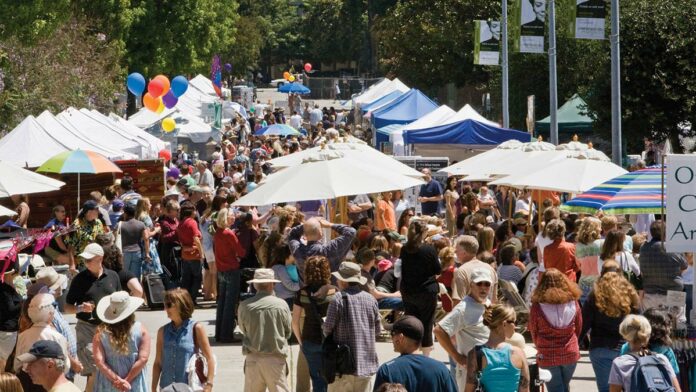

A small group of cyclists pedal past pedestrians who are chatting at the outdoor seating area of a Soquel Avenue cafรฉ on a Friday evening. The bikers whiz past traffic toward a bustling corner of Seabright Avenue, where a small grocery store takes up the ground floor of a new four-story apartment complex, with a community garden in the back and a car sharing station in the basement, filled with an eclectic mix of Santa Cruz locals and twenty-somethings.
The year is, letโs say, 2040, and in this scenario, the Santa Cruz Transit Corridor Zoning Update has been in place for a couple of decades, incentivizing what planners call sustainable or โsmart growthโ up and down the cityโs thoroughfares. The image is a rough sketch of what many city leaders hope to accomplish with a new corridor update for streets like Soquel Avenue. Along the way, cyclists are parking their bikes to stop in at boutiques and cafes that line the street.
โItโs so good for small business,โ says Peter Kennedy, a Santa Cruz planning commissioner, of the corridor plan. โThis whole parking lot mentality is old news, but you go down Soquel [today], and thatโs what you see: the Ford dealership, the Nissan dealership. Itโs still very much built on that auto row mentality.โ
The basic idea behind the corridor plan is simple: Encourage taller, denser buildings, retail, and housing development along the cityโs four biggest streetsโMission Street, Water Street, Ocean Street and Soquel Avenue.
Kennedy says the city is bound to grow no matter what, and the corridor plan offers the city a way to grow with a smaller carbon footprint. It encourages apartments in pedestrian-friendly areas with access to transit routes, and it should have less impact on quaint residential neighborhoods. As people of all ages get priced out of Santa Cruz, he feels, the plan is the best way to meet the cityโs housing demand.
โWe need more businesses for economic growth, and more housing, so that younger people can afford to live in this town,โ says Kennedy, who also serves on the Corridor Advisory Committee. โSimultaneously, we all face horrible traffic. Thatโs the trick with that. Yep, weโre going to continue to have bad traffic, and we still need to make small apartments, so that those kids who come out of UCSC with a great idea can actually stay here, do their startup and bring the money home to Santa Cruz. Itโs so hard for people to get in here housing-wise.โ
Growth Spurt
Candace Lynn Brown stands behind a camcorder on a tripod at a recent Corridor Advisory Committee meeting, swiveling the camera from the Power Point presentation to the commission to the audience.
Brown, a resident of Santa Cruzโs East Morrissey neighborhood, has been sharing the videos to get the word out about the plan. She worries about what it will do to parking and traffic around Soquel Avenue, a few blocks from her home.
The pros and cons of the issue are complex, Brown admitsโfor instance, her property values could climb if intersections on the Eastside and in Midtown became hubs of activity.
โBut then you look at the density implications, wondering whatโs that going to do to the neighborhoods, because theyโre very well established,โ she says. โAre people going to stay in these neighborhoods? Some of these units are 700 or 400 square feet. Theyโre very, very small. You might live in it for a few years, or you might even try to rent it, but itโs not going to have the established feeling of the neighborhood that is there now. Itโs going to have a big impact. And Iโm not just talking density, Iโm talking just in terms of community.โ
The basic idea behind the corridor plan is simple: Encourage taller, denser buildings, retail, and housing development along the cityโs four biggest streetsโMission Street, Water Street, Ocean Street and Soquel Avenue.
Then, Brown says, there are the traffic woes. Already, cars inch along during rush hour in her neighborhood. On Friday afternoons, the traffic along Soquel Avenue grinds to a gridlock-like crawl, just as the traffic on Ocean Street does every weekend from Memorial Day through Labor Day.
Brown notes that three of the four planned corridors are east of downtown, and worries that the Eastside would bear the brunt of new development under the corridor plan, which is slated to go to the cityโs planning commission next, and then the Santa Cruz City Council. She would rather see more new housing be on the Westside, close to UCSCโa notion that others are quick to bring up at public meetings.
โI want to bring up the concept of fairness,โ Deborah Marks, who lives near Ocean and Water streets, tells the Corridor Advisory Committee. โIf you have a neighborhood, like mineโsingle family homesโand we get surrounded because weโre near two corridors, itโs really going to be hell. And all the parking permits in the world arenโt going to help.โ
If city leaders do decide to incentivize building vibrant Eastside corridors, Brown would like to see them also put in ample parking structures, as planners did in Old Town Pasadena in Los Angeles County. No matter what, sheโs worried about growing in a community that already teems with tourists for more than a quarter of the year.
โWeโre like a balloon. We double in the summer. We have to have a little bit of room to breathe,โ Brown says of Santa Cruz, packing up her tripod as people filter out of the meeting. โWhatโs going to happen if itโs full all the time? And then the tourists come in.โ
Size Matters
Santa Cruz city planner Michelle King takes the microphone to open up the fifth Corridor Advisory Committee meeting. Itโs late March, and afternoon light floods the Louden Nelson Center Room, almost making silhouettes of the 12-person committee.
โThis is a start point, not an end point,โ says King. โBut we wanted to start somewhere and hear peopleโs thoughts.โ
To build one parking spot costs more than $15,000-$35,000, once you factor in construction, labor and land, according to planning experts like John Swift, a Santa Cruz developer who serves on the committee.
During the meeting, Sophie Martin, an urban planning consultant, explains the differences between the four main land-use designations that are scattered across the cityโs four corridors. The committee discusses how large the buildings should be, and how big they should appear to neighbors and people on the street. The plan is to bring newly constructed buildings 4 feet farther from the curb, allowing more space for pedestrians on the sidewalk. Upper stories will start even farther back from the curb to allow for a greater sense of space.
During the presentation, audience members, many of them Eastside neighbors, raise their hands with questions, and Martin, who works with a San Francisco-based firm, pauses to answer each, one by one. King chimes in occasionally, offering to chat with neighbors about how a certain provision might affect their area.
At times, the meeting is tense and at other times, heated. At one point, when several committee members take turns talking about the importance of affordable housing, one woman storms out of the room, calling the discussion โbullshit.โ
The planโwhich was borne out of the 2030 general plan passed by the City Council four years agoโwill call for consolidated development on certain โnodes,โ major intersections stretching from the Westside Safeway to Soquel and Seabright avenues. Another 1.5 miles farther east, where Soquel Avenue crosses Highway 1, turning into Soquel Drive, the corridor enters unincorporated Santa Cruz County, where county planners have a similar, albeit less ambitious corridor plan called Sustainable Santa Cruz County.
King says that with new construction buildings along the corridor, the changes could require developers to get creative.
โIf youโre near a bus line, could you build an affordable unit with less parking? But then you also have to think: What kind of impact does that have on the neighborhood?โ King tells GT. โThat incentive might have a negative impact on the neighborhood. So, you have to balance those things out.โ
To build one parking spot costs more than $15,000-$35,000, once you factor in construction, labor and land, according to planning experts like John Swift, a Santa Cruz developer who serves on the committee.
Several committee members and King have said that permit parking would be the best way to protect neighborhoods from an onslaught of new cars, but neighbors balk at having to buy permits, which typically cost $25 annually per car. The committee will revisit parking discussions at its next meeting on Monday, April 18.
Swift stresses that the general plan has already outlined Santa Cruzโs shift toward more densityโa component of goals to lower greenhouse gas emissionsโand says that density creates more interesting communities.
โDo people go on vacation to Stockton or to Modesto? Some people do. Iโm not trying to bash those places,โ he says. โBut do they go to Paris? Do they go to New York? Iโm not saying weโre going to make a big city, but we have that vibrancy downtown, a mix of uses. Those kinds of place are more exciting to live in, as well as visit.โ
Swift says it has always been difficult to get good housing built in Santa Cruz due to a combination of red tape and neighborhood uproar. Heโs โhopefulโ but skeptical that the plan will change anything. He says that building small units for people who can live without a car is the best way to build affordable housing without any government subsidies.
Part of the appeal of the corridor plan for some supporters is the opportunity for a vital corridor filled with new bike infrastructure for all residents to enjoy. But at the same time, Kennedy wants to be realistic about what kind of shift is really possible.
โThereโs great enthusiasm about people biking everywhere. Eh โฆ Iโm a car guy,โ says Kennedy, who drives a Nissan electric LEAF. โWhat are you gonna get?โ16 percent of people [riding], maybe 20 at the most? Thatโs great, letโs do that. But certain people are still gonna need a car. Itโs not like this is going to solve all that. I think it will make it better. Itโll give developers much more flexibility in how they provide parking.โ
Kennedy is sitting down with GT for a latte at Fins Coffee on Ocean Street. He notes that the corridorโs model housing isnโt hard to find, as he spins around in his chair and looks out the window and across the avenue at 1111 Ocean St.
Itโs a small housing complex with a Southwestern feel, green balconies and planter boxes sitting on top of offices and retail on the ground floor. โRight there. Multi-story residential above commercial store fronts,โ says Kennedy, whoโs wearing a Stone Brewing T-shirt from a trip to San Diego last year. (The corridor plan, when finished, should allow for a project that is a couple of stories taller.)
Swift stresses that the general plan has already outlined Santa Cruzโs shift toward more densityโa component of goals to lower greenhouse gas emissionsโand says that density creates more interesting communities.
Kennedy works as a project manager for Bright Green Strategies, a company based just off Ocean Street that helps buildings earn environmental certifications. Building something in a walkable neighborhood, he says, is a big plus.
Engineers, Kennedy explains, like to talk about โthe triple bottom lineโโpeople, profit, planetโreferring to something thatโs for the world, good for business and good for community, health or a variety of other reasons.
Some details have yet to be ironed out, of course. King has been talking to affordable housing advocates about the best ways to incentivize affordable housing. Many neighbors are also nervous about what the street design might look like along the corridors, another item that the committee is still discussing.
โPeople who are building are going to make a profit,โ Marks, one of the neighbors, said at the March corridor meeting. โTheyโre going to make a lot of money. I think they have a responsibility to make something that coexists with the feeling of the community.โ
Kennedy says that many developers may help to pay for neighborhood improvements, in order to get the community on their side, just as Safeway did in the side streets off Mission Street when the grocery chain remodeled its Westside location. He says neighbors should come forward and say what they want, so that city leaders can work it into the plan. For instance, traffic circles, speed bumps and permit parking on side streets, he says, could all lessen the corridor planโs impact on local neighborhoods.
Kennedy, whose late father Scott Kennedy twice served as mayor, in the 1990s and 2000s, learned about the art of compromise from having a little politics in the family.
โWhat did dad used to say? โThink of the person you agree with the least and think of just one thing they would want that you could fit into the solution,โโ Kennedy says. โThatโs such a nice way to look at it, because youโre never going to make everybody happy.โ
The sixth Corridor Advisory Committee meeting will be at 5:30 p.m. Monday, April 18 at the Louden Nelson Community Center. The meeting will cover topics like zoning changes, parking and open space and landscaping.