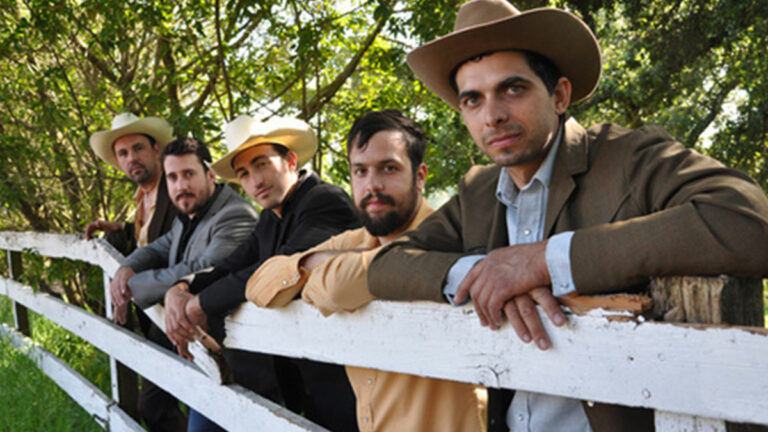
Described as hard-drivin’ California honky-tonk, Miss Lonely Hearts is a staple of Santa Cruz’s thriving roots and country scene. But where some acts might be content to strum guitars sweetly while singing tender tunes of love and loss, MLH grabs life, liquor and love by the horns and emerges with a rebel-rousing sound that sets dance floors rocking deep into the night. As Devil Makes Three’s Cooper McBean has said, “Will they drink you out of house and home, dance with every lady in the house, and wear nothing but snow pants while they do it? You just never know what might happen when these guys come to town.” This show is a double album release party, along with the Carolyn Sills Combo, and also features the McCoy Tyler Band. INFO: 9 p.m. Friday, May 27. Catalyst, 1011 Pacific Ave., Santa Cruz. $12/adv, $15/door. 423-1338. WANT TO GO? Go to santacruz.com/giveaways before 11 a.m. on Friday, May 20 to find out how you could win a pair of tickets to the show.
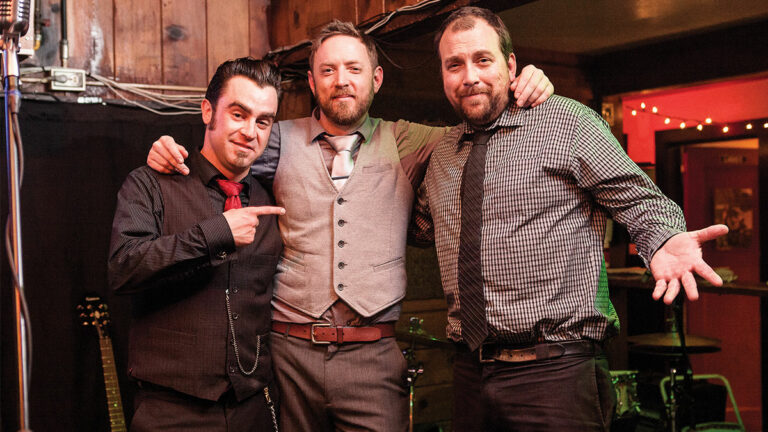
“After our first gig wearing ties, it was amazing how differently we were treated,” recalls Olde Blue frontman Yeshe Jackson. “People just parted ways when we were walking through, like, ‘Oh, you must be official.’ The bouncers waved us right through, the bartender said, ‘Oh, you guys are the band, you need some drinks?’ At the end of the night the owner got us our check right away … everything just went so smoothly.” The three members of the Santa Cruz band now adhere to a formal dress code, but their commitment to professionalism extends beyond the uniform. “We’ve really learned how to work with club owners,” says drummer Marcus Thayer. “It’s not just about us, it’s a partnership; when we were teenagers it was like, ‘This is it! This is our show!’ But if we’re not playing in concert halls, we’re going to work with the venue—get people drinking and having a good time.” Inspired by the Blues Brothers, their style and attitude match their classic sound. Influences include Howlin’ Wolf, Muddy Waters and Buddy Guy, and any given set features several covers, but always with a twist. “We tend to play all the old blues covers with a little more energy. The slapping stand-up bass gives our songs a more upbeat feeling, an almost rockabilly vibe,” says Jackson. Their own sets range from lively to laid-back, making Olde Blue a natural fit for restaurants and brew houses—or, as Jackson puts it, “Anywhere people are drinking.” Bassist Morgan Monticue agrees: “Exactly. There’s nothing too complex about the music we’re playing … It’s a good drinking, good foot-stomping time.”
INFO: Olde Blue plays every Tuesday night at Hoffman’s Bistro downtown. 1102 Pacific Ave., Santa Cruz. Free. 420-0135.
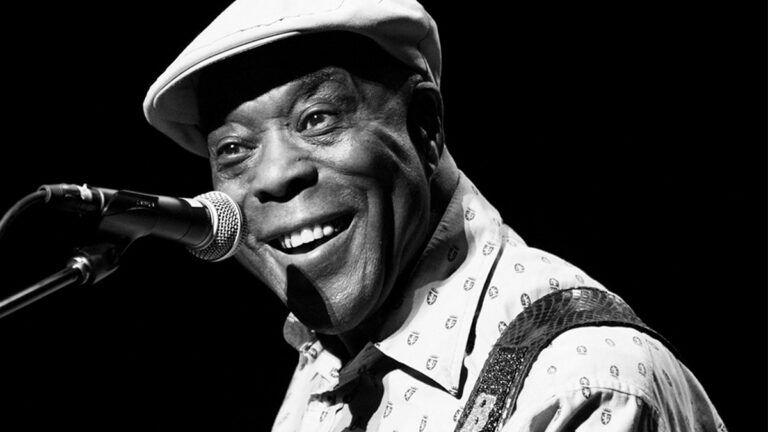
Buddy Guy is worried about the future of the blues—and with good reason. So many of the pioneers of the American-born-and-bred music have died—generations of legends who brought the music from the cotton fields of the South to Chicago’s electric avenues have stepped off the stage for good, and Guy wonders who will mentor the next generation. That’s one of the reasons he’s on a national tour with Jeff Beck, his 80th spin around the globe. On Memorial Day weekend, he makes a major solo stop at Santa Cruz’s second American Music Festival, where Guy is the headliner of Saturday’s blues day. The line-up for that day offers a look at the past and the future of the blues. Sunday does the same for country and roots music, showing off artists who have their feet planted in the soil sown by Hank Williams, Waylon, Willie, Merle Haggard, and Johnny Cash, but are taking things into a new century. “You go to sleep and you wake up and I looked around and I’m saying, ‘My God, Buddy,’ after B.B. passed last year and we lost a couple of great ones, now, British and American musicians,” Guy says in Ernie Ball’s “Pursuit of Tone” interview series. “I look around and I say, ‘Oh shit, you’ve got to keep it alive as long as you can. Hopefully I can introduce some other young persons who can carry along a little more than what we’ve been doing.’” He wants people to see how it was done and how it should be done, and he wants to mentor new musicians, as he inspired many in the past who became legends themselves, including Jimi Hendrix, Stevie Ray Vaughan and Billy Gibbons. “It’s harder to carry on now, because the young persons are looking for a role model. They don’t say they want to be like Buddy Guy. They say, ‘Who is that?’ And I can’t blame them for that. My kids didn’t know who I was until they got 21 to come in a club.” And he’s not the only one who has been thinking about these things. “We talked about this with every one of these guys who are no longer with us. We used to joke and say, ‘If I go before you, don’t you let the blues die,’” says Guy. Last year, Guy recorded his 28th album, one that does just what those late legends hoped he’d do. Born to Play Guitar isn’t some nostalgic look back propped up by guest stars, as some performers have been known to do in their later years. It’s got guest appearances by Billy Gibbons, Joss Stone and Kim Wilson, but they are only seasoning for the main course. It is an absolutely contemporary, crisply written album with themes that include politics and the economy, the loss of blues stars B.B. King and Muddy Waters, and some of the usual blues fare; lost love, cheating women and men, smoky nights, and cheap whiskey. “And now they’re selling water, I drank water from a creek/ Someday they are gonna sell us the very air that we breathe,” he sings on “Crazy World,” with an echo and blistering guitar that would make Jimi proud. “It’s a crazy world/Oh it’s a crazy world/You can lay your money down and win every bet/But the tax man’s gonna take half of what you get/Politicians spend millions trying to get your vote/But everybody knows, they’ve already bought your soul/People killing each other in the name of the lord/No one wants to stop a moneymaking war.” The disc, which won a Grammy in February and a Blues Music Award earlier this month for Best Blues Album, answers the question of how you keep the blues alive: you write about what matters to people now. Buddy Guy: Philidelphia 1969
Tin Picking
That’s something Guy has been doing since he started recording in the 1950s. Born George “Buddy” Guy in Lettsworth, Louisiana, July 30, 1936 he grew up playing a homemade two-string instrument made of wire and tin cans. In the 1950s he was working days as a custodian at Louisiana State University, and playing at nights as a sideman for John “Big Poppa” Tilley, where he overcame stage fright and began to take on the larger-than-life persona that breaks through the fourth wall in his shows today—which almost always feature a trip through the audience while he solos and maybe a stop at the bar or a climb on top of it. That’s a trick that he started in 1958 in Chicago, where he made a name for himself in the 508 Club, where his trips around the room were aided by a 100-foot-long guitar cable, replaced today by a wireless system. He had a small hit in 1960 with the song “First Time I Met the Blues,” but spent most of the decade touring clubs and backing up bigger artists such as Muddy Waters, Howling Wolf, Koko Taylor, and Little Walter. His reputation and influence spread, as British rockers from John Mayall to the Rolling Stones paid homage to Chicago blues. In 1970, he was on the magical drug- and alcohol-filled train tour of Canada documented in the movie Festival Express, featuring the Grateful Dead, Janis Joplin, the Band, Delaney Bonnie & Friends, and the Flying Burrito Brothers. If you really want to treat yourself to some living history, check out some of the online footage of Guy’s performances and see the scrawny, fired-up guitarist laying down jams that still hold up 46 years later. He spent two decades touring and recording with harmonica player Junior Wells, forming a blues super group. Finally, in 1989, a tour with Eric Clapton led to a record deal with the Silvertone label and a breakout hit album, Damn Right, I’ve Got the Blues. It had guest performances by Clapton, Jeff Beck and Mark Knopfler, but the standouts were Guy’s own penned songs, including the title track, “Too Broke to Spend the Night” and “Remembering Stevie,” for Stevie Ray Vaughan.
At the Bar with Buddy
Around the same time, he opened a club in Chicago called Legends. I was lucky enough to spend the better part of a week there with Guy, waiting for a promised surprise set by the Rolling Stones. They never showed, but I got to see the real Guy, who was as at home tending to the details of his club as he is being a superstar on stage. We sat at the bar together every evening, before the crowds came in, looking up expectantly every time the door opened. The Stones were starting their 1997 Bridges to Babylon tour in the city and played another club, the Double Door, but had sent word they may also play Guy’s. He shrugged it off when they didn’t show, but he said he was hoping they would. Guy’s career—and the blues—were on the upswing in the ’90s. He put out a series of rootsy blues discs, including 1993’s Feels Like Rain and 2001’s return to his southern roots, Sweet Tea. Now he’s one of the last men standing, but drawing crowds not because of his longevity, but because he still brings it. He headlined what was then called the Santa Cruz Blues Festival in 2010, and San Jose’s Fountain Blues Festival in 2007, and the thing that got me as a listener was the tone. Not just Guy, but his whole band took me to another place, Heaven’s Roadhouse, where blues really mattered—and was the only thing that did. The kind of sound dripping from the bass, drums and guitar, I have heard only a few times in my life. If it were barbecue, it would be authentic Chicago smoky meat with thick drippings, making almost everything else taste like Arby’s. I played his new album for my girlfriend who says she hates the blues, and she was smiling and bouncing her head. “This sounds like a new album,” she said. “Not blues.” And there’s a sign that Buddy Guy is doing what he was meant to be doing: spreading the gospel of Muddy, B.B., Walter, Junior, and the rest. He sums it up in the last line of Born to Play Guitar, on the song, “Come Back Muddy”: “I’m keeping your promise that I will keep on playing. I miss you, Muddy.”
When I think about how I misjudged last year’s Santa Cruz American Music Festival, formerly the Blues Festival, I have to laugh. I was one of the people who was dreading Sunday’s show, which skewed country rather than blues. I figured I’d give it a try and leave early if I hated it. But it turned out that Sunday featured my two highlights of the weekend: Kellie Pickler and Ryan Bingham. I wrote off Pickler, an American Idol alum, figuring she would be too commercial for me to stand. To my shock, she was one hell of a soulful and rocking singer, who brought to mind Janis Joplin. Mind blown. Bingham was a singer/songwriter who reminded me of John Hiatt, Ryan Adams or the Band. Despite the fact that he was on the “country day,” he could have played the blues day and fit right in. That’s what festival booker Phil Lewis is striving for. Most people, he says, have broad tastes that include all sorts of influences. So does the current crop of country musicians, some of whom fall into subgenres like “bro country”—which includes influences of electronica, hard rock and hip-hop—and “red dirt country,” which is sort of indie outlaw music. The festival changed from strictly blues last year and Lewis sees the future as a three-year plan, figuring the country day will be as popular as the blues day in years to come. Last year, it wasn’t, and he heard a lot of complaints from Santa Cruzans who had attended the Blues Festival over its 21-year run. “We’re trying to appeal to a wider audience,” says Lewis, who was one of the Blues Festival’s founders. “We’re doing it in a segmented way. We want to pay homage to the blues heritage with a straight blues day, like we’ve done for 23 years. But we want to stretch out.” He’s counting on word of mouth to boost the country day and figures it might take three years to catch on the way the blues festival did. Last year they padded the day with Los Lonely Boys, an act that would appeal more to blues fans. This year, it’s all modern country—but not the slick kind. Headliner Josh Turner has one of those deep baritone voices that sounds like it should never be able to make commercial hits—but it does. He’s got a voice that resembles another unlikely baritone, Johnny Cash, and is joined on his songs by the likes of Ralph Stanley and Dolly Parton. It’s new country with old cred. Josh Turner headlines the American Music Festival on Sunday 5/22 “When I grew up as a cowboy, I listened to Waylon and Willie and Merle Haggard,” says Lewis. “But then, after Garth Brooks turned things toward pop, I dropped out.” But Lewis has come back, because the new country goes back to authentic roots. And, he says, it appeals to fans in their 20s and 30s. “To me, when I listen to music, there’s a certain sound that just clicks. It’s hard to put your finger on it, but you can hear when music is genuine and when it’s not,” says Lewis. “That’s how we choose the music for the festival. It has to ring true.”
The Lineup:
Saturday
Buddy Guy: Current King of the blues. Need we say more? Trombone Shorty: The New Orleans’ trombonist’s fourth appearance at the festival. He started as an unknown opener and is now an international celebrity. Robert Randolph: Gospel meets pedal steel. Music is a religion and Randolph’s sinuous slides lift you skyward. Indigenous: These Native American blues players sound like they are from the tribe of Stevie Ray Vaughan. Carolyn Wonderland: This Texan’s third time at the festival. She plays like Bonnie Raitt, sings like Janis and is a downhome star.
Sunday
Josh Turner: The fact that this God-inspired scrapple-voiced baritone from South Carolina is a star brings hope to the modern country scene. He sounds too pure to be commercial, but he’s selling without selling out. David Nail: This Missourian’s vocals have that twang, but the music behind them borders on indie rock with some Bob Seger or Springsteen thrown in. Granger Smith with Earl Dibbles, Jr: This Texan channels indie rock hooks for really catchy tunes. Dibbles adds some heavier metal, sort of like Kid Rock meets AC/DC. Canaan Smith: Though he’s probably best-known for appearing on The Amazing Race, his second single “Love You Like That” is a better sampling of this Nashville singer-songwriter’s talent. Brodie Stewart: Country meets Aerosmith. This dude rocks. He’s from the Bay Area and Sacramento (say what?) but spent summers in Red Bluff. Had to get that country somewhere. Don’t miss him. Leaving Austin: They aren’t Texans. Austin Machado and his outfit are more countrified Californians hailing from Visalia. They look like a tattooed punk rock ensemble, but play fresh partying new country.
INFO: Santa Cruz Music Festival is Saturday and Sunday, May 28 and 29. Adult tickets are $65/general, $100/gold circle for a one-day pass. More info at santacruzamericanmusicfestival.com.
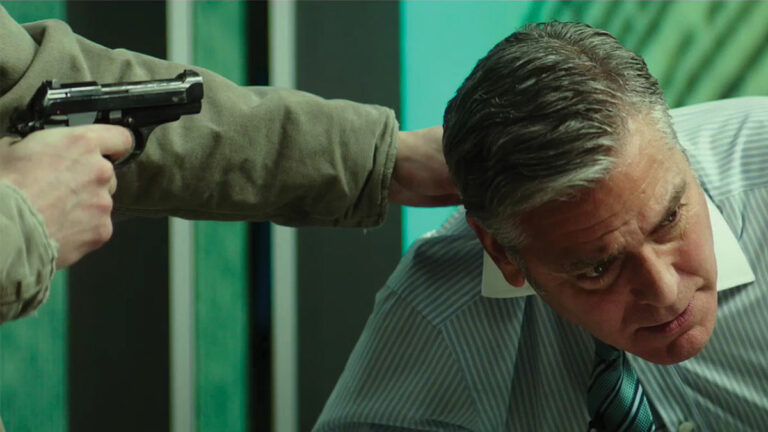
Remember in Network, when Peter Finch played that fed-up TV news anchorman? “I’m mad as hell, and I’m not going to take it any more!” was his rallying cry. The news hasn’t gotten any better since then, and the media is more a focus for outrage than ever—especially in this era of “reality” television. All of which comes into play in Money Monster, a smart, fast-paced thriller in which a disgruntled Everyman, burned by the system, takes to the airwaves to vent his anger. Written by Jamie Linden, Alan DiFiore, and Jim Kouf, the movie was directed by actress Jodie Foster—who has starred in enough thrillers by now to know what she’s doing. The narrative unfolds in real time (a fleet 98 minutes), not only in the New York City studio where a TV host is taken hostage—live, on-air—but in a couple of other key flashpoints around the world that turn out to be connected to the hostage drama. George Clooney stars as Lee Gates, host of a financial advisory TV program called Money Monster. Lee is a showman; he doesn’t just advise which stocks to buy or sell, he drives home his points by donning a top hat and dancing with showgirls, slamming a giant red buzzer on his desk, or running a few frames of vintage monster movies to express his fear, or zeal, about the market. It’s all showbiz to Lee, barely held in check by his exasperated-but-forgiving director, Patty (Julia Roberts). “Your money better be faster than the other guy’s,” is his mantra. One day, with the crew assembled for their live broadcast, Patty tells Lee that his interview guest, the CEO of a financial conglomerate called IBID, is a no-show, but they have an onscreen chat lined up with the company’s PR chief, Diane Lester (Caitriona Balfe, who plays Claire on Outlander). IBID stock has recently taken a dive, which company spokespeople are calmly blaming on a renegade computer algorithm—a “glitch.” But the show has hardly started when a deliveryman sneaks backstage, and suddenly appears on camera waving a gun. He is Kyle Budwell, (Jack O’Connell), a little guy who’s just lost his life savings investing in IBID, and was hoping to get some answers from the CEO. But as long as he’s there, he forces Lee into a flak jacket loaded with explosives (Kyle holds the trigger), and makes him watch a video clip of last week’s show (called up on command by Patty in the control booth, so as not to make the gunman any more testy), in which Lee crows that investing in IBID is as safe as a savings account. There’s plenty of blame to go around, with predatory, unregulated Big Banks routinely making a meal of small investors. But while Lee insists at first that he’s not the bad guy in this scenario, he begins to re-evaluate his role in the system. Meanwhile, forbidden to cut the live feed by Kyle, Patty sends everyone out of the studio except the camera and sound crew, while the NYPD surrounds the building—and assembles its best snipers. The plot is full of ironic twists and emotional shifts that defy our expectations. We’ve seen a thousand hostage dramas where the gunman’s loved one is brought in to reason with him, but it plays out differently here. Lee’s attempt to play the star card and rally the support of his loyal viewers also has unexpected results. Diane’s feeble attempt to spout the party line in defense of IBID gets Kyle, Lee, Patty, and the whole crew incensed, then launches Diane into her own investigation into the shady activities of her boss, Walt Camby (Dominic West). None of this narrative would be possible without the split-second technology that connects a programmer in Seoul, hackers in Finland, and strikers in South Africa, with Patty’s crew, as the live drama unfolds. The immediacy of modern technology is the fascinating subtext, where billions are earned, lost, or diverted electronically, and no one has to consider the messy human cost.
MONEY MONSTER *** (out of four) With George Clooney, Julia Roberts, and Jack O’Connell. Written by Jamie Linden, Alan DiFiore, and Jim Kouf. Directed by Jodie Foster. A Sony Pictures release. Rated R. 99 minutes.
Gemini Festival of Humanity, World Invocation Day, Full Moon.
The Gemini Solar Festival of Goodwill, of Humanity, and World Invocation Day occurs at 2:14 p.m. on Saturday, May 21, at 1.14 degrees Gemini. This is the third Spring Festival and the first of two blue moons of Gemini. Very auspicious, blue moons (which means two full moons) in the time of Gemini.
As the light of Gemini enters the Earth, the forces of reconstruction also stream in. They sweep throughout the Earth, producing in humanity (seeking God’s Will) a dedication and an aspiration to express Goodwill. Goodwill produces Right Human Relations, which produce the first anchoring of Peace on Earth. During the festival of the Christ, the Hierarchy (inner spiritual government) and New Group of World Servers distribute to humanity the Will-to-Good (the Wesak blessing) from the Father. The Buddha’s blessing, safe-guarded by the Christ since the last full moon, is released to humanity. During the Gemini festival all things polarized come into harmony and unity. The Gemini festival invoking world fellowship, represents the work of both Buddha and Christ (brothers). During the festival, the Christ, representing humanity as its elder brother, reads the last sermon of the Buddha. The three spring festivals and the two great teachers, together, through united invocation and rhythm, stabilize East and West, humanity and the kingdoms for the coming year.
Since 1952, humanity worldwide has celebrated World Invocation Day, a global day of prayer and meditation where people of different spiritual paths invoke together the energies of Light, Love and Spiritual Purpose, using the Great Invocation.
The NGWS invites everyone to join the Gemini Festival World Invocation day (on inner levels) by reciting the Great Invocation together. (Read more on my Facebook page, Risa D’Angeles). Sunday, Mercury turns stationary direct.
ARIES: Notice your many and varied goals this year, climbing the ladder to reach those goals. Notice also that a new authority, one finer-tuned, responsible, and aware of the importance to serve others, has appeared as new values in your life. These are the beginnings of great accomplishments, as well as great challenges. They are the qualities of the Soul. You have done well. Keep climbing.
TAURUS: Your true self is a leader and teacher everyone seeks in these times of unpredictable change and relationship instabilities. Is a heath crisis making work difficult? Does it seem that time has lessened? Do you barely have time for other pursuits? Continue research and contact with others also concerned for humanity’s future. Expand your garden. Build a green house. Find land for community, humanity and its children.
GEMINI: Offer the praise and recognition everyone in your life needs by articulating your gratitude to them ceaselessly. You’re blessed with creative gifts manifested as outer abilities. A new identity is taking shape. It’s a deeper Soul identity. One gift of the Soul is recognizing the spiritual purpose behind all relationships. Can you see these? Or are you caught in a duality of purpose? A Gemini test. Stand always with intentions for Goodwill. This is your festival. CANCER: You may feel your work at times takes you away from family. And then, in turn, family feels like it takes you away from your (spiritual) work. Your task is to balance the two. The more difficult, the greater the Initiation. Do you have visions and dreams for a different future? Envision and (day) dream more. In between health crisis and responsibilities, glimmers of dreams occur. Record them. LEO: The work demanded in your life may feel overwhelming. So much to do, so many people to mentor, so many thoughts, so many emotions trying to express themselves all at the same time. Difficult communication creates a touch of sadness. Someone(s) needs communication. Relationships could feel hidden, like art objects yet to be found. Someone thinks of you daily. VIRGO: A profound creativity is building within you. Some Virgos become pregnant with new physical life. Some will gestate a new level of artistry and creativity. You’re being impressed from all levels, high and low, to bring beauty forth. Each day recognize the life force within all kingdoms by expressing clear unconditional love to everyone and everything. Study essential oils and flower remedies.
LIBRA: As thoughts from the past appear and reappear, your response to them determines how you feel each day. If saddened or in grief, take Ignatia Amara (homeopath). Some thoughts may urge forgiveness, contact and care of another. Distorted remembrances and beliefs hinder your deep creative self. Develop intentions for Goodwill. It creates Right Remembering and Right Relations. More love follows. SCORPIO: Communication expands internally, becoming full and rich with memories. Though it’s internal, you realize the need to communicate thoughts to others who can listen with care, ask the right questions, and maintain confidentiality when needed. Seek these people. Let others see your strengths as well as the need for security. Don’t keep secrets. Share a bit more. It’s safe. SAGITTARIUS: Yes, more change is coming, having its own sense of timing—and this can lead you to feel impatience. A new world stage is being prepared. Your sign creates publishers, world travelers, foodies, writers, philosophers. Nothing overshadows your sense of adventure. Maintain the present direction. Let the doors (of perception) open by themselves. A. Huxley’s words/book. CAPRICORN: Spiritual forces, ever-directing, inform you to rest from climbing that ever-present ladder reaching into the heavens of success. It’s good to unwind from your extraordinary capable sense of responsibility. We award your high standards applied to all endeavors of life. Now you must relax and rejuvenate before your next tasks appear. Begin each day with the words, “I have the intention for Goodwill in all aspects of my life.”
AQUARIUS: All realities in life begin by having needs, then hoping, then imagining things appearing. Inner life is shaped by these until one day dreams appear in form and matter. Attempt to clarify what’s important, of value, and what you must pursue next. Sometimes this is difficult. Some of us live only in the moment. But within each moment is a vision of the future. Try to capture it. PISCES: You had future plans. However, they are changing daily. Create collaboration with another. It will take you far into the future, creating the template for a new future. You understand the changes occurring on our planet. You “seek to serve and not exact due service, to heal not hurt others.” At times you are hurting. This is so compassion deepens—your particular task. The future isn’t formed yet. It must be imagined by all of us. Demonstrate this daily. Follow or Contact Risa D’Angeles on her Facebook page or at nightlightnews.org.
ARIES (March 21-April 19): “An oar moves a boat by entering what lies outside it,” writes poet Jane Hirshfield. You can’t use the paddle inside the boat! It’s of no value to you unless you thrust it into the drink and move it around vigorously. And that’s an excellent metaphor for you to keep in mind during the coming weeks, my friend. If you want to reach your next destination, you must have intimate and continual interaction with the mysterious depths that lie outside your known world. TAURUS (April 20-May 20): The short attention span is now enshrined as the default mode of awareness. “We skim rather than absorb,” says author James Lough. “We read Sappho or Shakespeare the same way we glance over a tweet or a text message, scanning for the gist, impatient to move on.” There’s a problem with that approach, however. “You can’t skim Shakespeare,” says Lough. I propose that we make that your epigram to live by in the coming weeks, Taurus: You can’t skim Shakespeare. According to my analysis, you’re going to be offered a rich array of Shakespeare-level information and insights. To get the most out of these blessings, you must penetrate and marinate and ruminate. GEMINI (May 21-June 20): “There are situations in life when it is wisdom not to be too wise,” said Friedrich Schiller. The coming days may be one of those times for you. I therefore advise you to dodge any tendency you might have to be impressed with your sophisticated intelligence. Be suspicious of egotism masquerading as cleverness. You are most likely to make good decisions if you insist on honoring your raw instincts. Simple solutions and uncomplicated actions will give you access to beautiful truths and truthful beauty, especially if you anchor yourself in innocent compassion. CANCER (June 21-July 22): To prepare you for the coming weeks, I have gathered three quotes from the Bulgarian writer Elias Canetti. These gems, along with my commentary, will serve you well if you use them as seeds for your ongoing meditations. Seed #1: “He would like to start from scratch. Where is scratch?” Here’s my addendum: No later than your birthday, you’ll be ready to start from scratch. In the meantime, your task is to find out where scratch is, and clear a path to it. Seed #2: “All the things one has forgotten scream for help in dreams.” My addendum: Monitor your dreams closely. They will offer clues about what you need to remember. Seed #3: “Relearn astonishment, stop grasping for knowledge, lose the habit of the past.” My addendum: Go in search of the miraculous. LEO (July 23-Aug. 22): “There are friendships like circuses, waterfalls, libraries,” said writer Vladimir Nabokov. I hope you have at least one of each, Leo. And if you don’t, I encourage you to go out and look for some. It would be great if you could also get access to alliances that resemble dancing lessons, colorful sanctuaries, lion whisperers, prayer flags, and the northern lights. Right now you especially need the stimulation that synergistic collaborations can provide. The next chapter of your life story requires abundant contact with interesting people who have the power to surprise you and teach you. VIRGO (Aug. 23-Sept. 22): “Perfection is a stick with which to beat the possible,” says author Rebecca Solnit. She is of course implying that it might be better not to beat the possible, but rather to protect and nurture the possible as a viable option—especially if perfection ultimately proves to have no value other than as a stick. This is always a truth worth honoring, but it will be crucial for you in the weeks to come. I hope you will cultivate a reverence and devotion to the possible. As messy or maddening as it might be, it will also groom your powers as a maker. LIBRA (Sept. 23-Oct. 22): An invigorating challenge is headed your way. To prepare you, I offer the wisdom of French author André Gide. “Through loyalty to the past,” he wrote, “our mind refuses to realize that tomorrow’s joy is possible only if today’s joy makes way for it.” What this means, Libra, is that you will probably have to surrender your attachment to a well-honed delight if you want to make yourself available for a bright new delight that’s hovering on the frontier. An educational blessing will come your way if and only if you clear space for its arrival. As Gide concludes, “Each wave owes the beauty of its line only to the withdrawal of the preceding wave.” SCORPIO (Oct. 23-Nov. 21): “How prompt we are to satisfy the hunger and thirst of our bodies; how slow to satisfy the hunger and thirst of our souls!” Henry David Thoreau wrote that, and now I’m passing it on to you just in time for a special phase of your long-term cycle. During this upcoming interlude, your main duty is to FEED YOUR SOUL in every way you can imagine. So please stuff it with unpredictable beauty and reverent emotions. Cram it with mysterious adventures and rambling treks in the frontier. Gorge it with intimate unpredictability and playful love and fierce devotions in behalf of your most crucial dreams. Warning: You will not be able to rely solely on the soul food that has sustained you in the past. Be eager to discover new forms of nourishment. SAGITTARIUS (Nov. 22-Dec. 21): “Here’s how every love letter can be summarized,” says Russell Dillon in his poem “Past-Perfect-Impersonal,” “What is it you’re unable to surrender and please may I have that?” I bring this tease to your attention because it may serve as a helpful riddle in the coming weeks. You’re entering a phase when you will have an enhanced ability to tinker with and refine and even revolutionize your best intimate relationships. I’m hoping Dillon’s provocation will unleash a series of inquiries that will inspire you as you imagine how you could supercharge togetherness and reinvent the ways you collaborate. CAPRICORN (Dec. 22-Jan. 19): Fifth-century Christian theologian St. Jerome wrote that “it requires infinite discretion to look for gold in the midst of dirt.” Ancient Roman poet Virgil on one occasion testified that he was “searching for gold in dung.” While addressing the angels, nineteenth-century French poet Charles Baudelaire bragged, “From each thing I extracted its quintessence. You gave me your mud, and I made gold out of it.” From what I can tell, Capricorn, you have been engaged in similar work lately. The climax of your toil should come in the next two weeks. (Thanks to Michael Gilleland for the inspiration: tinyurl.com/mudgold.) AQUARIUS (Jan. 20-Feb. 18): “At this time in my life,” says singer Joni Mitchell, “I’ve confronted a lot of my devils. A lot of them were pretty silly, but they were incredibly real at the time.” According to my reading of the astrological omens, Aquarius, you are due to enjoy a similar grace period. It may be a humbling grace period, because you’ll be invited to decisively banish worn-out delusions that have filled you with needless fear. And it may be a grace period that requires you to make strenuous adjustments, since you’ll have to revise some of your old stories about who you are and how you got here. But it will also be a sweet grace period, because you’ll be blessed again and again with a visceral sense of liberation. PISCES (Feb. 19-March 20): More than halfway through her prose poem “A Settlement,” Mary Oliver abruptly stops her meandering meditation on the poignant joys of spring’s soft awakening. Suddenly she’s brave and forceful: “Therefore, dark past, I’m about to do it. I’m about to forgive you for everything.” Now would be a perfect moment to draw inspiration from her, Pisces. I dare you to say it. I dare you to mean it. Speak these words: “Therefore, dark past, I’m about to do it. I’m about to forgive you for everything.”
Homework: What’s the one thing you would change about yourself if you could? And why can’t you? Go to Relastrology.com and click Email Rob.
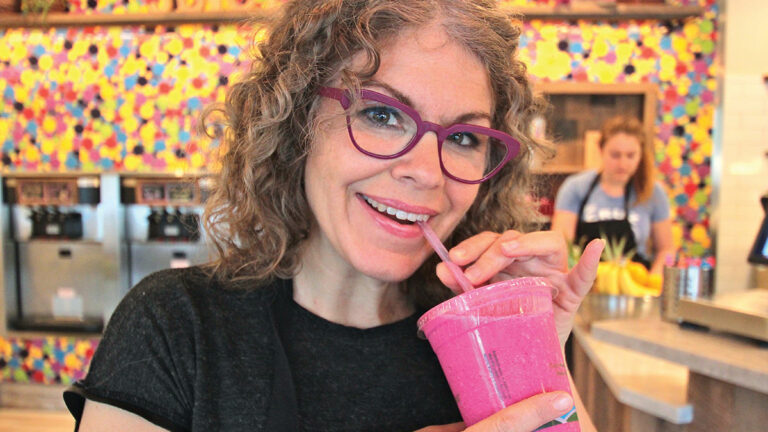
Aptos has been in desperate need of a good juice-smoothie-frozen yogurt spot, so Diane Carver and John Lindberg took matters into their own hands. Owner Lindberg wanted to open a frozen yogurt joint, and general manager Carver had been dreaming of opening a juice/smoothie shop for 10 years. They collaborated on Juicy Sweet, which opened in January. We spoke with Carver who is behind all the recipes, some of which she invented years earlier. With so many smoothie and frozen yogurt places, it can be hard to stand out. What’s your emphasis? DIANE CARVER: A lot of it is on health. The smoothies are all whole food, nutrient-based. But then there’s fun, too. We have 36 toppings for frozen yogurt. It’s all self-serve, and a lot of fun toppings: chocolate-covered marshmallows, we have chocolate Sriracha sauce—it just has a little heat to it. Sriracha is so popular on everything now. Might as well mix it with chocolate. What do you recommend to first timers? It seems like a lot of people like the Yogi Berri, which is fruit and yogurt. The Face Lift is our most popular juice. It has apple, lemon, a lot of greens: kale, spinach, celery, cucumber. What about for smoothies? I’d say the Holy Cacao. It has raw cacao powder. That one’s really healthy. It has maca, coconut oil, almond butter. It’s really rich and creamy. It has a chocolate shake consistency. You do juice shots as well? Our most popular juice shot is the Cough Drop. It hits all the senses. It has pineapple, apple, there’s a little bit of Himalayan salt and honey. It’s really good. All the juices are beneficial, health-wise. The Cough Drop is for people who aren’t feeling good. It has honey, which soothes your throat. Salt and pepper helps clean out your lungs. There’s usually a purpose to them. But I’ve put a high value on balancing the flavors, and it appeals to everybody, even the novice juicer to the veteran juicer. They’re all going to like it. It has a lot of flavor. What’s your most unusual juice? I’d probably say the Pink Dragon. It has dragon fruit, or pitaya. So it’s a bright pink color. It also has cinnamon. It’s a nice combination of flavors, nothing that really overwhelms you. Pitaya is a little bitter, and then the pineapple sweetens it and then the cinnamon adds a nice spice. It’s a hard one to explain, actually. It’s very creamy. It has a little vanilla in there, too. For more info, visit juicy-sweet.com.
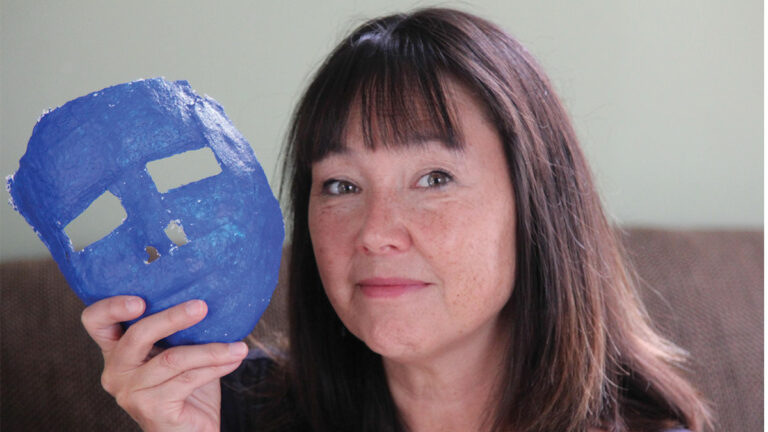
Once, a friend lured me into talking about a particularly venomous fight my parents had when I was 10, just to prove a point: In less than a minute, I was distressed, and my pulse rate, (which she’d measured before and after this sojourn into childhood imbroglio), had quickened. I’d heard before that thoughts affect us both physically and emotionally—and scientific research into this connection has turned up fascinating findings—but it was the first time I really got it. To what extent do our thoughts influence our mood, decisions, and ultimately, our life path? For Ami Chen Mills-Naim, a local author and wellness coach, the answer is a key component to our mental and spiritual well-being. In the late ’90s, around the time that Prozac was making its grand debut on the market, Mills-Naim, who was working as a journalist at the time, began to investigate the Western biomedical explanation of depression as a disease caused by brain chemistry imbalances. “When I did the research, I found that there’s this huge placebo effect with antidepressants,” says Mills-Naim. “And I thought, what is happening here?” Indeed, a 2015 study published in JAMA Psychiatry found that the placebo effect accounts for 30-45 percent of response to antidepressants. “I discovered this thing called neuroplasticity—this was in 1996—and I started writing about: maybe the brain can change in the other direction, and if we change our thinking, or through this free will we have, or the human spirit, maybe we could change our brain chemistry so that we are not depressed,” says Mills-Naim. It’s hard to imagine this well-put-together woman with the contagious laugh in a bad mood, much less depressed or hopeless, but she is no stranger to the darkness of her own mind. An estimated one in five Americans lives with mental illness each year, and for Mills-Naim, the darkest hour came in the fall of 1991, with an advanced chronic depression. “No longer was the universe a loving, benign universe. Dark pits pocked it, living hells one could fall into for no good reason … If before I was embraced by the universe, now I merely existed in it for no reason. Life had lost its meaning,” writes Mills-Naim in a 1997 Metro article “Club Meds”—a thorough investigation of depression and the rise of SSRIs in America. It’s been more than 20 years since Mills-Naim has returned to that suffering, and she credits a spiritual insight with her recovery. It’s not that Naim-Mills is against antidepressant medication: “There are meds that are helping people. So when I have a client who wants to take meds, I say to them, take the meds, at least it’s nice to know that it’s there. Because depression is catastrophic,” she says. But Naim-Mills has devoted herself to empowering sufferers with another tool. Conceived by a welder named Sydney Banks who had a profound insight in the ’70s, and gathering momentum over the past few decades, the Three Principles acknowledge the essential role of thoughts in human existence and suffering, along with consciousness and mind; or an innate intelligence that is larger than us. “When you have a thought, you have an emotion,” says Mills-Naim. “My father used to say that the strength of our emotions can be tricky, because then we think that our thought content is real, or true, that we’re justified.” Mills-Naim’s father is the late Dr. Roger Mills, a community psychologist who became friends with Banks in the ’70s and pioneered the application of Three Principles-based community projects—under the then-title of “Health Realization”—in challenging settings, including police departments, prisons, mental health clinics, drug rehabilitation programs, schools and low-income housing developments in Miami, with profound results. Mills-Naim was right there beside him, founding the Center for Sustainable Change with her father in 2004, which she ran for 10 years, and which brought the psychology to schools and communities across the U.S. “We’re not talking about thought content, which is very psychological and individual and personal, we’re talking about the function of thought, which is a formless power that we all share,” says Mills-Naim. “We’re speaking of thought as a formless energy, or capacity, that is spiritual.” For Mills-Naim, it was the very absence of the spiritual in modern treatment of depression—SSRI’s and psychotherapy that often fixates on the past—that prompted her efforts to share principles-based tools to change our brain chemistry. “It may take time, but certainly that must be a possibility,” she says. “I myself had overcome depression, and now I see that many, many people have.” For more information visit amichen.com.
After judging the Dare to Pair Food & Wine competition last month in the Surf City Vintners complex on Ingalls Street, I dashed over to Odonata Wines on Mission Street to get a bottle of a brand-new release of 2015 Rosé of Mourvedre, Machado Creek Vineyard, Santa Clara Valley. A gorgeous light rhubarb-colored wine full of rich minerals and tropical fruits, it’s a Rosé lover’s delight for a reasonable $18, and an easy pairing with a variety of food. “It has super aromatic peaches and stone fruit on the nose, crisp acidity and minerality in the palate,” says Odonata winemakerDenis Hoey. “We picked, cold-soaked on skins for two days, and pressed to a stainless-steel tank, where it is cold-fermented for a long period of time. It’s a taste of last season’s harvest,” Hoey says. “Drink it on a hot summer day or with spicy fare where you might otherwise have a beer.” Hoey named his winery Odonata after an order of insects encompassing dragonflies and damselflies, which he happens to love, and each label’s artwork depicts a beautiful dragonfly. Odonata also makes Malbec, Petite Sirah, Sparkling Rose, and a wonderful Dessert Petite Syrah that is perfect for after dinner. Check them out for yourselves at either of Odonata’s two locations. Odonata Santa Cruz, 2343 Mission St., Santa Cruz, 566-5147. odonatawines.com. Odonata is open Friday to Sunday from noon to 5 p.m. Open for every First Friday Art Walk. Odonata South, 645 River Road, Salinas. Open noon to 5 p.m. Saturday and Sunday.
Teroldego Release Party Bottle Jack Winery in Santa Cruz is celebrating the release of a varietal made from a rare Italian grape: its 2013 Teroldego. A delicious assortment of Italian fare to complement this unique wine will be prepared by the talented chefs of local Tramonti and La Gioconda restaurants. Picnic on the Pad is Sunday, May 22 and tickets are $35 ($25 for wine club members). Bottle Jack Winery is at 1088 La Madrona Drive, Santa Cruz. Visit bottlejackwines.com or call 227-2288 for reservations (required). Due to limited space and parking, there are two event time slots; Noon-2 p.m. or 2-4 p.m.