Serene Cellarsโ€™ Satisfying Sauvignon Blanc

One of the most popular wines made under MJA Vineyardsโ€™ Serene Cellars label is Sauvignon Blanc.

The 2018 โ€œInsatiableโ€โ€“every wine gets named by owner Marin Artukovichโ€“is a fruity-floral white wine that โ€œwill leave you wanting more.โ€ With its pale straw color and bright minerality, this delicious Sauvignon Blanc ($32) is choc-full of zingy Meyer lemon, notes of nectarine, and cucumber flower on the nose. Ending with a tangy marmalade finish, thereโ€™s not much more you could want from a Sauvignon Blanc.

Artukovich suggests pairing it with grilled tandoori-spiced chicken breast and peach chutney.

MJA has two tasting rooms, both of them fun to visit and each with a different vibe.

MJA Vineyards, 328-A Ingalls St., Santa Cruz, 421-9380; 24900 Highland Way, Los Gatos, 408-353-6000. Mjavineyards.com.

Testarossa Wine-Tasting at Seascape Sports Club

Testarossa Winery is located in Los Gatos, but they will be pouring their wonderful wines at Seascape Sports Club in Aptos from 6-7:30 pm on Friday, Jan. 17. Cost is $20 and includes heavy hors dโ€™oeuvres.

Pelican Ranch Winery Moves to Scotts Valley

Pelican Ranch closed its Capitola location at the end of December and has relocated to Scotts Valley. Their opening date is Jan. 18, with noon-5 pm tasting room hours every Saturday. Pelican Ranch owners Phil and Peggy Crews say the cellar conditions in their new facility (in the old Skov Winery) are ideal. They see the move as a major plus, and look forward to hosting special tastings in a lovely spacious room, which is also available to rent. Pay them a visit on their opening day.

Pelican Ranch Winery, 2364 Bean Creek Road, Scotts Valley. 332-5359. Pelicanranch.com

Passport โ€“ Winetasting in the Santa Cruz Mountains

The next Passport event is Saturday, Jan. 18. If you have a Passport for winetasting, you can visit as many participating wineries as you like on that date. Your Passport also lets you visit them on other days.ย 

Santa Cruz Mountains Winegrowers Association, scmwa.com.ย ย 

Hole Foods Dreams Up Healthy, Vegan Donuts

It was during their travels up and down the West Coast that Steven and Eva Castro had an idea. The Salinas Valley residents were inspired to open their own pop-up shop. Their specialty? Donuts that are actually healthyโ€”or at least healthier.ย 

Hole Food Vegan Donuts has since taken its fan favoritesโ€”like egg-less, butter-less churro donutsโ€”around the Central Coast, to pop-up food destinations like Watsonvilleโ€™s Elkhorn Slough Brewery and Fruition Brewing.

How did you come up with the name and logo?

EVA CASTRO: The name Hole Foods is a funny spin on โ€œWhole Foods.โ€ As in, eat more wholesome, healthy foods, but most people correlate it with the grocery store.ย 

When it came to our logo, we wanted to incorporate our Mexican culture. Steven grew up watching wrestling and lucha libre with his dad and abuelito, so that was the inspiration behind the luchador and the donut mask.ย 

What makes a donut vegan?

A common misconception about vegan desserts is that theyโ€™re dry, bland and taste healthy.ย  But if youโ€™ve had one of our donuts, you know theyโ€™re just as delicious as a regular donut. Dare we say, maybe even better?ย 

Our donuts are made without animal products. That means no butter, milk or eggs. Instead, we use plant-based alternatives such as almond milk. Our donuts arenโ€™t deep fried. Theyโ€™re baked and made with organic and natural ingredients. We pride ourselves with using healthier alternatives, but we donโ€™t sacrifice any of the flavor.ย 

What are your most popular flavors?

Our flavor menu rotates at every pop-up shop, so we have a few fan favorites. If we had to narrow it down to three, I would say churro, Mexican chocolate and blueberry.ย 

Where can people find your donuts?

We donโ€™t have a storefront. The best way to find us is to follow us on Instagram @vegandonuts831, where we post fliers about our events. Weโ€™ve had pop-ups in Salinas, Watsonville and Gonzales. Next year, weโ€™ll be in more surrounding cities and the Bay Area.ย 

Opinion: Jan. 15, 2020

EDITOR’S NOTE

At this point, many of us have been asked by law enforcement to turn over security footage as part of an investigation. We certainly have here at the GT office, thanks to the crazy things that go on regularly around the river. And who doesnโ€™t want to help, if it means making our streets safer?

But as this weekโ€™s cover story reveals, there are deeper questions in the ever-escalating world of surveillance. For instance, would you feel as happy to help if law enforcement was able to access your personal footage without your permission? When do privacy issues begin to trump public safety concerns? Nicholas Chan takes a deep dive into these and other issues in a story that may make you rethink home security.

In other news, I saw โ€œNight Bโ€ of 8 Tens @ 8 last weekend, and this yearโ€™s selection of 10-minute plays are as thought-provoking and funny as ever. I hope to still catch โ€œNight A,โ€ but Iโ€™m told most of the remaining weekends are already sold out or selling out, so those of us who still want tickets had better be quick about it.

Also, check out this weekโ€™s news section for the final results of Santa Cruz Gives. And time is running short on Best of Santa Cruz balloting, so go to goodtimes.sc and get your votes in now!


LETTERS TO THE EDITOR

Read the latest letters to the editor here.

Circle Back

I was very interested to read Todd Guildโ€™s article, โ€œAs the Churchโ€™s Downtown Brewpub Fails, A Fight Over Its Old Homeโ€ (GT, 1/8). I appreciate that the Good Times is publicizing this issue, but the article paints an incorrect picture of the true beauty of the Circle Church and the significance of its history.

The current owners have abandoned landscape maintenance and have let the buildings fall into disrepair. This formerly vibrant and lively property has become neglected and underutilized. Neighbors and friends of the Circle Church want to protect the Church from demolition and support revitalization. We want to see the Circle Church return to its full glory as a thriving spiritual and community Center, the heart of the Circles Neighborhood, and a hub for classes, gatherings, and events. We have been active for over a year and have more than 1050 petition signatures and a large email list.

We were especially concerned about the developersโ€™ first historic report for the property. Guildโ€™s article has incorrect information about the historic report. The developersโ€™ historic report uses the California State document number of DPR523. The State did not prepare this reportโ€”the developers paid a consultant to prepare it. This first historic report was critiqued by members of the Santa Cruz Cityโ€™s Historic Preservation Commission and found to be inadequate, incomplete, and full of errors. The developers were required to submit a second historic report.

The Santa Cruz City Council voted on December 10th to ask the HPC to review the second historic report at a Public Hearing on Thursday, January 30, 7pm, at the City Council Chambers (note re-scheduled date). The City Council has also asked the HPC to provide a recommendation as to whether the property merits designation as a Local Historic Landmark.

We are convinced that the property will receive historic designation and will be spared from demolition.

Sue Powellย |ย Circles Neighborhood


Getting to Yes

Re: โ€œWalk This Wayโ€ (GT, 12/4): As Jimmy Panetta began his run for Congress in November 2015, impeaching President Trump had to have been the furthest thing from his mind, mainly because the very idea of Trump as president was the furthest thing from any of our minds.

Then, two months ago, when he knew he would be called upon to cast a vote for or against the initial impeachment inquiry, Congressman Panetta approached his decision with the same careful thought and determination that he learned to apply as a U.S. Navy intelligence officer in Afghanistan and as a deputy district attorney in Monterey County.

The executive board of the Santa Cruz County Democratic Party asked to meet with him as he was considering his position. For us, the sooner Trump is gone, the better. Nevertheless, we were altogether impressed and pleased with Jimmyโ€™s logical and legally sound approach, culminating with his vote to approve the Articles of Impeachment against Donald Trump.

Thank you, Congressman Panetta.

Coco Raner-Walter |ย Chairperson, SCCDCC


Online Comments

Re: Circle Church

As a member of the Circle Womenโ€™s Coalition, a group that has come together to preserve and develop this property as a community center, I am aware that a very purchasing offer was made to the Circle of Friends. And they refused. Also of significance is the fact that a huge L.A. developer, Alex Hakakian is the major shareholder of this development. And thatโ€™s being buried in the greenwashing of this project. We all agree housing is an issue. But hitting a community for the financial benefit of a few very privileged people isnโ€™t folksy. And neither is this project.

We want to think of the good of the many and true social equity of a place that provides culture, connection, and confluence to our children and the future, in perpetuity.

โ€” Jennifer Smithย 


PHOTO CONTEST WINNER

Birds at the Hook. Photograph by Aurore Sibley.

Submit to ph****@*******es.sc. Include information (location, etc.) and your name. Photos may be cropped. Preferably, photos should be 4 inches by 4 inches and minimum 250dpi.


GOOD IDEA

HITCHING POST

Many young romantics have their ideal wedding planned out in their heads. For some, thatโ€™s a ceremony at a coastal resort, while others dream of tying the knot in a fancy cathedral. But some couples would prefer to save thousands of dollars by getting hitched at the County Government Center! Sign-ups are now available for weddings on Valentineโ€™s Day, Friday, Feb. 14. Ceremonies cost $100, last 30 minutes and can accommodate 20 guests. For scheduling, visit sccoclerk.com or call 454-2060.


GOOD WORK

SCHOOL OF THOUGHT

The Santa Cruz County Office of Education will be hosting two free upcoming community events titled Delivering on Our Promise: The Santa Cruz COEโ€™s Strategic Plan for Education. The events will mark the release of a new strategic plan. Speakers will include 2020 Senate candidate John Laird. The first event will be at Watsonville Civic Plaza Building on Tuesday, Jan. 21, at 5pm. The second will be at the Museum of Art and History on Tuesday, Jan. 28.


QUOTE OF THE WEEK

โ€œNo one likes to see a government folder with his name on it.โ€

-Stephen King

5 Things To Do in Santa Cruz: Jan. 15-21

Green Fix

DIY Reusable Beeswax Wrapsย 

Learn to make reusable beeswax wraps to avoid wrapping food in plastic. Plus, learn to wrap gifts #ZeroWaste style โ€” without plastic tape! Reusable wraps made with beeswax and other natural ingredients help reduce the use of cling film, ziplock bags and aluminum foil that aren’t recyclable or easily reusable. The workshop is hosted by local tree-based, zero-waste skincare line Anato. Each attendee will create eight reusable wrappers, and are encouraged to bring any of their favorite cotton fabrics from home.ย 

INFO: 3-5pm. Saturday, Jan. 18. Anato Life Studio, 2215 Soquel Drive, Santa Cruz. anatolife.com. $66.

Art Seenย 

โ€˜Scoville Unitsโ€™ย 

Tandy Beal and Company presentsย  a celebration of Jon Scovilleโ€™s extraordinary music for two shows only. Scovilleโ€™s music and artistic insights have inspired dances for not only Tandy Beal herself, but for choreographers around the world. Scovilleโ€™s music has been featured on international concert stages, circus tents, radio, video, art galleries, corporate events and commercials. Scoville Units is a multi-arts celebration of Scovilleโ€™s wide-ranging compositions from cool to hot, accompanied by 32 musicians and dancers, and two filmmakers.

INFO: 7:30pm Saturday Jan. 18 and 2pm Sunday Jan. 19. Cabrillo Crocker Theatre, 6500 Lower Perimeter Road, Aptos. tandybeal.com. $22-$50.ย 

Thursday 1/16ย 

Renowned Cheeses Eventย 

Staff of Life Natural Foods will host its inaugural โ€œSlow Foods Santa Cruz ”โ€”a meet-the-producer tasting event showcasing cheeses from around the world. There will be top cheese experts from Europe representing generations of artisan cheesemaking in France, Germany, Switzerland, Belgium and more. There will also be beer pairings from local brewers Sante Adarius, Elkhorn Slough, Shanty Shack, Discretion and more. Proceeds go to nonprofit Slow Food Santa Cruz.

INFO: 4:30-7pm. Staff of Life Market, 1266 Soquel Ave., Santa Cruz. $10.ย 

Thursday 1/16ย 

Tannery Talks: Water and Environmental Justiceย 

The Tannery Talks series brings Tannery artists together with artists, activists and other professionals from the Santa Cruz region and beyond for discussions about the pressing issues of our times. This talk in particular focuses on examining issues of water and environmental justice, and is moderated by local artist Wes Modes. This yearโ€™s Tannery Talks series will include four conversations on the role of the arts in the environmental justice movement. View the lineup online for additional dates, topics and speakers.ย 

INFO: 7pm. Radius Gallery, 1050 River St., Santa Cruz. 706-1620. Free.ย 

Sunday 1/19ย 

Protecting Manta Rays from Our Seafood System

Manta and devil rays are a group of charismatic and biologically fascinating ocean icons. Unfortunately, they also face enormous threats from wildlife trafficking, plastic pollution, and accidental entanglement in fishing gear. A unique collaboration of scientists, fisheries managers, and industrial tuna fisheries is out to document and understand this accidental manta and devil ray โ€œbycatch,โ€ and to develop conservation solutions to save these threatened ocean giants. Join Melissa Cronin as she discusses her work on these incredible creatures, and explains how consumers can play a role in protecting them.

INFO: 1:30pm. Seymour Marine Discovery Center, 100 McAllister Way, Santa Cruz. 459-3800. Free with $9 admission.ย 

Will Local Police Departments be the Next to Sign Ring Camera Deals?

By Nicholas Chan

A man in a gray hoodie and flannel pajama pants strolls casually along the walkway. As he nears a mother and her young daughter, he lunges, snatching the womanโ€™s purse, pulling her and the girl down a stairwell to the concrete.

In a flash, he disappears from the frame.

Using old-fashioned methods, tracking down a suspect like this one is an ordeal. In this case, San Jose police canvass the area surrounding the two-story office complex off of Towers Lane on the East Side. Using private security camera footage, investigators reconstruct the crime and identify the suspectโ€™s getaway vehicle, a black Lexus sedan. Detectives ultimately match the purse-snatcher to a string of similar incidents, and five days later the police have their suspect.

On May 11, San Jose police arrested 26-year-old Pablo Cabrera Jr. at his home in San Jose. A search of the premises turned up evidence connecting Cabrera to similar robberies of Asian women carrying pricey purses. He was booked at Elmwood jail on suspicion of robbery and violating a burglary conviction parole. The video footage proved crucial to cracking the case, which recently went to trial.

Security camera footage often helps cops track down other possible criminals, including suspected murderers, like 24-year-old Carlos Arevalo-Carranza, accused of murdering San Jose resident Bambi Larson last year.

โ€œWe have solved homicides, sexual assaults and shootings with the use of surveillance cameras that are privately-owned,โ€ SJPD Police Chief Eddie Garcia says. โ€œIn the Bambi Larson murder, if it weren’t for stitching those neighborhood camera videos together, I donโ€™t know where that investigation would be.โ€

To obtain video evidence, officers go door to door, asking for permission from individual camera owners or obtaining a search warrant from a judge. Had SJPD obtained the footage of Cabrera, or Arevalo-Carranza sooner, they might have avoided days of searching for suspects.

But now, some law enforcement agencies have a shortcut. Over in Silicon Valley, San Jose, Santa Clara and Milpitas police departments recently became the first agencies in the South Bay to use a new virtual tool, one that allows detectives to easily obtain privately-owned security video.

The Neighbors App, created by the Amazon-owned networked doorbell and home security camera maker Ring, connects users to security videos of suspicious or criminal activity in the surrounding community. The service is billed as โ€œThe New Neighborhood Watchโ€ in ads.

The Amazon subsidiary has also created a โ€œLaw Enforcement Portalโ€ that allows investigators to request home-security videos from residents through the app. Over the past year, however, Ring has faced mounting scrutiny, including a negligence suit over hacked cameras. Earlier this month, Amazon announced in an email to five concerned U.S. Democratic senators that it fired four employees who abused internal access and spied on customers.

Since launching its Law Enforcement Portal for the Neighbors App in the spring of 2018, nonetheless, the digital doorbell company has teamed up with more than 400 police departments across the United States.

The partnerships between local law enforcement and Ring raise concerns about privacyโ€”and the creeping corporate sway on public policy. Civil liberties advocates sound alarms about Ringโ€™s terms of service with police, warning that local law enforcement has become a promoter of an ecommerce monopolist that already has huge stockpiles of personal data, including groceries purchased, shows watched, books read, music enjoyed. Some police departments even let Amazon, which has offices in downtown Santa Cruz, control aspects of their messaging. It sets a dangerous precedent, critics argue, for law enforcement agencies to grant leverage over their messaging to one of the worldโ€™s most powerful companies.

โ€œThe company is looking out for their bottom line,โ€ says Matthew Guariglia, policy analyst at the Electronic Frontier Foundation, a digital rights advocacy group. โ€œSo when they get the machine of government working for their benefit, you donโ€™t know as a citizen if the police department in your town is looking out for your best interest or Amazonโ€™s interest.โ€

CORPORATE PR

Here in Santa Cruz County, no local law enforcement departments have deals with Ring, although Scotts Valley began looking into the program last year.

Capitola has used footage submitted by citizens to assist with investigations, although it doesnโ€™t have any access on the back end of the portal.

And the Santa Cruz County Sheriffโ€™s Office, for its part, has its own neighborhood video partnership that residents may sign up for. In November after the murder and kidnapping of Tushar Atre from his Pleasure Point Home, the sheriffโ€™s office released survellience footage from a nearby home of the suspects walking through the neighborhood, carrying a duffle bag and a rifle.ย 

In Watsonville, Police Department spokesperson Michelle Pulido tells GT in an email, that her employer doesnโ€™t have plans to make sort of any agreement with Ring. โ€œIf we were to partner with the company in the future, we would first need to ensure the benefits for our residents outweigh any possible concerns,โ€ she writes.ย 

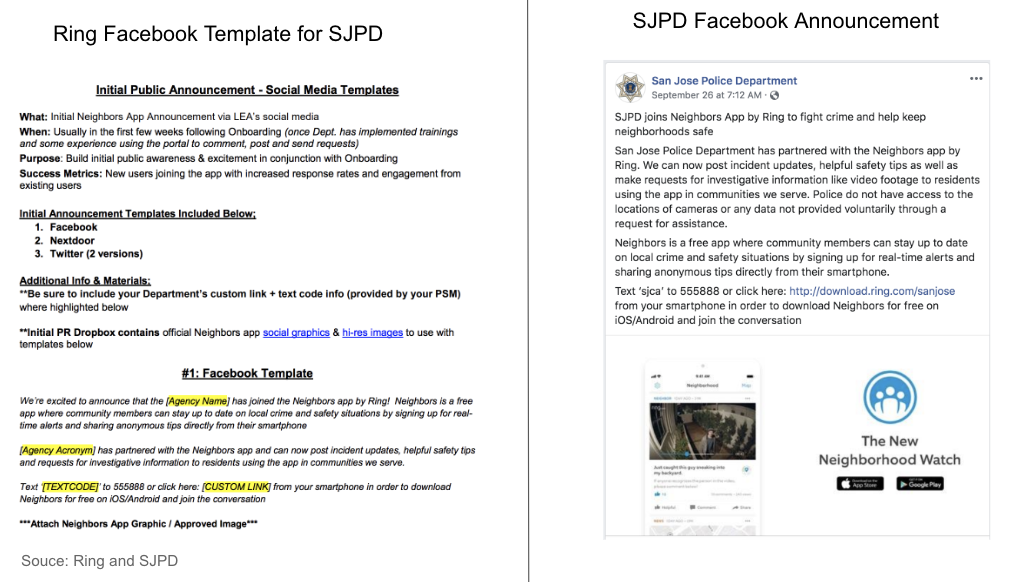
Over in Silicon Valley, itโ€™s a different story. Ringโ€”under its agreements with San Jose and Santa Claraโ€”can control the content of press releases about the police departmentsโ€™ partnerships with Ring. The company also expects to approve any Ring-related public service announcements from Santa Clara PD. Even SJPDโ€™s social media posts are scripted by Ring.

โ€œItโ€™s very concerning when an enormous corporation is writing the press releases for the government. People think their police department is speaking, when, in fact, itโ€™s Amazon thatโ€™s speaking,โ€ American Civil Liberties Union (ACLU) attorney Jacob Snow says. โ€œItโ€™s using police departments as the mouthpiece for a giant corporation.โ€

A trail of records illustrates the nature of partnerships between local agencies and the doorbell-surveillance company. In one of those documents, Angela Kang, who manages public agency partnerships for Ring, wrote in an email to Santa Clara PD that all press release drafts must be submitted in advance to me***@**ng.com.โ€

Kang sent the department four attachments of press release materialsโ€”a โ€œPress Release Template,โ€ โ€œSample Social Media Posts,โ€ โ€œTalking Points and Reactive Q&A Sheet,โ€ and โ€œNeighbors App Logo and Imagery.โ€

When this news organization asked Santa Clara police to include those attachments, they denied the request without offering any justification. According to Dave Snyder, executive director of the San Rafael-based free-speech non-profit First Amendment Coalition, thatโ€™s a clear violation of the California Public Records Act (CPRA), which requires the government to disclose public records upon request and cite specific exemptions to the law in order to deny requests for information. A Santa Clara County Civil Grand Jury slammed the city for the same offense earlier this summer.

Per the terms of their contracts with Ring, neither police San Jose nor Santa Clara can disclose the terms of their video surveillance program with Ring. San Joseโ€™s agreement with the company does include a provision, though, for complying with requests for certain documents made under the CPRA.

Such language about the CPRA is missing from Santa Claraโ€™s memo.

According to Snyder, thatโ€™s a problem. โ€œIt gives broad discretion to Ring to designate records as confidential,โ€ he explains. โ€œIt appears to give a private entity the final say about whatโ€™s public and whatโ€™s not. Thatโ€™s improper. The Public Records Act makes clear that a government agency has an independent obligation to provide records and cannot put the public rights of access in the hands of a private company.โ€

San Jose police proved more forthcoming than their counterparts in Santa Clara. Records obtained from SJPD show that Ring sent the department talking points and fill-in-the-blank templates for its social media announcements on Facebook, Nextdoor and Twitter.

And according to a review of the messaging, SJPDโ€™s social media posts have largely mirrored Ringโ€™s templates.

A Ring representative, who asked to be identified only as a spokesperson for the company, wrote in an email that โ€œRing requests to look at press releases and any messaging prior to distribution to ensure our company and our products and services are accurately represented.โ€ The Ring official wrote that police departments can use Ringโ€™s social media templates at their discretion.

Andrew Ferguson, author of The Rise of Big Data Policing, says everyone should be leery of Ringโ€™s reach.

โ€œWe should pause when a private company is demanding editorial oversight of public press releases about public safety,โ€ Ferguson says. โ€œThat is an unusual move and seems to infringe on the question of who the city is working for and with.โ€

For his part, SJPD Chief Garcia insists that he has the final stamp of approval when it comes to his departmentโ€™s messaging. If Ring disagrees with his press releases and ultimately wishes to end its partnership, then so be itโ€”he says heโ€™ll severe ties with the company.

But another point of concern for privacy advocates is the lack of public oversight inherent in these kinds of contracts. โ€œPeople in town have no say about the existence of the partnership,โ€ says the Electronic Frontier Foundationโ€™s Guariglia. โ€œItโ€™s not being discussed in city council.โ€

PUBLIC AND PRIVATE

Critics worried about Ring aiding and abetting Big Brother are overreacting, California Police Chief Association President Ronald Lawrence says.

After all, this app simply expedites surveillance video requests for police departments. โ€œACLU and their advocacy groups tend to spin this,โ€ he argues. โ€œPolice agencies have no desire to be in the 24/7 surveillance arena. Furthermore, we donโ€™t even have the resources. Thereโ€™s no infrastructure.โ€

To those concerned about corporate overreach, Lawrence says that private companies have long done business with police departments. For example, Axon, the manufacturer of the Taser, is also one of the largest vendors of police body cameras; gun manufacturers Sig Sauer and Glock are major suppliers of firearms; telecom giant Motorola owns a large share of the radio infrastructure for police and fire departments across the nation.

As technology has evolved rapidly over the last decade, Lawrence says itโ€™s prudent for police departments to partner with technology companies to upgrade their tools. The Neighborhood App is just the latest example in a long line of public and private policing partnerships.

Civil liberties groups have a history of thwarting the efforts of law enforcement to adopt modern technology, Lawrence says, and Police Chief Association leaders are getting worried. Ring isnโ€™t their first target, he notes. Civil liberties advocates successfully backed a bill to temporarily ban facial recognition in police body cams.

โ€œWe faced the same [problem] when Tasers first emerged. People said, โ€˜Oh my god, you canโ€™t have that.โ€™ Well the reality is, the use of police batonโ€”a far more blunt instrumentโ€”decreased significantly,โ€ Lawrence says. โ€œWe need to embrace technology.โ€

NEW NORMAL

Privacy advocates say these kinds of privately penned, publicly adopted policies are becoming the new status quo. As Ring continues to expand its partnerships, Ferguson warns that Amazon is gaining unfettered access to peopleโ€™s daily lives.

Supporters of surveillance technologyโ€™s growing reach argue that the potentially chilling effect of crime overshadows any concerns about personal privacy and government transparency. โ€œAnyone that is against using cameras to deter crime and convict criminals has to reassess their values,โ€ SAFER San Jose President Issa Ajlouny says. โ€œPeople are sick and tired of the crime thatโ€™s going on a daily basis.โ€

All over the world, consumers have voluntarily adopted smart speakers with always-on microphones, like the Amazon Echo and Google Home. (Google also owns the wifi camera and smart thermostat maker Nest.) Our phones, watches and even our appliances are increasingly collecting information from sensors and beaming it to the cloud, where the data is stored and can potentially be correlated with personal profiles.

โ€œAmazon is selling surveillance as a service,โ€ Ferguson says. โ€œThey are building more and more information about all of us. We are normalizing ordinary surveillance, building networks of surveillance in certain neighborhoods that will have a chilling effect for people going about their business.โ€

The Ongoing Grade Standoff Between UCSC and Striking Grad Students

Itโ€™s nearly 1pm outside UCSCโ€™s Kerr Hall on Thursday, Jan. 9, and the hour-long rally of at least a couple hundred protesters is louder than ever.

Grad students organized this rally in the quad in front of UCSCโ€™s main administrative building, as part of their strike calling for a โ€œcost of living adjustment,โ€ one that would amount to an extra $1,412 per month to help cover the cost of housing. Many teacherโ€™s assistants and graduate student instructors went on strike over those demands, and they refused to turn in fall quarter grades, which were due nearly a month ago.

As a loudspeaker is passed around at the rally, speeches cover a range of topics. They include calls for increased protection for undocumented immigrants and support for students who donโ€™t have the money to cover basic needs.

As the rally wraps up, students explain that they often canโ€™t afford to eat. The organizers announce a plan to occupy the Porter Dining Hall when. Then they start marching.

History of Consciousness grad student Will Parrish lags a couple hundred yards behind the marching coalition while he talks to me about the strike and housing affordability. I ask him why grad students are focusing so much on UCSC when leaders at the city, county, and state levels have done so little to reverse the crippling housing crisis that makes rent so expensive in the first place. He says students wouldnโ€™t be able to get their demands met by going to other government officials, at least not in a timely fashion.

โ€œIn short, we donโ€™t have much leverage there,โ€ Parrish says. โ€œOur powerโ€™s really here at the university. Hopefully, legislators will respond to what weโ€™re doing, and I could see a point where we focus more energy there.โ€

Parish isnโ€™t teaching this year, so he didnโ€™t have any grades this past quarter. But if he did, he says that he definitely would have participated in the grading strike.

As they took control of the dining hall for the afternoon, marchers said it was important for the grad students to get a square meal at a time when the university was failing to provide for their basic needs and leaving them no choice but to take from the university what they felt was rightfully theirs.

UCSC spokesperson Scott Hernandez-Jason says, however, that the student dining budget is separate from the rest of the school. The operations, he says, arenโ€™t funded by state money, but rather by students who have meal plans and from anyone who comes in to pay for meals throughout the year. That means that any losses come directly out of the services meant to serve paying students, not university coffers, he says.

The UCSC administratorsโ€™ message for the past month is that they are sympathetic, but they wonโ€™t sit down with the coalition of striking students until they turn in their grades.

โ€œThereโ€™s a subset of grad students withholding grades, which students worked hard for and deserve to know,โ€ he says. โ€œWe told grad students on numerous occasions that weโ€™re ready to support them, and we want them to succeed and afford to live in Santa Cruz. But until grades are turned in, we wonโ€™t be able to sit down and talk through what ideas we have in mind for providing them with additional support.โ€

Hernandez-Jason says that, because the grad students called the action, they should end it, so that everyone can move forward with a productive dialogue. The Santa Cruz Sentinel reported last week that 12,000 grades from last quarter are missing.

Film and digital media grad student Yulia Gilichinskaya, whoโ€™s participating in the strike by withholding grades from class she taught this past fall, says the coalition of students will wait for the university to say what its offer is before calling off a strike. โ€œOnce the university gives an offer, we will take a vote,โ€ she says.

The stand-off began before the deadline for grades. Going back to November, the tension was palpable in an email chain between the grad student coalition and Interim Campus Provost Lori Kletzer about getting together to negotiate. In their emails, some students signed off using phrases like โ€œwith hostilityโ€ and โ€œwith hatred.โ€

Now at the start of a brand new winter quarter, education grad student Kylie Kenner told her students that she will be grading all of their work. She added, however, that she wonโ€™t submit grades at the end of the quarter if the strike is still ongoing. โ€œI would so hope that this would be resolved before then,โ€ she says.

The grad students generally view themselves in solidarity with other on-campus groups, including skilled craft AFSCME workers, who started picketing at the base of campus this month.

ACTIVE RESPONSE

Up on campus after taking over the Porter Dining Hall, the protest keeps moving. Whatโ€™s left of the group keeps marching to go occupy another dining hall. In a Porter College plaza nearby, Parrish says he believes the university has the latitude to make decisions to improve the welfare of the student body. He often sees news stories that make him question the universityโ€™s priorities. There was the coverage two years ago of a University of California audit, which found that the school system was hiding cash, Parrish says. That same year, then-UC president Janet Napolitano even put pressure on UCSC and other campuses to change their responses to questions from the auditor.

UCSC, Parish stresses, is a political institution. And in general, the strikers donโ€™t imagine school administrators as a bunch of passive decision makers given money by state, he explains, with certain dollar amounts locked in for every item. โ€œWe see them as having a lot more latitude than they let on with everything that they do,โ€ he adds, before catching up with the protest march en route to its next stop at Rachel Carson Dining Hall. โ€œThe responsibility really lies with them. If theyโ€™re going to run a university, they need to do the basic things that it takes to have a health university environment for people.โ€

Capitola Wharf Reopened, More Repairs Needed

Quick engineering work and a bit of luck allowed the Wharf House Restaurant and Capitola Boat and Bait to reopen on Jan. 9, just a week after heavy winter surf destroyed two pilings that support the small boat hoist.

The New Yearโ€™s Day damage on the Capitola Wharf prompted immediate temporary fixes, including installation of a steel beam and braided cables that are currently holding up the damaged portion.

But even as hungry customers returned to the eatery, the boat business is hobbled without its hoist, which is the cornerstone of its business and out of commission until permanent repairs can be made.

โ€œThis is about 10 tons of concrete, and a small boat hoist that sits there, causing it to sag,โ€ says Capitola Public Works Director Steve Jessberg.ย 

Jessberg says he saw the area under the hoist sink six inches when he visited on Jan. 2, and another two inches a few hours later. It was the first time such settling has occurred, he says.

โ€œIt was moving quickly, and we determined that we needed to take immediate action to stop the hoist from falling into the ocean,โ€ he says.ย 

The Capitola City Council on Thursday unanimously approved the repair work, which so far has cost $25,000.

Engineers are now evaluating two options, the less desirable of which would require bringing in a pile driver to replace the broken pilings to the tune of $100,000.

Jessberg says the city is scheduling a team of divers who would evaluate the parts of the broken pilings that remain underwater, so that fiberglass-concrete pilings might be installed on top. That would cost about $50,000, Jessberg says, and is the option he recommended to the council.

In either case, the damaged wharf must be raised back into place. The work could include removal and reinstallation of the heavy hoist.

All the repair work comes from Measure F, the quarter-cent sales tax approved by voters in 2014 and again in 2016 to fund city services.ย 

The fund currently has $1.2 million, which is earmarked for flume, jetty, and wharf improvements.ย 

The City Council will approve the final project.

โ€œI think we got really lucky,โ€ Councilmember Ed Bottorff says. โ€œLooking at that I think the fact that the hoist didnโ€™t fall into the bay really was fortunate for us.โ€

Santa Cruz Gives Sees Record Donations

In its fifth year, GTโ€™s Santa Cruz Gives 2019 holiday giving campaign saw a record increase in donations over previous campaigns, and far exceeded its goal of raising $300,000 for local nonprofits, with a final tally of $410,048.

That total represents a 74% increase over last yearโ€™s $235,041 result.

As broken down by the Volunteer Center of Santa Cruz County, which has partnered with GT since the programโ€™s inception in 2015, there were similarly remarkable jumps in several aspects of the 2019 campaign. Individual donations were up 81%, while matching/incentive funds rose a staggering 91 percent. The program crossed the 1,000 mark for individual donors for the first time, with a total of 1,022. The largest individual donation was $20,000.

In all, 37 nonprofits were selected to participate in this yearโ€™s Gives. The most money was raised by the Santa Cruz County Animal Shelter Foundation; a total of $49,942. The SCCASF also had the most individual donors, with 317. For each of those accomplishments, theyโ€™ll receive $1,000 awards; a third $1,000 award for Most Innovative project will go to the Bird School Project, which focused their campaign on โ€œCreating Leaders for the Environment.โ€ All three awards are made possible by Oswald.

Despite the groupsโ€™ individual accomplishments, Santa Cruz Gives founder Jeanne Howard says that a review of this yearโ€™s results revealed how the campaignโ€™s structure allowed the participating nonprofits to build on each otherโ€™s successes.

โ€œVery few donors gave exclusively or even predominantly to one or two organizations,โ€ says Howard. โ€œTop donors consistently gave to five or ten or more organizations. This is exactly what we hope to inspire. It is also rare to see donors give only to environmental groups or only to youth groups or any single category. Most donors support nonprofits across the spectrum of needs.โ€

Besides the Volunteer Center and Oswald, GT has also drawn on the support of its other partners in Santa Cruz Givesโ€”Community Foundation Santa Cruz County, Santa Cruz County Bank and Wynn Capital Managementโ€”in finding its breakout success this year. A last-minute donation of $10,000 from the Community Foundationโ€™s Applewood Fund put the campaign solidly over $400,000, which had been considered its โ€œOMG goal.โ€

โ€œThe Community Foundation is proud to tip our hat and give thanks to the many generous people who helped break records in this yearโ€™s Gives campaign,โ€ says the Community Foundationโ€™s CEO Susan True. โ€œWe sponsor Gives because itโ€™s exactly what we like to do most of all: bring people, resources and ideas together to inspire philanthropy and accomplish great things.โ€

‘Topics of Conversation’ Explores Power in Popular Culture

The first buzzed-about novel of the 2020s has no overt Santa Cruz themes or references. But the subtext? Thatโ€™s a different story.

Miranda Popkeyโ€™s newly released Topics of Conversation is a debut novel composed of a series of fictional encounters between an unnamed narrator and several other women over the course of 17 years. And those conversations and anecdotes always seem to lead, whether obliquely or explicitly, to themes of female desire, infidelity, violence, and victimization at the hands of predatory men. Whether it was meant to or not, the book will be seen as an uncomfortable if bracingly honest documentation of #MeToo disclosure.

The book is set, in part, in Californiaโ€”but in Los Angeles, Santa Barbara, San Francisco, and Fresno. There are no references to Boardwalk rides or banana slugs.

The subtext comes from the 32-year-old novelist herself. Though she claims no one would ever guess it, Popkey is Santa Cruz County born-and-raised. And if her new book has any sense of restless spiritual dislocation to it, that may have started in her childhood.

โ€œI think I had a feeling growing up that I was emotionally out of sync with Santa Cruz,โ€ she says. โ€œThere is an easygoing vibe that the city has. But Iโ€™ve always been a little tighter-wound than your average Santa Cruz resident. I donโ€™t surf. I donโ€™t like to go to the beach. A lot of my adolescence was spent trying to figure out how I felt in relation to the place I grew up.โ€

Popkey, who now lives in Massachusetts, grew up in a series of homes with one divorced parent or the other, mostly in Ben Lomond and Bonny Doon. She graduated from Pacific Collegiate School in 2005. And at the age of 18, she left Santa Cruz for good.

Of the San Lorenzo Valley in particular, she says, โ€œItโ€™s a magical place. But thereโ€™s light magic, and then thereโ€™s dark magic.โ€

Popkey comes to Bookshop Santa Cruz on Jan. 16 to celebrate the release of Topics. If her attitude toward her hometown is ambivalent, her feelings toward Bookshop are much less complicated. โ€œItโ€™s incredible honor to read at Bookshop, which was one of my favorite places to spend time growing up.โ€

Regardless of her complex relationship with Santa Cruz, her return is triumphant, thanks to the new book, which has been well-received in media reviews across the country. There have been interviews on NPR, and recommendations from Time magazine, the Boston Globe, the New York Times, and other outlets.

The themes of the bookโ€”most vividly, how women are socialized to adapt to the demands of menโ€”have been percolating with Popkey for most of her adult life. But she was just beginning to write some of the short stories that eventually became Topics when the revelations about predatory Hollywood producer Harvey Weinstein first came to light in 2017.

โ€œThat was a big moment in unlocking what I wanted to write about, thinking about the kind of people who have been in control of our popular culture,โ€ she says. โ€œI thought about how far-reaching that really was, most horrifically for the women who were assaulted and raped, and whose life trajectories were changed by the fact that they had a single interaction with a man who had a great deal more power than they didโ€”but also in the way that the women who watched the movies he produced were changed in smaller but not insignificant ways.โ€

Topics is notable not only for its themes, but also its narrative style. It is written in a kind of hyper-realistic adherence to the way people really speak, complete with conversational misdirections, weaponized bluntness, and the shorthand of intimacy.

โ€œI wanted it to sound like people talk,โ€ she says.

She credits listening to a lot of first-hand podcasts, particularly one from psychotherapist Esther Perel, for helping her internalize the natural rhythms of her prose.

Popkey says that growing up, her inclination as a writer was not toward fiction, but instead toward analytical writing. But she has found in fiction a basis for self-discovery.

โ€œI always thought that if I ever wrote a novel, it would be embarrassingly autobiographical. The truth is every single feeling that is in this novel is a feeling that I have had, but nothing in the novel actually happened to me or anyone I know in the way [described in the novel].โ€

Her fish-out-of-water state of mind growing up may have sharpened her writerโ€™s sense of empathy and self-awareness. But that sense of dislocation is part of her life still. In fact, she began writing the novel while staying at her motherโ€™s house in Santa Cruz County.

โ€œCalifornia is the place Iโ€™m from,โ€ she says, โ€œand it is part of my identity. Itโ€™s this problem that Iโ€™ve been trying to solve: Iโ€™m from California, but I donโ€™t really seem like I am. But the older I get, the more the California comes out in me.โ€

Miranda Popkey will read from and discuss โ€˜Topics of Conversationโ€™ at 7pm on Thursday, Jan. 16, at Bookshop Santa Cruz, 1520 Pacific Ave., Santa Cruz. Free. bookshopsantacruz.com.

Whatโ€™s more important, security or privacy?

0

“Without security, privacy doesn’t mean very much.”

Melissa Brint

Walnut Creek
Retired

“I think that privacy is more important, because if you have a private place, you feel secure.”

Mikel Campbell

Santa Cruz
Artist

“You canโ€™t have privacy without security. So I would say security is more important.”

Ralph Tunstell The 2nd

Santa Cruz
Writer/Musician

“Security first, then you can implement privacy.”

Robert Duffner

Santa Cruz
Product Marketer

“Well, donโ€™t you want security for your privacy? And donโ€™t you need privacy for your security? They are both the same thing.”

Aaliyah Wilson

Santa Cruz
Baker

Serene Cellarsโ€™ Satisfying Sauvignon Blanc

sauvignon blanc
This fruity-floral white wine is one of the most popular from MJA Vineyards

Hole Foods Dreams Up Healthy, Vegan Donuts

Hole Foods Vegan Donuts
Hole Foods Vegan Donuts cuts the butter and deep-frying

Opinion: Jan. 15, 2020

SJPD
Plus letters to the editor

5 Things To Do in Santa Cruz: Jan. 15-21

cheeses
DIY reusable beeswaxย wraps, cheese tasting, and more

Will Local Police Departments be the Next to Sign Ring Camera Deals?

Ring cover
Rising use of Amazonโ€™s security camera company Ring raises privacy questions

The Ongoing Grade Standoff Between UCSC and Striking Grad Students

protesters gathered at Kerr Hall
Administrators say they can make an offer once instructors and TAs submit grades

Capitola Wharf Reopened, More Repairs Needed

Capitola Wharf
Boat hoist still not operating

Santa Cruz Gives Sees Record Donations

Santa Cruz Gives
Donors shatter goal, contributing $410,048 for holiday giving campaign

‘Topics of Conversation’ Explores Power in Popular Culture

Miranda Popkey
Miranda Popkey returns to Santa Cruz following her debut novel

Whatโ€™s more important, security or privacy?

“Without security, privacy doesn't mean very much.” Melissa Brint Walnut Creek Retired “I think that privacy is more important, because if you have a private place, you feel secure.” Mikel Campbell Santa Cruz Artist “You canโ€™t have privacy without security. So I would...
19,108FansLike
8,845FollowersFollow