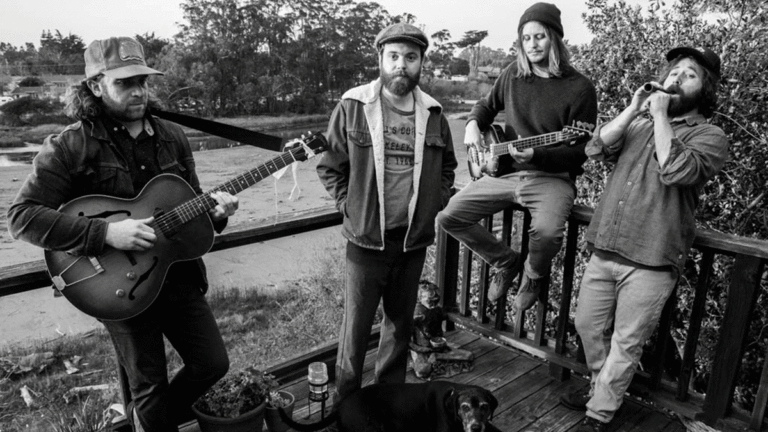
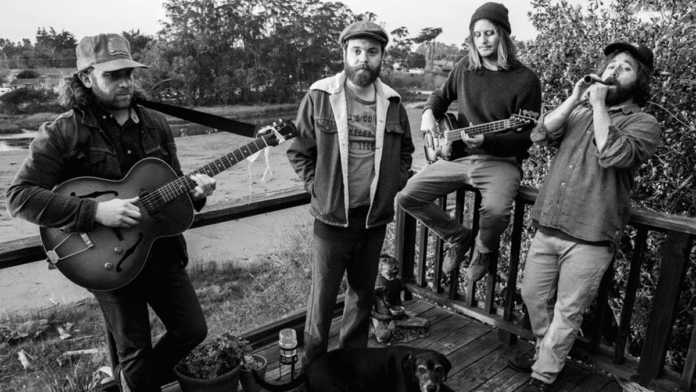
In late May, local four-piece Burning Pictures released its first single “Seaglass,” a dreamy Americana tune that could easily accompany a drive up the California coast.
On lead vocals is singer-songwriter Joe Kaplow, an artist already beloved in town, but this isn’t his band, per se. He’s one of four equal members—with Bobcat Rob Armenti, Michael Whalen and Elliot Kay—who take turns writing and singing songs. It’s a local all-star Americana supergroup.
“Joe will write a song that’s a very intimate, heartfelt thing. And then Mikey will bring in something that’s got a much more danceable, up-tempo, funky vibe to it,” Kays says. “Certain people in the band contribute different elements that are all important to the music.”
The group plans to showcase this diverse talent by releasing three more singles this year (and eventually, a full-length record). Each song will be written by a different member of the band, who will also sing lead, with the exception of Kay, who writes but doesn’t sing lead.
“We idolize a lot of bands from back in the day that were great being a sum of their parts,” Kay says, like The Band and the Beatles. “It’s really difficult to keep multiple people together in the same place long enough to really build something together.”
The group played its first official show in April, but the members have played together for over a year. They used to be the backing band in Kaplow’s solo project.
Eventually, Kay says, the group decided, “Let’s just give it a band name and all write and contribute our material and have it be more of a democratic thing.’”
9 p.m. Friday, June 21, Moe’s Alley, 1535 Commercial Way, Santa Cruz. $12 adv/$15 door. 479-1854.
Santa Cruz County live music picks for the week of June 19
WEDNESDAY 6/19
ROCK
SUMMER CANNIBALS
Summer Cannibals ditched its work in progress—nearly an entire album’s worth of material—when bandleader Jessica Boudreaux fought her way out of a toxic relationship. Using the ensuing complicated feelings and sense of freedom Boudreaux experienced, Summer Cannibals started a new super-charged project, Can’t Tell Me No (which comes out June 28). It has the same raw energy of their other two albums, but a new level of social confrontation stands front and center, unapologetic. Short and fierce rock anthems proudly rail against those who explicitly or tacitly try to silence women. AMY BEE
In 2017, the Real Sarahs released sophomore record Afternoon with the Dirty Birds. It was an unusual album for the acoustic trio, as it showcases the group’s folksy songs backed by the roots-rock stylings of the Dirty Birds. The band followed the record with 2018’s Headed For The Hills, a return to doing what it does best: strumming acoustic instruments and singing lush, hooky harmonies. These are gorgeous, emotive songs that’ll make you feel like you’re lost in a daydream. AARON CARNES
7:30 p.m. Michael’s On Main, 2591 Main St., Soquel. $10. 479-9777.
COMEDY
BETHANY VAN DELFT
Some comedians tell jokes; others tell stories. Bethany Van Delft is somewhere in the middle. This Bostonian stand-up veteran is never afraid to dig into her life and bare it all: being a mother to a child with Downs Syndrome, balancing her comedy career with a life at home while raising kids “who don’t need therapy,” and her hatred for “diversity” comedy showcases. She also currates a weekly showcase in Boston called “Artisanal Comedy” that highlights out-of-the-box comedians who might not fit into a normal stand-up night. She’s also been featured on Comedy Central, SF Sketchfest and the 2 Dope Queens podcast. MAT WEIR
8 p.m. DNA’s Comedy Lab, 155 S. River St., Santa Cruz. $20 adv/$25 door. (530) 592-5250.
FRIDAY 6/21
JAZZ
CECILE MCLORIN SALVANT & SULLIVAN FORTNER
A once-in-a-generation talent, Cécile McLorin Salvant has surpassed the oversized expectations that greeted her triumph at the 2010 Thelonious Monk International Jazz Competition. In February, she earned her third consecutive Grammy Award for best jazz vocal album, a highly interactive duo project with New Orleans pianist Sullivan Fortner, The Window. Brimming with divergent musical ideas, Salvant is an expanding creative universe. Sardonic, ironic and open-hearted, her music embraces folk-song simplicity and art-song sophistication, singer-songwriter revelation and bebop exultation. ANDREW GILBERT
7 and 9 p.m. Kuumbwa Jazz, 320-2 Cedar St., Santa Cruz. $31.50-$47.25. 427-2227.
SATURDAY 6/22
COMEDY
ADAM CONOVER
Adam Conover from the TruTV show Adam Ruins Everything calls himself an investigative comedian, which sounds like the set up for a raunchy joke, but it’s really just a label for those who research the wackier and weirder aspects of human knowledge and then crack jokes about what they find. On his podcast and show, Adam uses his nerdy visage and endearing charm to disarm our natural tendency to shut down when someone is trying to teach us facts, and then brings out an expert once we are defenseless. It’s a good tactic. But the question is: how good is his stand up? Only one way to find out! AB
7 p.m. DNA’s Comedy Lab, 155 S. River St., Santa Cruz. $20 adv/$25 door. (530) 592-5250.
METAL
SUPER MADNES
Naoki Kodaka penned the soundtrack for the NES Batman game, and wrote the tunes for Blaster Master, Spy Hunter, Fester’s Quest, and about 20 other classic-era titles. In the pantheon of video game music, Batman often gets lost in the shuffle of bona fide jams like Duck Tales and Mega Man 2, but Super MadNES hasn’t forgotten. At the Blue Lagoon this Saturday, the live-video-game-music metal band pay tribute to Kodaka with a full version of the Batman soundtrack, along with other period classics. If you got a utility belt, bring it: the bat signal waits for no one. MIKE HUGUENOR
7 p.m. Blue Lagoon, 923 Pacific Ave, Santa Cruz. $10. 423-7117.
FOLK
GHOSTS OF PAUL REVERE
Ghosts of Paul Revere isn’t so much a bluegrass group as a rock band that just happened to only have country instruments when it started. Listen past the surface and a whole world opens up, heavily influenced by the Beatles, Radiohead and others outside of so-called traditional music. MW
While some of the music on Zoe Boekbinder’s Shadow could be described as delicate, Boekbinder herself is anything but. Described as “ageless, beautiful, heartbreaking, and wise” by Neil Gaiman, Boekbinder’s voice is a powerful thing. Throughout Shadow, the New Orleans singer-songwriter looks straight into the darkness that follows her and pierces it, finding something like light on the other side. Boekbinder throws a bit of Amanda Palmer into a songwriting style reminiscent of Songs: Ohia, with a bit of the ol’ Big Easy for good measure. MH
Matthew Logan Vasquez’ latest single “Trailer Park” is a refreshing celebration of the diversity of rural Texas, where over a high-energy rock tune, he sings about the neighborly mix of “rednecks, hippies, Latinos, liberals and conservatives.” The song is one of the few upbeat tunes on his third record Light’n Up, where he devotes most of his time detailing a dark period in his life where he was caring for his ailing father. Better known as a member of Delta Spirit and Glorietta, Vasquez seems increasingly at home in the solo format, going into more introspective waters. AC
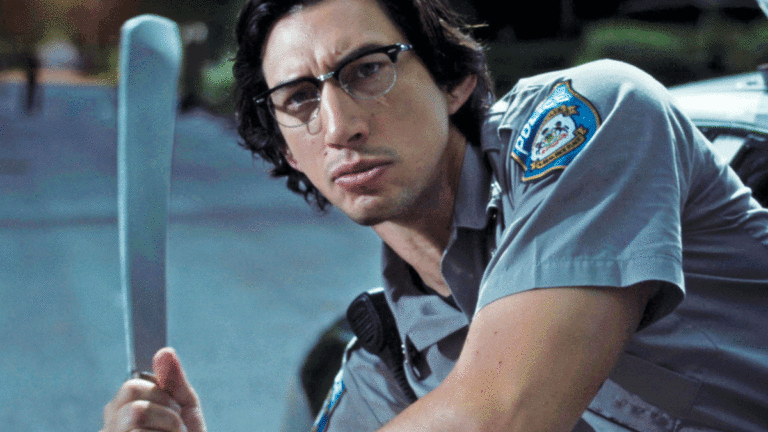
In some circles, the words Jim Jarmusch zombie comedy would be all the PR you’d need to sell a movie. It’s irresistible: the hipster auteur of Stranger Than Paradise, Coffee And Cigarettes, Ghost Dog, and Only Lovers Left Alive making a meal of the flesh-eating dead horror apocalypse genre. Especially when you learn the cast includes such longtime Jarmusch stock company stalwarts as Bill Murray, Steve Buscemi, Tilda Swinton, Iggy Pop, and Tom Waits. But while it looks so promising on paper, the onscreen result needs a little more meat on its bones.
It would be shameless punning to employ words like “stilted” and “catatonic” to describe a movie about reanimated dead people. Certainly, everybody involved seems to be having a swell time, from actors playing both the living and the dead (often getting to segue from one to the other), and Jarmusch himself, so tickled that he lingers over every shot; you can almost hear him chuckling off-camera. But the audience, not so much—we’re forced to endure long stretches of ennui between unsubtle moments that drive home the message, and name-that-zombie celebrity-spotting.
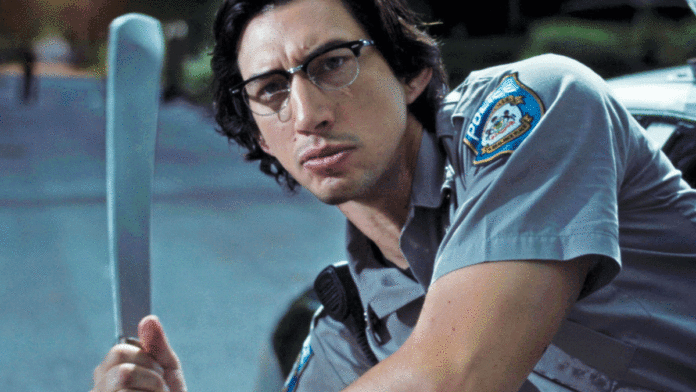
Centerville is a sleepy little burg that boasts a diner, a gas station/mini-mart, and a motel. There’s not much for sheriff Cliff (Murray) and his deputies Ronnie (Adam Driver) and Mindy (Chloe Sevigny) to do besides an occasional trip to the woods at the edge of town to scold Hermit Bob (Waits, in an enormous salt-and-pepper Rasta wig) for stealing a neighbor’s chicken.
But something weird is going on. It’s staying light too late. Watches stop. Radio contact fizzes out. Cell phones no longer work. Next morning, the town wakes up to a grisly crime scene. Cops and onlookers ask each other if it a wild animal, or perhaps several wild animals. It’s up to Ronnie to deliver the only explanation that appears to fit the evidence: “I’m thinking zombies.”
The deadpan (sorry) byplay between Murray and Driver in this interlude would be humorous, if Jarmusch weren’t guilty of overkill (sorry, again). Three different characters enter the crime scene, get an eyeful of the corpses (along with the viewer), and emerge with the exact same verbal response. Twice would be funny; by the third time, we’re wondering if they mistakenly slipped in a reel from Groundhog Day. Anyway, it’s all just prelude, because the next night—which begins way too early—every grave in the cemetery is shoved open as the dead take to the streets to chow down on the flesh of their living neighbors.
That’s it for plot, although Jarmusch comes up with some droll stuff long the way. It’s said that the undead flock to the things they loved in life (Iggy Pop is the one jonesing for coffee), so we hear various zombies moaning for Snickers, Xanax, Wi-Fi, and Chardonnay. (That last from Carol Kane, as the recently deceased town drunk.) Buscemi plays an angry racist in a red “Make America White Again” baseball cap. Swinton is a sword-wielding Scottish ninja. And nifty homages abound to Night Of the Living Dead, the granddaddy of the modern genre, from a trio of traveling teens in their “George Romero car” (a ’68 Pontiac) to a recreation of the iconic wall of two-by-fours hammered up to keep out the zombie menace.
The oft-repeated explanation is that “polar fracking” by stupid humans has knocked the Earth out of whack and opened the floodgates for the zombie apocalypse—one way for Mother Nature to get even. (Or, as Hermit Bob puts it so succinctly, “What a fucked-up world.”) Point taken. But a bit more honed outrage (or at least funnier satire) might have served better.
THE DEAD DON’T DIE
**1/2 (out of four)
With Bill Murray, Adam Driver, Tilda Swinton, Chloë Sevigny, Steve Buscemi and Danny Glover. Written and directed by Jim Jarmusch. A Focus Features release. Rated R. 104 minutes.
In its first year, NorCal’s newest punk rock party the Bash seemed impressively packed. Last weekend’s upstart festival at the Santa Clara Fairgrounds created a vibe that was not unlike late-’90s Warped Tour, when it actually had punk bands whose legacy could draw crowds across generations of fans.
There was legacy to spare in this line-up, for sure. Headliner Rancid turned the clock back to the days when “Time Bomb” and “Ruby Soho” were fresh additions to the radio playlists. But more importantly, they got back to why ’90s punk continues to resonate. When frontman Tim Armstrong first took the stage, by himself, he walked up to the edge and sang the words of set opener “Radio”— “When I got the music, I got a place to go.” I’ve always felt those lyrics described my relationship with punk rock, and I’m sure I’m not alone. He was then joined by the rest of the band, which blasted through old favorites from …And Out Came the Wolves and Let’s Go, as well as the band’s most recent album, 2017’s Trouble Maker. Along the way, the local legends gave a shout out to pretty much every city in the Bay Area, including Santa Cruz.
Hermosa Beach legends Pennywise have always been a crowd favorite, and they did not disappoint. Frontman Jim Lindberg is a relatable figure that reminds us to question authority and not to care what others think. Middle fingers were waving, pits were raging, and there was even a brief course in punk history when Lindberg guided the band through short snippets of songs by Descendents, Minor Threat and Dead Kennedys, plus a full version of Circle Jerks’ “Wild in the Streets.”
Suicidal Tendencies got the crowd moving with songs like “You Can’t Bring Me Down,” “Subliminal” and “Institutionalized.” New members Ben Weinman (ex-Dillinger Escape Plan) and Dave Lombardo (ex-Slayer) gave the band’s classic songs a brand new dimension. O.G. front man Mike Muir never lacked for something to say.
L7 and Sharp Shock opened the show while early arrivers sampled a large selection of craft beers. Here’s hoping the Bash returns, so area punkers know we have a place to go.
Marin Artukovich is an ace at producing wine—and he loves the challenge. He makes 46 different kinds! And Artukovich says he very seldom duplicates a wine.
On a recent visit to his tasting room at MJA Vineyards, I was spoilt for choice, but Artukovich is always ready to step in with a few suggestions. He’s a wealth of information about everything to do with the grape, so allow plenty of time to try his fabulous elixirs and soak everything in.
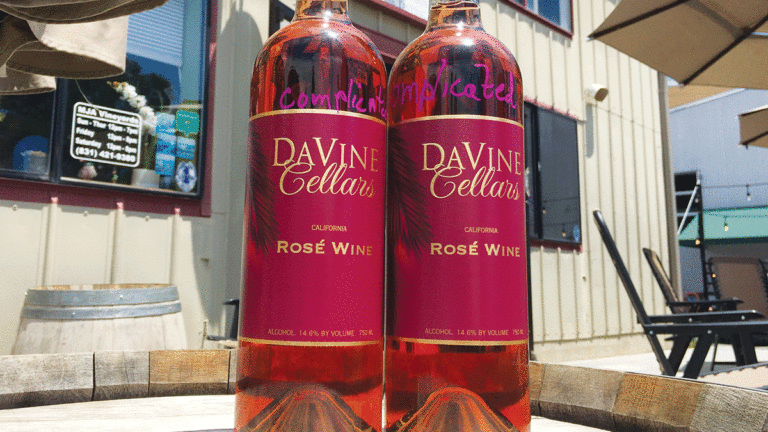
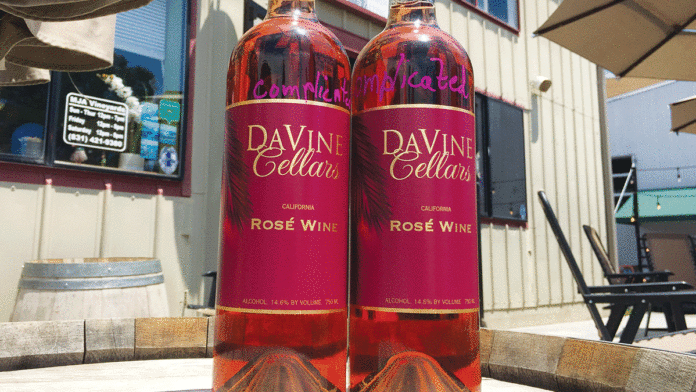
Artukovich is the owner of MJA, where David Middleton is the winemaker. The winery has two labels under this umbrella, DaVine Cellars and Serene Cellars. I’m nuts about good Rosés, and Artukovich has a great one. All his wines are given a name, and the Rosé ($30) is called “Complicated.”
Labelled NV (non-vintage, meaning the wine is made from grapes from more than one harvest), this earthy wine has delicious stewed fruit and herb flavors. And the almost-ruby color is an indication of the full-on fruit that lies within.
One of Artukovich’s goals is to “build a big wine club that stays with me.” And when you’re a wine club member at MJA, you’ll be in for lots of treats. Wine club members get 30% off their wine. “I don’t have a middleman, so wine club members get the benefit,” Artukovich says.
Music is a regular feature at the tasting room, along with food trucks offering good grub. Quarterly movie nights take place in the abundant space in the facility, which is also available to rent out for events.
The talented Artukovich also grows Kona coffee in Hawaii, and his coffee is for sale in the tasting room. He’s proud of his Croatian background, the coffee he grows and all the gold medals his wines have won. He credits his son John Artukovich, who also works at the busy tasting room, for entering the winery in competitions.
As Artukovich says about his eventful voyage of making wine and growing coffee on the islands, “We swear you can feel the journey and taste the aloha.”
MJA Vineyards, 328 Ingalls St., Santa Cruz, 421-9380; 24900 Highland Way, Los Gatos, 408-353-6000. mjavineyards.com.
Organic waste like food and yard debris makes up anywhere from 25-50% of what people throw away. Considering all of that waste is biodegradable, and beneficial for the soil and plants, sending it to a landfill is not only silly, it’s pretty backwards. Anyone can learn to build a simple, versatile, stacking compost bin to throw away food scraps and organics. This hands-on compost bin demonstration uses wood from an old deck, saving it from the landfill by repurposing it into a handsome container suitable for composting. All are welcome, no experience necessary.
INFO: 10 a.m.-noon. Saturday, June 15. Common Roots Farm, 335 Golf Club Drive, Santa Cruz. mbmg.org. Free.
Art Seen
‘Oceans Flamenco en Vivo’
On her 24th tour stop, renowned Seattle-based Flamenco artist Savannah Fuentes is bringing her latest work, Oceans Flamenco en Vivo, to Santa Cruz. The water-themed presentation will feature singer/percussionist Jose Moreno and guitarist Pedro Cortes, both of whom are third-generation Spanish Flamenco artists from New York City.
INFO: 8 p.m. Tuesday, June 18. Live Oak Grange, 1900 17th Ave., Live Oak. brownpapertickets.com. $22. Photo: Stephen Rusk.
Thursday 6/13
Pop-Up Picnics in the Park
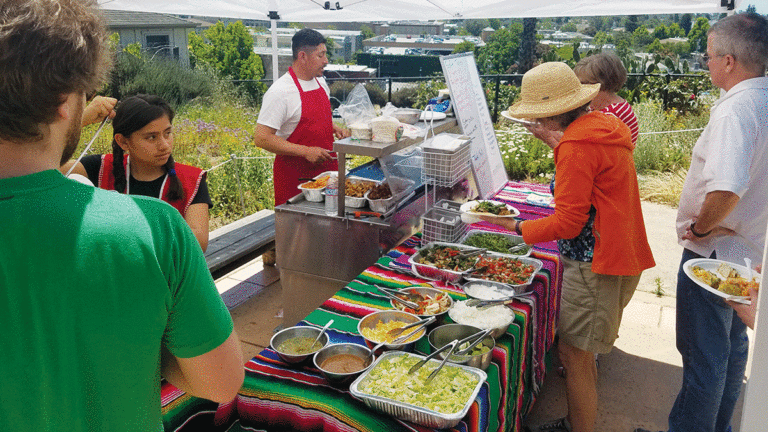
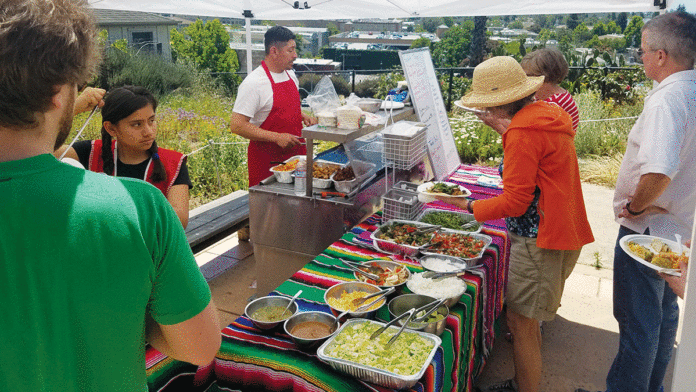
What better way to ring in summer and celebrate the warm, albeit delayed, weather than an outdoor picnic? Sponsored by the Santa Cruz Mission, these community picnics run every Thursday (not including the Fourth of July) until Aug. 15. Picnickers can purchase lunch or bring their own. Take in the view of downtown from the Mission’s plaza or enjoy lunch under the shade of avocado and redwood trees, and maybe even meet some new picnickers along the way. Taquitos Gabriel, a Mole and Mariachi Festival favorite and competitor, will serve food at each of the picnics. The menu includes tacos, plates, burritos, quesadillas, and drinks, with occasional specials like mole.
INFO: 11:30-1:30 p.m. Santa Cruz Mission State Historic Park, 144 School St., Santa Cruz. thatsmypark.org. Free, items for purchase range from $2-10.
Thursday 6/13
Marshmallows and Apples (Plus Skulls and Pelts)
Ok, so marshmallows and skulls and pelts aren’t really things that go hand-in-hand, except for maybe on Halloween. Even then, it’s questionable. Join the Big Basin park rangers in their weekly campfire, complete with marshmallows and roasted apples for the healthier types. The rangers are experts on all of Big Basin’s native animal pelts and skulls, so fuel your inner child and creepy curiosities all at the same event. There will be crafts and games, too. Hopefully not with the skulls and pelts.
INFO: 3:30-5:30 p.m. Big Basin Redwoods State Park. 21600 Big Basin Way, Boulder Creek. 338-8883. Free, daily parking $10.
Wednesday 6/14 and Friday 6/19
Bands and Movies on the Beach
Aside from rising temperatures, an increase in beachgoers and a preference for outdoor dining, the return of the Santa Cruz Beach Boardwalk’s free screenings and concerts is a welcome summer ritual. It’s one thing about Santa Cruz summers that has never really changed—think the Lost Boys’ Corey Feldman and his band of Angels in the late ’80s. Speaking of the Lost Boys, it’s also the screening that kicks off the summer movie series on Wednesday, June 19. Grab a blanket, cooler and chair and get there extra early for a good seat to an old tradition. Performances and movies listed in advance online.
INFO: Friday concerts begin at 6:30 and 9:30 p.m. June 14 through Aug. 30. Wednesday night movies begin at 9 p.m. June 19 through Aug. 14. Santa Cruz Beach Boardwalk. 400 Beach St, Santa Cruz. 423-5590. beachboardwalk.com/events. Free.
The last time I interviewed Patrick Simmons of the Doobie Brothers, he told me he was a little fed up with everyone assuming that Bay Area music began and ended in San Francisco around the Summer of Love. Most of the longtime Doobies, for instance, got their start in San Jose or Santa Cruz. And even the San Francisco bands drew on talent from around the Bay Area—as did the biggest bands from around the country and beyond. John McFee, the current guitarist and multi-instrumentalist who has been with the Doobie Brothers for the better part of 40 years, was born and raised in Santa Cruz, and has played on everything from the Grateful Dead’s From the Mars Hotel to Van Morrison’s Tupelo Honey to Elvis Costello’s My Aim in True.
Simmons goes so far back with Carlos Santana at this point that he told me didn’t even remember exactly when they first met, or even when the Doobies started playing shows with his band Santana. But there’s so much history with these two bands—including Santa Cruz history—that it’s great to still see them playing together more than four decades later. They’re doing a huge show at Mountain View’s Shoreline on Wednesday, June 26, and in this issue both Simmons and Santana himself talk about the history and legacy of their careers. Rock on!
Experts can agree that people are forced to live on the streets due to lack of affordable housing and stagnant wages. Increased rent prices have to lead to the rise of the homelessness population, especially in California’s expensive areas (Zillow, 2017). Federal housing vouchers, which are considered to be a solution, are not sufficient enough because only a quarter of homeless individuals receive it nationwide. $20 billion worth of vouchers are available per year, but only $1 billion vouchers are utilized (Zillow, 2017). It costs taxpayers a tremendous amount of money to leave people on the street. The homeless crisis could improve with the implementation of tiny home communities. Six states in the U.S. have had success stories (2018, Washington Post). In Austin, Texas, a program was implemented called Community First! Village. This program initiated a 51-acre development. It provides affordable, permanent housing as well as a supportive community for the chronically disabled homeless in central Texas. Community First! Village has become the largest community-based model in the country and exists to help and serve homeless neighbors who have been living on the streets (Mobile Loaves and Fishes, 2015). Other states that are using tiny houses to help the homeless include Kansas City, Missouri, Detroit, Nashville, Newfield, New York, and Seattle.
Tiny homes of 200-400 square feet could rent for $1 per foot per month, which is a much more affordable option for homeless individuals, with or without housing authority assistance. Permanent residences for the homeless is the first step to helping this population live healthier, quality lives.
Ashlyn Vargas, Khushboo Asija and Samantha Wildman
Santa Cruz
Poor Priorities
We spend millions on fruitless Russia probes and research on climate change, and billions have been spent subduing the cannabis industry. To what end? Are our lives any better? Of course not, and all the while the most vulnerable, the addicted and homeless suffer because of ineffective policies and poor financial planning. Why is it when citizens owe money to the government or you fail to show up for court, immediate action is employed and consequences ensue, yet when our very own suffer opioid addiction or homelessness the timeline to resolution is so prolonged?
Public schools should be beautiful, the weak, aged and disabled should be protected and have basic human needs, and no person should ever, ever be left sleeping on the street.
If we can’t at least shelter our own citizens (because no one in their right mind would choose this), then what good is government really? If government works with the people we can achieve great things. We need serious people to run on these issues and then we can indulge our relative curiosities via research.
A. Anderson
Santa Cruz
Re: Recall Effort
Right-wingers? Really, Nuz? Your accommodating arrogance puts you firmly in the running for Krohn’s next candidate recruitment, since Justin Cummings turned out to be so disappointingly independent. And to think just yesterday I was telling someone that GT’s journalism was superior to the Sentinel (a low bar, I know). I guess we all have our blind spots.
8,000 signatures will be a snap.
— Mark
Re: Microfibers
GT pointed out that the microfiber filter is a good solution “for those that can afford them.” Why doesn’t the County (and for that matter the City) of Santa Cruz and/or the water agencies offer a rebate on the filters, like for compost bins? This is a super important issue, especially for our seaside region. The filters will probably also save money in terms of wastewater filtration in the long run (since they appear to filter out other things as well).
— Julie
PHOTO CONTEST WINNER
Submit to ph****@*******es.sc. Include information (location, etc.) and your name. Photos may be cropped. Preferably, photos should be 4 inches by 4 inches and minimum 250dpi.
GOOD IDEA
A new report that says Santa Cruzans see the City Council’s antics as “dysfunctional,” “theatrical,” “childish,” “disrespectful,” and “embarrassing.” The study comes from a collaborative and consensus-oriented California State University Sacramento program, which was studying how to proceed with a possible taskforce on rental housing. The consultant’s recommendation? Don’t bother; the discourse is too toxic right now. The report could provide a needed wake up call for city councilmembers. Chances are they’ll sleep through it.
GOOD WORK
Immediately after GT covered the environmental microplastic disaster last week (“World Piece,” 6/2/2019), two new studies detailed findings about just how prevalent these ocean contaminants are. A study from Monterey Bay Aquarium researchers laid out frightening levels of microplastics swirling through our region, sometimes in concentrations greater than the surface of the infamous Great Pacific Garbage Patch. A separate study published in Environmental Science and Technology found that humans may be consuming anywhere from 39,000-52,000 microplastic particles per year.
QUOTE OF THE WEEK
“If someone thinks that peace and love are just a cliché that must have been left behind in the ’60s, that’s a problem. Peace and love are eternal.”
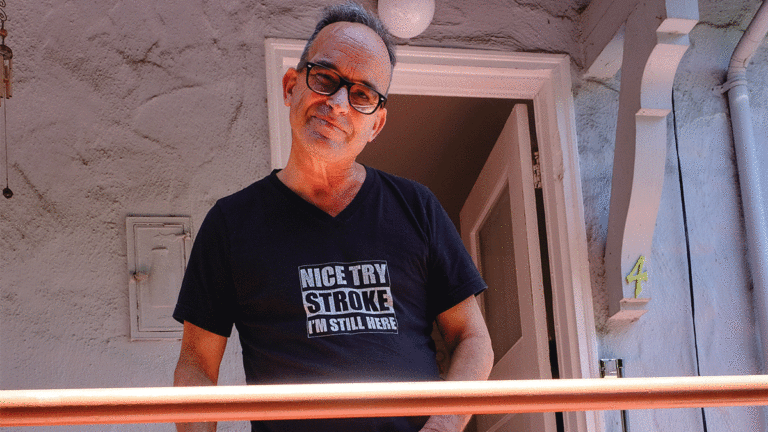
In February of 2017, Robbie Schoen, one of the most tireless advocates for the Santa Cruz visual-arts community, experienced a massive stroke that left him paralyzed on his left side.
Now, more than two years later, Schoen wants the arts community that supported him in the aftermath to know that he’s still very much involved in creative endeavors.
“I am healing,” says Schoen in a phone interview. “That’s the truth. I’m really starting to function again.”
On Friday, June 14, Schoen will mark his 61st birthday with a public celebration at the Felix Kulpa Gallery, the Santa Cruz art space that he managed and curated for more than a decade.
The event (5-9 p.m.), will feature barbecue, live music and plenty of good cheer to Schoen, who will be on hand with all the past and current directors of the Kulpa, including Robert Fallon, Michael Leeds and Mary Kopp.
Besides managing the Kulpa, Schoen was exhibit designer at the Museum of Art & History in Santa Cruz. And he was a working artist as well—in his heyday as a conceptual artist, he would often fashion guitars from a wide variety of found objects, including toilet seats and satellite dishes.
The stroke, which struck the right side of his brain, was devastating, and he was sedated for weeks afterwards. At first, the extent of the neurological damage was unclear. With intense speech and physical therapy, Schoen gradually began to regain language and memory function.
“He needed caregivers around the clock for quite some time,” says his uncle Ralph Meyberg. “But as he’s improved and his physical motor function has improved, he’s been able to cut back a bit on his caregiving.”
Though his left side remains paralyzed, Schoen has made progress in re-learning to stand and walk with a cane. “Every step is literally a step forward in his progress,” says Meyberg.
As for the future, Schoen says he’s focused on regaining even more motor skills, and picking up his artistic pursuits, which now include writing and making small art works from photographs. He would also love to contribute again at the MAH.
“I plan on keeping busy,” he says. “But I have to get able-bodied. There are still parts (of my body) I’m waiting to work again. But it is nice to be back.”
Robbie Schoen’s 61st birthday will be celebrated at 5 p.m. on Friday, June 14 at Felix Kulpa Gallery in Santa Cruz. Featuring live guitar music by Fixion Music. Free.
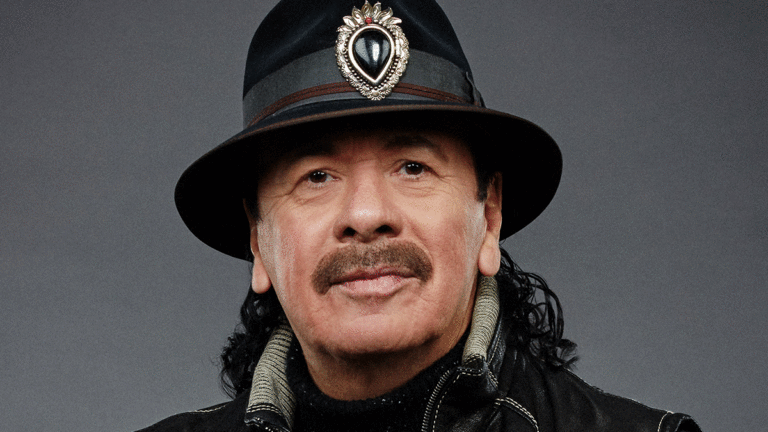
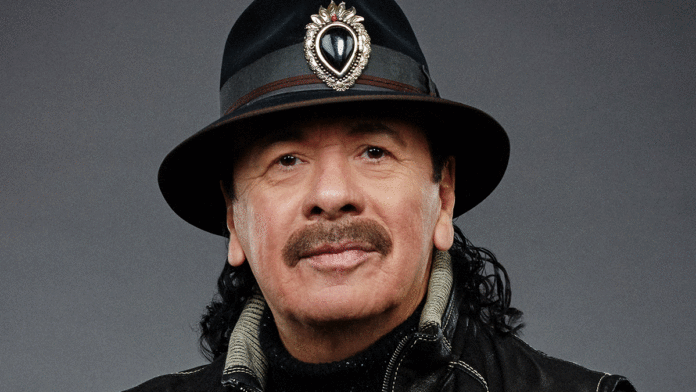
Though he no longer lives in the Bay Area, Carlos Santana holds fond memories of his time here—including living in Aptos, where he moved with his first wife in the early ’70s.
“It was time to start a family,” says Santana, who now lives in Las Vegas, via phone. “And that house in Aptos became like a nest.” The couple’s first of three children, Salvador, was born during their time there. “I’m very grateful and very clear about what each place that I have lived has given us,” he says.
The band to which Santana lent his last name—first as the Santana Blues Band in the late ’60s, then as simply Santana—is primarily linked to one place: San Francisco, where it rose out of the local music scene. Even once the group broke through to international success after its performance at Woodstock in 1969, the guitarist’s connection to the Bay Area has endured. He brings Santana back to NorCal on June 26, teaming up for a concert at Shoreline Amphitheatre with the Doobie Brothers, another classic band with an interesting connection to Santa Cruz.
When Santana lived in Aptos, he was a follower of the Indian spiritual leader Sri Chinmoy, and his band’s music has always had a somewhat mystical quality.
“Santana’s music is very spiritual and sensual,” he says of his band. He discovered the effect it had on audiences before he even landed a record deal, back when he and his crew brought their music to clubs and on campuses around the Bay Area. “The first thing we noticed is that the women move differently.”
While today’s pop freely blends global musical textures with traditional American forms—from rock to R&B to blues—it is worth remembering that Santana’s self-titled debut sounded nothing like its contemporaries.
From his earliest days as a bandleader, Santana has mixed guitar-led jamming with percussion rooted in Caribbean and African traditions. By combining high gain amplifiers and improvisational instrumentals with a repetitive Nigerian chant by Babatunde Olatunji and Latin flourishes, Santana’s 1969 lead single “Jingo” introduced a new kind of fusion, and in doing so, influenced a generation of musicians.
DOORS OF PERCUSSION
“I was learning how to do this alchemy between blues and African rhythms,” Santana says, explaining how he came to piece together all of the various musical idioms that form his distinctive sound. “We were learning from Willie Bobo, Jack McDuff and anyone who had congas and timbales. We put electric guitar with that, and something changed.”
The term world music may trace back to the early ’60s, but it wouldn’t come into wide use until the 1980s. By that time, Santana had been making music that drew from styles outside the European tradition for well over a decade.
His Mexican heritage—Santana was born in 1947 in the city of Autlán, and spent much of his youth in Tijuana—has always informed his music. Other early influences, like Hungarian jazz guitarist Gábor Szabó, broadened his horizons. From an early age, Santana’s interests included folk and, notably, blues guitarists B.B. King and John Lee Hooker.
But there was always something about African musical rhythms that moved him. In both raw form and filtered through Latin and Afro-Caribbean traditions, they would come to be a key part of the Santana sound. “Since the beginning of the Santana band, this has been a global consciousness music,” he says.
This year’s tour will feature as its opening act another deeply rooted Northern California rock ‘n’ roll institution—the Doobie Brothers. Started in San Jose in 1970, the Santa Cruz history of the Doobies is less well-known: their regular gigs at the legendary biker bar Chateau Liberté in the Santa Cruz Mountains earned them hardcore fans in the 1970s among the Hell’s Angels and other biker gangs. Multi-instrumentalist John McFee, still one of the core group members today after joining the Doobie Brothers in 1979, was born and raised in Santa Cruz.
Doobies guitarist Pat Simmons says the group has played with Santana a number of times over the years, including a 2017 swing through Australia and Japan. “We’re complementary musically and historically,” he says. “It’s always been a good show.”
BROTHERLY LOVEDoobie Brothers guitarist Pat Simmons says the Bay Area band has always been musically complementary to another longtime local, Carlos Santana.
“It’s always been great for us to play with other bands—Journey, Chicago, Eagles,” Simmons says. The Sep. 20 concert with the Eagles at San Francisco’s AT&T Park in front of 40,000 fans was one of last year’s big shows.
“We’ve been around for a long time, and any time we get a chance to play in front of new fans, it’s good for us,” he says. “You make your fans one at a time.”
Both bands are still creating new material. “We just cut five tracks,” Simmons says of recent recordings with producer John Shanks, set for release next spring, most likely as an EP. “Everything winds up online anyway,” he says, a realization that the industry’s changed a lot in half a century. “For a band like ours, it’s more about just letting people know we’re still working. I’m not sure it makes any sense to make a full album.”
He also reveals that the Doobie Brothers will perform a special show of 1973’s The Captain and Me at The Masonic in San Francisco this September. It’s a follow-up to their performance of that album and its 1972 predecessor Toulouse Street at New York’s Beacon Theater, which will soon be released as a live album.
Santana’s latest effort is Africa Speaks (out Jun. 7 on Concord Records). The album is full of the trademark Santana guitar style, but the rhythms are even more pronounced and upfront than on much of the band’s previous material.
“Everything that I ever learned came from Africa. Coltrane, Chuck Berry and Cream got it from Robert Johnson; Robert Johnson got it from Charlie Patton. Charlie Patton got it from Timbuktu in Africa,” Santana says. “No matter how you slice it or you shuffle it, you’re still playing African music. When I say this, I say it in a very divine way: it’s all the same. It’s still African language.”
And the guitarist comes by his African emphasis honestly. “Santana is one of the few bands that goes global, to each of the four corners of the world,” he says. “And we’re not tourists. We’re part of the family.”
Mallorcan singer and artist Buika takes the lead vocal on the album, much of which is sung in her native tongue, Spanish. Produced by Rick Rubin, the sessions for Africa Speaks yielded almost 40 songs, and dozens ended up on the cutting room floor, or as Santana puts it, “They’re in incubation.”
Name-dropping some of the top-tier artists he counts as friends—Mick Jagger, Lenny Kravitz and Sting—he teases the potential of the unreleased tracks. “Eventually, maybe I’ll find artists that can come in and sing on them.”
LOCAL NATIVES
As he chronicles in his 2014 memoir The Universal Tone, the Santana Blues Band formed in 1966, after the guitarist’s family moved from Tijuana to San Francisco. Once settled in the Bay Area, he became fully immersed in its burgeoning culture.
That same year, promoter Bill Graham started booking Santana’s band for local gigs. Graham, who started as a waiter in the Catskills and went on to invent the modern concert promotion industry, comes up whenever Santana is asked about his early days in the Bay Area music scene. “He was a supreme maitre’d,” Santana says. “Like my father and mother, he instilled in me how to present myself in a way that I wasn’t going to self-destruct. He would say, ‘The water is pure, the flowers are fresh, the apron is clean, the food is delicious. I hope you’re hungry; It’s my pleasure to serve you.’ That was his narrative.”
As Santana’s band grew in popularity, the group became a regular fixture at Graham’s Fillmore West. Before the release of the band’s debut album, Santana also played all over the Bay Area, including dates at the Dream Bowl in Vallejo, San Francisco’s Avalon Ballroom and Winterland.
WOODSTOCK NOTION
Prior to the release of Africa Speaks, the most recent Santana record was 2013’s Santana IV. That album marked the long overdue (if temporary) reunion of nearly all members of Santana’s early 1970s lineup, the band responsible for hits including “Jingo,” “Evil Ways, “Black Magic Woman,” “Oye Como Va,” “Everybody’s Everything,” and “No One to Depend On.” Each of those first three Santana albums reached the Top 10 on the Billboard charts, and the singles would all become staples of progressive radio, then AOR playlists, and finally classic rock radio.
That celebrated lineup is also the one that played the Woodstock Music & Art Fair on the afternoon of Saturday, Aug. 16, 1969. Sandwiched between a set by Country Joe McDonald and an impromptu performance by former Lovin’ Spoonful guitarist John Sebastian, Santana wowed the crowd at Max Yasgur’s farm with a 45-minute set that featured an incendiary reading of Olatunji’s “Jin-go-lo-ba” (today better known as “Jingo”) and an original, “Soul Sacrifice.” The band’s debut album wouldn’t hit record store shelves for another two weeks.
In his memoir, Santana says that he was high on mescaline at Woodstock; he writes that his memory of the set is “a blur.” But the festival’s overall vibe stayed with him. “What I remember is energy,” he says of the watershed cultural moment that marks its 50th anniversary this year. “The energy of people for three days sharing granola and good vibes: all the stuff that annoys the arrogant, cynical, slave people. It scares them to see that unity and harmony can actually happen before your eyes; people can not have needs for weapons or religion or politics, and we can actually share each other’s hope and celebrate each other. Woodstock really, really affected the rest of my life, my consciousness.”
CELEBRATION DAY
Though Santana has scored numerous awards on his own and with his band—including 10 Grammys and three Latin Grammys—and sold more than 100 million records across the globe, his commercial popularity has traversed many long and dry valleys between peaks.
Santana was in the midst of a particularly parched valley in the late 1990s; it looked as if his salad days were behind him. That perspective was underscored by his winning a kind of lifetime achievement award in 1998, induction into the Rock and Roll Hall of Fame. “Usually,” he says with a laugh, “when they give you that award, it’s over for you.”
Not long after the ceremony, the guitarist was approached by industry mogul Clive Davis. The executive—then the head of Arista Records—suggested that Santana collaborate with a range of current hot artists. The result was the juggernaut album Supernatural, featuring “Smooth” (sung by Matchbox 20 vocalist Rob Thomas) at its center.
The seemingly unlikely roster of artists who worked with Santana on Supernatural reads like a who’s who of 20th-century fin de siècle: in addition to Thomas, Supernatural pulls in Dave Matthews, Everlast, Lauryn Hill, CeeLo Green, and Eagle-Eye Cherry. The album even included a nod to rock history by way of a collaboration with Santana’s musical peer, guitarist Eric Clapton.
Santana’s principal vocalist during the Supernatural period, Tony Lindsay, has been an anchor of the South Bay’s jazz, soul and R&B community for the past four decades. He ended his 25-year run with Santana four years ago and hasn’t seen the new lineup, saying he cherishes the memories of bandmates he performed with. Still, he says, “I might just go” when Santana plays Shoreline on June 26. “Since it’s so close, I’ll probably be there,” the Peninsula resident says.
With Supernatural’s 20th anniversary this month, it would seem that a victory lap in the form of a retrospective tour would be in order. Instead, the creatively restless Santana is observing the ’99 album within the context of a tour that presents his newest material as well. Both “Candomble Cumbele” and “Breaking Down the Door” from Africa Speaks show up often in the band’s current set.
PASSION PROJECTS
One of the enduring qualities that ties together every project in which Carlos Santana has engaged is intention. At the height of Santana’s successful run of albums (Santana, Abraxas and Santana III), he shifted gears and made 1972’s decidedly uncommercial Caravanserai. That album brought in new players and explored Santana’s growing interest in improvisational jazz.
For Santana—who has also made collaborative albums with virtuoso guitarist John McLaughlin, Alice Coltrane and his brother Jorge—all of his work fits together. He brings the same commitment to projects that aren’t destined for the charts as he does to hit singles like “Smooth.”
“The connection between any album that I’ve ever done and will do is passion, emotion and feelings,” he says. A deeply spiritual man, Santana says that his music “is assigned and designed to take you out of your misery. It’s a frequency of certain elements that makes people feel at home.”
While he can freely quote the great philosophers, Santana instead chooses words from the Godfather of Soul to make his point: “As James Brown said, ‘Jump back and kiss yourself.’” When one does that—literally or metaphorically—“you’re actually validating your light,” Santana says. “You’re celebrating your spirit. That’s what we were born to do. And the only way to uplift someone is to help them be aware of their own light, their own magnificence.”
PEACE, LOVE & MUSIC
At press time, Santana was on the bill to perform at Woodstock 50, a half-century to the day after the band’s original set there. The modern-day event’s future is in serious doubt, and it’s not at all clear if Woodstock 50 will even happen—this week, the event lost its venue when Watkins Glen International decided not to host it, and then saw (as of press time) two of its producers walk away. True to form, Carlos Santana brings a mixture of mindfulness and intention to the question of whether a revival of the iconic festival is even a good idea.
“It depends on the consciousness of the artists,” he says. “Why are you coming to play? Are you coming to sell more records? Are you coming to sell Mountain Dew or tacos or marijuana? Or are you just coming here to celebrate the good qualities of humans?”
Santana says that those who came to the first Woodstock with the right intentions are still here: “We’re singing the same songs, differently. We reinvent ourselves, but the song is unity and harmony and healing and coming together and doing away, eventually, with patriotism, which is prehistoric. Anything that has to do with walls and patriotism and arrogance about, ‘We’re number one,’ that’s a division between ego and spirit. With spirit, we’re all one.
“Woodstock—the real Woodstock—is the opposite of fear and greed,” Santana says. And if that makes him sound like a hippie, he doesn’t mind. “Not a fake hippie with fake mustaches, fake wigs and phony values,” he says. “Not that hippie; the real hippie.” To him, that includes figures who “care for the environment, who want equality, fairness, and justice. Dolores Huerta, Cesar Chavez, the Black Panthers; those kind of hippies.”
For Santana, making music with intention is part of that mix, a vehicle to achieve those hippie goals. “It’s an art,” he says. “We do this so we can do that.”
Dan Pulcrano and Nick Veronin contributed to this story.
Santana and the Doobie Brothers perform at Shoreline Amphitheater in Mountain View at 7 p.m. on Wednesday, June 26. $35 and up. livenation.com.
It was just about five years ago when a small Santa Cruz software startup operating in the vague realm of “business intelligence” moved a couple dozen employees into the top corner of downtown’s stately E.C. Rittenhouse building.
Last week, Google paid $2.6 billion to acquire that now-not-so-little company, data analytics provider Looker.
“My gut reaction was, ‘Wow, this is huge news for Santa Cruz and for Looker,’” says Sara Isenberg, founder of the Santa Cruz Tech Beat news site.
Isenberg has seen past tech booms spawn local outposts for companies like Netflix, Seagate, Intel and Cisco, but a familiar migration pattern over Highway 17 to Silicon Valley has lent Santa Cruz a reputation as a place for tech companies to set up shop and have fun before they leave and get serious.
Though the terms of Looker’s new deal with Google are still being finalized, the company founded by local entrepreneur Lloyd Tabb in 2012 plans to keep its headquarters in Santa Cruz, a spokesperson tells GT.
“This is not, by any means, the end for Looker, but simply the closing of our first chapter,” Looker President and CEO Frank Bien wrote in a blog post announcing the deal last Thursday. Though Silicon Valley’s biggest companies have something of a reputation for smothering promising startups—a “kill-zone,” as The Economist put it—Google Cloud CEO Thomas Kurian wrote in his own blog post that the Looker acquisition “builds on an existing partnership” between the two companies, which share 350 joint customers like Buzzfeed, Hearst and Yahoo.
The Central Coast tech industry has seen a flurry of activity in recent years as local officials and business leaders aim to branch out from the area’s entrenched mix of long commutes and low-paying jobs in fields like hospitality. In addition to Looker’s success (it raised $280 million from investors), smaller startups in fields like genomics have been launched by researchers emerging from UCSC. Robust agriculture industries in Salinas and Watsonville have also fueled startups focused on next-generation farming or water efficiency. Still, Looker’s 10-figure deal with Google is far and away the biggest in recent memory.
On the day the acquisition was announced, Looker listed 102 open jobs on LinkedIn in locations from Tokyo to Dublin to New York. About two-thirds of all hiring was for positions in the greater Bay Area, including around 30 jobs in San Francisco and three dozen new positions in Santa Cruz in sales, finance, engineering and other corporate roles.
The company has come a long way since it first set up shop on the top floor of the Rittenhouse building in 2014.
“They started off with using half a floor, then the whole floor. At the time they had no idea how big it would be,” says Matt Shelton, a real estate broker with J.R. Parrish who has since helped Looker expand its downtown headquarters to almost the entire four-story building. “Nothing’s ever happened like this in downtown.”
Amid Looker’s growth spurt, Santa Cruz has also been forced to reckon with the region’s changing connection to high-value tech companies. In addition to homegrown startups like Looker, new outposts for big names like Amazon and growing legions of freelancers—plus the many local residents who ride private tech shuttles over Highway 17 each day—the influx of more affluent white collar workers has put pressure on the local housing market and notoriously anti-growth cities.
Looker’s new parent company is already expanding in all directions in the Bay Area, including Google’s planned 25,000-person office in downtown San Jose. If and how Santa Cruz could figure into those plans remains to be seen.
“Santa Cruz is one of the few corners of the San Francisco Bay Area that Google doesn’t own a big chunk of,” CNBC wrote in an article about the Looker deal. “Should Google decide it wants to expand in the area, it could have political capital with Looker’s Santa Cruz-native leaders.”
IN THE CLOUDS
Founded at the height of the “Big Data” craze, Looker describes itself as a company “dedicated to empowering humans through the smarter use of data.” Google Cloud’s Kurian praised the “unified platform for business intelligence, data applications, and embedded analytics.”
In human speak, Looker sells businesses software to better manage information that could help increase sales, save money or otherwise improve operations. Like other data-centric companies, that puts Looker at the center of the fast-evolving conversation about privacy in the digital economy. Late last year, the company hired a chief privacy and data ethics officer, tech industry veteran Barbara Lawler.
To compete for experienced corporate executives and highly-sought-after engineers, Looker has waded deeper into the world of Silicon Valley employee perks. In 2014, Carolyn Hughes, Looker’s vice president of talent and culture, told me as a reporter for the Silicon Valley Business Journal that the startup was recruiting workers from other parts of the Bay Area by offering relocation bonuses worth 15% of annual salaries and renting rooms at Hotel Paradox for those who still chose to live elsewhere.
Though large tech buyouts often result in vastly different payouts for employees with varying levels of seniority, an influx of new money could exacerbate tension in a community already grappling with mounting anxiety about income inequality. The pressure is particularly acute for the region’s low-wage workers, but it’s also felt by other would-be founders.
“I think the cost of housing is an issue for startups,” Isenberg says. “The fact is that’s a California problem. That’s not going to be fixed if they go to Silicon Valley.”
Santa Cruz County had a total of about 5,000 local tech jobs and 10,000 tech commuters as of early last year, according to a report by Christopher Thornberg of Beacon Economics. Though six-figure jobs at area tech companies are getting more common, he said that “growth depends on land use” and adding more housing, according to a write-up in the Sentinel.
There are also logistical issues like office space to contend with. Between Looker, Kaiser Permanente and other growing companies like Warrior Media, Shelton says the city is approaching capacity for large office space. “It’s gonna be difficult for the next big company,” he says.
In its first year, NorCal’s newest punk rock party the Bash seemed impressively packed. Last weekend’s upstart festival at the Santa Clara Fairgrounds created a vibe that was not unlike late-’90s Warped Tour, when it actually had punk bands whose legacy could draw crowds across generations of fans.
There was legacy to spare in this line-up, for sure. Headliner Rancid turned...