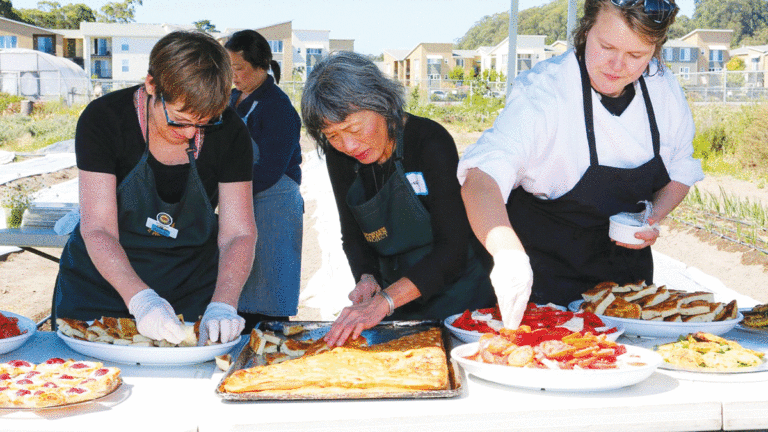

When my husband Jim died in 2003, it was an obvious choice to scatter his ashes at the Santa Cruz Mountains Estate Vineyard we co-owned with our winery partner. Benito & Azzaro’s Pacific Garden Chapel handled our funeral services and arranged for his cremation. Soon after, to protect my family from future cost increases, I locked in my own funeral plan there by pre-paying at current rates. It was my intention to be cremated—that is, until I read a 2017 GT article by Maria Grusauskas about how “Eco-Friendly Burial Practices May Make Death Greener.” I’d been dedicated to organic, chemical-free living since the ‘70s, so a green burial plan got my attention immediately.
Though environmental impacts aren’t often the focal point of funerals, American burials put 1.6 million tons of reinforced concrete, 20 million feet of wood, 17,000 tons of copper and bronze, and 64,500 tons of steel into the ground each year.
But what is a green burial? The Green Burial Council, an environmental certification organization setting the standard in North America, states that a burial is green only when it furthers legitimate environmental and social aims, such as protecting worker health, reducing carbon emissions, conserving natural resources, and preserving habitat. Levels of environmental benefits are detailed in the organization’s standards and eco-rating system. Soquel Cemetery is a hybrid burial ground, or a conventional cemetery allowing green burial. PurissimaCemetery in Half Moon Bay rates as a natural burial ground. The green rating system excludes concrete vaults and the use of embalming fluids in the body. Only caskets made of untreated pine or wicker, markers made of natural field stones, and linen or cotton shrouds can be used for the burial. Costs for green burial are lower because of the restrictions on caskets, embalming and elaborate headstones. Plots at Purissima run from $3,000 to $5,000, while conventional burials can cost up to $12,000, plus $6,000 or more for extra services. Ed Bixby, owner of Purissima Cemetery since 2017, has been restoring the dense, overgrown grounds to their original natural beauty. The 5.5-acre property along Purissima Creek is surrounded by massive cedar and pine trees with sweeping views of the Pacific Ocean. His term, “cremation conversion,” refers to individuals who originally planned for cremation but after visiting the grounds decided on a natural burial.
At the invitation of Patricia Kimie, pre-arrangement counselor and advocate for green burial at The Benito & Azzaro Chapel, I joined her for the idyllic drive to Half Moon Bay to visit Purissima. After meeting Bixby and touring the lush grounds, I felt deeply inspired to consider a cremation conversion of my own.
Bixby says that religious and ethnic groups often ask for their own private section, but he declines. “We’re all from the same earth; there’s no need for division now,” he says.
When he acquired his first cemetery in New Jersey after his brother’s burial, Bixby asked the state to fund a clean-up of the unkempt grounds. The response was that the only way to raise money was to sell plots. He became certified with the sole intention of raising enough money to clean it up. After witnessing his first green burial, he says, “I saw the effect it had on the family and got a new passion for what I was doing.” Then he began getting natural burial requests from California and a search led him to Purissima.
According to historian and author Mitch Postel, the cemetery is all that’s left of a town in the 1860s that had a saloon, hotel, schoolhouse, store, livery stable and post office. He writes in San Mateo County, a Sesquicentennial History that, “The town was founded by immigrants who thought Purissima would become the coast’s leading community. However, Half Moon Bay’s better location on the road to San Mateo gave it the advantage, and Purissima slowly disappeared.” (Wikipedia is the only source that mentions a change from the original spelling of Purisima, with one ‘s,’ stating that the change comes from local Portuguese influence taken from Puríssima Conceicão.)
While I hadn’t even heard the term green burial until two years ago, a conversation with my neighbor, Margaret Hammond Larson, made the concept real. I learned that when her daughter died five years ago, she and her son chose a beautiful spot in Soquel Cemetery designated as green.
As for how my four grown kids will react, I’m sure they’ll honor my wishes after they see the ocean-view plots at Purissima. With the blessing of my Creator, I visualize this “blue-minded”—as Wallace J. Nichols might put it—woman’s soul uniting in glorious harmony with the brilliant blue sea.
Look for the fire-breathing dragon on Alfaro’s Dragon Slayer label when you go searching for this flavor-packed red wine. Winemaker Richard Alfaro makes it easy to spot his wines on supermarket shelves with well-designed labels, often with his signature script “A” logo.
The Dragon Slayer wine’s color theme is decidedly purple—a deep, dark purple—thanks to an abundance of “baked dark fruit, stewed tomatoes and hints of cinnamon and pepper.” These spicy flavors on the palate, plus bright cherry, raspberry and mocha notes on the nose, give one enough courage and stamina to slay at least a dozen dragons!
A lively blend of Sangiovese, Zinfandel, Carignane, and Syrah, this reasonably priced wine ($20) pairs well with different foods. “Try it with sharp cheeses, beef, pork, sausage, Italian meatballs, pizza, and tomato sauces,” the winery suggests.
Alfaro’s tasting room is the place to be to try some for yourself—and then get a bottle to pair with your next T-bone.
Alfaro also participates in the quarterly Passport program, organized by the Santa Cruz Mountains Winegrowers Association (see below).
The next Passport event on Saturday, Jan. 19 is a day when you can visit vineyards, meet winemakers and enjoy a winter tasting of wines from the Santa Cruz Mountains. Passport Day offers an opportunity to visit wineries not usually open to the public. About three-dozen wineries participate, from Woodside to Gilroy. Each passport cost $75 and is valid for one year.
The next time you’re at Verve Coffee and you get the munchies, try their poached egg biscuit. An organic egg served on a heavenly Manresa biscuit with cheddar cheese is all yours for $7.50—and guaranteed to hit the spot!
A fill-you-up avocado toast with chives, radish, shallot, and a poached egg comes in at $9. Another of my go-to hunger-pang inhibitors is Verve’s chocolate croissant. It goes without saying how good their coffee is.
Live music highlights for the week of Jan. 16, 2019
THURSDAY 1/17
DANCEHALL
CHAM
Dancehall, the Jamaican musical genre that finds a meeting ground between hip-hop and reggae, has in recent years found a home in mainstream American culture with artists like Shaggy and Foxy Brown. Even Drake and Rihanna have embraced the genre. Cham (formerly Baby Cham) is a Jamaican dancehall artist who is both bringing the authentic dancehall sound to international ears and broadening its range with high-profile collaborations with Alicia Keys, DJ Khaled and T-Pain. AARON CARNES
Good classic rock epitomizes restless youth and reckless abandon. Howlin’ Rain exude both of these things, and will also goad you into selling your condo for a hippie van, warning you against a vague and problematic future and inviting you to live now. The endearing magic of their raucous rock ’n’ roll is at once nostalgic and invigorating. Howlin Rain howl and yowl and pierce your apathetic heart with the grittiest, sweetest, meanest, truest guitar riffs. AMY BEE
Easygoing indie rockers the 131ers’ latest album Nothing’s As It Should Be sounds ripe for radio with its cool, breezy beats, pseudo-anthem power pieces, and slick-but-not-corporate production value. But these guys are proud of their working-class ethic and strive to keep the DIY vibe as long their audience continues to find worth in it—and they keep having fun doing it. With charming harmonies and catchy, well-executed riffs, the 131ers exude friendly confidence as they deftly navigate the space between “selling themselves and selling out,” as frontman Kaleb Davies once quipped. AB
Twenty five years in, Lyrics Born is still as distinct a voice in hip hop as when the Tokyo-born Bay Area transplant first rapped over a DJ Shadow beat back in ’93. This year’s Quite A Life plays like a victory lap for the self-proclaimed “funkiest rapper alive,” stuffed to the brim with tenement-rocking party jams, huge funk beats, killer guest spots, and endlessly playful lyrics. “The biggest thing I hate about hatred is how it keeps us distracted from achieving our greatness,” he raps on standout track “Same But Different.” Truer words, LB. Truer words. MIKE HUGUENOR
Plaintive, soft-spoken and with vulnerability front and center, John Elliott’s music rides a diagonal which crosses the early work of Ben Gibbard. For those who wish the Death Cab singer’s work had stayed bedroom-sized instead of distending into stadium rock, Elliott’s gentle Rhodes and reverby guitar may have what you’ve been missing. On the recent album North Star, the California singer projects internal desires for meaning, connection and escape onto the night sky, following the same celestial metaphor for freedom that has inspired dreamers for generations. MH
It’s been said before, but we’ll say it again: there has not been a more influential band in recent rock history than the Melvins. For 35 solid years, the sometimes-trio, sometimes-quartet has created a fuzz-filled, distorted cacophony of sound that has influenced everyone from underground artists like Karp and Earth to mainstream gods such as Nirvana, Soundgarden and Tool. Now, King Buzzo, Dale Crover, Jeff Pinkus and Steven McDonald return to the Catalyst Atrium for a show that, if it’s anything like last time, will probably be elbow-to-elbow sold out, with 350 of your closest new best friends. MAT WEIR
I first saw Sheila Jordan in the late 1980s at Kuumbwa in an astounding duo concert with bass virtuosos Harvie S. She was already a revered veteran who literally sang the praises of Charlie Parker, who mentored the young singer when she was starting out on the vibrant Detroit jazz scene in the 1940s. At 90, few figures in jazz are more beloved by their peers. The fact that her voice is in remarkable shape and her improvisational spirit is undaunted make Jordan a natural wonder. She’s touring as part of another high-wire duo with bassist Cameron Brown. ANDREW GILBERT
INFO: 7 p.m. Kuumbwa Jazz, 320-2 Cedar St., Santa Cruz. $31.50 adv/$36.75 door. 427-2227.
TUESDAY 1/22
INDIE
DENT MAY
L.A.-based Dent May is determined to take yesterday’s corny pop clichés and make them sound cool again. Just about every trick up his sleeve would have been viewed as pastiche a decade ago: lounge music, ’70s am pop, retro keyboards that steer clear of the obviously cool-sounding analog synthesizers. Just about his only overtly cool move is his uncanny Brian Wilson-esque vocal style. And maybe that’s how he’s able to take all this retro silliness and somehow make timely indie pop. AC
In 2019, it’s hard to find country legends of the same caliber as the likes of Hank Williams or Willie Nelson. Then strolls in Billy Don Burns, and one can’t help but wonder if maybe some myths still live. If the name isn’t familiar you’ve surely heard his songs—everyone from Willie to Connie Smith to Whitey Morgan have recorded Burns’ outlaw honky-tonk tunes. On Jan. 22, he’ll lay down his stories and maybe even pass a thing or two along to Santa Cruz’s own outlaw kid, Jesse Daniel, who opens the show. MW
INFO: 7:30 p.m. Michael’s on Main, 2591 Main St., Soquel. $10 adv/$12 door. 479-9777.
When Zac Shober was living in Europe, he really missed Santa Cruz. So he wrote the reverb-drenched, low-key dream-pop song “Summer” as his ode to the sunny California coastlines and carefree afternoons spent surfing.
When he returned to Santa Cruz, the song found a home with his new trio, Coastal Greetings. Their first EP, also called Summer, features the image of three guys on the shoreline walking back with their surfboards on its cover. It’s not a surf record, though. The rest of the songs have similar influences, but go into darker, sadder territory, with prominent psych-pop influences.
“I feel like surf culture is an influence in our lives,” Shober says. “We don’t want to sound like a normal surf-rock band. It’s kind of boring for us. We just want to be more technical music.”
Shober says they started working with reverb to help fill in the spaces of their low-key music. Pretty soon it came to define their sound.
“It makes it sound really full, especially when we’re performing live as a three-person band,” Shober says.
INFO: 9 p.m. Saturday, Jan 19. Bocci’s Cellar, 140 Encinal St., Santa Cruz. Free. 427-1795.
Big house EDM was all the rage not even a decade ago. It didn’t go anywhere, but now the big thing is DJs producing some of the catchiest pop songs out there.
Texas duo Tritonal are pop hook masters. And with those infectious, high-energy beats to get crowds moving, they just might be your favorite live act in 2019.
These guys are producing songs that will stay in your playlist indefinitely—and get your hands up in the air hyped out when you feel the beats run through you at the concert.
If you’ve heard the intro to the Who’s “Baba O’Riley,” you’ve heard the influence of Terry Riley.
In the wake of his genius with tape loops and interlocking repetitions came Philip Glass, Brian Eno, Riley’s many commissions for the Kronos Quartet, and inevitably, countless rock feedback loop knockoffs. Unlike Glass, whose minimalism explores process-based abstraction, Riley pushed onward, interweaving electronic cycles and jazz tropes with serious engagement in world music, notably the hypnotic rhythms and melodic improvisations of Indian raga. As inventive as Bach and audacious as Miles Davis, the California-born new music guru has soared into the mystic ever since.
Riley shredded the musical status quo with In C in 1964. Loosely controlled improv met jazz swing in Tread on the Trail (1965). After completing an MFA in Composition at Berkeley, Riley headed for the jazz clubs of Paris, where he played piano for rent money with greats like Chet Baker. Transformed by psychedelics, his musical quest went supernova with the much-adored A Rainbow in Curved Air (1969), with its droning organ and bubbling melodic patterns that defined the future of layered electronica. Suddenly there were no boundaries, either to what his generation wanted to hear or what he was willing to discover.
Now, the world master of the restless arpeggio will bring his voice, keyboards and sense of wonder to Santa Cruz on Feb. 2 for a plunge into electronic invention. The headliner for the next New Music Works 40th season concert, Riley, now 83, will join the NMW ensemble for a concert devoted almost entirely to his music.
Riley’s performance will display his long immersion in Indian classical music and why, as new music aficionado Sarah Cahill puts it, “the classical music establishment has never known what to do with his music, and how freely he moves between Indian raga, jazz, minimalism, ragtime, and other genres.” The concert will conclude with a NMW ensemble performance of Riley’s Tread on the Trail, one of his improvisationally bold and most widely interpreted pieces, in which his jazz origins break open new territory.
“The object is to free yourself of all set composition,” Riley told me in a recent phone interview. “That takes the aliveness out of the music. The point is to surprise yourself as you go.”
‘Trail’ Blazing
Tread On the Trail was born after Riley heard a concert with the tenor saxophonist Sonny Rollins in San Francisco. “It was an interesting night,” Riley has said, “because he just sat up on the stage, and he would start improvising something with his horn, and he would kind of glance at the musicians and expect them to interact with the music he was playing.” Riley then concocted his jazzy canon of six repeated lines for a San Francisco State University band he played with.
The version he’ll perform in Santa Cruz will include flute, clarinet, tenor saxophone, violin, cello, double bass, piano, vibraphone, drum set, electric guitar, and acoustic guitar. Tread‘s title page reads, “For any number of instruments.” NMW’s arrangement has never been heard before.
DARE TO ‘TREAD’ Bassist Stan Poplin (left) and New Music Works director Phil Collins have re-imagined Riley’s classic 1965 composition ‘Tread on the Trail’ for the Feb. 2 NMW event. PHOTO: JULES HOLDSWORTH
As with his tradition-shattering In C, Tread invokes world music influences as well as intuitive collaboration among the musicians, who are free to negotiate duration and repetition of the piece’s six lines of notation. Each time this piece is played, it is refreshed through the tempo, placement and instincts of the performers. Overlapping improvisations add depth and playfulness to a piece that is free to explore within the composer’s very loose parameters. Lightly structured freedom of form is Riley’s signature. Compelling intensity is the result.
The score itself is fascinating. A single page of musical notation, six lines of 12 bars, plus one pivot bar. Each line is a palindrome—at bar six, the sequence of notes reverses itself. The performance notes Riley provides encourage variation and play. “The six lines may be performed in a variety of ways,” the composer suggests. Musicians may play each line many times, enter and exit at any point—indeed, Riley’s notes specify, “any performer can decide at any time whether to play the line or the drone part that goes with the line.” Any number of musicians may be involved, and while Riley suggests that an ideal performance could last 10-12 minutes, “longer and shorter performances can also be considered.”
Player’s Perspective
“There’s lots of freedom in Riley’s work,” says Stan Poplin, the double bass artist who will perform in Tread. “But freedom that requires far more boundaries.” NMW director Phil Collins proposed the idea to Poplin, who then found Klub Katarakt”s version on the Internet. “That gave me some direction,” he says. “But then I saw the music and that changed everything.”
Poplin began forming a vision of how the piece might be performed, and will work on the “proper jazz feel,” thanks to Riley’s instructions for a swinging 1/16. (In lay terms, the 1/16 note is played in slight syncopation ahead of the beat. Essentially, the feeling of music being “swung” is what makes jazz sound like jazz). Once that’s established, “We can work on a plan to present the material and how we will work through it,” Poplin says.
Poplin’s approach to the music is to “go through it very slowly, learn the notes and figure out the fingering.” After decades as a professional musician, Poplin is comfortable improvising.
“I find this kind of music exciting,” he says. “It’s the excitement of not knowing exactly what will happen, combined with the freedom to move in unexpected directions that makes this music particularly interesting to me.” Poplin, who leads UCSC’s jazz ensemble, also plays with Nicole Paiement’s Opera Parallele performing classical music that is fully composed. “The result of that kind of musical setting is very much shaped by the composer’s intention,” he says. “Tread offers a different result—the excitement of the unknown and an opportunity to be freely playful in the process.”
Poplin will act as what he calls the “traffic conductor” of the ensemble during the performance. “The tempo is easy to show,” he says, demonstrating for me by breathing and raising his head as if indicating the start of the performance. “Then we could go into different grooves, like Latin, more jazz, or straight interpretation.”
Poplin, a 40-year NMW veteran, has worked with all the players who will be involved in this performance. Three rehearsals are planned, plus meetings with NMW director Collins, mapping out ways to explore and interpret the piece. “I want the audience to feel that what we’ve done is not simply to indulge ourselves as performers,” says Poplin. “But to present it in a way that widens their ears and hopefully they’ll enjoy. A small town like Santa Cruz supporting new music for all these years. That’s incredible.”
The Long Vision
Collins—composer, conductor, guitarist, and world music educator—founded New Music Works 40 years ago, and has since worked with avant-garde pioneers like Lou Harrison, Aaron Jay Kernis, Pauline Oliveros, Philip Glass, Sarah Cahill, and Larry Polansky. A protege of Harrison’s, Collins had met Riley several time at his mentor’s estate. After Riley sent a donation for NMW’s 39th season benefit, Collins decided to make contact. “He’s part of the California experimental tradition, and after some negotiation he agreed to come,” says Collins.
Riley and Collins share world music interests. “Improv is at the basis of classical Indian music—that’s what you hear in his music,” Collins believes. “When he performs, as we’ll hear, he lets himself go where the material takes him. Fearless.”
In a recent note to Collins, Riley suggested, “As far as Tread on the Trail goes, the one piece of advice I would offer is for the group to try to coalesce into a unison occasionally after treating the lines canonically. I don’t want to say too much because part of the fun is for the players to get creative and have fun with the chart and I love to be surprised by the solutions different groups come up with.”
DIFFERENT BEAT From Paris to India, a young Terry Riley collected musical influences from around the world. PHOTO: BETTY FREEMAN
A performance note like this is a musician’s dream—a few guidelines, and then permission to get creative.
“As musicians, we look forward to seeing how it manifests,” says Collins. “After each line is introduced, the players are encouraged to experiment canonically, which makes everyone’s different points of entries sound wonderfully unexpected and off-kilter.”
Collins calls Tread for the Trail “a fascinating piece to address. It’s the most jazz vernacular I’ve encountered in Terry’s music, and a unique rhythmic application of repetitive cell improvisations,” says the NMW director, who will play amplified acoustic guitar in this piece. “Like In C, everyone plays from the same single sheet of music, six lines across an 11×17 sheet. We enter a new neighborhood on each line. We’ll begin by working through each line several times in unison, and then it starts to tweak away.”
Riley is “a perfect fit for Santa Cruz,” says Collins. “He erases all boundaries, both within his musical works and in terms of his openness to musical traditions. He started with rock ’n’ roll and jazz roots—he seemed to come to the table somehow already ready.”
Swing Shift
Asked about his own performances, traveling all over the world from his home base in the Bay Area, Riley laughs. “I’m old now, and every day is a gift. Taking chances is easy—I have nothing to lose.” Riley’s mystique among professional musicians is built upon his sheer performance courage. Armed with a cross-cultural lifetime of virtuosity and favored tropes, the experimental master tends to approach the keyboard with only a sketch of a map. He is willing to lean way out on the edge and see what shows up. “Improvisation means you’re willing to crash and mess up in public. Putting yourself out there, that’s where the great moments are.”
Of the repetitive structures that ripple through his work—“a path toward ecstasy,” as he calls it— Riley says, “It happened accidentally. I was living in Southern Spain and I went to Morocco, where the repeated musical cycles to achieve an altered state were an old tradition.”
Traveling onto India, where he eventually lived for several years, Riley found that, “Repetitive principles were millennia old. So I studied there, and now I do Indian classical vocal music as a daily practice.”
Asked whether he made music for the performer or for the listener, Riley responds: “The performer is also a listener. They make decisions according to their ears, not a set of notes on the page. I’ve tried to get further away from a written score. But,” he says with a wry chuckle, “I find that musicians need some architecture.”
These days, Riley says he lives with music day in and day out. “Indian classical vocal music, which I practice daily, hones your senses. Almost all guided spontaneity taps into the free-floating universe of music out there,” he says.
He often performs with his guitarist son Gyan, but Riley says he no longer composes. “It’s much more real to have my existing music performed over and over. I keep hearing new aspects each time. I work on improvisation daily, to keep sharp, like sparring with a partner. I practice every day as if it’s for a performance.”
For the new music innovator, every concert is a unique experience. “I like what happens with each interpretation,” Riley says. “I like to see it from the now, from fast to slow, the colors and shapes that emerge.”
He refuses to be labeled a conceptualist or a minimalist. “That’s not me,” he says. Riley’s also pleased that audiences find emotional and expressive content in his work. “There’s no way to pin down a composing style. Everything is a hybrid now because of availability of recorded music and the internet.”
Spontaneity defines his solo piano pieces. “Playing a concert is always affected by where I am, and how it feels that day. What the crowd is like. I like to keep it open.” He says he uses, “the known and familiar to launch into unfamiliar territories. I am happiest as a performer when surprising directions in the musical flow occur that allow me to see and hear things from an unexpected angle.”
___________________________
An Evening with Terry Riley and New Music Works
Saturday, Feb. 2. Peace United Church of Christ, 900 High St., Santa Cruz.
Pre-concert talk with Terry Riley 6-6:45 p.m., concert 7:30 p.m. newmusicworks.org
The program includes Riley’s works for piano four hands, Waltz for Charismas (2003, commissioned by pianist Sarah Cahill) and Jaztine (2000), as well as Terry Riley in Performance, voice, keyboard. Eighteen-year-old Alice Jen makes her debut with Sarah Cahill, premiering Phil Collins’ going places (2018). To honor Frederic Rzewski’s 80th birthday, To the Earth (1985) will be performed by percussionist Henry Wilson. Tread on the Trail (1965) will be performed by an 11-member ensemble of NMW all-stars.
Preview this piece on Saturday, Jan. 19th, when Stan Poplin and Cary Nichols will play a version of Tread on the Trail at R. Blitzer Gallery. 6-8 p.m. rblitzergallery.com
Some Santa Cruz leaders are pushing to expand a special committee tasked with examining the city’s elections, as well as the basic framework of the town’s government.
The 2018 election has come and gone. Three new members have been seated, and the Santa Cruz City Council is considering adding five new members to the town’s 13-member Charter Amendment Committee. That council-appointed task force had its first two meetings last year. Now, members of the newly minted City Council majority say that their suggested change would give more folks a seat at the committee’s table.
“Having diverse representation is important,” says Councilmember Sandy Brown, who endorsed both Justin Cummings and Drew Glover, two of the council’s three new members. Councilmember Chris Krohn, who is part of the push to add members to the task force, says he defines diversity in this context as “pulling people from various economic backgrounds, as well ethnicities and race and gender.”
But the change would also allow the council’s majority—Krohn, Brown, Cummings, and Glover—to partially reshape the overall makeup of the committee. The news has raised concerns about the intentions behind the possible shift, as well as about what they would mean for the future of the city.
Cummings, now the vice mayor, and Glover both expressed an interest in picking committee members who might share their values. Donna Meyers, the council’s other newly elected member, said she would prefer to keep the Charter Amendment Committee at the size that it is now. The council was scheduled to vote on Tuesday, Jan. 8, but ultimately decided to put off the decision until a later date.
I spoke with a member of the watchdog group Common Cause, who says he has never heard of a city considering such a change to a special committee that had already been seated.
The organization’s California Director Rey Lopez-Calderon says that while the changes don’t sound like they’re illegal, they do strike him as potentially unethical. “The council should play by the rules and not try to change the committee in the middle of the process,” says Lopez-Calderon, who’s based in San Diego. Without knowing the council’s true intentions, Lopez-Calderon adds, a change to the committee’s membership could potentially be warranted, provided that the electeds can prove that the current committee is lacking in a certain kind of diversity—and if the council has a specific plan remedy that issue.
Others are supportive of the move, arguing that it can be generally beneficial to bring wider-ranging representation to city discussions like these. That’s particularly the case when the scope of a body is as large as this committee’s is, says Pedro Hernandez, the senior policy advisor for FairVote, which has supported a campaign to introduce ranked-choice voting to the city of Santa Cruz.
Krohn, for his part, says the suggested changes are “just leveling the playing field,” adding that he thinks the body could benefit from seating more students, in addition to committee member Keshav Kumar.
If the changes to the group go through, the committee would be the city’s largest council-appointed body in more than 15 years.
No one I talked to at the city—Brown and Krohn included—can remember the last time that the City Council added new members to a committee after it began meeting, nor the last time that an election necessitated a change in a committee’s makeup.
Over the summer, some councilmembers s recommended that the council pump the brakes and slow down on picking committee members, partly because the makeup of the council itself was about to change with elections just around the corner.
Before Krohn’s favorite candidates won their election bids, he was not one of the councilmembers who felt that way. “That happens all the time,” Krohn said at the time. “When you get elected to the council, all the commissioners are selected by past councilmembers who are off the council, so I don’t see a problem with that.”
Mayor Martine Watkins said last week that the idea of reversing course now and adding new members strikes her as odd.
Rep Up
The council formed the Charter Amendment Committee last fall, at a time when many were calling for changes to the setup of the city government and local elections. But there has been nothing close to a consensus on what those changes should be. It’s not even clear that anyone can agree on what the problems are.
However, city councilmembers of all stripes have complained over the years that voters find the current setup of Santa Cruz’s council elections confusing. Under the city charter, Santa Cruz’s city operations aren’t run by the mayor, but rather by its city manager. The seven-member City Council is only part-time, and the mayor isn’t elected by the voters. Instead, the leading role rotates between councilmembers, with various members each serving one year at a time.
On top of that, one-fifth of the town’s residents are Latino, but the council hasn’t had a Latino member since Tony Madrigal left the council in 2012. The new elections committee is looking at a long list of possible changes to the system, including the concept of having a directly elected mayor, increasing councilmember pay, changing the size of the council, tweaking term-limit rules, implementing ranked-choice voting, and switching to a system of district elections.
After the committee wraps up this summer, their recommendations will go to the City Council. Significant changes would require approval from city voters at the polls.
Long Division
Last week’s discussion about the committee was understandably overshadowed bya vote about banning no-cause evictions. The council voted 4-3 to take the first step toward implementing temporary tenant protections similar to portions of Measure M, the local rent control initiative which 62 percent of voters opposed at the polls in November. While the anti-rent control group Santa Cruz Together painted it as a brazen attempt to force a rule that voters had overwhelmingly already shut down, supporters praised the new effort as an important step to provide relief for renters. The council also finalized a new law aimed at penalizing landlords who enact significant rent increases by forcing them to pay relocation assistance if their tenants get priced out.
That debate may have stolen the headlines, but it’s the tension over the city’s election committee that is exposing a rift over political power and questions of process.
Of the current 13-member committee, seven members were appointed by individual councilmembers this past fall. The council then voted on a pool of 13 applicants to determine the other six committee members, two of them nominated by Krohn. He says that he would like to see more of the types of applicants that he liked serve on the committee. He also hopes the council gets more applicants to the committee, including additional renters and young people, if it opens up the matter again.
Under the new proposal, which the council discussed Jan. 8, each of the three new councilmembers would get to appoint one member to the committee, and the council would approve two additional members.
Krohn says that he generally doesn’t like the idea of district elections, but he insists that he isn’t trying to tip the scales with this move. “I’m interested in what’s going to come out of the committee’s conversations, but I’m not at all sure that they’re going to come out with something I want,” he says.
I’ve watched a few special council-appointed bodies wade through touchy subjects over the years. When they wrap up, the council does often make tweaks to whatever recommendations come back to them. Krohn emphasizes that the real decision on how to proceed with these matters will, in fact, be left up to the council.
But that’s part of what makes this saga so confusing. If the council’s going to have the final say over the matter, why stack the committee with people that you think are more likely to agree with you?
“I just wanted to see a robust debate,” says Krohn.
The proposal was originally on the council’s consent agenda, which is reserved for items thought to be non-controversial. Councilmember Cynthia Mathews, however, pulled it from the consent agenda, demanding a full discussion. Cummings, one of the councilmembers who supported the item, says he would actually like to learn more about the committee and its members before deciding where he stands on the issue. After 40 minutes of deliberation, the council voted to put off the matter until a later meeting.
Before that happened, though, Glover, Cummings and Mathews each mentioned that they were open to adding just three new members instead of five as a compromise.
Krohn, however, drew a line in the sand last week and insisted that he wasn’t willing to budge. “We are talking about politics,” Krohn said. “It’s real important to have more voices in a group like this.”
Ah, Santa Cruz. The city where street performers with a penchant for pink umbrellas and techies into one-wheeled electric skateboards are free to “Dream Weird.”
Such carefree nostalgia seemed to be the gist of a five-page article in the winter issue of local magazine Santa Cruz Style—that is, until you see the photo of a figure in the white robes and hood synonymous with America’s most notorious hate group standing under a hot pink awning that says “Bikinis Beach & Sport.” A caption reads, “A Ku Klux Klan member makes a phone call from a pay phone on Beach Street in Santa Cruz.”
The decision to run the photo absent any historical context not once but twice, also in the magazine’s table of contents, has sparked condemnation online and and letters to the editor at multiple area media outlets, including GT. Last week, Santa Cruz Style quietly deleted the photo from its online edition, though print copies are still available at some newsstands that distribute the free quarterly lifestyle publication.
Brenda Griffin first saw the photo when a concerned reader copied her local chapter of the NAACP on a letter to Santa Cruz Style two weeks ago. After Griffin’s initial reaction—“I was incensed. I was insulted. I was outraged.”—she says the lack of explanation and magnitude of the image set in.
“I’m saying to myself, ‘This has nothing to do with Santa Cruz’s weirdness,’” Griffin says. “It’s insulting because of the history—the violence and the torture and the murder of black Americans. To use that image to represent Santa Cruz, the town in which I live, is mind-boggling.”
Amid national controversy over white supremacist rallies, confederate statues and the rise of the Black Lives Matter movement, Santa Cruz has also seen racial tension boil over in recent years. In 2017, a UCSC administrative building was “reclaimed” by student activists with the Afrikan Black Coalition, who occupied the building for three days calling for more support for students of color. Months later, Westside restaurant O’mei Szechuan Chinese closed after the owner’s 2016 campaign donations to former KKK leader David Duke came to light. Art exhibitions like photographer Allison Garcia’s “Black Lives in Santa Cruz: What Matters” have also pushed residents to consider a lack of racial diversity and common slights—conscious or not—in a county where about 1 percent of residents are black, 2017 Census data shows.
In the case of the recent KKK photo, “We’re always disappointed when we see things like this, but we weren’t incredibly surprised,” says a representative of UCSC’s Black Student Union, who declined to give their name after the group received death threats following the 2017 campus occupation. “The casual context was pretty indicative. Santa Cruz is so cut off and such a big bubble that it’s almost like blind sheep leading the blind.”
On Jan. 10, Santa Cruz Style Editor Michael Seal Riley wrote a public post on the magazine’s Facebook page acknowledging “numerous posts concerning the historic photo.” The image shot by longtime photojournalist Dan Coyro first appeared in the Santa Cruz Sentinel in 1999, Riley wrote, before numerous follow-up stories about the subject and his eventual suicide.
“I felt the juxtaposition between the person’s outfit and surf shop created a unique photo,” Riley wrote in the Facebook post. “The photographer and I both felt it represented the wide range of ‘weird or unusual’ people that over the years have called Santa Cruz home.” Though some readers felt the photo was “harmless,” Riley wrote, he added that the magazine’s staff and advertisers “of course” do not support the hate group.
What next?
The explanation has done little to temper backlash, both on- and offline. Sharla Jacobs, CEO of business consultancy Thrive Academy, is among those who have posted the magazine’s advertisers on Facebook and urged others to voice their concerns. “If you live in Santa Cruz and you want to stop perpetuating racism, please call their advertisers and complain,” Jacobs wrote. “They obviously aren’t getting it.”
Griffin also says the explanation falls short. Ahead of Martin Luther King Jr. day next week, she quotes the civil rights icon: “Nothing in all the world is more dangerous than sincere ignorance.” Still, she says, her goal is not to shame Riley, but to meet with him. While she says the editor has yet to respond, the NAACP is in talks about a community discussion with local religious and social justice groups, including Temple Beth El, the Resource Center for Nonviolence and Innerlight Ministries.
Neither Riley nor Coyro respond to GT’s requests for comment. The author of the story, local writer Ryan Masters, says he was unaware of the photo “until I opened the finished magazine.” (At many media organizations, reporters do not select images or write headlines for their stories.)
“My article has nothing to do with the KKK or racism in any form,” Masters tells GT in an email. “I was totally baffled by the decision and felt the photo was at best a bizarre non sequitur, at worst a totally tone deaf and potentially offensive mistake.”
As for what comes next, representatives of the Black Student Union say that Riley’s online comments about encouraging “dialogue on the subject” ring hollow given ongoing local issues. In November, for instance, a student rally ended in reports of physical altercations with police, sparking calls this month for an official review of the incident from UCSC’s ethnic studies faculty.
“We make the effort and we’ve been making the effort,” the representative says. “There’s only so much we can do.”
UCSC’s Black Student Union offers one-on-one support for local residents of color at bs*******@***il.com. The 2019 MLK March For the Dream will start at 10 a.m. on Monday, Jan. 21 at Cathcart Street & Pacific Avenue; details at cityofsantacruz.com.
Bruce Van Allen bicycles across the San Lorenzo River railroad truss bridge at least a couple times each week.
When he does, he rolls across the bike and pedestrian path slowly. If he comes across a pedestrian going the other way, he stops to let them pass. Sometimes, Van Allen says, he sees a fellow cyclist and blurts out to them, “Someday they’re gonna widen this bridge!”
The other cyclists, Van Allen says, inevitably yell back something along the lines of, “Yeah, sure, they’ve been saying that for years!”
But the era of a wider bridge is finally coming—it’s one step in a process many years in the making to build a bike and pedestrian path alongside the county’s coastal railroad tracks.The Regional Transportation Commission (RTC) is scheduled to vote on a Unified Corridor Study (UCS) on Thursday, Jan. 17. The report includes a wide-ranging preferred scenario laying out the county’s next few decades of transportation planning. It recommends preserving the railroad tracks while further investigating other transportation options for the corridor, including bus-rapid transit.
On Thursday, Jan. 10, Van Allen, a former Santa Cruz mayor, hung out with hundreds of other transportation activists and politicians at the groundbreaking ceremony for construction of the rail trail in a Santa Cruz Beach Boardwalk parking lot. Under a brisk, sunny sky, Mayor Martine Watkins took to the microphone first, followed by fellow leaders like RTC Chair Ed Bottorffand Bike Santa Cruz County’s Janneke Strause. Santa Cruz Mountain Brewing, meanwhile, poured its Rail Trail IPA into commemorative pint glasses, and members of Friends of the Rail and Trail—which advocates for a combination of a commuter train and a trail down the corridor, an approach that the RTC has generally supported—were in full celebration mode.
Their rival nonprofit Greenway has pushed back, arguing, in part, that ridership projections are anemic and that the trail would be inadequately narrow if shoved next to running locomotives. The group has called for other solutions, including a trail-only plan or bus-rapid transit.
Greenway’s new Executive DirectorManu Koenig says that he’s happy about the new 340-foot-long bridge improvement, although he’s more sanguine about the celebration’s underlying significance in the county’s wider transportation strategy.
Many cyclists were hoping that a much longer leg of the rail trail—segment 7, stretching from Natural Bridges Drive to downtown—would have been finished by now. Instead it’s been beset by multiple delays and hasn’t broken ground. Even six months ago, Santa Cruz civil engineers were boasting that construction would begin by the end of summer of 2018. But when bids came in above budget, the Santa Cruz City Council rejected the proposals, opting to try to get more funding, clarify the contract wording and send the project to bid again.
“Have a beer, say a cheer,” Koenig told GT, sarcastically, as rail trail supporters toasted around him. “Let’s party.”
For information about the RTC’s vote on the Unified Corridor Study, check GoodTimes.sc later this week.
When local artist Augie WK began his latest mural project, he knew he’d have to commit to working full time everyday, but he didn’t quite expect that it would take so long, nor that he would get complaints about his work.
After getting a grant from the Arts Council for supply funding in August, WK thought he’d be able to wrap up the mural by the end of the summer. WK’s girlfriend and fellow artist Jessica Carmen contacted the city of Watsonville to inquire about a permit. After not hearing back from the city, and being told through word of mouth that there were no mural permit laws, they began painting in August. But then the city’s graffiti abatement personnel showed up a month later and, according to WK, said it was too large, too colorful and offensive.
“The person just didn’t like me, and didn’t like what I was doing,” WK explained. “For me, it’s incredulous. I’ve been there since August, I was there on Thanksgiving, Christmas and New Years. Those were the days I had off, so I had to work on it. For the most parts passersby can appreciate art, but not everyone apparently.”
Despite the fact that the mural was on private property, it was on a public throughway. The city billed WK almost $1,000 for a public hearing to approve the mural. After starting a GoFundMe page to foot the bill, the project got the mayor’s support and the city dropped the hearing, settling on a $187 signage fee.
WK’s 62-foot-long Sabor mural is inspired by candy, Latin serape blankets, and a love for big, bold colors. Look closely and Sabor—which means “flavor” in Spanish—is made up of hundreds of lines that WK and his girlfriend hand-painted. Stand further away and the colors meld into one big, colorful image.
“I wanted to be a muralist all my life, and it’s not necessarily as easy as saying ‘Hey, let me turn your wall pretty,’” he says. “People really liked the idea at first, but I felt like they were bureaucratically a little shy. Watsonville is a working town, people are just trying to work and get by, and don’t want to deal with extra headaches. That’s what I felt like I was bringing at times when I was looking for a place for it.”
When he approached one of the partners of Don Rafa’s Supermercado in Watsonville, his work was welcomed. This was WK’s largest project yet, and after receiving the grant he donated his time, working on the weekends to try and get the mural done as soon as possible.
“The mural is my gift to the community,” he says. “The reason the word ‘Sabor’ hangs so high in the air is because I want people to be able to walk around in the rich color that is the three dimensionals of the word. Color is my favorite part about it. It’s mostly basic colors, but they are strategically placed. It’s like a serapre blanket, but it reflects the Mexican culture as a whole.”
Now that it’s complete, WK has been fighting the weather to set a grand opening date. He finally celebrated the unveiling on Jan. 13 and says around 100 people showed up to celebrate and support the mural.
“The community has responded overall really well to it,” he says. “The people who live nearby, they wake up and see it every morning. One lady told me she bought the house before the wall was built and used to have a great view of the skyline, then when the building went up she was really sad. But now she’s really excited to see the mural, and says she’s so happy she bought the house. Kids run by and say ‘mom you didn’t tell me we could paint on the walls outside!’ It’s really cool to see.”
WK says that the most common question he got at the event was, “What’s next?” Although he wants to take some much-needed time off, he’s already exploring his next project.
“I don’t have a plan for another mural, but I’ve had a lot of people approach me about their own projects and doing another mural,” he says. “My girlfriend and I also do screenprintings, so maybe I’ll do some shirts. I’d love to paint a mural the same size as this one. I really loved the response from people, so we’ll see.”