What’s Really Driving Santa Cruz’s Affordable Housing Crunch

When UCSC students made their way around Santa Cruz to conduct a survey about housing, some residents slammed the door in their faces. They got a similarly chilly response during community meetings, while conducting research for the latest installment of a university project to assess the effects of the housing crisis. That they hoped to contribute to a solution didn’t sway many locals who believe UCSC students are part of the problem.

While there is widespread agreement that more needs to be done in Santa Cruz County to make it an affordable place to live for people of all income levels, there’s a simmering disagreement about the dynamics of the problem and how to best address it. While some encourage construction of all types as a starting point to help boost the overall housing supply, others say the focus of any new development should be affordable housing.

The co-leads of the UCSC “No Place Like Home” study believe their data can help create a more informed conversation around these issues. Last year’s study, which focused on renters, highlighted issues around rent burden, forced moves and more. This year’s study includes findings from both renters and homeowners. Students surveyed nearly 500 city and county employees, as well as employees of Community Bridges and Salud Para la Gente, two of the largest local nonprofits. The UCSC team collaborated with Service Employees International Union Local 521 on the research.

The goal is to make the research relevant for students and the community, say project co-leads Miriam Greenberg, a UCSC sociology professor, and Steve McKay, an associate sociology professor.

They’ll share the results at the free event “No Place Like Home: Building Local Housing Solutions for All” on Oct. 18 at the Santa Cruz Civic Auditorium, which will include a panel discussion of the findings and cap off a week of Affordable Housing Week gatherings.  

The study found that more than 60 percent of renters and half of homeowners surveyed spend more than 30 percent of their income on housing. Nearly half say they’ve had difficulty paying their rent or mortgage in the last five years, and half of those individuals say they skipped buying food or medicine to make their housing payments.

Possible ways to address those issues include expanding social services and exploring the need for the production of new affordable housing, the preservation of existing affordable housing, and the protection of tenants and renters, Greenberg says.

In addition to two ambitious statewide initiatives, there are two housing-related local measures on the Nov. 6 ballot. The first is a contentious citywide Santa Cruz rent control measure, Measure M, which has garnered high-profile opposition, although Greenberg and McKay both support it. The second, Measure H, is a countywide bond measure with wide-ranging support—but also opposition from a few homeowners—which requires support from two-thirds of voters in order for it to pass. The measure would fund assistance for first-time homebuyers and put money toward homeless facilities and more than 1,000 new affordable units. Such homes are badly needed, according to data collected statewide.

One thing that’s clear is that there’s likely no silver bullet to the complex crisis. “These kinds of things should be thought of holistically; they should be thought of in connection with one another,” Greenberg says. “We need to both be thinking long-term [about] really expanding the supply, and at the same time protecting folks who are desperately trying to hold on right now.”

LARGER LAG

The issues in the Santa Cruz region reflect a larger problem: a dearth of housing statewide, with the number of new homes failing to keep pace with population growth. State housing department data from June showed 96 percent of California’s 539 local governments are not meeting their housing goals as set by the Regional Housing Needs Assessment. That includes Santa Cruz County and its four cities.

That data shows that the pace of affordable housing, in particular, has failed to meet expectations locally.

The state and the Association of Monterey Bay Area Governments set goals for the total number of housing units that must be added from 2014-2023 to meet the needs of people at different income levels locally, including a total target of 3,044 units in Santa Cruz County, 747 units in the city of Santa Cruz, 700 in Watsonville, 143 in Capitola and 140 in Scotts Valley.

The disparity in the affordability of that housing is clear: While the city of Santa Cruz issued permits to meet 79 percent of its goal for above moderate-income housing, and 141 percent of its goal for moderate-income housing, it only issued permits for 30 percent of its low income housing goal and 14 percent of its very low-income housing goal.

Capitola issued permits for 38 percent of above moderate-income housing but only 4 percent of moderate-income housing, and nothing for low and very low-income tiers.

Watsonville issued permits for 4.5 percent of its low-income housing goal and 14 percent of its very low-income housing goal. In unincorporated Santa Cruz County, those numbers were 11 percent and 10 percent respectively.

Scotts Valley has not submitted any annual progress reports to the state. (The city did not immediately respond to a request for comment on whether it has the data on its housing development by income tier.)  

The numbers collected by the state reflect building permits issued for housing, not the number of building permits where construction is finished. That housing may never be built for a variety of reasons, even though it’s counted for now as if it will be.

NAIL ON THE HEAD

In the city of Santa Cruz, staff are well aware of the progress that still needs to be made on affordable housing.

One challenge, planners say, has been recovering from the elimination in early 2012 of the state’s more than 400 redevelopment agencies. Those agencies collected around $5 billion per year statewide, a portion of which was targeted at building low-income housing.

“A lot of times that was our tool to be able to develop those types of housing which may not be as lucrative for a developer,” says Sarah Fleming, principal planner in the city of Santa Cruz Department of Planning and Community Development. “Without those tools, we’re looking at additional ways to do that.”  

That involves changing rules to encourage more development of accessory dwelling units and more inclusionary housing to help generate affordable units.

“It is very much on the radar—how do we address that very low-income need without the tools that we had in the days of yore?” Fleming says.

A number of local groups have sprung up in recent years to present their own ideas.

Santa Cruz YIMBY, which stands for “Yes in My Backyard,” formed last year with the goal of educating people on housing policy and getting them involved by going to city council and planning commission meetings.

Jamileh Cannon, founder of Santa Cruz-based development, design and construction company Workbench, is part of the local YIMBY group.

“Housing is a basic right,” she says. It disturbs her to know that, while the greater Bay Area is thriving economically, housing can easily eat up half of a resident’s income.

In addition to being active with YIMBY, Cannon is taking direct action through her company. Workbench owns a property in Soquel, where it hopes to start construction on 16 new townhomes, including four affordable units, next year.

“It is not adding a giant number of units to the housing stock, but it is something,” she says. It’s important that families, seniors, people on fixed income and others are able to stay in their communities, she adds, and that means building a variety of kinds of housing.

Groups like Save Santa Cruz take the stance that affordable housing, and not just any housing, should be the priority.

“This housing crisis has linked any housing with the idea that any housing is good,” says Candace Brown, a longtime East Morrissey resident and steering committee member of Save Santa Cruz, which formed in opposition to the corridor zoning update, a policy idea that the City Council has back-burnered for now. That plan calls for increased density and taller buildings on Santa Cruz’s busiest streets.

Brown doesn’t believe building market-rate housing will have any impact on affordability.

“No Place Like Home” researchers hope to see housing get dissected from a number of different angles at their Oct. 18 event.

“We know we don’t all agree,” UCSC’s McKay says, “but we think it is really important that we talk to each other.”  

‘No Place Like Home’ will be 7-9 p.m. on Thursday, Oct. 18 in the Santa Cruz Civic Auditorium. Affordable Housing Week begins on Saturday, Oct. 13 at 9:30 a.m with Measure H Canvass and Volunteer Party, located at the campaign kickoff at 115 River St., Santa Cruz. For a full list of the week’s events, visit santacruzcommunitycalendar.org.

Update, Oct. 11: A previous version of this story misreported the address of the Measure H campaign office.

Venus Retrograde: Risa’s Star’s Oct. 10-16

We have begun many months of planetary (Venus and Mercury) retrogrades. Venus, the Evening then Morning Star, has retrograded in Scorpio. Venus began its retrograde Oct. 5 (11 degrees Scorpio) and continues until Nov. 15 (when Mercury begins its retrograde). Venus retrogrades every 20 months for about 40 days and nights.

When planets retrograde, the past reappears, decisions are delayed, plans are set aside for reflection and assessment and all areas and subjects associated with the retrograde planets are reviewed in order to either renew, revitalize or set them aside forever.

With Venus retrograde we assess what we love, our intelligence, money, relationships (lovers, partnerships, friends), possessions and values. With Venus in Scorpio retrograde, we review what we share with others. Venus represents the intelligent heart, and the emergence of the Love principle. Venus turns knowledge (Jupiter, the Father) into intuition and wisdom (Pallas Athena, emerging knowledge, the mind of her father, Jupiter).

Venus resolves duality (through right knowledge), promotes diplomacy (Libra) and establishes Right Human Relations, created through intentions for Goodwill. Venus coordinates our intelligence so that we can choose acts of Goodwill, which creates Right Relations. This is a new concept of Love for humanity.

Two notes… when Venus is retrograde the value of things is confused. Prices may be too high or too low. Again, discernment is needed in all interactions. Also, the midterm elections (Nov. 6) will occur during this Venus retrograde cycle. When public events occur during retrograde times, we are often surprised by the outcomes. Venus governs unity and harmony, love and wisdom, values and Right Human Relations (Venus ruling Libra). Let’s watch what happens.

ARIES: You will assess and reassess your professional life and work in the world. Be sure not to do less than is expected. Pay attention and complete all tasks. This isn’t your greatest strength but it’s important now that projects be on time, that negotiations go smoothly, that you do your very best and more the next several months. Review goals. Do you like your work? Are you challenged? Are you dutiful? These are important questions.

TAURUS: Venus is your guardian angel (also for Gemini, Capricorn and Pisces). But Venus likes you best. Sh, don’t tell! On your mind are ways to safeguard your future, visions and dreams of creating a refuge, teaching and creating realities that are new. Consider how your values and beliefs affect relationships. Do they help or hinder? Do they include others’ thoughts, ideas and needs? Building a fence around a garden may be a necessity.

GEMINI: You may be concerned with resources, values and sharing thoughts, ideas and feelings. Nothing about this Venus retrograde is light for you. Love calls you to be kind and patient. To be honest about finances, resources, desires, intimacy and relationships. Are you studying the mysteries yet? At some point you will commit to this. Then your life will change. You may look back for a while. Remembering things past. Then they fly away.

CANCER: Many people passed your way and left an indelible mark on your heart. You will remember relationships, past and present, assessing their goodness, value, what you learned, gave and received. All relationships help us learn how to be in them. Then one day we’re ready and the real relationship comes along. Your practicality creates a solid foundation of trust. Your nurturance helps people grow strong.

LEO: Evaluating daily tasks, you ask are they effective and efficient? Increased technical work skills affect work routines. Expect challenges in communication and understanding due to Venus retrograde. Notice if animals begin to feel unease, agitated or become ill. Look after your health. Go slower than usual. Know that rest is good and all that happened in your past also was good. There was love.

VIRGO: Creating a winter garden, beginning a creative project, visiting museums and galleries, choosing to be playful instead of serious, remembering generous moments from the past, reconnecting with loved ones—these and more are part of your life the next several months. They have already begun, actually. Consider changing the way you ask for affection. Expressing it more is one way.

LIBRA: You will experience an interesting state of insulation the next several months. You will ponder upon many things—the state of your home, the foundations of your life, your parents, especially mother. You’re both mental and sentimental. As you sustain and nourish others you’ll need to hide away, hibernate a bit for study, retreat, warmth and comfort. Tranquility will be your aim. Forgiveness the outcome.

SCORPIO: Your mind expands exponentially through study, training, travel, culture and the mysteries. One study particularly important is the Electric Universe. It seems our present scientific systems are all wrong. Gravity isn’t holding us together. Electricity is. Studying this subject of the electrical universe places you on the very edge of the new reality. Continue to visualize your dream/vision. It comes quietly on little cat’s feet.

SAGITTARIUS: Feelings of nobility within solitude appear. You’ve been mentally active, engaged, diligent and industrious for so long. Now it’s time to retreat a bit, have late afternoon tea, cultivate trusting friendships, and assess resources slowly and cautiously with a sense of gratitude. An internal shift eventually rebalances your energy, helps organize your future. You will see goals clearly and visualize how to reach those goals. Learn archery.

CAPRICORN: At times you feel restless, realizing something’s changing foundationally in your life, perhaps your self-identity and your usual ways of being. You will experience your natural and familiar winter identity as Persephone (both female and male Capricorns) underground in the world of Pluto. You’re deeply internal. Make sure you have baskets and baskets of pomegranates. They keep you alive and well and in touch with the Mother.

AQUARIUS: There are four rulers of Aquarius. The dour strict rule-oriented Saturn (old ruler) who criticizes a lot. The revolutionary Tesla-like newbie Uranus creating new rhythms and the Aquarian Age. The loving wise teacher, Jupiter. And the lightning-like revelatory genius Uranus (again). Which would you like to be? Knowing the rulers of each sign and what their tasks are allows us to assume different identities. Blending Uranus and Jupiter is good. When we’re Saturn we scare everyone. Jupiter loves you.

PISCES: Be caring and kind to everyone. Have intentions to bring harmony to all relationships and interactions. This is to be your goal. You may reconnect with past friends and lovers. There are several you would like to see, talk with, create new friendships with. This may or may not happen. Many are on another path. Be generous, helping those in need. Everyone is in need of something sometime. Discover it. Offer it. Have patience and faith. Protect yourself in all ways, more so than usual.

Rob Brezny’s Astrology Oct. 10-16

Free will astrology for the week of Oct. 10, 2018

ARIES (March 21-April 19): In his book The Snow Leopard, Peter Matthiessen describes his quest to glimpse the elusive and rarely seen creature in the Himalayas. “Its uncompromising yellow eyes, wired into the depths of its unfathomable spirit,” he writes, give it a “terrible beauty” that is “the very stuff of human longing.” He loves the snow leopard so much, he says, that it is the animal he “would most like to be eaten by.” I bring this up, Aries, because now would be a good time, astrologically speaking, for you to identify what animal you would most like to be eaten by. In other words, what creature would you most like to learn from and be inspired by? What beautiful beast has the most to give you?

TAURUS (April 20-May 20): Richard Nelson is an anthropologist who has lived for years with the indigenous Koyukon people of Alaska. He lauds their “careful watching of the same events in the same place” over long periods of time, noting how this enables them to cultivate a rich relationship with their surroundings that is incomprehensible to us civilized Westerners. He concludes, “There may be more to learn by climbing the same mountain a hundred times than by climbing a hundred different mountains.” I think that’s excellent counsel for you to employ in the coming weeks.

GEMINI (May 21-June 20): “It is sad that unless you are born a god, your life, from its very beginning, is a mystery to you,” writes Gemini author Jamaica Kincaid. I disagree with her because she implies that if you’re human, your life is a complete and utter mystery; whereas my observation has been that for most of us, our lives are no more than 80 percent mystery. Some lucky ones have even deciphered as much as 65 percent, leaving only 35 percent mystery. What’s your percentage? I expect that between now and Nov. 1, you can increase your understanding by at least 10 percent.

CANCER (June 21-July 22): You Cancerians may not possess the mental dexterity of Virgos or the acute cleverness of Geminis, but you have the most soulful intelligence in the zodiac. Your empathic intuition is among your greatest treasures. Your capacity to feel deeply gives you the ability to intensely understand the inner workings of life. Sometimes you take this subtle acumen for granted. It may be hard for you to believe that others are stuck at a high-school level of emotional skill when you have the equivalent of a PhD. Everything I just said is a prelude to my advice. In the coming weeks, I doubt you can solve your big riddle through rational analysis. Your best strategy is to deeply experience all the interesting feelings that are rising up in you.

LEO (July 23-Aug. 22): Do you ever experience stress from having to be so interesting and attractive all the time? It may on occasion feel like an onerous responsibility to be the only artful egomaniac amidst swarms of amateur egomaniacs. I have a suggestion that might help. Twice a year, celebrate a holiday I call Dare to Be Boring Week. During these periods of release and relief, you won’t live up to people’s expectations that you keep them amused and excited. You’ll be free to be solely focused on amusing and exciting yourself, even if that means they’ll think you’re dull. Now is an excellent time to observe Dare to Be Boring Week.

VIRGO (Aug. 23-Sept. 22): A Chinese proverb says, “Tension is who you think you should be. Relaxation is who you are.” I’m happy to let you know that you are currently more receptive to this truth than maybe you have ever been. Furthermore, you have more power than usual to change your life in ways that incorporate this truth. To get started, meditate on the hypothesis that you can get more good work done if you’re calm and composed than if you’re agitated and trying too hard.

LIBRA (Sept. 23-Oct. 22): My astrological analysis suggests that life is conspiring to render you extra excited and unusually animated and highly motivated. I bet that if you cooperate with the natural rhythms, you will feel stirred, playful, and delighted. So how can you best use this gift? How might you take maximum advantage of the lucky breaks and bursts of grace that will be arriving? Here’s my opinion: be more focused on discovering possibilities than making final decisions. Feed your sense of wonder and awe rather than your drive to figure everything out. Give more power to what you can imagine than to what you already know. Being practical is fine as long as you’re idealistically practical.

SCORPIO (Oct. 23-Nov. 21): How far is it from the Land of the Lost to the Land of the Lost and Found? What’s the best route to take? Who and what are likely to provide the best help? If you approach those questions with a crisply optimistic attitude, you can gather a wealth of useful information in a relatively short time. The more research you do about the journey, the faster it will go and the more painless it will be. Here’s another fertile question to meditate on: is there a smart and kind way to give up your attachment to a supposedly important thing that is actually quite burdensome?

SAGITTARIUS (Nov. 22-Dec. 21): In her only novel, Save Me the Waltz, Zelda Fitzgerald described her main character like this: “She quietly expected great things to happen to her, and no doubt that’s one of the reasons why they did.” That’s a bit too much like fairy-tale wisdom for me to endorse it unconditionally. But I do believe it may sometimes be a valid hypothesis—especially for you Sagittarians in the coming months. Your faith in yourself and your desire to have interesting fun will be even more important than usual in determining what adventures you will have. I suggest you start now to lay the groundwork for this exhilarating challenge.

CAPRICORN (Dec. 22-Jan. 19): Russian philosopher George Gurdjieff taught that most people are virtually sleepwalking even during the day. He said we’re permanently stuck on automatic pilot, prone to reacting in mechanical ways to every event that comes our way. Psychology pioneer Sigmund Freud had an equally dim view of us humans. He believed that it’s our normal state to be neurotic; that most of us are chronically out of sync with our surroundings. Now here’s the good news, Capricorn. You’re at least temporarily in a favorable position to refute both men’s theories. In fact, I’ll boldly predict that in the next three weeks you’ll be as authentic and awake and at peace as you’ve been in years.

AQUARIUS (Jan. 20-Feb. 18): In the late 19th-century, American botanist George Washington Carver began to champion the nutritional value of peanuts. His influence led to the plant being grown and used more extensively. Although he accomplished many other innovations, including techniques for enhancing depleted soils, he became famous as the Peanut Man. Later in life, he told the story that while young he had prayed to God to show him the mystery of the universe, but God turned him down, saying, “That’s for me alone.” So George asked God to show him the mystery of the peanut, and God agreed, saying, “that’s more nearly your size.” The coming weeks will be a great time for you to seek a comparable revelation, Aquarius.

PISCES (Feb. 19-March 20): Every year, people discard 3.3 million pounds of chewing gum on the streets of Amsterdam. A company named Gumdrop has begun to harvest that waste and use it to make soles for its new brand of sneakers, Gumshoe. A spokesperson said the intention was to “create a product people actually want from something no one cares about.” I’d love it if you were inspired by this visionary act of recycling, Pisces. According to my reading of the cosmic omens, you now have exceptional powers to transform something you don’t want into something you do want.  

Homework: Name 10 personal possessions you’d put in a time capsule to be opened by your descendants in 200 years. Testify at Freewillastrology.com.

Does the Unified Corridor Study Change the Rail Trail Debate?

The highly anticipated Unified Corridor Study is out—and everybody’s arguing about what it means.

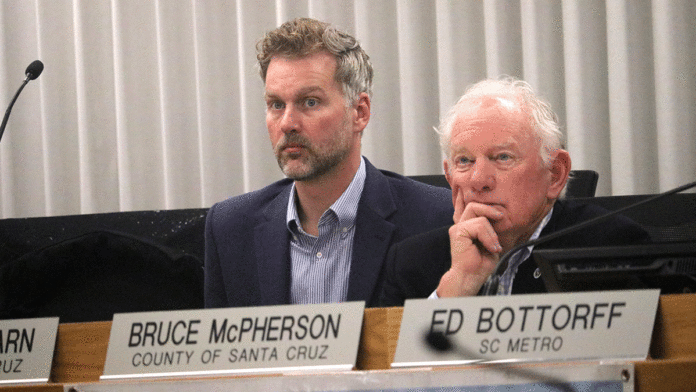
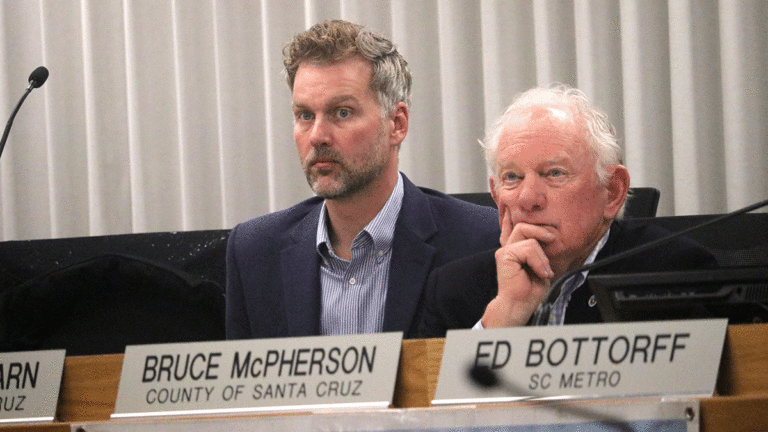
The new Unified Corridor Study (UCS) analysis represents a big step forward, said Capitola City Councilmember Ed Bottorff at the Santa Cruz County Regional Transportation Commission (RTC) meeting last Thursday.

Staff and consultants made the 200-plus-page document as complete as possible, said Bottorff. Experts surveyed the best ways to get from one end of the county to the other. The most closely watched portion of the analysis has been the question of what to do with one of the three major north/south avenues—the county’s coastal freight rail corridor. The document has a lot of numbers and estimates, some of them open to interpretation.

The costs are estimates, and many of the calculations are moving targets, said Bottorff. “As we’ve all learned in construction, some projects may seem like they cost a certain amount, and most likely, they’re gonna cost more,” he said. “So I think everyone should just take that into consideration when they look at this.”

Friends of the Rail and Trail tout the analysis as proof that a train is not only feasible, but also the best use for the corridor. Members of Greenway and Trail Now, who want the corridor used for a wider trail with no train, say that the estimates have a pro-rail bias and are further proof that the whole process has been unfair.  

There will be two public meetings this month on the UCS analysis, one in Live Oak and another in Watsonville. Staff will present a recommendation on a preferred scenario on Nov. 15. The commission may vote and take action no sooner than Dec. 6. (That date would be three days after the RTC’s next executive director is expected to take over for George Dondero, who is retiring.)

Each scenario outlined in the study has a mixture of different options. The first one features carpool lanes, additional auxiliary lanes, on-ramp metering, intersection improvements, and a form of bus rapid transit—as well as a bike/pedestrian rail trail, but no train.

Commissioner Randy Johnson, a Scotts Valley city councilmember, compared the various scenarios to four pre-made pizzas. Furthering his metaphor, Johnson suggested the commission should take a more central role in building its own pizza, although the commission did approve the chosen scenarios last year.

Johnson also felt that the consultants should have updated commissioners as they worked on their study.

Commissioner Andy Schiffrin, who is a staffer for Supervisor Ryan Coonerty, said the consultants never talked to him—and he’s glad they didn’t. Schiffrin said if critics believe the study is just a sham, meddling from the commission would only contribute to that perception.

“What we wanted was an independent analysis, and an independent analysis doesn’t mean you asked people along the way what they were doing,” Schiffrin said. “What it means is you wait until the end, and then you get mad.”

There will be two public meetings on the UCS analysis. The first is 6-7:30 p.m. on Monday, Oct. 15 at Live Oak Elementary School’s multi-purpose room. The second will be 6-7:30 p.m. on Tuesday, Oct. 16, in the Watsonville Civic Plaza Community Room A, on the fourth floor of the City Hall building. Input can also be emailed to uc*@****tc.org, or mailed to the RTC at 1523 Pacific Ave., Santa Cruz, 95062.

UCSC’s ‘Strange Window’ Gives New Life to Classic Ghost Story

The gothic chiller written at the very end of the 19th century may just be the ultimate ghost story. A governess joins an eerie household to care for two young and precocious students. In the sinister manor also lives a housekeeper, and perhaps some shadowy others. The governess sees them, but she seems to be the only one who does. Are they the ghosts of previous servants? Creations of the children’s overactive imaginations? Or mischievous attackers of the governess’ sanity?

This weekend, that ghost story—Henry James’ curious masterwork The Turn of the Screw—receives a fresh interpretation in the multi-genre video and live performance piece Strange Window, directed by innovative conceptualist Marianne Weems. Founder and director of the award-winning Builders Association in New York, Weems brings her company to UCSC for four performances this weekend before the production moves to New York for its East Coast premiere at the New Wave Festival.

A visually ingenious interpretation of James’ classic, Strange Window casts its spell through state-of-the-art media design and stagecraft. The blend of sound/video media and live action captures the flavor of James’ tale of illusion, psycho-reality, and the semipermeable membrane between the two.

“I think that seeing this old-fashioned ghost story told with our 21st century tools will be a visceral and thought-provoking encounter,” says Weems. “As artistic director, I work with different media and media designers. I generally introduce the concept and then bring together the strands. Everything flows from that, the connectivity. We create the form around the idea. Some of our pieces, such as this one, are text-based. The dialogue in Strange Window is taken directly from James’ text.

“This is something I’ve wanted to do for a long time,” Weems says. “This text is about ambiguity. Are the ghosts real, for example. And the staging heightens the ambiguous.”

In the upcoming production, the governess, the children, and all characters are seen in magnification—“a live film,” Weems calls it, “projected into a mediatized space.” The special magic of this work comes in its duality; viewers see the live performance as well as its simultaneous projection magnified on the screen behind the players. “United on the screen yet fragmented on the stage” is how Weems describes it. The play is interwoven with assorted contemporary film clips, as well as a soundtrack of abstract music and voices.

“Media and living action intertwine to heighten the same ambiguity James explores in his novella,” she explains. “The intimacy comes from the magnified faces.” Also, she promises, “the ghosts appear in an ambiguous way.” We won’t reveal what that is.

“It will all be really intense here, in this space,” Weems says, gesturing toward the raked seats in the Performing Arts Experimental theater. “I love this space. And the production itself is visually rich, the work has high impact. Like filmmaking and storytelling together.”

“The whole thing is coherent. In this case, the whole is more than the sum of its parts,” she says with a grin.

The play is also “opened out” at a few points, Weems notes. “There is a Q&A session with a child psychologist talking about truth and lies, especially among children.” Henry James’ belief in something called micro-psychology, “where you can read a person’s inner life according to micro-expressions on their faces and body language, is also referenced in this production.”

Weems describes her production group as “working in that grey area between theater and cinema.” She admits her interests have advanced beyond traditional theater. “Blending video, sound, performance, and text—it’s hard to return to traditional stage production.”

Marianne Weems has confidence in the radical interests of audiences here in Santa Cruz, which she believes are in line with the vision of new Arts Dean Susan Solt. The director of Strange Window aims to extend the boundaries of theater, anticipating that audiences will find this piece “stimulating, new, and surprising.”

‘Strange Window: The Turn of the Screw.’

Oct. 13-14, The Experimental Theater, UCSC. 70 mins, $10-$25. ucsctickets.com.

Lulu’s Micro-Sizes New Westside Coffee Outpost

Trust the ever-ingenious Manthri Sinath to convert a vintage 8 x 4 foot Fotomat into a sleek, state-of-the-art coffee depot. Lulu’s Westside is a bright, shiny, six-week-old wraparound, drive-by godsend to those in need of breakfast, pastry, and caffeine.

Holding down the very tip of Almar & Mission (in the U-Save parking lot) the latest jewel in the Lulu’s tiara makes custom espresso drinks and serves up house-baked pastries to a host of grateful Westside neighbors—as well as tourists, bicycle clubs, yoga aficionados, telemarketers, students, and realtors.

After the success of Lulu’s Midtown, “we learned how valuable the drive-thru feature was,” Sinath explains, while whipping up a macchiato at the gleaming espresso machine that fills one-third of the little kiosk. At the opposite wall is a prep area with refrigerator, counter, microwave, and tiny toaster oven. Glass windows fold out to create an open-air ambiance as patrons—in cars, on bikes or on foot—watch their favorite coffee drink being finessed.

A true wraparound coffee kitchen, the newest Lulu’s is a tribute to streamlined space management. Explaining that the former photo dispensary turned coffee kiosk had to be refurbished and custom-appointed, Sinath offers me a delectable little Sous Vide Egg Bite ($4) to try, while he whips up coffee for a patron in a gigantic Hummer.

“I like doing interesting things,” the entrepreneur confesses. “And usually at a slight angle to the universe.”

The original metal building is still there, under the Lulu’s chartreuse graphics. “These things are like art projects,” he says. In fact, this ingenious little facility is practically a landmark restoration, and many patrons under the age of 40 will be fascinated to discover a relic from the photographic Time Before Instagram. The compact coffeehouse-in-a-box is truly a sparkling addition to the Westside.

The menu outside offers patrons a quick glimpse of possibilities, even a pumpkin spice latté for six bucks. A stack of fresh pastries offers further temptation. “We make them in-house at the downtown Lulu’s,” says Sinath. But I have to say that creamy egg bite was a revelation. The one I sampled was laced with cheddar, tarragon, and red pepper. There’s another version with bacon. Morning protein for $4! A brilliant advance on the monotonous “breakfast sandwich” concept. Ditto the house egg and Applewood-smoked bacon on a biscuit, with sriracha aioli. All your favorite coffee drinks—and more—are here in this small, well-designed emporium.

930 Almar, Santa Cruz. Open 5 a.m.-2 p.m. daily. lulucarpenters.com/westside.

Fat Babies at HOM Korean Kitchen

Here’s the perfect excuse to try out some of the menu items at HOM, housed in the former Hoffman’s at 1102 Pacific Ave.: the energizing and sassy “Santa Cruz Fatbabies” exhibition of paintings by Ashley Yujin Roberts. Painted with loads of style, confidence, and bright colors on wood, the artworks feature plump and highly athletic babies with haircuts very reminiscent of those worn by a certain Korean head of state. These playful characters are shown jumping and surfing on stylized waves, among fish, chrysanthemums, leaping bunnies, and lots of other outrageously imaginative scenarios, many drawn from Korean folklore. If you don’t fall in love with these fatbabies by Ashley Yujin Roberts, AKA Ashley Yeo, you might not be breathing. Her show is up at HOM Korean Kitchen until Halloween.

Products of the Week:

At Shopper’s Corner, where we regularly pick up our weekly quota of Fernet Branca and salty crunchy bar mix, we’ve fallen for dried cherries—chewy and intense—as well as the organic Honeycrisp apples that have appeared lately in the produce array. Mmmmm.

Preview: Screaming Females at the Crepe Place

0

New Jersey alt-rock trio Screaming Females spent a decade refining their sound to a near-perfect punch on 2015’s Rose Mountain. They took elements of metal, punk, alternative rock and pop and melded them together into increasingly more concise songwriting.

Then the band took a surprise left turn with 2018’s All at Once, a wandering, unfocused, ambitious, and kind of long-winded heavy-rock record. And it’s their best album to date.  

“I think we definitely did a lot of self-editing with Rose Mountain. We were working toward cutting the fat out of our songs,” says singer/guitarist Marissa Paternoster.

The group had gotten a lot of positive feedback for Rose Mountain, and were busy touring on it for a majority of the past three and a half years, so they didn’t have a lot of uninterrupted time to focus on making its follow-up. They tend to not write on the road, so it was a song here, a song there when they were at home. This gave them a chance to do a lot of demos and experiments.

Rather than continue to refine the sound that has proven to work for the group, they expanded every aspect of it. Some of the poppiest moments of the group’s career emerge on this record, as well as some of the angriest, and certainly some of the longest songs they’ve ever written.

“We don’t really usually have any kind of list of rules that we need to adhere to when we start writing, we just try and do whatever feels natural—but also try and do things that are new and challenging for us,” says Paternoster.

Songs like “Agnes Martin” have an almost hair-metal vibe. “Dirt” draws from late ’70s art rock. “Soft Domination” channels the groove-rock of Fugazi (in fact, Fugazi drummer Brendan Canty adds a second drum part to the recording).

This is the first record the band really thought about in terms of being a single work of art. The title All at Once refers to a concept the members had early in the process; that one can focus in on all of the smaller parts of a piece of art, while simultaneously considering the whole.

“There are some albums that you can get a vibe when you think about the record. It makes you think about a certain time or a place, how the weather was outside when you first heard it. We wanted to make records that can be a part of people’s personal lives,” Paternoster says. “Before, we’ve always wanted to make records that people enjoy listening to, and there’s not much else to it, I suppose.”

The album jumps around lyrically, but a theme that seems to pop up frequently is the changing nature of connection. On opener “Glass House,” Paternoster talks about how hard it is to create a meaningful online relationship. On “Step Outside,” she tells people to leave their house even though “you won’t be safe.”

“There’s no way any of us really knew how quickly the way we interact with each other in the world would change in such a small period of time,” Paternoster says. “So I think if it’s not something that’s on your mind, that’s kind of crazy, especially if you’re my age.”

Despite it being a departure for the band, the reviews and responses for All at Once have been quite positive, maybe the best they’ve ever received.

“We have been lucky that every record we’ve done has gotten incrementally received a little bit better than the last one,” Paternoster says. “Our ultimate goal is to engage with as many people as possible, and hopefully make their lives feel a little more fulfilled and happy—and go out on tour and have cool experiences and make new friends.”

Screaming Females play at 9 p.m. on Thursday, Oct. 11 at the Crepe Place, 1134 Soquel Ave., Santa Cruz. $12/adv, $15/door. 429-6994.

Second Story: Mental Health Home Gets a Second Chance

Encompass Community Services CEO Monica Martinez thrilled mental health advocates when she announced in an Oct. 3 press release that the Second Story peer-run respite house would remain open after all, and for the foreseeable future. The flagship program is Santa Cruz County’s only alternative to inpatient psychiatric hospitalization.

Less than a month earlier, Martinez and Santa Cruz County health professionals had reluctantly decided to close the home after weighing financial and bureaucratic hurdles facing the program, as reported by Good Times at the time. After reading GT’s story, private donors came together to make an anonymous contribution totaling more than $1.1 million—the largest in Encompass history—and enough to pay off a state loan on Second Story’s Aptos property. Encompass will own the six-bed mental health facility and be able to keep offering comprehensive services for years to come. A portion of the donation will finance the cost of the program’s operations while Encompass and the county draft a long-term sustainability plan.

Second Story’s expected closure came as a shock to the program’s staff last month. Erik Riera said at the time that a complicated funding situation made the program—a model for almost a dozen respite houses across the nation—unsustainable. After eight years, Second Story was set to close its doors at the end of November.

Yana Jacobs, who helped establish Second Story almost a decade ago, was looking to save the program, searching for ways to reconfigure the house or move funding around to sustain services. That responsibility has been lifted off her shoulders. “I’m exuberant and relieved and have a joyous, renewed faith in humanity,” Jacobs tells GT via email. “Our work resonates with a call to social justice in the mental health arena.”

At Second Story, staffers are taking a deep breath. Excited voices are bouncing off the walls of the living room as piano music plays in the background. “It’s really starting to set in,” says Program Manager Adrian Camp. “The magnitude of the gift—to give us the house. I’m awed by it. It’s unbelievable.”

Film Review: Monsters and Men

Filmmaker Reinaldo Marcus Green knows how to get your attention. In the first moments of his contemporary drama, Monsters and Men, a black man is driving down a city street, punching absently at his car radio. When Al Green’s dreamy, “Let’s Stay Together” comes up, the driver grins, relaxes and starts singing along (as do most of us in the audience—in our heads, anyway). We’re with this guy 100 percent.

But the mood alters drastically when a police cruiser shows up out the rear window. The driver braces himself, but while he remains courteous and cool as he’s pulled over, the audience goes into panic mode. Nothing suggests the driver is some kind of criminal. Is this guy we already identify with going to become another tragic statistic in the ongoing war between law enforcement and people of color—whose casualties we read about in the paper almost every day?

Fortunately, this encounter has a peaceful resolution, the surprise of which won’t be revealed here. But it sets up the edgy tone of Green’s urban drama, where something horrible might happen to anyone at any moment, for no good reason. Green’s skill is involving us deeply in the lives of three bystanders caught in the metaphorical crossfire. The more we care about them, the more we agonize over their fates in Green’s compelling tale of choices and consequences in the Black Lives Matter era.

Set in the Bed-Stuy neighborhood of Brooklyn, the movie introduces Manny Ortega (an excellent Anthony Ramos), who lives with his girlfriend and their toddler daughter in his mom’s apartment. Motivated to better himself to support his family, Manny has just started a new job at the reception desk of a large corporation. But one night, he and his friends stumble upon a tense encounter between police and an unarmed man; Manny switches his phone to video mode just as things turn violent.

What should he do? Put himself and his family at risk by making the video public, or deal with the guilt of staying silent? Meanwhile, a black police officer named Dennis (John David Washington from BlacKkKlansman, in a performance of guarded restraint), also a devoted husband with a young child, has to decide how to respond during an internal police investigation into the nature of the officer who did the shooting—whose reputation within the department is already dubious.

The third principal observer is Zyric (Kelvin Harrison Jr.), a high school baseball phenom on the brink of being signed to the majors. His proud single dad is also a cop, who urgently wants his son to grasp his opportunity to get out of the neighborhood. But Zyric must weigh the option of getting involved in his community—the trials of living as a person of color—even if it jeopardizes his ticket out.

When Zyric is first introduced—a young man in a hoodie walking home from practice, pulled over by the cops—viewers think at first that it’s Manny, who we have seen pulled over by the police in much the same way in an earlier scene. This is the essence of racial profiling, in which the viewer is invited to participate—do young men of color in hoodies all look alike to the cops? Yet we also see Dennis, his white female partner and two other beat cops join a friendly,  impromptu game on a neighborhood basketball court with local youths—putting tribal antagonisms on hold for a few minutes.

The brilliant Blindspotting, from earlier this year, also featured the shooting of a black man by police as a key plot element. That movie, set in Oakland, also added hip-hop poetry, blistering dark humor, and unresolved racial tensions between its two protagonists into its volatile mix. While not quite as complex as its predecessor, Green’s movie urges us to delve beneath the headlines and slogans and face the nature of injustice in our dysfunctional society.

MONSTERS AND MEN

*** (out of four)

With John David Washington, Anthony Ramos, and Kelvin Harrison Jr. Written and directed by Reinaldo Marcus Green. A Neon release. Rated R. 95 minutes.

Vape Wars: Are We Missing the Bigger Picture?

A little over six years ago, Michael Wright walked into Beyond Vape in Capitola—one of the area’s first e-cigarette shops—with a few crumpled $20 bills, a half a pack of smokes, and a big dream: to end his smoking habit once and for all.

Wright started smoking what he calls “analog” cigarettes at age 14—two to three packs of Camel Reds a day for almost 12 years. Big Tobacco hooked him early. “When I was smoking cigarettes, I couldn’t breathe. I couldn’t exercise, and I smelled really bad,” he says. “My whole life changed when I started vaping.”

Wright says he had tried every other product on the market designed to beat smoking, numerous times. The gum and the patch made him physically sick. The pills gave him terrible nightmares. When he tried to go cold turkey and eliminate nicotine entirely, he was miserable and angry. “No one wanted to hang out with me,” he says.

Wright, 27, is one of the millions of people around the globe who has managed to quit smoking cigarettes using vaping devices. He calls electronic cigarettes, which were invented by a Chinese pharmacist whose father died from smoking in 2003, the “ultimate smoking cessation device.”

Vaping, however, receives its fair share of scorn. Scary stories about exploding devices, toxic chemicals, and grade schoolers getting hooked on e-cigarettes are hitting social and mass media outlets with more frequency. And there’s one question Wright hears a lot these days: “Is vaping safe?”

In the United States, e-cigs have developed a menacing reputation. Powerful campaigns from anti-smoking groups have created the perception that e-cigs are just as dangerous as their tobacco counterparts. Vaping devices contain no tobacco, but they are deemed tobacco products and placed under similar restrictions.

The U.S. Food and Drug Administration has been a vocal critic of electronic cigarettes for years, consistently warning the public about the potential dangers of e-cigarettes. Recently though, things at the agency may have begun to change. Although not recommending vaping outright, FDA Commissioner Scott Gottlieb has repeatedly discussed vaping as a valuable, yet unproven, tool to wean adult smokers off cigarettes.

Most experts agree that conventional cigarettes are the true menace, significantly more damaging than their electronic counterparts. Groups like the American Cancer Society highly recommend electronic nicotine delivery systems to smokers trying to quit.

The ACS contends that members of the general public are being misled by anti-vaping campaigns on social media and the mainstream media. “Over one-third of the population is under the mistaken impression that vaping is just as dangerous to one’s health as smoking,“ estimates the ACS.

Studies documenting “toxic chemicals” found in e-cigs make regular headlines in American news outlets. One highly publicized study done by Harvard University found that diacetyl, known to cause damage to the lungs’ smallest airways, was found in 75 percent of flavored e-cigs. Tobacco cigarettes contain at least 100 times the amount of diacetyl found in vaping products.

While teenage vaping is frequently being called an “epidemic,” what isn’t mentioned is that since the advent of e-cigs teen smoking rates have plummeted to historic lows.

In Great Britain, health agencies, the government and the public are more welcoming of e-cigs, as millions of Brits are using them to ditch “the stinkies.”

The U.K.’s National Health Service reports that “an estimated 2.9 million adults in Great Britain currently use e-cigarettes, and of these, 1.5 million people have completely stopped smoking cigarettes.”

In the U.S, the decades-long war on smoking has become, in effect, a war on nicotine. But nicotine has arguably never been the deadly villain in cigarettes. British scientists and politicians contend the harm from smoking doesn’t come from nicotine, which is already an over-the-counter component in gum, the patch, and pills. Experts agree the true harm comes from the thousands of other chemicals contained in tobacco smoke, including tar and carbon monoxide.

The British Parliament recently concluded that e-cigs are 95 less harmful than traditional cigarettes. An August 2018 report rejects claims that e-cigs can be a gateway to smoking, and that taxes on vaping should be cut significantly. Just last month, the U.K’s House of Commons and Technology Committee recommended that e-cigarettes be made available on a prescription basis as a smoking cessation tool.

What’s Really Driving Santa Cruz’s Affordable Housing Crunch

santa cruz affordable housing
The county is behind on its goals—but so is most of the state

Venus Retrograde: Risa’s Star’s Oct. 10-16

risa's stars
Esoteric Astrology as news for week of Oct. 10, 2018

Rob Brezny’s Astrology Oct. 10-16

Astrology, Horoscope, Stars, Zodiac Signs
Free will astrology for the week of Oct. 10, 2018

Does the Unified Corridor Study Change the Rail Trail Debate?

rail trail unified corridor
It’s open season for more arguments as both sides scrutinize the long-awaited document

UCSC’s ‘Strange Window’ Gives New Life to Classic Ghost Story

Strange Window
Henry James’ ‘Turn of the Screw’ as a multimedia performance piece

Lulu’s Micro-Sizes New Westside Coffee Outpost

Lulu's Westside
A local fixture reimagines a vintage Fotomat

Preview: Screaming Females at the Crepe Place

Screaming Females
Alt-rockers expand their musical vision on ‘All at Once’

Second Story: Mental Health Home Gets a Second Chance

Second Story
Generous donation keeps peer-run facility open

Film Review: Monsters and Men

Monsters and Men
It's choices vs. consequences in compelling contemporary drama

Vape Wars: Are We Missing the Bigger Picture?

vaping
Controversial e-cigs surge in popularity as smoking declines
17,623FansLike
8,845FollowersFollow