
Beyond the trivialities of everyday life and the freak show of contemporary culture, there are only three questions truly worth pondering: Is there life after death? What is the fate of humanity? Are we alone in the universe?
Frank Drake may have opinions on the first two—who doesn’t? On the third, though, he might be as close to an empirical answer as any person, living or dead, has ever been. In the broad field of study known as the Search for Extraterrestrial Intelligence (SETI), Drake is the essential figure.
In fact, he’s SETI’s George Washington.
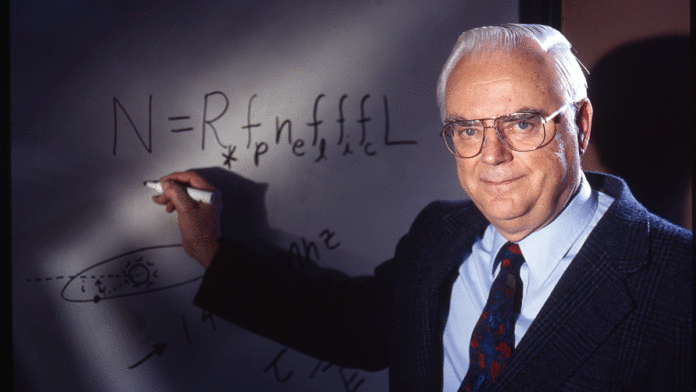
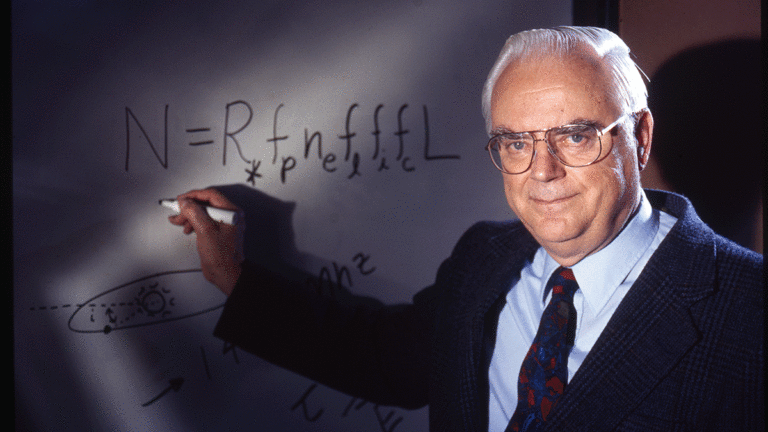
Almost 60 years ago, as a young Harvard-educated physicist, he conducted SETI’s first serious experiment, convened its first all-star scientific conference and drew up the famous Drake Equation that forms the fundamental framework scientists still use to estimate the number of technologically advanced civilizations that might exist in our galaxy.
Now, at 88, Drake is tracking from his home in Santa Cruz County an unlikely turn of events only slightly less miraculous than contact with an alien species: A second life for SETI.
The Great Martian Chase
In 1993, Congress zeroed out government funding for the SETI program administered by NASA; the program was lampooned by the senator who introduced the amendment to kill it as “The Great Martian Chase.” From that point forward, SETI was pushed to science’s back burner, muddling along on inconsistent private donations and struggling to maintain research momentum.
But today things are dramatically different for SETI, largely thanks to Russian-born Silicon Valley venture capitalist Yuri Milner—who was born the same year as the Drake Equation, and was named after Soviet cosmonaut Yuri Gagarin. In 2015, Milner announced the establishment of Breakthrough Listen, an enormous moonshot SETI project to which he has pledged $100 million.
“It’s changed everything,” says Drake. “We’re not scrounging around trying to raise money anymore. He’s guaranteed $10 million a year for 10 years. One of the problems we’ve had is that we could never plan for the future. We couldn’t create a program beyond a year because we never had the funding. Now we do.”
Does this mean that Close Encounters is now close? Probably not, say some who are involved in SETI. But the Breakthrough Listen funding, along with access to new and powerful telescopes, represents an expanding of vision. Where once we were looking through a narrow window in a small room, now we can step outside to see a bigger piece of sky.Before 1960, American pop culture was awash in aliens, especially at the drive-in theater—It Came From Outer Space, The Thing From Another World, Invasion of the Saucer Men, among many others all exploited a template established by the H.G. Wells novel War of the Worlds.
At the time, the idea of life elsewhere in the universe was firmly in the realm of cheesy sci-fi paranoia, but that was merely a sign of the times. Contemplating other worlds has been a human preoccupation for eons. As far back as 300 B.C., the Greek philosopher Epicurus was pushing the idea that there must be other worlds like our own.
But before the Drake Equation, no one had applied the rigor of science to the question.
“Frank turned into a science,” says astrophysicist Andrew Siemion, the director of the Berkeley SETI Research Center. “He took something that was at the time philosophically important—almost a religious question—and brought it into the realm of modern scientific inquiry.”
A Beautiful Equation
Siemion occupies the Bernard M. Oliver Chair of SETI Research at the SETI Institute in Mountain View, and is a lead researcher at Breakthrough Listen. “It’s impossible to overstate Frank’s importance to the field on so many levels,” he says. “He was the general in the battle to create the field, and he was the statesman that allowed it to flourish.”
In 1960 at the Green Bank Observatory in West Virginia, Drake aimed a radio telescope at two nearby stars to see if he might be able to detect radio waves coming from other civilizations. He called the experiment Project Ozma, borrowed from L. Frank Baum’s The Wizard of Oz.
The idea was simple: Radio signals on certain frequencies can leave a planet’s atmosphere and, theoretically, travel to distant points in the galaxy, thus providing proof of a technological civilization. (Some of our civilization’s earliest, and thus farther out in space, signals are broadcasts of Nazi propaganda including Hitler speeches, providing a potentially awkward moment if they ever reach otherworldly ears).
In ’61, Drake presided over a secret meeting at Green Bank featuring some of the marquee names in the field—including a young Carl Sagan—in a meeting that SETI people like to call “The Order of the Dolphin,” because the work of one of the attendees was an attempt to decode dolphin language.
From that meeting came the Drake Equation, which even today is to SETI scientists what Stairway to Heaven is to fans of dad rock: That One Thing Everybody Knows.

The Drake Equation is less an equation to be solved and more of a way to think about the probabilities of communicating with an alien culture. It is essentially a string of variables, each one narrowing the probabilities that any given Earth-bound scientist on any given day might encounter a radio signal from another world. The variables include the number of stars like the sun; the number of those stars with a planetary system; the number of planets in those systems in a habitable zone for life; the number of those planets where life is likely to have emerged in some way; the number of those life-friendly planets in which “intelligent” life might have evolved; the number of the intelligent-life planets that might have developed technology that could be transmitted and detected; and the length of time civilizations are likely to last.
“[The equation] is not really about a number,” says astrophysicist Griffin Foster, another Breakthrough Listen researcher. “It’s more about a philosophy.” Foster says the beauty of the equation is how it invites engaged minds from other sciences and even the humanities. Some of the variables are less about physics than about biology and chemistry. What constitutes “intelligent” life or a “technological” society is something that social scientists can chew on. And the length of time that a civilization typically lasts is a question for the historian.
“It’s not for any single individual to solve,” says Foster. “It’s a societal question. The scope of the problem is so big that it’s not about trying to find some basic law of physics, but really about how we fit in the universe.”
The Drake Equation is durable even in other fields, such as exoplanet research or astrobiology, the field that explores planets in the “Goldilocks zone” for signs of water or other indicators of primitive life. MIT’s Sara Seager, one of the most prominent exoplanet researchers in the field, has come up with a riff on Drake’s equation (yep, it’s the Seager Equation) that is more adaptable to her interests.
“I asked him about it,” she says by phone from her office at MIT. “I just wanted to make sure it was all OK with him. No one wants to have someone take their work and mangle it. What I’ve done is more of a tribute [to the Drake Equation] than anything else. He was actually very nice about it.”
Beaming Into Space
Who knows what kind of breathtakingly cool art hangs in the elite private homes of the Bay Area? But it’s hard to conceive of anything more badass than what Frank Drake has in the house near Aptos that he shares with his wife Amahl. It is a stained-glass window version of “The Arecibo Message,” a pictorial illustration transmitted into space in 1974 from the Arecibo radio telescope in Puerto Rico. The message, designed by Drake, transmits information about atoms, DNA, and the basics of the solar system.
It looks like the crudest prototype of a videogame, and Drake himself says, “In my judgment, it’s pretty bad.” But it’s been hurtling out into space at the speed of light for 44 years. No one else can make such a claim for their interior décor.
A few years after creating the Arecibo Message, Drake was also involved in the creation of “the Golden Record,” a double-disc copper-plate phonograph recording featuring a number of sounds and music to represent Earth, from Stravinsky’s Rite of Spring to Chuck Berry’s Johnny B. Goode. The recording was packed onboard the Voyager space probe, which today is the most distant human-made object from Earth.
“There’s long sections of sounds from Earth: chainsaws, airplanes, babies crying,” says Drake, hovering over a replica of the Golden Record, speculating on some potential curious alien intercepting the Voyager. “Once they figure out how to use the stylus, we tell them how fast to spin the record.”
Even before Breakthrough Listen, Drake was not prone to sit around wallowing in nostalgia. His CV is peppered with honors and prestigious positions in the sciences. The former Dean of Natural Sciences at UC Santa Cruz has also sat for years on the board of the SETI Institute.
But Breakthrough Listen has given an adrenaline boost to Drake’s life-long quest to find evidence of other civilizations. Not only has Milner’s millions brought new muscle to SETI, but the new, bleeding-edge MeerKAT radio telescope in South Africa, which launched just three months ago, promises to open up vast new possibilities for the project.
The MeerKAT, the Parkes Telescope in Australia and the Green Bank Telescope, at the site where SETI was born with Project Ozma, are the three major points where Breakthrough Listen has raised the stakes of listening in on the universe’s radio waves.
Griffin Foster, a researcher at Oxford University who is also a visiting scholar at the Berkeley SETI Research Center and has worked for Breakthrough Listen at MeerKAT in South Africa, says the approach of Breakthrough Listen has been primarily to spend its time and money on the big telescopes.
“There was a lot of talk about the best way to scale this up,” he says. “The idea was let’s not just fund some research project. Let’s buy telescope time. Let’s do thousands of hours of observing. And instead of looking at just a few stars, let’s look at thousands. And now with MeerKAT, we can look at millions of stars.”
In less than 60 years, SETI has gone from analyzing one radio channel to using spectrum analyzers that can handle 10 billion channels at one time. And yet the work is still the same: to look for electromagnetic signals that are different from those natural objects produce.
“The only thing that’s different about [Breakthrough] Listen from what Frank did,” says Andrew Siemion, “is simply scale and intensity. We’re doing more and more observing, with better instruments and faster computers. But we’re still using the Drake Equation. We can plot Frank’s experiments on a graph with the experiments we do today, and we can make comparisons between them because his experiments are as fundamentally and scientifically credible today as they were back in 1960 when he was doing them.”
The telescopes in the Southern Hemisphere are especially valuable, because, from a SETI point of view, that’s the most compelling angle at which to view the Milky Way.
“What’s interesting about the Southern Hemisphere,” says Foster, “is that’s where you can see the galactic center the best. If there’s an extraterrestrial technology out there, they might put beacons near the galactic center. So, that’s a very exciting region to look at.”
“SETI is much better and in a more stable state than it has ever been,” says Drake. “The rate we’re observing now, we’re doing as much searching in a couple of days as we did with all the previous searching put together.”
Waiting for the Signal
Frank Drake is a scientist, which means he doesn’t have much use for fantasy. In the Hollywood narrative, when the friendly advanced civilization finally answers our call, Frank would be the respected elder flown in by helicopter by the president for the honor of representing the Earth.
“The idea that you’re going to communicate, that you’re going to ask questions and get answers, that’s absurd,” he says. “That’s not going to happen. The nearest technological civilization is probably a thousand light-years away. That means any signal you get is already going to be a thousand years old. The hope is that you can detect a signal through the noise, watch their television, so that you can learn a lot about them without asking them anything.”
Drake says he’s an optimist, that in 10 to 20 years, given the vast space the new instruments will be covering, we may have some evidence of another technological civilization, even if it’s a long-extinct one.
“Mathematically, there has to be,” he says. “To say the universe is an empty void is not only presumptuous, but stupid. I think there may be an earlier discovery, that we’ll find [primitive] life elsewhere in the solar system. That will make concrete that the origins of life are common.”
As for SETI, says Drake: “It’s a lottery. The chance of winning is still very remote. But we’re buying a whole lot of tickets.”