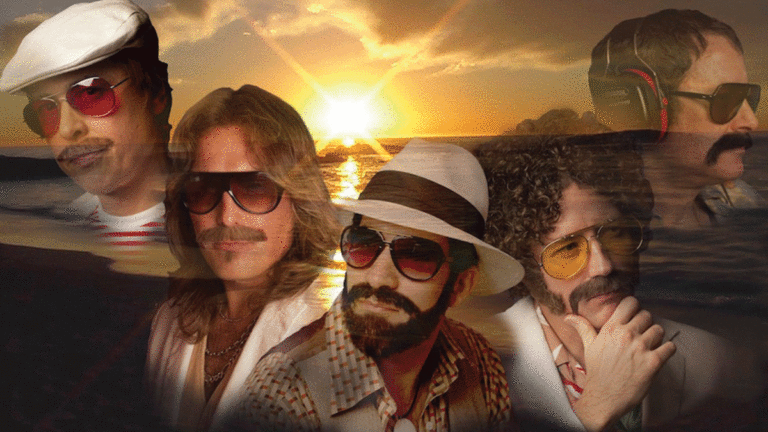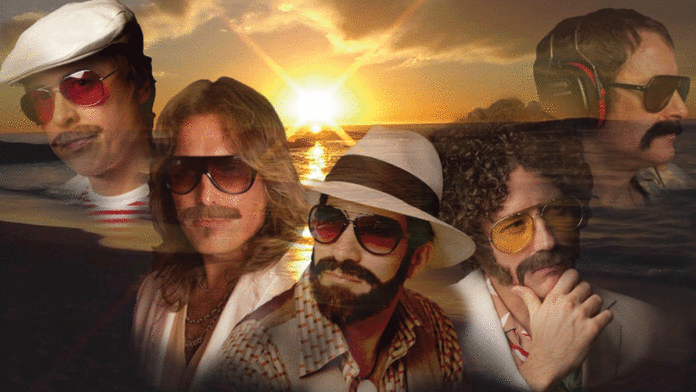

Alex Bleeker and the Freaks go all in for the Dead sound on ‘Country Agenda’ Grateful Dead fans are so devoted that they not only followed them around town to town, but even earned the first fan nickname. And they pop up in the least likely of places—even in the music world, where they include Jane’s Addiction’s Perry Farrell, Sonic Youth’s Lee Ranaldo, and Real Estate’s Alex Bleeker.
The Dead’s influence isn’t all that apparent in any of these groups, but it’s unmistakable in Bleeker’s solo work, which is far removed from Real Estate’s dream-pop sound. When he started recording solo in 2009, the Dead influence was there, but the blown-out production, combined with a Crazy Horse energy, disguised the full extent of Bleeker’s Grateful Dead fandom. Things became quite a bit clearer when he penned a heartfelt essay for Stereogum about his experience at all three of the Dead’s farewell shows.
This is all important to keep in mind when listening to Bleeker’s third record, Country Agenda, which was released in October. He’s gone all in and let his Grateful Dead flag fly high and proudly.
But Country Agenda is very specific in the inspiration it takes from the Dead. It brings to mind their two 1970 albums, a highlight in their recording career (and the only period some non-Deadheads consider listenable). These two records, The Workingman’s Dead and American Beauty, are gorgeous breezy mixtures of country, folk and bluegrass that keep the wandering solos to a minimum.
The same is true of Country Agenda. This is a feel-good, country-inspired record in literally the same vein. Real Estate fans might run screaming at the mere mention of the Grateful Dead as the record’s primary influence, but if they give it a shot, they might be surprised to find themselves liking these lighthearted folk tunes (and maybe even find themselves digging into the Dead’s discography). Alt-rockers may feel an affinity to the music, too, as this era of the Dead influenced ’90s groups like Wilco.
This is the first album by the Freaks that’s a full-band collaborative affair. On Bleeker’s self-titled debut, he enlisted mostly fellow Real Estate bandmates to back him (which produced a record that was a little disjointed and jolting), but now he’s got a band of like-minded souls, and the chemistry is fantastic. On Country Agenda, Bleeker and the Freaks play with confidence and sound like they’re having a lot of fun in the process.
The record was recorded at a studio on the coast of Stinson Beach, which seems to be perfectly captured in the music. Whether or not Bleeker was trying to make a record inspired by the California coast, he did—it has a gentle, breezy sound, and laid-back groove. Even the lyrics fit the theme, as in “California” (“California, California, you’re set free”).
Deadheads will get a kick out of their rendition of the traditional tune “Turtle Dove,” which Jerry Garcia covered frequently. Overall, the record’s only real problem is that Bleeker may have succeeded a little too well in bringing his influences to the fore—I’m not exaggerating when I say that Country Agenda literally sounds like the Grateful Dead circa 1970. A lot of Deadheads will just listen to the real thing. INFO: 8 p.m., Dec. 10, Don Quixote’s, 6275 Hwy. 9, Felton. $15. 335-2800.
OUT COME THE FREAKS Alex Bleeker and the Freaks play Don Quixote’s on Thursday, Dec. 10.
The aerial show ‘Eos’ combines circus feats with themes of rebirth Say circus to someone over 40 and they’ll probably think of old-school clowns and prancing animals, fire eaters and tightrope walkers. But the circus has evolved, from three rings and a big top to the surrealistic morphing of technique and creativity that grew Cirque du Soleil into a worldwide performance juggernaut. Its place in our imagination now ranges from the insane-yet-somehow-Zen image of Philippe Petit tightrope walking between the twin towers to the fitness craze that blends trapeze, acrobatics, juggling, and balance. Circus has become more than a show or pastime. It has transformed into a mode of expression.
Take Allie Cooper and her ensemble AeraFlux, who created the dark, industrial-themed aerial dance show Aurora in 2014. Onstage, she showed with gravity-defying precision that circus can tell a complex, dynamic story. For Cooper’s new show, Eos—a “second phase” of the project she began with Aurora—she has partnered with fellow local aerial/acrobatic teacher and choreographer Rose Calucchia, as well as musician Logan Gritton.
“I dabbled in circus when I was young,” says Cooper, “but it wasn’t until I moved to Santa Cruz that I really became involved with the circus community.” Since then she has traveled all over the world teaching workshops and performing. “People who don’t have a lot of exposure to circus default to the glitz, but for me, and especially abroad, it’s more of an art form, more contemporary. That’s what I’ve tried to bring back, a departure from the spectacle to embrace contemporary circus.”
She’s not daunted by the way pop culture has appropriated circus concepts into other realms like fitness: “It’s like anything. The accessibility is great, but it brings growing pains,” says Cooper. “There’s a network of artists who have been doing this for years who want to maintain the integrity of circus as a creative language. It’s just a matter of finding balance.” Aurora used literal balance, as well as soundscapes and visual projections, to express the dissonance of conflict.
“It was about the idea of battle,” she says, “a group struggling to survive, dark and chaotic, but working together.” The notion of teamwork continues to play out in Eos, her current show and Aurora’s reflective, even somber, follow-up. Eos means “dawn” in Latin, and its stripped-down approach evokes aftermath as well as rebirth. Fittingly, the six dancers in this hour-long piece of aerial, acrobatic and dance work are young women between the ages of 12 and 15. Cooper knew they were the right performers to tell her story. “It’s a difficult time to be young and female in our country right now, so it’s important to acknowledge that vulnerability, even as we celebrate inclusiveness and strength in a group,” she says.
After two commanding presentations, will there be another chapter after Eos to complete the journey? “I hope so,” says Cooper. “I’d like to bring together the adult cast members and this young group. It would bring things full circle. The third piece will be about rebuilding.”
What inspires her about this show, she says, is the extraordinary talent at work.
“These girls may be young,” she says, “but their skill is incredible, totally professional, comparable to any high-level circus performers anywhere.”
Though Eos is family-friendly, it’s not a kids show. “These are serious themes,” Cooper says, “and yet having young people explore them, wearing utilitarian, pedestrian costumes, makes what they’re doing that much more spectacular.”
Without the glitz, in other words, there’s nowhere to hide.
“Exactly,” she says. “And that, coupled with the innocence and power these young women bring to their performance, is going to blow people away.” AeraFlux presents ‘Eos’ at 7 p.m. on Friday, Dec. 18 and Saturday, Dec. 19 at the Santa Cruz County Memorial Veterans Building, 846 Front St., Santa Cruz. Tickets are $20 general, $15 for youth 12 and under. 800-838-3006, aeraflux.brownpapertickets.com.
ON THE UP AND UP ‘Eos’ means ‘dawn,’ and the young cast will explore themes of renewal and rebirth in the show. PHOTO: JAKE J. THOMAS
Santa Cruz honored with gold award and new grants for biking, but improvement still needed on hazards Long before bearded hipsters made cycling cool again, Santa Cruz prided itself as a bike-friendly community, and now it has a gold award—plus several sizable grants—to back it up.
The League of American Bicyclists announced its bi-annual Bicycle Friendly Communities awards on Nov. 16. With rankings from platinum to bronze, the league’s rankings are announced each fall and spring. This year Santa Cruz came out in the gold tier, making it one of 24 in the entire country to receive the honor since the awards began in 2003.
A public celebratory ride took place on Nov. 24 from City Hall down the San Lorenzo Riverwalk, although the chilly winter night brought in a lower-than-expected turnout, says Amelia Conlen, director of the nonprofit Bike Santa Cruz County. “But we did have treats donated by the Pacific Cookie Company and Cocoamotion,” she says.
The League of American Bicyclists was originally founded in 1880 as the League of American Wheelmen—as cyclists apparently were then called. The League is a national bicycling advocacy group working to change policy and create a safer experience for anyone who chooses to ditch four wheels in favor of two.
Santa Cruz is now in good company, with only three other gold members in the state: San Francisco, Palo Alto and San Luis Obispo.
Among its accolades, Santa Cruz was acknowledged for its strong infrastructure, cycling education programs and 10 percent of its population biking to work. Sixty percent of Santa Cruz’s arterial streets have bike lanes, compared to an average of 78 percent in most platinum-ranked areas. Davis is the only Californian city that’s achieved platinum status.
On the city’s “report card,” the league noted a few reasons why Santa Cruz did not receive a platinum rating, and a big one is accidents. Santa Cruz County routinely has among the highest rate of per capita bike accidents in the state. The county’s higher-than-average ridership at least partly explains those numbers. Still, the report card notes that the city’s average crashes per 100,000 cyclists is 222, more than twice the average for platinum communities.
Ken Mcleod, the league legal and policy specialist, was one of three reviewers who went over Santa Cruz’s application, and he says the city is on the right track when it comes to transportation. “It seemed very ambitious for the community compared to other applications we received,” he says, “especially with the building of new facilities to encourage more cyclists.”
Earlier this year, the Santa Cruz County Regional Transportation Commission won two big grants for bike projects. One grant extends part of the Coastal Rail Trail, a planned multi-use 32-mile path from downtown Watsonville to Davenport. The other adds bicycle route signs to instruct commuters about the safest and fastest paths, something Conlen is excited about. “Many cyclists may not be as experienced as others, which is why the sign program is so important around town,” she says.
The league based its awards on 111 questions, as well as data collected by both the city and by the league itself. Criteria ranged from the number of bike-friendly laws to access to cycling education programs. The number of active bicycle advocacy groups within the community also played a factor.
Bike Santa Cruz County, formerly known as People Power, is probably the best-known of those advocacy groups. This year, the nonprofit teamed up with the city to complete the Arana Gulch multi-use trail and the green lane bike path on Laurel Street. One of its programs is the Earn-A-Bike program in Watsonville. Over the course of six weeks, students are taken on bike-related field trips, and they learn to work on bicycles donated by community members—which they then get to keep at the end of the program.
“Having access to bikes can be difficult,” explains Conlen. “Especially the tools and accessories needed to hang-on [to] and maintain one. We provide all that, so the kids are ready to go.”
But there is even more good bike news that didn’t make it into the Bicycle Friendly Community award application. Just three weeks before being honored, Santa Cruz was awarded $3.2 million in grants from Caltrans.
The first grant of $1.4 million went to a program to improve school crossings. The city and environmental nonprofit Ecology Action will work together to improve 24 crosswalks around eight local schools, as well as transportation education in the classrooms. Sometimes changing people’s habits can create serious momentum when it comes to how people get around.
“Many of the crossings are simply perceived as being unsafe—causing more parents to drive and drop off children, which in turn puts more cars on the road,” Santa Cruz transportation manager Jim Burr tells GT in an emailed statement via a city spokesperson. “This is a vicious cycle that the ATP and Safe Routes projects are seeking to reverse.”
The second grant, an impressive $1.8 million, was allocated for the Branciforte Creek Bridge. The project is a multi-use path stretching from under the Soquel Avenue bridge to San Lorenzo Park, and it’s the last remaining gap in the riverwalk along the levees. Staff originally had the idea almost three decades ago, and although it was a popular concept, funding was scarce. Construction on it should begin by 2017 and be finished within six months.
“It’s been a pretty incredible year,” says Conlen.
The League of American Bicyclists also took special interest in Santa Cruz’s Active Transportation Plan (ATP), which the Santa Cruz City Council approved in April.
Mirroring the state’s Active Transportation Program, the ATP takes a comprehensive look at transportation throughout the city, in an attempt to make pedestrian and cycling traffic safer and more convenient. Since August, city staff has been doing public outreach and collecting data for the ATP and aims to submit its first draft to the Transportation and Public Works Commission in March. The city hopes the new Active Transportation Plan will pave the way for even more grants.
More than a small niche, the world of cycling has become its own economy, and more cycling and safer routes mean big business, according to Bike Santa Cruz County. In its 2015 State of Cycling Report, the nonprofit estimated that the cycling industry employed over 1,000 individuals in the county, generating $800 million.
When it comes to building a community, Conlen says, it all boils down to the basics.
“It takes good facilities to make people feel safe enough to get out of their cars and on their bikes,” she says. “If you build it, they will come.”
FINISH LINE Amelia Conlen of Bike Santa Cruz County and transportation planner Claire Fliesler stand near the last remaining project on the San Lorenzo Riverwalk. PHOTO: KEANA PARKER
There’s an assumption these days in politics that labor and environmentalists have a hard time seeing eye to eye.
Sure enough, a recent meeting for the county’s Regional Transportation Commission broke, more or less, along those lines. The matter this time is a half-cent transportation sales tax measure that the RTC board is leaning toward supporting. Environmental activists, worried about climate change, are taking issue with 25 percent of the proposed money going toward adding merge lanes—also called auxiliary lanes—from off-ramp to on-ramp, stretching from Soquel Avenue to 41st Avenue and back.
After Santa Cruz activists made the case that any improvement would be marginal, the RTC board responded with Santa Cruz Mayor Don Lane mentioning that it may not have a huge impact, but it also isn’t a huge chunk of change in transportation dollars. He showed sympathy for the people of Watsonville, many of whom have to commute to Santa Cruz. “Those folks have been waiting, not just in traffic every day, but for our county to do something,” Lane said.
RTC boardmembers, especially those representing South County, said it was time to lend a hand to the predominantly lower-income work force driving northbound every day—and much of the Santa Cruz economy year-round. District 2 County Supervisor Zach Friend admitted that merge lanes don’t do away with a ton of congestion, and that’s why the RTC tried 11 years ago to build carpool lanes, which reduce traffic and cost more. The board proposed a measure in 2004 that the Campaign for Sensible Transportation lobbied hard against and helped defeat.
With some of those same people in the room for the Dec. 3 meeting, Friend explained that many of his poorest constituents couldn’t make it to the meeting because they were either stuck in traffic or stuck at their jobs, but he insisted they would beg the RTC to “do something. They would say, ‘we didn’t elect you to do nothing.’”
With that, he asked for the activists’ support. “If not, I invite you come down to the South County to sit with people to tell them why we couldn’t get something done,” Friend said.
During a meeting break, Paul Elerick from the Campaign for Sensible Transportation suggested that maybe it would help if more people changed their working hours and reiterated that he didn’t think the lane would make for much change.
“Looking at the EIR [Environmental Impact Report],” he said, “I don’t think it will have the impact people are looking for.”
PICTURED: District 2 County Supervisor Zach Friend
Screenwriter defies injustice in sharp, witty ‘Trumbo’ Bryan Cranston has come a long way since he played in A Doll’s House and The Taming Of the Shrew with Shakespeare Santa Cruz onstage in the Festival Glen in 1992. He was a flustered TV sitcom dad for several seasons on Malcolm In the Middle. And, oh yes, there’s a little item in his résumé called Breaking Bad, for which he won four Emmys and a Golden Globe.
Cranston has also been making films for years, but rarely has he landed such a plummy starring role—and played it with such relish—as Dalton Trumbo, the blacklisted real-life Hollywood screenwriter at the center of Jay Roach’s smart, incisive drama, Trumbo. Scripted by John McNamara, from the nonfiction book by Bruce Cook, it’s a wildly entertaining plunge into the dark heart of anti-Communist witch-hunting in Hollywood during the 1940s and ’50s, as experienced by one extremely savvy intended “victim” who had the guts, the brains and the chutzpah to survive.
In 1947, at the height of a fruitful Hollywood career writing hit movies for the likes of Spencer Tracy and Ginger Rogers, Dalton Trumbo (Cranston) has just inked a deal with MGM to become the highest-paid screenwriter in the business. He and his wife, Cleo (Diane Lane, terrific, as always), and their three young children live on a gorgeous property in the Hollywood Hills. Then one day, he gets a subpoena from the House Un-American Committee to testify in Washington DC about alleged Communist “infiltration” of Hollywood.
As the prologue reminds us, plenty of people joined the Communist Party in the Depression ’30s in solidarity with the poor and oppressed, back when Russia and the USA were allies against the Nazis. But as the Cold War heats up in the late ’40s, “Commies” become the target for right-wing “patriots” like the HUAC, and the Motion Picture Alliance (MPA)—headed up by gossip columnist Hedda Hopper (played by Helen Mirren with viperish verve) and John Wayne (David James Elliott)—who claim the film industry is “infested with traitors.”
Membership in the party is considered treason. And when attempts at rational discourse with HUAC prove impossible, those who refuse to comply by giving up the names of their friends, or repudiating the original ideals for which they first embraced Communism, are cited in contempt of Congress. Trumbo won’t play the game, and spends a year in a federal penitentiary. (His writer friend Arlen Hird (Louis C.K.), tells the HUAC he can’t answer their questions until he visits his doctor, “to see if he can remove my conscience.”)
Freed from prison, Trumbo, Hird and the rest of the “Hollywood 10” are blacklisted; any producer who hires them risks a public boycott. Trumbo downsizes his life, but keeps writing to support his family. The screenplay he’s been working on becomes the famed romantic comedy Roman Holiday; it wins an Oscar, but the name inscribed on the statuette is another writer, Ian McLellan Hunter, through whom Trumbo had to submit the script.
At the exploitation house King Brothers Productions, Trumbo pseudonymously grinds out no-budget sci-fi and film noir thrillers (an insane schedule that takes its toll on his family). John Goodman is hilarious as honcho Jack King; when a prissy MPA rep tries to threaten him with exposure in the papers if he doesn’t fire Trumbo, King retorts “I make crap! The people who go to my pictures can’t read!” It takes A-Listers Kirk Douglas (Dean O’Gorman, the most persuasive of the onscreen impersonators) and Otto Preminger (Christian Berkel) to end the conspiracy of silence, restoring Trumbo’s on-screen credit (on Spartacus and Exodus), and his reputation.
Cranston plays Trumbo with an edgy, raging wit, pounding away at his typewriter with a cigarette holder in one hand and a glass of hooch nearby. He edits in his bathtub with its makeshift desktop, literally cutting up the script with scissors (in those pre-computer days), and re-pasting the scenes in better order on what looks like a long roll of shelf paper. He’s the heart of this sharp, frisky film for anyone interested in stories about writers, backstage Hollywood, or the (belated) triumph of reason over fear-mongering. TRUMBO
***1/2 (out of f our)
With Bryan Cranston, Helen Mirren, Diane Lane, Louis C.K., and John Goodman. Written by John McNamara. Directed by Jay Roach. A Bleecker Street Media release. Rated R. 124 minutes.
BREAKING RED Bryan Cranston plays the blacklisted screenwriter Dalton Trumbo in ‘Trumbo,’ a wildly entertaining plunge into the anti-Communist witch-hunting that took place in Hollywood during the 1940s and ’50s.
Meet the newest craft brewer on the block Not all beers are created equal, so allow us to introduce you to the latest homegrown Santa Cruz brewer that’s certainly worth your time: Humble Sea. Their beers will be hitting the market in the coming month or two. The company is the brainchild of local Nick Pavlina; also on the Humble Sea team are Taylor West and Frank Krueger. The trio is trying to strike that perfect balance between traditional and experimental beers. Did someone say jalapeños? Can people buy your beer at stores?
NICK PAVLINA: Not just yet. We just got our final legal approval a couple of weeks ago. Our plan is to be in a handful of restaurants around town in the next month or two. Right now we’re brewing in Ben Lomond in a small barn. We’re not allowed to have a taproom on residential property. Our plan is to open one in Santa Cruz. This is our first step to getting there. We’re small scale right now. It doesn’t make sense to package our beer in anything but kegs. I’ve been brewing beer for about eight years and have been trying to open Humble Sea for quite a few years now. I approached Frank and Taylor about a year ago to go in as business partners to help me really get this thing going. We’ve really come a long way in the past year. What’s your specialty?
It’s mostly craft lagers, as opposed to ales, which is what everyone makes, [and] which are a little easier and take less time. We do a lot of traditional beers with a West Coast twist: a little extra hoppy, with some non-traditional ingredients here and there like coriander and lemongrass and jalapeño. We do a Mexican IPL, an India Pale Lager. We use jalapeño in it. There’s some tropical fruit and corn with the jalapeño. It’s a very interesting and different beer. It’s not overpowering. You can smell it and taste it, but it doesn’t burn. Where did you get the name Humble Sea?
I used to live in Pleasure Point. When I really thought seriously about brewing, I was trying to think of a name that represented me. The sea has always been a big part of my life; I wanted to incorporate that somehow. And I’ve always tried to stay humble with everything that I do, especially making beer. Humble Sea just sounded cool. It sounded different, and it just kind of stuck. Info: humblesea.com.
BARN BREWS Frank Krueger, Nick Pavlina and Taylor West of Humble Sea Brewery, which will roll out its new line of traditional and experimental beers in the coming month or two. PHOTO: CHIP SCHEUER.
Don’t call the Aggrolites’ music ska just because it doesn’t sound like Bob Marley For a lot of people, Bob Marley is the embodiment of reggae. But the style existed a decade before the world knew who he was, and evolved quickly in its early years. L.A.’s Aggrolites, who formed in 2002, are influenced by the lesser-known, upbeat pop-reggae sound from the late ’60s, as opposed to the slowed-down, bass-heavy version from the ’70s.
“That’s roots reggae. We’re not that,” says lead singer/guitarist Jesse Wagner. “People hear us and they’re like, ‘this is more like soul or funk.’ People compare us to the Mighty Mighty Bosstones—‘oh you’re like ska,’ or ‘you’re like the Temptations.’ No, this is reggae.”
The term often used is “skinhead reggae,” a name that originated in England when working-class Brits were listening to reggae in the ’60s. But it’s more appropriate that the Aggrolites call themselves “dirty reggae”—the name of their first album—because it captures the rawness of both their retro and modern-day elements (Wagner’s gruff, raspy voice, for instance, sounds like something out of a punk band).
“We’re never going to play reggae like the Jamaicans. We’re not from that era. We’re influenced by it, but we could never call ourselves this straight-up band that plays reggae,” says Wagner. “We love the old ’69 reggae sound, how it would be scratchy and gritty and analog, a live-in-a-room kind of vibe. That little flaw that the guitar player played makes the song the best thing in the world, even though it’s a bad note. A lot of bands record one take at a time. We’re like, ‘no, let’s all get in a room and play live.’ Just dirty.”
Before the Aggrolites, Wagner played in the ’90s reggae band Rhythm Doctors, while other members were in the reggae band the Vessels. They played late ’60s reggae-style music, too—while just about every other band in SoCal was playing hyper-kinetic third-wave ska-punk. The Aggrolites formed after the band’s members were brought together for a recording session backing ska pioneer Derick Morgan. The album never got released, but the chemistry was there immediately.
“It was picking the best of the people we loved the most to put the Aggrolites together,” Wagner says. “We were trying to do for reggae what Hepcat did for ska: bring reggae back—like old-school reggae, the traditional style of reggae—to the masses.”
The group toured hard for eight years and released several albums. They developed a noteworthy following because of their work ethic, but also had a few breaks along the way, like signing with Hellcat Records in 2005, performing on Yo Gabba Gabba in 2007, and collaborating with Rancid’s Tim Armstrong on his first solo record, A Poet’s Life, that same year.
The days of being road warriors are over for the group, but they are still very much an active band.
“We’re not doing 250 days a year on the road anymore. Everybody needed a break to get back to sanity. We could if we wanted to, but we don’t want to. We want to slow things down for a bit,” Wagner says.
It’s also been four years since their last full length, and they aren’t in any rush to record their next one, though they still record and release new music. They just have a different mindset about it now.
“I don’t think it really means anything to put out a full-length album now. We tour and constantly put out new music, and that’s where we’re at. We don’t need to have a big campaign of a release of an album. We have three songs in the works right now,” Wagner says.
INFO: 8 p.m. Friday, Dec. 4, Moe’s Alley, 1535 Commercial Way, Santa Cruz. $15/adv, $20/door. 479-1854.
’LITES COME UP L.A.’s Aggrolites play Moe’s Alley on Friday, Dec. 4.
Holiday sale on cases of this easy-drinking Rio Del Rhône Rio Del Rhône Rouge (2010) is a red-wine blend made by the Corralitos Wine Company. It’s an easy-drinking wine that pairs well with most foods. I cracked open a bottle very recently to have with a portobello mushroom sandwich. By the time I had piled the sandwich high with lettuce, tomato, avocado, mayo, and mustard, this delicious veggie dish needed a hefty glass of wine to go with it. And the robust Rio Del Rhone was perfect.
A blend of 97 percent Syrah and 3 percent Viognier from Tehama County, these two Rhône-based varietals harmonize together beautifully. The end result is an impressive mouthful of red wine with an emphasis of floral notes from the Syrah.
Corralitos Wine Company is a collaborated effort by experienced and dedicated winegrowers who craft small lots of unique high-quality wine and sell directly to their customers. Right now, they are having an amazing sale on the Rio Del Rhône Rouge—and it’s a good time to stock up so you don’t run short on wine over the holidays. The Rio Del Rhône Rouge usually sells for $269 for a case of 12, but the sale price through Christmas is $180 per case (sold only by the case). Contact Rob at 254-1617 or email ro*@co*******************.com“>ro*@co*******************.com. The tasting room in Aptos is open by appointment.
Wine Club of the Santa Cruz Mountains
If you don’t know which local wines to try next or you want to ship out a gift, then the Wine Club of the Santa Cruz Mountains, run by Shannon Torres, former director of operations for the Santa Cruz Mountains Winegrowers Association, makes it easy. Check online for a list of the wines offered, and you can always contact Torres for any assistance with selection. Wines are hand-picked by professionals in the Santa Cruz Mountains wine industry. A wonderful opportunity to try something new from the area. For more information visit wineclubsantacruzmountains.com or email sh*****@wi************************.com.
Winemaker’s Dinner
The next winemaker’s dinner at Casa Nostra Ristorante in Ben Lomond is Wednesday, Dec. 9 and will feature Scratch Wines. These dinners are held outdoors, with farm-table-style seating under a canopy—and with plenty of heaters to keep you toasty. Tickets are $65. Info: ristorantecasanostra.com
OUR CUPS RUNNETH OVER When stocking up on wine for the holidays, keep it local and shop the deals.
Plus Letters To the Editor If I told you that a new, tech-based system for teaching dyslexic kids was being used to teach kids internationally, you’d probably assume that it was a product initiative from some big company. But isn’t it so Santa Cruz that it’s actually a system developed by one educator in Aptos, who...
I’m a geek at heart, so I would go to Atlantis Fantasyworld. Ron Carskaddon, Santa Cruz, Front Desk Manager The Sockshop is my favorite place to buy gifts. Everybody likes socks. Jennifer Koski, Santa Cruz, Teacher Gift certificates for Cafe Mare. Bookshop Santa Cruz and Chefworks are...