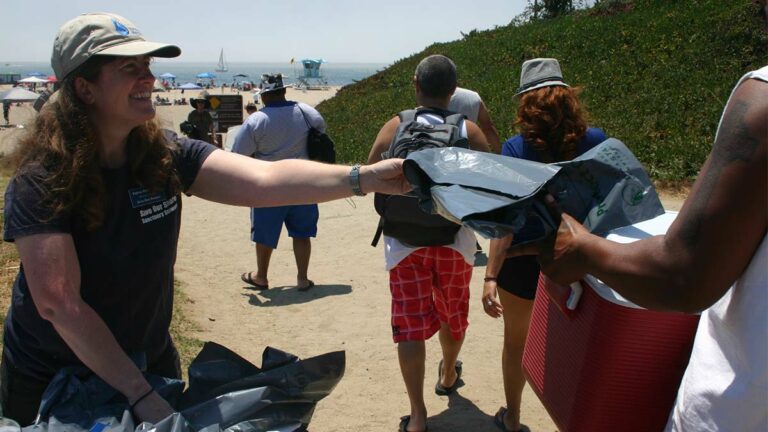
The county’s annual fifth-of-July beach cleanup crew may be slimmer than in past years, and that has begun to worry leaders from Save Our Shores, Santa Cruz’s marine conservation nonprofit. With Independence Day falling on a Monday, it will be the first time in three years that the day-after cleanup doesn’t fall on the weekend. Ryan Kallabis, communications manager for Save Our Shores (SOS), is trying to get the word out about the cleanup, as well as the volunteer efforts on the Fourth to hand out trash bags along the coast and tell beachgoers about stewardship. With fewer volunteers expected this year, prevention will be more important, and Kallabis is launching a social media campaign to remind folks that “no one likes a dirty beach.” The first of the group’s five tips this year is to leave Styrofoam at home. Vacationers often bring large polystyrene coolers to the beach, filled with food and drink for the holiday. Then when people head back, sometimes they realize that the beach’s trash cans are all full. They end up leaving their garbage in the coolers on the beach, and the tourists may think they’re doing everyone a favor, Kallabis says, by putting it all in one place. “But there are waves. There are birds. There’s wind. And these things get torn apart,” he says. “You can imagine dozens of families bringing these things. The whole beach becomes a Styrofoam mess.” The second tip is to pack food and drinks in reusable containers worth taking back home. Beach lovers should also bring party equipment in reusable bags, Kallabis recommends. The fourth tip is not to leave firework shells, tents, barbecues, coolers or chairs behind. Lastly, Kallabis says vacationers should not burn trash or put it in a fire pit because shards can get carried out to sea. This year, SOS is shooting for a goal of 300 volunteers. Last year’s cleanup had 182. The nonprofit’s all-time high was around 600 volunteers for an Earth Day cleanup.
With the season of glossy fliers and knocking on doors approaching quickly, five Santa Cruz City Council candidates have announced their intentions to run. Though they are campaigning on similar issues, like the city wide housing crisis and homelessness, they each bring unique perspectives and solutions to the larger discussions. Mayor Cynthia Mathews will seek another term, and current Councilmember Micah Posner has yet to decide. Councilmember Pamela Comstock will not run, and Councilmember Don Lane is getting temporarily termed out after eight years, leaving at least two open seats. The candidacy nomination period begins July 18 and runs through Aug. 12, and the general election is Nov. 8.
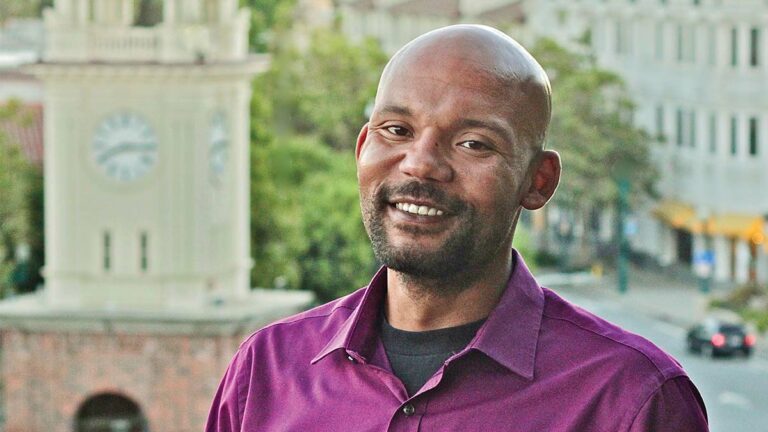
Drew “Dru” Glover A cancer survivor and photographer, Dru Glover founded Santa Cruz nonprofit Project Pollinate to promote environmental sustainability for the future by hosting educational events around Santa Cruz. “The next generation is what we should be focusing on,” Glover says. “Our generation and the generation before us are important, but our future leaders of the community are who we need to be focusing our time and energy into.” Glover wants to make housing more affordable by building more units, as well as improving alternate and accessible forms of public transportation—whether that means maintaining Metro routes or making it easier to cycle around town. He also wants to create more community involvement in local politics. Glover insists, though, that Santa Cruz doesn’t have any singular issues. “All of the issues are combined, and we need to take a really holistic approach to addressing [them], educating the community, getting people involved, and brainstorming solutions,” Glover says.
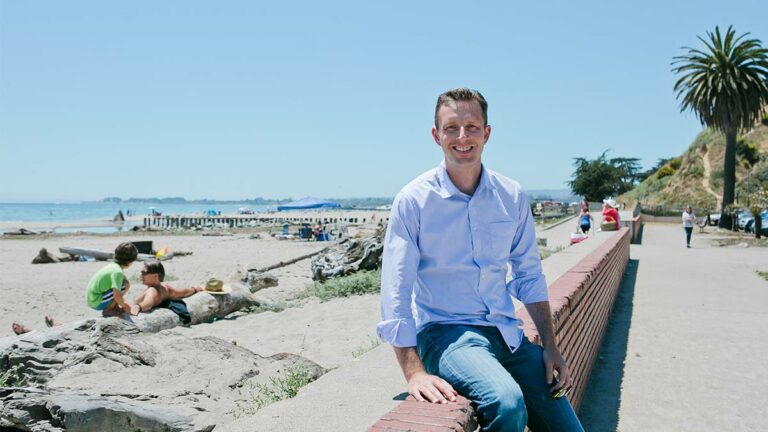
J.M. Brown J.M. Brown, a public relations representative, says his reasons for running for city council align with his background in journalism: he has a desire to serve the public. “I got into journalism to ensure accountability in our community, be a voice to the underrepresented, and to shine light on social problems,” says Brown, a former Santa Cruz Sentinel reporter. “When I decided to leave that profession, I realized that those are the same attributes that someone should want in a city councilmember: someone who is going to ask good questions, be an independent thinker, and have the best interests of the public in mind.” Brown wants to focus on creating and maintaining affordable housing, advocacy for the “highest and best” use of the San Lorenzo River, public safety, and mental health. Brown has so far garnered the most impressive list of endorsements, including Assemblymember Mark Stone, County Supervisor Ryan Coonerty and former mayor Hilary Bryant, also a campaign advisor to Brown. Brown is serving as a City of Santa Cruz Parks and Recreation Commission member and a member of the Santa Cruz County Housing Advisory Commission.
Martine Watkins Martine Watkins says she has always been a problem solver. A mother of two, Watkins works as the senior community organizer in the Santa Cruz County Office of Education. “I come from a perspective of thinking about the future, and ensuring that the decisions that we make today are considerate of what it takes to build a healthy future,” says Watkins, who is the daughter of county schools superintendent Michael Watkins. Martine Watkins, who grew up in Santa Cruz County before pursuing legal studies at UCSC, wants to find solutions to the housing crisis. “If we don’t think about these issues, I don’t know that our kids will be able to live here,” Watkins says. “We have to be mindful about what policies today have on those who are here to inherit the world and our community tomorrow.”
Steve Pleich With around 150 days until the November election, Steve Pleich has already begun knocking on doors. “I am going to be out every day asking people what their issues are, and how city council can serve them better,” Pleich says. “City council is the most powerful and influential position that people have in Santa Cruz, and it’s also the position from which you can do the most good.” Pleich is a self-employed professional grant writer actively involved in community service and nonprofit programs throughout Santa Cruz. He has run twice before, largely on repealing the sleeping ban and other homeless issues, and says he is pushing a three-issue campaign. “We really can make Santa Cruz a more self-sustaining community just by raising the minimum wage to a living wage, finding affordable rental spaces, and promoting sustainable transportation,” Pleich says. “All of these things are interrelated. That’s what I am going to concentrate on … It’s really a working-class campaign.”
Nathanael Kennedy Though he has no political experience, Nathanael Kennedy wants to advocate for more public restrooms downtown, more homeless shelters and bicycle cops. “The number one thing I am trying to accomplish is simply getting the police some tandem bicycles, because that way two police arrive at the same time,” Kennedy said. “It’s important that when they are on bikes they can have a passenger.” As a self-employed artist, Kennedy has made and given out more than 9,080 origami cranes this year, he says. He’s been arrested a handful times in the past 15 years, and was convicted in a 2008 misdemeanor weapon exhibition charge—a detail he’s not thrilled to have re-hashed in the media. In 2002, Kennedy was arrested for vandalism misdemeanor charges related to sidewalk chalking. If elected, he hopes to have spaces designated for chalking downtown.
Steve Schnaar Steve Schnaar, the latest candidate to jump into the race, is the founder and director of the Santa Cruz Fruit Tree project, and a volunteer mechanic for the Bike Church. He is passionate about preserving the Beach Flats Community Garden, environmental sustainability, solutions to homelessness, and affordable housing. “Like Bernie Sanders, I’m someone with a broad vision of economic and environmental justice, and I have a very long track record of fighting for these ideals,” Schnaar tells GT via email. He has several proposals for more affordable housing, including rent control, making it easier for homeowners to build back units and requiring the inclusion of affordable housing units in all new developments.
Maybe it’s because my high school mounted a stage production of Look Homeward Angel when I was a senior, and I had a big crush on the guy who played the lead, but I’ve always had a soft spot for Thomas Wolfe’s coming-of-age novel, and the mystique of its author. Both figure prominently in the literary biopic Genius, which delves into the relationship between Wolfe and his editor at Charles Scribner’s Sons, the legendary Maxwell Perkins—the designated “genius” of the title—who was, by the time he met Wolfe, already famed as the editor who shepherded both Ernest Hemingway and F. Scott Fitzgerald to publication in the 1920s. Based on the biography, Max Perkins: Editor of Genius, by A. Scott Berg, the movie depicts Wolfe as a larger-than-life persona, eager to swallow life whole, and blast it out again in torrents of gorgeous prose. It’s a view of the author that perhaps you can best appreciate if you fell in love with Wolfe’s great, sprawling verbiage at age 17. Jude Law is way over the top in the role, with his frenzied eyes and Southern-fried drawl, but his performance conveys the essence of a man utterly, passionately besotted by words. In contrast to Law’s flamboyance, the movie gives us stoic, thoughtful, dependable Colin Firth as editor Perkins. At the time the movie begins, in 1929, Perkins is a happily married father of five daughters, who takes the commuter train into New York City every day, usually with a manuscript he’s reading in hand. Having wrangled with the likes of Fitzgerald and Hemingway, he chooses his words with great care, for maximum impact. Firth plays Max as a man so button-down, he never takes off his fedora, even listening to the radio at night by his own fireside. It makes sense that the director of Genius, award-winning stage director Michael Grandage, making his film debut, is also an actor. Working from a script by John Logan (Hugo; Skyfall), Grandage turns the story of these two literary giants into a character study; a pas-de-deux between polar opposites, where the actor’s nuance is as crucial as bluster in moving the story forward. (In Law’s performance as well as Firth’s. Watch Law’s face when someone confronts Tom with a hard, unexpected truth). Moving the story forward is also Max’s job description, and the film’s backstage look at the business of publishing, as he and Tom tussle over every line and page, is as fascinating as it is mind-boggling. Granted, Wolfe was an extreme case; in the movie, he delivers the manuscript for his second novel, Of Time and the River, in a parade of paper-filled crates, totaling 5,000 hand-written pages. (And he keeps adding more.) It takes a fleet of Scribner’s typists months to pound it into typed pages before the editing can even begin. The movie is as in love with words and their power as Tom is. The filmmakers acknowledge Max’s point, that a book’s primary function is to tell a story, and if excessive verbiage—no matter how gloriously written—gets in the way, out it goes. But it also sympathizes with Tom’s lust for words for their own sake. When Max explains to Tom why an achingly beautiful passage has to go, first he reads it out loud, so we can all enjoy it. Nicole Kidman adds a dark, waspish note as Tom’s unstable lover, Aline Bernstein. A stage set designer married to someone else, she’s left her family for Tom, and reacts in volatile ways to think she might be losing him to his new friendship with Max. Guy Pearce seems a bit too robust and forthright to convey the romantic tragedy of Fitzgerald, but Dominic West is great in his one scene as Hemingway. It’s a shame this movie’s own preview trailer gave away so much; it’s difficult to get swept up in the story when you know what’s coming. But there’s still enough of interest here, in both the era and the industry, to keep us engaged, lit geeks and normal people alike.
GENIUS *** With Colin Firth, Jude Law, Nicole Kidman, and Laura Linney. Written by John Logan. Directed by Michael Grandage. A Roadside Attractions release. Rated PG-13. 104 minutes.
Lacking a robust sweet tooth, I was pretty picky about candy as a kid, and have become even more discerning as an adult. I usually prefer a piece of chocolate on the rare occasion that I crave something sugary. But a bag of assorted Sour Fruit Strips from Ashby Confections may have awakened a sweet side of me I didn’t know I had—although they are pretty sour, too. The zingy sunset-colored candies ($2.75/ounce)are packed with intense flavors like strawberry rhubarb, golden apricot and kiwi, and they seem to glow with the warmth of tree-ripened fruit sourced directly from farmers markets. Best of all, these candies contain only five (reasonably wholesome) ingredients: fresh local organic fruit, cane sugar, glucose, pectin and citric acid—which is fantastic, because even if the kid inside of me is delighted to be eating candy, seeing a laundry list of indecipherable chemicals on the back of a package kills, with a bolt of processed lightning, whatever craving adult me was trying to satisfy. Jennifer Ashby, the mastermind behind this fruity treat, also says that the gummies contain no GMOs and are vegan, and soon will be using only certified organic ingredients. You can’t get much more “mother approved” than that. These sour fruit strips got their beginning as a happy accident, after a batch of fruit candy was left to sit out too long. After some tweaking and experimentation, they have become Ashby’s most popular product. Inspired by the ultra-beautiful fruit found year round at local markets and her relationships with farmers, Ashby has tried every seasonal flavor she can get her hands on, from Malaysian guava and Concord grapes to peach and Santa Rosa plum. Her Sour Fruit Strips made with fresh oranges were a finalist for a Good Food Award in 2015. “I’ve always loved fruity candy. That was my favorite thing when I was a little kid,” says Ashby. “People of all ages appreciate candy, and even those that claim to not like fruity stuff love these.”
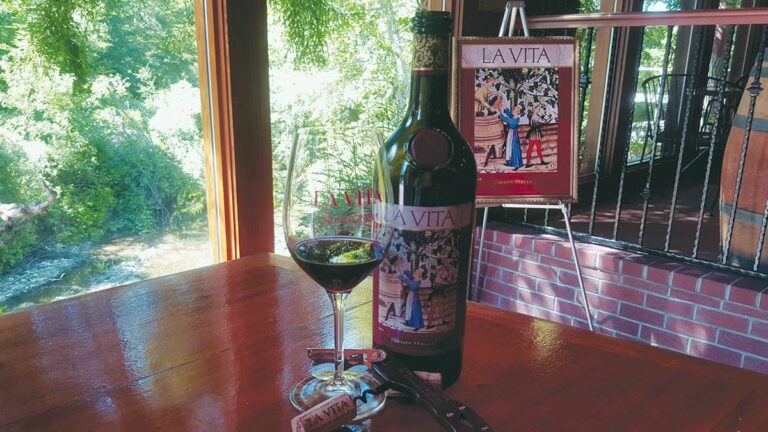
The annual La Vita release party at Bargetto Winery in June is always a sell-out affair. I found a good spot in the shade, picked up my complimentary wine glass and plate of food (included in the ticket), and began tasting their splendid wines. But what everybody’s really waiting for is not just the release of the La Vita, but also the unveiling of the La Vita label—each year it’s a beautiful piece of art. As John Bargetto revealed the La Vita 2012 wine label, people were delighted with its Arabian theme. “It’s a 13th century piece on vellum—Arabic school—named the Grape Harvest,” says Bargetto. “The actual piece came from Baghdad.” “La Vita wine is our finest effort in winemaking,” adds Bargetto, “from growing the grapes, to producing the wine to designing the unique package.” And although the label is certainly impressive, best of all are the contents of the bottle—the exotic wine itself—a unique blend of 49 percent Refosco, 30 percent Nebbiolo and 21 percent Dolcetto. Kudos are due to winemaker Olivia Teutschel for creating this superior nectar—one that Bargetto calls a “rich vintage.” As the 2012 La Vita ($60) is officially released, Bargetto Winery also released one bottle from each of 14 previous vintages, adding even more pleasure to the delightful afternoon. The Bargetto family has always supported the community, so it came as no surprise that John Bargetto announced that he is running for a position on the Soquel Creek Water District board, which, as it happens, was co-founded by his father in 1961. Let’s drink a toast to that! Bargetto Winery, 3535 N. Main St., Soquel, 475-2258. bargetto.com.
Opening of Urban Wine Row in Marina
Three wineries will celebrate the opening of their new tasting facility from noon to 5 p.m. on Saturday, July 2. A collaboration of Comanche Cellars, Cima Collina and Sinecure Wines, the tasting room is close to Highway 1 and located in the Marina Business Park. The cost is $15 per person, which includes three tastes at each winery. A tri-tip sandwich, salad and a cookie is $15, with proceeds benefiting Best Buddies International. Visit urbanwinerow.com for more information.
It begins in May, sporadic at first. It builds steadily to a crescendo in early July, before leveling off and holding steady until August peters into September. The whistle and bang. The crackle and pop. The occasional jarring boom. “Fireworks are a big issue,” said Santa Cruz County Supervisor Zach Friend at a recent community meeting in Rio Del Mar. “It’s not just about one night, either. It’s every night throughout the entire summer. It seems like it wakes up my 1-year-old every night.” Fireworks persist throughout summer evenings in Santa Cruz despite a strict ban throughout most of the county. Increasingly, Friend and other officials are fielding a plethora of complaints from residents who say the intermittent blasts are traumatizing their pets, causing veterans issues related to Post-Traumatic Stress Disorder (PTSD) or simply impinging on the peace and quiet of otherwise calm summer nights. During a June meeting at the Rio Sands Hotel in Aptos with sheriff and fire officials, Friend unveiled a new set of measures aimed at curtailing the fireworks that amateur pyro-technicians launch into the sky—especially on the Fourth of July at the beach. Friend says that one step toward curbing illegal fireworks is educating locals about the law. The county has been purchasing ads in the counties of Santa Clara, Monterey and San Benito, as well as in the Central Valley. Many of the tourists who come to Santa Cruz in the summer to vacation aren’t aware that fireworks are illegal around the county (except in Watsonville, where “safe and sane” fireworks are sold from July 1 through July 4, with proceeds going to community nonprofits). County workers are also sending letters to vacation rental owners to let them know they are liable for infractions of the fireworks ordinance, while other officials work with parents through the schools. The sheriff’s office is also beefing up enforcement, mobilizing additional deputies in the days leading up to the Fourth of July. There will be 13 deputies assigned to patrol the beach area during the day on July 4, and 26 during the night, as well as increased signage and triple fines for setting off fireworks on the Fourth that could run as high as $1,500. But after hearing about the county redoubling its outreach and patrol efforts, some people at the meeting suggested that the police presence along the beach already goes too far. One woman said she’s grown tired of seeing “the Fourth of July turned into a police state.” “This is America, and Fourth of July means fireworks,” resident Liz Karzag said. “You are not going to stop it.” Even people who don’t think the tradition is a blast have expressed doubts about anti-fireworks enforcement. They say that cutting off beach access for the many drunken enthusiasts blasting them off only sends them into residential areas. “I don’t condone fireworks all year round,” said Mary Dixon, a resident of the area. “But you scare these people off the beach and they go inland and do damage to our neighborhoods.” Dixon also added that there is more of a chance of wildland fires the farther inland people go—a worry echoed by Mike Conrad, fire chief of the Aptos/La Selva district. “The biggest concern is Larkin Valley and Day Valley, because there is a potential to create a significant fire event,” Conrad said at the meeting. “We don’t want to get it pushed back to the mountain side of Highway 1.” Sheriff Jim Hart conceded that barricading the beaches and performing rigorous searching of bags has produced the unintended consequence of driving more fireworks usage into the neighborhoods around the beach. “In the past, we routinely had stabbings and shootings on the beach,” Hart said. “So we worked on funneling foot traffic so we could look into backpacks, but it has gotten fireworks off the beach and into the neighborhoods.” Hart mentioned the robust patrols planned for this year’s event will concentrate on neighborhoods in proximity to beaches, and that the county will ease barricade and search operations at county beaches. But State Parkswill maintain barricades on state beaches like Seabright State Beach and Seacliff State Beach. In the city of Santa Cruz, the city council passed its annual safety enhancement zone, which triples fines for a dozen violations—including fireworks, open-container and noise violations—and extended the zone from the beach area to the entire city for the holiday weekend. At the county meeting, many locals attested to enjoying the amateur fireworks display, arguing that the county should adopt a formal policy of making fireworks legal on the Fourth and vigorously enforce infractions during other parts of the summer, when residents are less prepared for sudden explosions. Friend balked at the idea, saying nobody would “really want the county to be liable for an injury to any kid for allowing this type of permissive activity.” In response, resident Monica McGuire suggested that simply erecting signs telling people their activities are at their own risk might solve the problem, but county officials say that would still create a legal and safety nightmare. Additionally, Katherine O’Dea, executive director of Save Our Shores, says that while the beach is indeed more fire-safe than inland areas, guerilla fireworks and debris can wreak havoc on the marine ecosystem. And unexploded rockets pose a safety threat to those who volunteer to clean up garbage on the morning after the holiday. “It’s a polarizing issue,” Hart says. “The vast majority of people don’t want fireworks in their neighborhood. But some people standing on the bluff over the ocean want to see a great show on a national holiday. We have to work with that group as well.” Friend has suggested hosting a professional fireworks show as a possible solution. In recent years, both city and county workers have suggested that might alleviate some of the demand from people who want to see things blow up. Friend says the major hurdle is cost, and tells GT that running a professional show would take about the same number of officers as the county already has on patrol for the holiday—along with members of the fire department, insurance and related costs. “How could we justify taking a sheriff’s deputy off the street to put on a fireworks show?” Friend says. The county has entered into discussions about partnering with local businesses and sponsors to kick in the necessary dollars to make such a show a reality. But considering the expense, those talks are extremely preliminary. The city has looked at hosting a professional fireworks display down by the Santa Cruz Beach Boardwalk. But after receiving a tepid response from Santa Cruz Seaside Company, coupled with fears about how an enormous crowd would snarl traffic and make it nearly impossible for first responders to react to an emergency, the city abandoned those plans, says Scott Collins, assistant to the city manager.
In their 20 years of playing music together, the Bills have celebrated joys and successes, taken breaks, and weathered challenges. Like a family that’s grown stronger with time, they’re tighter than ever, musically and otherwise. “What happens is that you sort of breathe like a single musician with 10 arms and 10 hands,” says guitarist and vocalist Chris Frye. “You get so used to working together and you have a history of musical ideas and inside musical jokes. You’ve shared the ups and downs that really create a bond in a relationship.” Hailing from Canada’s West Coast, the Bills are global ambassadors for Canadian folk and roots music—a thriving scene that boasts large festivals in several cities across the country. Perhaps somewhat underappreciated in the States, the Canadian music scene birthed numerous folk-rock icons, including Joni Mitchell, Neil Young, Leonard Cohen, k.d. lang and the Band. The Bills—comprised of Frye, Marc Atkinson on mandolin, guitar and vocals, Richard Moody on violin, viola and vocals, Adrian Dolan on fiddle, piano, accordion and vocals, and Scott White on upright bass and vocals—enrich Canada’s folk landscape with their diverse musical backgrounds in orchestras, jazz ensembles, rock bands, and early roots music. “We feel like we follow as much in that folk and rock tradition as anything,” says Frye, “But there’s also a much more traditional style that we have strong roots in as well. We try to bring it all together and put it all through a West Coast Canadian lens, and it comes out being the Bills.” Playing what they describe as a “kitchen-jam exploration of traditional and modern styles,” the Bills embrace the simple joy of acoustic instruments. It’s a casual setting, and they’ll bring in whoever happens to be around to join the jam. “The thing about this roots music thing is that it’s very inclusive, and it’s meant to be played at an acoustic level. We can make it happen right here, right now, around any table,” says Frye, “You put acoustic instruments in a shared human space, with no speakers, no monitors, no electronics, and you can just rock people and bring up so much energy and emotion.” Taking this open approach to making music, the Bills have collaboratively composed five albums going back to their 2000 debut, The Bill Hilly Band. The band’s latest, Trail of Tales, was recorded in a farmhouse on Mayne Island, off the coast of British Columbia, where the band stayed for over two weeks. Dolan produced the record and gave it a warm, classic sound by using vintage microphones and old-school isolation techniques, including putting the band members on different floors of the farmhouse. The experience was, as Frye puts it, “like a big old Bills campout.” “We were all together, all the time, for 17 or 18 days. It was great,” says Frye. “You couldn’t escape each other, but you didn’t really want to.” The result is a record rooted in rich harmonies, stellar musicianship, sunny days and the natural world—if you listen carefully, you can hear birds singing. The unofficial theme of Trail of Tales is the planet and humanity’s relationship with it. It’s full of songs about the complexity of the issues society faces, the beauty of the earth, simple pleasures, and cautionary tales. From the funky “Jungle Doctor” to the feel-good “Happy Be,” it showcases a mature band putting their music where their consciousness is. “It’s pretty hard to avoid those issues in this day and age,” Frye says. “As a group of human beings, we lean in that direction of concern for the earth—our ecosystems and our planet. We feel really excited to have tunes that really rock, but also speak to things that are important to us and our fans and our families.” For their upcoming performance at Kuumbwa, which falls on Canada Day, the band has “a few tricks up [their] sleeves” and they promise to bring the tight, rich sound they’ve perfected over the last two decades. “We hold ourselves to a really high standard, musically,” says Frye. “If we keep that quality control high, then we feel like good things will keep coming to the Bills and we’ll continue to be good representatives of the part of the world we come from.”
INFO: 7:30 p.m. Friday, July 1. Kuumbwa Jazz, 320-2 Cedar St., Santa Cruz. $25/$40. 427-2227.
The razzle-dazzle didn’t always ignite on opening night of the new Cabrillo Stage production of Chicago. But despite a few miscues, the inaugural show in the company’s summer musical season mostly delivered the goods, in the ways we’ve come to expect from CS—a couple of outstanding performances, and a terrific corps of dancers. A glitzy tale of crime, celebrity, and media in the Jazz Age, the show hit Broadway in 1975, with music and lyrics by John Kander and Fred Ebb (who collaborated on Cabaret), and choreographed by Bob Fosse, who also co-wrote the book with Ebb. The parallels to Cabaret are notable: both shows are presented on a nightclub stage, with a visible orchestra upstage and an emcee to introduce the numbers and set the scene. That most of the story in Chicago takes place in jail cells and a courtroom only intensifies the equation of crime and justice with showbiz. The Cabrillo production was directed and choreographed by longtime CS stalwart Janie Scott. She locates the orchestra—a 13-piece jazz combo led with plenty of verve by Musical Director and keyboardist Mazera Cox-Goulter—in a balcony across the back of the stage, overlooking the action. A central staircase descending to centerstage, and a couple of side balconies and stairwells, complete Patrick Klein’s clean, functional set, on which the story plays out, in all its glamour and tart cynicism. The show begins cleverly, with silent movie-style title cards on a white screen, with the usual requests to turn off our cell phones, etc. The screen falls away for the dynamic opening number, “All That Jazz,” featuring the entire company, led by Jessica Whittemore in the central role of Velma Kelly. Whittemore is the undisputed gemstone of this production, with her great voice, fearless dancing (especially in the one-woman duet, “I Can’t Do It Alone”), and her ever-insouciant attitude. The opening number ends with a murder, when blonde chorine, Roxie Hart, shoots her boyfriend for two-timing her. Co-protagonist Roxie is played by Danielle Williams, who manages the character’s lightning shifts between tough cookie and innocent Kewpie Doll with brisk, comic dexterity. Roxie also has a loyal schlub of a husband who adores her, good-hearted, downtrodden auto mechanic, Amos. Dave Leon plays Amos with a mixture of hopeful pluck and resignation that wins the audience’s hearts over the course of the show. Roxie almost gets Amos to take the murder rap for her, until he realizes she was cheating on him. The main story kicks in when Roxie goes to jail, joining Velma and her sextet of “merry murderesses” awaiting trial. (Their number, “Cell Block Tango”—better known by its recurring refrain, “He Had It Coming”—captures the show’s wry asperity.) The cell block is presided over by matron “Mama” Morton, played with panache by Danny Dwaine Wells II. The ironic duet, “Class,” that Mama sings with Velma is a highlight of the show. In jail, Roxie falls under the wing of slick lawyer Billy Flynn, (a chipper performance from David Jackson), who famously gets his sexy (and guilty) clients acquitted by drumming up sympathy in the celebrity-obsessed tabloids, and employing “Razzle Dazzle” in the courtroom. Roxie’s rising media fame begins to eclipse Velma’s, and while the women are initially antagonistic, they establish their sisterhood in time for the big finale. Reynolds is a crowd-pleaser as “sob sister” gossip columnist Mary Sunshine, although lyrics delivered in a startling operatic soprano are sometimes hard to decipher. And Nick Rodrigues is polished, exuberant fun as the versatile emcee, who also takes an occasional role in the story. As for those opening night glitches, the house lights kept going up in the middle of the show, and while this problem was resolved in the second act, a spotlight was late coming on at a climactic moment. And Billy’s pinstripe suit pants suffered a wardrobe malfunction when he made his first entrance from behind a cloud of ostrich-feather fans. But the great thing about live theatre is that all these minor problems can be solved as the show goes on.
Info: The Cabrillo Stage production of ‘Chicago’ plays through July 10 at the Crocker Theater, Cabrillo College. For information, call 479-6429, or visit cabrillostage.com.
I met Jared Truby, Chris Baca and Charles Jack—collectively known as Cat & Cloud Coffee—at their new location on the corner of 36th and Portola avenues on a recent sunny morning. The building we stood in was completely gutted, but will eventually hold an open, light-filled community space and the newest specialty coffee roastery in Santa Cruz. Their energy and enthusiasm was palpable as we looked over blueprints and discussed their vision to bring Santa Cruz the perfect morning buzz. “Coffee beans have magic locked inside of them, and for us it’s always a challenge to get that magic out and deliver it right to the cup,” says Baca. “We’re excited to give the community the very best of what we have to offer,” Truby adds. Cat & Cloud recently raised $34,423 in 30 days through a fundraising campaign on Kickstarter, exceeding their $30,000 goal. The money will go toward renovating their permanent location, which they hope to open in September. Until then, they will be holding pop-ups at Companion Bakeshop from 7 a.m. to 1:30 p.m. on Mondays, as a way of introducing the local community to their vivid roasts. Before taking the leap into coffee entrepreneurship, Truby was a founding pillar at Verve, where he was head of retail for Northern California and store manager for three years. He and Baca met in 2006 at their first United States Regional Barista Championship (yes, that’s a thing). While working at Verve, they met Jack, a “reformed” Wall Street financial adviser who discovered his passion for coffee while working with coffee farmers and nonprofits in East Africa. Now, the three of them are pursuing their own coffee vision, with unique roasts and cutting-edge brewing techniques. Without letting the cat fully out of the bag, they hinted at a hyper-fast by-the-cup brewing technique and a non-coffee coffee beverage brewed with sound waves. These guys are definitely nerds, but despite the sciency seriousness of their approach, Truby emphasizes, “We want to eschew the snobby baristas and cliquey feel of coffee shops and connect with people. Our goal is to educate people about how to do what we’re doing at home without trying as hard as other companies might make you feel you have to try.” Cat & Cloud’s roasting philosophy strays from the brighter, more acidic lighter roasts that tend to be favored by the specialty coffee industry to darker roasts, which they view as more approachable for the average coffee drinker. “There’s a big argument going on in specialty coffee right now. One side of the argument says that in order to maintain the intrinsic qualities of coffee, you have to roast them really, really lightly to the point where they’re almost pretty sour, and if you take them too far and roast them a little bit more to the point where they’re a little more approachable, you lose a lot of the clarity of flavor and the character,” explains Baca. “We don’t agree with that at all. We believe you can have clarity of flavor, nuance and a really nice developed roast that anyone can drink. It just takes a lot of intentionality, and you really have to be paying attention. It’s very hard. You ride a thin line, but that’s what we do and that’s what we’re excited about, for people to drink a full mug of these specialty coffees and want more.” 3600 Portola Ave., Santa Cruz. catandcloud.com.
Chili Pow Burn’s probiotic, three-ingredient hot sauce has taken over my breakfast, and now they’ve added a new product to their growing arsenal of spiciness: probiotic chili powder. In an effort to lower their waste to as close to zero as possible, Burn preserves the seeds and skins that don’t blend fine enough to become sauce and dehydrates them at a super low temperature, which preserves the probiotic qualities from fermentation. With all the flavor and kick of their Thai bird, Serrano and Cayenne chilis, and the umami cheesiness of nutritional yeast, the powder is amazing on popcorn, as a marinade for meat and veggies, or on roasted potatoes. Find it at their booth at the downtown farmers market. $3 for 1.5 ounces. burnhotsauce.com.
Men in the vineyards, muscles gleaming in the hot sun. Men hauling barrels in the cellars. Men making wine. The age-old romance of winemaking was founded on the image of the charismatic man—often the one whose name is on the label. Is any of this changing, I wondered, as I foraged for stats and anecdotes about women winemakers in the 21st century? Celebrated British wine writer Jancis Robinson offered me this wry comment on the increase of women in the world of wine: “Women are a much more powerful force in the wine business than they were when I started 40 years ago. Most of the men I meet in the wine business admit that their female partners are better tasters than they are. But, there is still a bit of a glass ceiling for women as far as important positions in bigger companies are concerned.” Robert Marsh, an expert in the domain of Central Coast wine sales, went further. The ceiling for women in the business isn’t glass, he says, “it’s cement.” Marsh believes the biggest impact women have had on the wine business is in sales and marketing. “And that’s because many women have started their own brokerages, having been turned down by the large, male-dominated firms,” he says. Marsh works for Alexia Moore, who started her company in the ’70s. He says it’s difficult for women to get into wine distribution “because of the culture of old-school men.” Wine researcher and University of Santa Clara professor of psychology Lucia Gilbert’s 2014 case study of top California wineries indicated 14.7 percent female winemakers in 2014, versus 10 percent in 1999. “That’s not much of an increase in 15 years,” she says. In her 2015 study for American Association of Wine Economists (AAWE), Gilbert found that, contrary to the widely touted myth that women winemakers in California are shattering the glass ceiling in an industry historically dominated by men, in fact only 9.8 percent of California wineries have a woman as their lead winemaker. In a similar study of winemaking roles among Australia’s wine producers for the AAWE, Jeremy Galbreath reported in 2014 that 9 percent of wineries employed women in the top winemaking role. Because there are fewer women winemakers, Gilbert’s study noted, their careers experience particular challenges. Those who are successful are not only highly motivated, but also have to deal successfully with challenge and risk management. Marsh says he finds a female winemaker is rarely an important factor in sales. “The winery itself, how its grapes are grown, its program—organic or biodynamic—those things I’ll mention,” he says. “If I’m talking with a true wine geek, or if I encounter a woman buyer, I might mention that the winemaker is a woman.” Probably the single biggest impact a woman has made in local winemaking, according to Marsh, is at Bargetto Winery. So that’s where I began my attempt to let local women winemakers tell their stories, and get some other perspectives on women in the business, as well.
Olivia Teutschel, Winemaker, Bargetto Winery
Olivia Teutschel, Bargetto Winery Aptos native Olivia Teutschel, who has been Bargetto’s winemaker of record for the past two years, tells me she has always loved farming and being outdoors. At Cal Poly, Teutschel thought she would try wine marketing, but found her life’s work when she took a winemaking class. “It was very hands-on. We learned with actual equipment, the nitty-gritty stuff. I loved it!” When it came time to do an internship, Teutschel went to Edna Valley and applied for a cellar job. “It was my first and only interview,” she says. “I was told, firmly, that it would be ‘hard work.’ That evening, I sent back an email and said I could do hard work. I got the internship. But then I really had to prove myself. Get there early and stay late.” Graduating in 2009, she interned at Sebastiani Vineyards in Sonoma, in the lab of a very big, old company. Then in New Zealand, she worked at Vavasour Winery to get more experience. Then she met Peter Bargetto of Soquel Vineyards on a winemaking tour right up the street from her aunt and uncle’s house. “He put me to work, at first on weekends at Soquel Vineyards and then at Bargetto during weekdays,” she says. Her current favorite house wines include Bargetto Winery’s Nelson Vineyards Syrah. “This vineyard is very consistent, even in rough years. The other thing I’m most excited about is our Regan Reserve Chardonnay.” Why are you good at this? OLIVIA TEUTSCHEL: Being so detail-oriented, I think. Being a detective, paying attention—in fact, that might be a gender item. It’s served me well here. I ask questions. I enjoy being really organized. Organized but flexible. There are a lot of moving pieces in winemaking. The mystery—the unknown—is part of the excitement. But I also like all the nitty-gritty things. Right now, Bargetto is surfing the changing tides. My job as winemaker was made easier by the fact that I was here as an assistant for many years first. And it’s getting easier. With owner-operated wineries you have to do all the work. I do it all—everything but driving the truck filled with grapes down those winding roads. Is being female an extra hurdle? I’ve only been the official winemaker for two years. When I first started as winemaker, there were some awkward moments. There was a seniority thing—a lot of people have been here for a long time, and suddenly I was their boss. But it wasn’t about my being female. bargetto.com
Nicole Walsh, Owner and Winemaker, Ser Wine Company
Nicole Walsh earned a degree in winemaking at Michigan State before coming to Santa Cruz in 2001 to work at Bonny Doon Vineyard. After a stint as a wine consultant in New Zealand, Walsh returned to manage the estate vineyard for Randall Grahm in San Juan Bautista. At what point did you start your own label, Ser? Nicole Walsh, Ser Winery NICOLE WALSH: I began Ser because of Alex Krause, my old friend and winemaking colleague at Birichino. He gave me the idea. After the economic collapse, we scaled down to 15,000 cases at BD. The world had no money, I felt negative and I was pregnant with our second child. It was a soul-searching year. Krause said to me, “You’re a winemaker. Make wine!” I talked to Randall, he said OK. I bought a few tons of grapes—you have to get good grapes. What was the big change when you had your own label? It’s inspired me, rekindled my passion. I’m creating something based on my own decisions. It’s such a different connection with wine. It’s also renewed my relationship with Randall. I’m learning so much. 2013 was my first label. Next I’m opening up a tasting room in Saratoga with Silvertip. If I’m going to be small and artisan, I need more exposure. Direct to consumer—I felt it was the next step. How hard is it to juggle family, winemaking, and real life? I’m completely overwhelmed! I have two kids, working for Randall, and now my own label. I need some balance. I’m a surfer, and I haven’t surfed for three months. I wonder, “Am I ever going to see the ocean again?” What’s rewarding? I just did an Outstanding in the Field dinner. And I realized “this is what it’s all about.” Sharing the wine, paired with foods. This was the moment to savor. I love wine. It felt very special. Are there any advantages to being a women in this business? A woman is an exotic, I believe. There is some textural distinction in the wines themselves—a delicacy, an elegance. Using the same grapes, my wines were different than those made by men. That might be described as feminine. A certain quality. I don’t know what it is, but it’s definitely there. I think wine made by a woman is most appealing to other women. It’s still surprising that there are so few of us. A big two-day tasting in Healdsburg last month opened my eyes. It was such a boy’s club. I think it is empowering for other women to see a woman making wine in a male-dominated field. Women customers, when they taste the wine and I tell them I am the winemaker, their eyes light up, there is interest, more questions asked. serwinery.com
John Locke, Wine Buyer, Soif
Are women treated differently in the wine world? JOHN LOCKE: I imagine women winemakers are given a shorter leash than men. Women probably have to be better than men to keep their jobs, or at least advance through the ranks. I am not prepared to say that women are dispositionally more likely to be superior to men in the realm of winemaking, though the ones who do make it to the top probably deserve to be there. Are they considered a rarity? From my own perspective, I do not think women winemakers are exotic or rarities anymore. That being said, one does hear distributor reps and journalists note with regularity that a particular wine is made by a woman, suggesting that this is noteworthy and might inform one’s opinion of the wine or the house from which it comes. Rarely do people talk about Cathy Corison’s Napa Cabernet without noting that there is a feminine quality to it. So yes, certainly many people believe this could help move boxes. In the case of Cathy Corison, her reputation is beyond reproach, so in my opinion, very few professionals purchase the wine based on her gender, only her considerable chops. I would be quite frankly very surprised if the wine industry is so extraordinarily progressive that it has managed to be nearly unique in transforming from a formerly male-dominated business into one based solely on merit. I would like to think it is a meritocracy, but I would be surprised.
Leslie Fellows, Owner, Uruguay’s Artesana Winery
Are women more prevalent in South American winemaking? LESLIE FELLOWS: Yes. Our female winemakers are in charge of Uruguay operations, vineyards, production, tourism, sales and export preparation. In Uruguay, there are many women winemakers and owners, partly because so many are family operations. Do you see any signs that women are making an impact elsewhere in a traditionally male profession? There are more and more women winemakers making a name for themselves in the U.S.; however, I believe we still have a long way to go with distribution. The industry is dominated by huge companies like Southern, Republic, and Young’s. There has been a lot of consolidation in recent years—fewer and fewer small-to-mid-size distributors. This is unfortunate, as big distribution—the “big boys”—generally are less interested in working with small producers. And men are making the choices of what we drink! Do women bring some special—or at least different—approaches to wine, both crafting and marketing? Yes, I think absolutely. Our winemakers make a big bold Tannat wine, though they seem to have a little more elegance than other Tannats I’ve tried. Regarding marketing, it’s more difficult to say. I think women have to work harder in general in this industry to be recognized. It’s a very competitive business and you have to develop a thick skin. artesanawinery.com
Jane Dunkley, Associate Winemaker, Bonny Doon Vineyard
Jane Dunkley, Bonny Doon Vineyards Jane Dunkley has spent the past year translating the vision of Randall Grahm into distinctive results. Growing up on a “big cattle farm” in West Australia, she worked grape harvests as a teenager before taking a biochemistry degree. “In the end the degree wasn’t that big a deal. People need to see that you can do the work,” she says. “I did custom winemaking at many wineries. It’s not glamorous, but you got to work with many wines. I was trying to soak up as much as possible.” In 2014, Dunkley heard about the assistant winemaker gig at Bonny Doon, where Nicole Walsh was vineyard manager and Randall Grahm had just inaugurated his San Juan Bautista estate property. Dunkley became an instant fan, both of the winery founder and the town. How did you get into winemaking? JANE DUNKLEY: In Australia, there are a lot of women in the industry, but not a lot at the top. It’s still a bit of a rarity. Why Bonny Doon Vineyard? Santa Cruz fit me—I had found my people! [Grahm] is the architect, I’m the engineer. Day to day I get to figure out the wines. It’s fantastic to be near his vision. How do you succeed in this legendary facility? I’m still young enough [at 30] to push myself. I’ve gotten where I am by always pushing myself. My mother is a very strong woman. She was a great model. In fact, she encouraged me to come here. Is it glamorous? In 2014, I went to vineyards more, but now I’m doing a lot of spreadsheets. Mostly the grapes come to me … It’s about spreadsheets, OSHA compliance, safety and health. And Randall doesn’t sleep, so when I wake up at 6 a.m., I’m already behind schedule. What’s it like working as a woman winemaker at Bonny Doon? Randall Grahm has always had a posse of strong women around him, so clearly he thinks women are up to the task. I do tend to use my intuition more, and I try to describe wines in a visual rather than biochemical fashion. But I also do the hard work like a man. I was a tomboy growing up. You’ve gotta be one of the boys. bonnydoonvineyard.com