Re: “Split RTC Vote Derails Rail Trail Plans” (GT, 4/1): The No Way campaign describes tearing out the rails on the Santa Cruz Branch Line as a bad thing, a deceptive thing, an almost evil proposition.
It might be worthwhile to look at what we actually have in our rail transportation corridor.
According to the Union Pacific track charts, a rail-by-rail survey produced in 2001, the Branch Line rails are “second hand.” This is not unusual for branch lines: rails from main lines are downcycled to the less-profitable branch lines. These track charts give the age of each rail, under the heading of “Surfacing & Lining.” According to these charts, our earliest rails date from around 1910, miles and miles from the nineteen-teens, and the newest, a short stretch near California Street in Santa Cruz, is dated 1996. Even on newer bridge structures, second-hand rails were used.
The Association of American Railroads says that “the lifespan of rail averages 50-60 years.” Our rails are older, most older than a century, and even they are second hand. They are federally ranked “excepted track.” “Excepted track” is track that is limited to no more than ten miles per hour. Keeping these failing rails will make for a long commute on the Coast Connect.
In 2018, the Regional Transportation Commission sponsored a speaker series called “Innovations in Transportation.” One of the speakers was Kurt Triplett, the City Manager of Kirkland, Washington. Kirkland had recently converted an unused rail line through railbanking to a greenway trail as an interim transportation solution. It is beloved by the community and embraced by the politicians.
In the question period following the presentation, RTC Commissioner Mike Rotkin opined that in order to preserve the transit option here, we should “just leave the rusty old track that’s not going anywhere.” Triplett replied: “The wonderful thing about the interim solution is that it’s cheap and it’s cost effective and it’s quick. We did it really fast, and in fact, on the salvage part of the ties and the rails you actually make some money on the thing.”
“Just leave the rusty old track that’s not going anywhere” is not No Way’s official campaign slogan, but it is its result. It is inaction, a complete locally originated climate cop-out. Railbanking, while it sounds passive, is our most assertive action to preserve our public transit options. If we do not railbank, we threaten the integrity of the rail right-of-way and its continued public ownership.
We’re having an election because our local transportation politics is at stasis. We can wait even longer for a “someday” solution, or we can act on the immediately possible. The adage “don’t let the perfect be the enemy of the good” is our way forward now.
Greg Becker
La Selva Beach
These letters do not necessarily reflect the views of Good Times.To submit a letter to the editor of Good Times: Letters should be originals—not copies of letters sent to other publications. Please include your name and email address to help us verify your submission (email address will not be published). Please be brief. Letters may be edited for length, clarity and to correct factual inaccuracies known to us. Send letters to le*****@*******es.sc
I listened to the Psychedelic Furs growing up, like every teenager in the late ’80s—you ran the risk of getting your teen-angst card taken away if you didn’t have the Pretty in Pink soundtrack, and even when the cooler people at my high school said they were selling out in ’87, I bought the “Heartbreak Beat” 7-inch. (No regrets, it was catchy.)
But I didn’t see them perform until a few years ago, and whoa, it is truly a whole thing. First of all, I’d never seen someone act out their lyrics before, but that is literally what frontman Richard Butler does on stage. I was hoping against hope that he’d also act out his answers to Adam Joseph’s questions for this week’s cover story, but apparently that didn’t happen. (Adam will be talking about what interviewing the band’s brothers, Richard and Tim Butler, was actually like tomorrow on KSQD’s “Cruz News and Views” show from 3-4pm.)
Still, it’s interesting to hear the band members talk about the ups and downs of making the music that was so formative to so many of us. And they are returning to Santa Cruz at what seems like the perfect time, on the heels of what Adam calls their best album since their ’80s heyday. Read his story, and hey, if you could never figure out what Richard Butler was saying in “Love My Way” either, I recommend going to the show and getting the visual cues.
STEVE PALOPOLI | EDITOR-IN-CHIEF
LETTERS TO THE EDITOR
ONLINE COMMENTS
RE: SURFING MOMS
Thank you so much for this wonderful, well-written story! I’m thrilled that Surfing Moms has helped so many moms with small children who surf, and I’m sure it will continue to grow.
— Elisabeth Newbold
RE: ASSEMBLY PERMITS
First Amendment, US Constitution: “Congress shall make no law respecting an establishment of religion, or prohibiting the free exercise thereof; or abridging the freedom of speech, or of the press; or the right of the people peaceably to assemble, and to petition the Government for a redress of grievances.” But no worries, it’s just a piece of paper, right?
SOMETHING TO SPRAY A surfer does a 360 near Lighthouse Point. Photograph by Michael D. Montañez.
Submit to ph****@*******es.sc. Include information (location, etc.) and your name. Photos may be cropped. Preferably, photos should be 4 inches by 4 inches and minimum 250dpi.
GOOD IDEA
MIDSUMMER MADNESS
What light through yonder ticket window breaks? To thine own seats be true! If you ticket us, do we not laugh? OK, we could go on and on here, but the point is tickets for Santa Cruz Shakespeare’s 2022 season went on sale Monday. Running July 10-Aug. 28 at the Audrey Stanley Grove in DeLaveaga Park, this year’s slate includes a world premiere of Santa Cruz playwright Kathryn Chetkovich’s The Formula, inspired by A Midsummer Night’s Dream, as well as Twelfth Night and The Tempest. Go to santacruzshakespeare.org.
GOOD WORK
CONNECTING COMMUNITY
Thanks to a $500,000 grant from the Board of Supervisors, and the county’s partnership with Cruzio Internet, 1,200 more households now have access to affordable, high-speed internet. The areas of broadband expansion either completed or under construction include economically disadvantaged neighborhoods near six school sites in the Pajaro Valley Unified and Live Oak Unified school districts, and also covers farmworker families at the Jardines Del Valle Farmworker Family Housing Community—including 21 homes that will receive high-speed internet for free. The county plans on bringing more sites online in the coming months in an effort to bridge the digital divide.
QUOTE OF THE WEEK
“We are Shakespeare and the Simple Minds are crap.”
The letter from council member Shebreh Kalantari-Johnson (GT, 4/13) is a hat trick, grand-slam, tour de force of name dropping—seven local political leaders! Yet, are we to believe that in the approach to homelessness she describes there was no participation by her opponent Justin Cummings? Unlikely.
Bruce Holgers
Santa Cruz
These letters do not necessarily reflect the views of Good Times.To submit a letter to the editor of Good Times: Letters should be originals—not copies of letters sent to other publications. Please include your name and email address to help us verify your submission (email address will not be published). Please be brief. Letters may be edited for length, clarity and to correct factual inaccuracies known to us. Send letters to le*****@*******es.sc
It’s a cold March afternoon in Wakefield, Massachusetts. Tim Butler says the sky looks like it might even snow. But it will take a lot more than weather to derail the Psychedelic Furs show at the Academy of Music in Northampton—or any of the longtime band’s 2022 shows, for that matter.
The Furs had to cancel their last attempt to tour after just a couple of weeks of shows throughout the Midwest and Florida, due to the pandemic. The forced hiatus was a punch to the gut for Butler, the group’s bassist and co-founder, and his bandmates.
“When [the tour] came to a grinding halt, it really hurt,” Butler says. “We had just released Made of Rain and lost that huge opportunity to tour behind it, which is so important. But we’re making up for it now—a year-and-a-half later.”
It was almost like a cruel joke: The Brit rockers had recently released their first new album in three decades, Made of Rain, and were feeling inspired in the same way they had decades ago, when they established themselves as something a bit different from their ’80s New Wave peers like Echo and the Bunnymen and Siouxsie and the Banshees. The group’s self-titled 1980 debut is a Sex Pistols-Velvet Underground bastard lovechild, channeling the punk and art rock that coursed through the veins of Tim’s older brother, Furs co-founder and singer Richard Butler. Duncan Kilburn’s dissonant sax parts brought an unexpected yet welcome component reminiscent of John Cale’s grating electric viola in the Velvets.
Along with his musical influence and never-crack-a-smile-in-public sensibility, the Butlers—natives of Teddington, Middlesex in England—borrowed Lou Reed’s pre-goth, all-black fashion sense, including the nighttime sunglasses. The entire band sported hairdos that looked like Johnny Rotten dipped his head into a vat of L’Oréal Mousse. Aside from some gray hair and updated (but still primarily black) garb, their style hasn’t changed much throughout the years—although they do smile every so often nowadays.
“When I said I loved you and I lied/I never really loved you, I was laughing all the time,” Richard Butler sings in “Come All Ye Faithful.” PHOTO: Raul Umeres
The Furs have been called post-punk and New Wave, which Richard has openly disagreed with, but Made of Rain is a return to the music that the Butler brothers and the core band initially set out to make when they began—whatever the fuck they feel, with no rules confining them to any particular genre.
“When we started again, we were revitalized,” Tim says. “We were talking about a new album, and we all were writing songs in the back of our minds while thinking, ‘Is this good enough to stand up to our back catalog?’ It finally got to the stage when we had a bunch of songs, and the band was playing really well together—locked in.”
The Furs dashed into the studio with high velocity, as if they were on some wonder drug that only lasted a certain amount of time, and they had to record before the effects wore off. Made of Rain was recorded in just two two-week sessions.
“We had the songs, and we had the right band,” Tim says. “[Made of Rain] sounds fresh. It doesn’t sound like every song’s been overplayed, because we only needed two or three takes to record each track.”
The result is the Furs’ best album since the early-to-mid-1980s. Made of Rain sits somewhere in between the outfit’s gritty debut, the poppier Talk Talk Talk and the Todd Rundgren-produced Forever Now, powered by intricate arrangements. However, Made of Rain isn’t one of those sentimental pieces of naval-gazing crap that we sometimes get from once-great bands trying to rehash earlier masterpieces. It helps that the Butler brothers continue to surround themselves with killer musicians, with the addition of drummer Paul Garisto (Iggy Pop) and saxman Mars Williams (The Untouchables), both of whom are good enough to carry their own bands.
“Over the course of the years, we’ve listened to a lot of different music, and it tends to seep into the way we think about writing,” Tim says. “I think [Rain] is very current-sounding and intense, musically, which we always have been. When we started, we used to make a wall of sound. The things around us have always influenced our [sound]. So, we might be influenced by the people we influenced.”
After listening to Made of Rain from start to finish, the paradox of writing songs “influenced by the people we influenced” becomes clear.
“Wrong Train,” a song that was 15 years in the making, opens with a guttural, shoegaze guitar wall of sound that could be from a My Bloody Valentine tune. But that boisterous cacophony is nicely juxtaposed with deep-tone bleakness that recalls the National’s Matt Berninger (whose vocal style ironically reflects Butler’s).
“I took the wrong train, ate all the wrong pills,” croons Richard. “I ran the wrong light, got in a car crash/ A wife that hates me, so does her boyfriend.”
Such lyrics might seem heavy, but the famously snarky Richard talks about the song as if it is light as a feather, and darkly humorous.
“[“Wrong Train”] was written at the time of a break up which initially inspired it, but it took wings from there,” Richard says. “The line, ‘a wife that hates me’ is kind of a joke. It made me laugh anyway. Still does!”
As personal as Made of Rain may appear compared to the Furs’ previous records, Richard says that’s not unusual.
“[Made of Rain] isn’t any more personal than most other records I have made,” he says. “The lyrics always have to ring true in some way, which often involves lots of rewrites.”
“A flight of crows my insect heart/ The ticking veins this godless dark,” he belts out on the eerily spectacular album opener, “The Boy Who Invented Rock & Roll.” His trademark raspy baritone vocals carry his prose with the panache that the mainstream gravitated to with the Furs’ biggest hit, “Pretty in Pink.” This time, however, the path spins, with Rich Good’s reverberated guitar riff mimicking a murder of crows squawking in the distance alongside a hypnotic drum beat.
A Hard Rain
Tim’s memories of the Furs’ early years, especially the writing process behind the songs that appear on their 1980 eponymous debut, is that the music “flowed easily.”
“We were young and naïve, and we’d write a song and say, ‘This is good’,” Tim says. “We just had the attitude to back [the songs] up. It might not have been a great song, but with the energy we put into it, it worked. We’ve gotten more adept at writing songs. We’ve become pickier, and we no longer crash everything in together just to make the wall of sound. We structure songs better now.”
Unlike early hits “Love My Way,” “Heaven” and “Heartbreak Beat” that center around one riff, the songs now have multiple sections and middle eights. Tim credits the Furs’ evolution as songwriters to spending so much time around producers like Rundgren and Steve Lillywhite, who shared their knowledge about “proper songwriting.”
Since forming in 1977, the Furs have had their share of disagreements, extended hiatuses, reunions, personnel changes and so on—it seems to be par for the course for bands who stick around for a substantial amount of time.
“Love My Way,” off Forever Now, was the band’s first big MTV video hit. At the time, any band that didn’t have a video on MTV playing in heavy rotation was forgotten.
“We weren’t planning on using [“Love My Way”] as a single, but Todd said, ‘I think this is the single,’” Tim says. “It wasn’t like anything else on the radio, but seemed to catch on with people. We started to go off the rails as far as our original sound—it was a very poppy record.”
Poppy was not the Furs’ vision for the band, but it was the direction the record label pushed them in. In 1987, Midnight to Midnight—produced by another big-time producer, Chris Kimsey—produced “Heartbreak Beat,” the band’s first Billboard Top 30 song. The album placed high in the charts in the U.S. and the U.K.
In 2020, the Psychedelic Furs released ‘Made of Rain,’ their first new album in 29 years. Furs co-founder Tim Butler (pictured). PHOTO: Matthew Reeves
“I think we bent to the will of the American record company and got into the Americanization of our [music], which we really regretted,” Tim says. “We were also seduced by the idea of getting a big producer like [Kimsey], who wanted us to use loads of keyboards. It was a lush production—they wanted us in big, puffy hair and touring with all the largescale staging and ramps, walkways and stuff. It was like what we fought against when we first started. This whole pomp and circumstance and nobody listened to what we were playing or saying, so we just stopped doing interviews during [the Midnight to Midnight tour].”
The band didn’t even want to make a video, but relented and made a video for “The House.”
“By the end of the Midnight to Midnight tour, none of us were happy, and we almost broke up,” Tim says. “We fought to get back to where we started.”
End of Days
Tim considers the Furs’ 1989 album Book of Days as the one that kept the band together. It was a blatant rebellion against the mainstream that had smothered them over the previous five years. Book of Days is thrashier and more guitar-driven, there are no synths, and it’s rife with dissonance, and what Tim calls “natural-sounding keyboards and piano.”
“It’s the kind of music that makes us happy,” Tim says. “Many of our hardcore fans had left, but when we did Book of Days, they returned. Even though the record company got behind it, it was too late; many of our other fans got tired of trying to follow what we were doing.”
1991’s World Outside, which Tim regards as the band’s most underrated album, continued the group’s momentum as a guitar-oriented rock band, but the record was a commercial flop.
Shortly after its release, the sextet disbanded indefinitely. The Butler brothers formed the alt-rock band Love Spit Love with Furs guitarist John Ashton in the mid-’90s. They released a couple of records, but the Psychedelic Furs’ glow was too strong to simply lock away in a closet and throw away the key.
The Return
In 2001, the Furs reunited and toured behind Beautiful Chaos: Greatest Hits Live, which featured one new tune, the gloomy and somewhat forgettable “Alive.” Around this time, Richard began toiling with some of the lyrics that became songs on Madeof Rain two decades later.
In addition to persistence and remaining true to their roots, Tim and Richard acknowledge the importance of maintaining a solid relationship as siblings, unlike many notable bands. They’ve had disputes throughout the years, but nothing that couldn’t be resolved. Most of the arguments he and his older brother would get into resulted from partying too much, jealousy and an overall lack of maturity.
“I think now, since we got back together [in 2001], we are sort of more grown up,” Tim says. “We respect each other’s importance in the band. And we both have a role to play. We’re happy with that. We always had arguments in the ’80s. We’d have them just because we’re brothers. We’d have an argument, and 10 minutes later, we’d be over it. Family is more important than rock ’n’ roll when it comes down to it. Bands like Oasis and the Kinks brothers, I don’t know why they have such arguments with each other. I think it’s all over the money they get from their songwriting or whatever, which is stupid because we’re always going to be there for each other, but rock ’n’ roll might not.”
Adds Richard, “Tim and I share pretty similar tastes and aims. We have never really had any serious fights that I can recall. No more so, at least, than any other band members. We are pretty close, actually. I never understand why brothers in some bands have such a tough time. There are plenty of bands with siblings involved that get along famously, but I think people tend to focus on the disastrous ones.”
Technically Speaking
Tim says that the songwriting process now is entirely different from how the Furs worked throughout the 1980s, primarily due to technology—everyone writes on their phones and uploads everything to Dropbox. Also, it no longer matters how far the band’s members live from each other.
“In the ’80s, we’d have ideas and jam for weeks and weeks and weeks,” Tim says. “Sometimes, you’d stand there scratching your head, and someone would have an idea, and you’d say, ‘Oh, and join in.’ It was very laborious.”
But Richard says technology also has a down side.
“I think it’s good that [bands] can get their music out there more easily, but I think it’s much harder to get people’s attention, simply because there is so much more to choose from,” he says.
Still, technology has connected a whole new generation of fans to the Psychedelic Furs’ music. And Tim says the band’snew guitarist, Rich Good, who grew up on the My Bloody Valentine style of guitar-centric rock, has brought an additional freshness to the music, even the tunes written over 40 years ago.The Furs’ Made of Rain tour is set to continue, as of now, through August 2022. Several shows, including their Pasadena and Baltimore concerts, are already sold out.
Richard says touring now is much better than in the early years.
“We don’t have to travel in a van these days!” he says. “Touring is more comfortable in many ways. It is fantastic to have developed something of a fanbase. We have a much larger catalog of songs to pick from also.”
Adds Tim, “We’ll keep [performing] until it doesn’t interest us anymore or we get bored of it. But ever since we got back together, it’s exciting and fun to play and take the audience with us. We had to wait so long through the pandemic that we were able to pick up where we left off and get out and play the album. For now, the new album is still super fresh to us. So it’s really exciting to play, and we have a whole different vibe now with a new drummer [Zack Alford]. We’re excited to play as long as the energy is still there.”
The Psychedelic Furs with The Grinns play Tuesday, May 10, 8pm. $39.50/$40 plus fees. The Catalyst, 1011 Pacific Ave., Santa Cruz. catalystclub.com.
It’s a crisp, sunny Tuesday afternoon and the Monterey Bay F.C. Union—the Central Coast’s new professional soccer team—is in the middle of an intense passing drill that has players riled up, yelling for the ball and fighting for position on the pitch.
Among them are midfielder Adrian Rebollar and forward Walmer Martínez, the latest pair of Santa Cruz County players to make it to the professional ranks.
Martínez, a 23-year-old Santa Cruz native, was the club’s first-ever signing. He says it’s an honor to be such a big part of the team’s historic inaugural season back at his old college stomping grounds of Cal State Monterey Bay (CSUMB).
“I’ll grow up and be able to say that I was the [first] signing,” he says. “It makes me the happiest guy, because it’s on my home turf. I grew up playing here in this area.”
Rebollar, a 22-year-old from Watsonville, was the second Santa Cruz County native and CSUMB player to join the Union. After signing with the team, the first thing he thought about were the numerous early morning workouts and solo training sessions that helped him get to his first pro deal.
“I want to say it was like a relief, but at the same time I was proud of myself,” he says. “For the most part I was proud I reached what I wanted to do and now I’m living my dream.”
The United Soccer League (USL) announced last year in February that Monterey Bay Football Club was its newest member of the USL Championship—which is one division below Major League Soccer, the top league in the U.S.
Both Martínez and Rebollar will be sharing their dreams with their respective communities on Saturday when Monterey Bay F.C. will debut the newly remodeled Cardinale Stadium at the CSUMB campus in the team’s first-ever home match. They play the Las Vegas Lights F.C. at 7pm.
The stadium was once home to the Fort Ord Warriors, a former semi-pro football team comprised of military service members, and has served as the site of CSUMB graduations. But after an $11 million infusion from Monterey Bay F.C., the 6,000-seat stadium will be unrecognizable to most.
“Everyone’s so excited, especially for me,” Rebollar says. “I’m very proud to represent the 831 community. I’m big about where I’m from, Watsonville. I hope I get to see as many people as I can, because we’re playing for our fans and our community ultimately.”
Different Paths
Rebollar and Martínez have played together since they were in their teens. Martínez went to Soquel High School and Rebollar attended Watsonville High School, but neither played for their respective schools. Instead, they opted to play for the Santa Cruz Breakers Academy, a local competitive travel squad.
Their friendship developed while at CSUMB, and their games did, too.
Martínez starred at Cabrillo College before transferring to CSUMB, where he finished second all-time in assists (16) and fifth in goals (17). In his senior season in 2019, Martínez had the second-best attacking season in Otters’ men’s soccer history, recording 13 goals and 33 points.
Rebollar joined CSUMB in 2017, appearing in 63 matches—60 starts—in four seasons. He notched 16 goals and 14 assists with the Otters, including seven game-winning scores.
Rebollar scored a career-high seven goals in 1,394 minutes in 2021. He recorded a career-high eight assists in 2019, which was good for the third-best season mark in the program’s history.
Martinez’s true breakout year would be 2021. He not only scored his first pro deal, signing with the Hartford Athletic—the only pro soccer team in Connecticut—of the USL Championship, but he was also selected for the El Salvador National Team. He made his international debut for La Selecta in a 7-0 win against the U.S. Virgin Islands on June 5, 2021.
He scored his first international goal three days later in a 3-0 victory against Antigua and Barbuda. Martínez has gone on to make 16 appearances for the side while recording two goals.
Martínez played at the 2021 Concacaf Gold Cup and saw action in the final stage of FIFA 2022 World Cup Qualifying, competing against the United States, Mexico and Canada.
When Monterey Bay F.C. announced they had acquired Martínez via transfer, club president Mike DiGiulio said that his homecoming signified “the beginning of the Union as we continue to bring athletes here to make Monterey Bay their home.”
Rebollar’s path to the pros was a bit different. After graduating from CSUMB in 2021, he was among dozens of prospects that trained with Monterey Bay F.C. throughout the offseason and into camp. The team announced his signing a day before its inaugural match on March 12. Union lost 4-2 to Phoenix Rising F.C., but Rebollar scored his first professional goal.
“From what I’ve seen, it really doesn’t matter what path you take,” Rebollar says. “It’s all about what you do in the path that you go through. As long as you put the work in, you kind of set yourself up for success.”
Fitting In
Monterey Bay F.C. coach Frank Yallop says both Martínez and Rebollar have soaked up everything around them over the past two months.
“They are really, really great pros,” he says. “They’re brand new to that, but they work hard, they want to learn, they’re everything I like in young players—and the greatest news is that they’re local guys, which is fantastic, too.”
Yallop says that Rebollar has done well since earning his way onto the team; he says the young forward is full of energy and always on the go.
“[Rebollar’s] got a ways to go with his final pass and stuff we’re talking to him about, but you can’t get a better kid for attitude,” he says.
Along with the one goal, Rebollar has a 68.6% passing accuracy, while on defense he’s had three interceptions and one tackle.
Yallop says he’s looking forward to developing this group, and Martínez has been a big part of playing well.
Martínez has yet to score, but he has an outstanding 80.5% passing accuracy. On defense, he has eight clearances, six tackles won, four interceptions and two blocks.
“I just love his energy, I love the way he plays,” Yallop says about Martínez. “I think he’s got a bright future. We’ve had a tough start to the season, but it’s kind of expected with a lot of away games in a row, which is never easy. I don’t care who you are.”
Rebollar knows it’s rare to transition from the collegiate level to the pros while staying close to home. He says it’s helped him ease into the next level, taking away some of the nervousness of having to move away.
“I just think that’s helped me develop a little quicker to the speed of play and kind of the culture in the professional environment,” he says.
Both have had the opportunity to meet people on the team who come from different cultures. Rebollar says he is learning new traditions from his teammates and has already picked up some Japanese from Jiro Barriga Toyama, who is from Japan. Seku Conneh is from Liberia, Robbie Crawford is from Scotland, and both Simon Dawkins and Sam Gleadle are from England.
Martínez says the key is figuring out how to unite players from all of these backgrounds to create a bond, a Union.
“We come here and we unite, we share those stories and we become a family,” he says.
Martínez plans to have a big barbeque in the near future and is hoping everyone brings a traditional dish for an international-style potluck. Rebollar has already shared his mom’s homemade food with his teammates, and says he’s also looking forward to taking his teammates to the taco trucks in his hometown.
“It’s all about learning, being very open to what other people are used to,” he says. “Getting out of your comfort zone as well and trying something new.”
He’s mostly thrilled to learn from his comrades, and as one of the youngest players on the team, he keeps an open mind.
“I want the criticism. I enjoy when my teammates and my coaches tell me if I’m doing something wrong and what I can do better,” he says. “It can be frustrating sometimes having someone tell you something, but at the end of the day they’re looking out for me and they want me to get better. I appreciate that.”
Bright Future
Monterey Bay F.C. is heading into Saturday’s game with a 1-6 record. Martínez says it’s been a developing year for the new club and he believes they’re going in the right direction.
“I feel like the team is coming together, the facilities are coming together and we’re starting to see the bigger picture,” Martínez says.
In many ways, Monterey Bay F.C. is starting from scratch. Along with rebuilding the stadium, the club had to rebuild its roster. Coach Yallop says most USL Championship squads use their academies to recruit local players, but because they’re a brand new club, they don’t have that option.
Yallop played 13 years in England along with stints in Major League Soccer and the Canadian national team. He also spent 13 years as a head coach in the MLS, including two championship seasons with the San Jose Earthquakes. Most recently, Yallop has been integral to the growth of the USL Championship, serving in coaching and leadership positions with Phoenix Rising F.C., Fresno F.C. and Las Vegas Lights F.C.
Yallop says it takes years to build a second team or a youth club, especially one that could serve as a pipeline for players in the future. Monterey Bay F.C. doesn’t have anything planned for this season, but the coaching staff is working on helping players take that path to the pro level. Assistant coach Ramiro Corrales, a Salinas native and former Earthquakes player, has already tapped into the pool of talented players in the Salinas area.
“My mind is on that—really capture this area and have a conveyor belt to the first team playing in the stadium, which will be fantastic for any sort of 8-to-10-year-old right now,” Corrales says. “If we get a system in place, then he could end up like a Walmer or Adrian.”
Monterey Bay F.C. plays Saturday, May 7, 7pm. Cardinale Stadium, CSU Monterey Bay, Seaside. montereybayfc.com.
Santa Cruz Police Chief Bernie Escalante says there wasn’t a particular “rhyme or reason” that prompted him to apply for the BearCat, the police department’s SWAT armored combat vehicle, in 2015. Escalante, who was announced as Santa Cruz’s next Police Chief on April 26, says that he simply saw the vehicle as a practical investment, one that would save lives.
The BearCat, a hulking 17,550-pound tank on four wheels that the department calls an “Armored Personnel Carrier vehicle with entry apparatus attached,” was a controversial acquisition at the time. Protesters filled the Santa Cruz City Council chambers in response to the council’s decision to accept a grant for the armored vehicle. At the same time, protests were still erupting across the nation in response to the 2014 killing of Michael Brown, an unarmed Black teenager, by a police officer.
Seven years later, the BearCat is still a source of contention.
The vehicle was brought up again during the most recent city council meeting, as they discussed the implementation of Assembly Bill 481, a new state law that went into effect at the beginning of the year. The law, which requires police departments to publicly disclose all of their military-grade weapons, is part of a broader effort to increase transparency and accountability within police departments. It also requires departments to draft a publicly available military-weapons-use policy, to give an annual report on all costs related to the military weapons and to get a sign-off from councilmembers before purchasing new military weapons, among a few other requirements. SCPD’s policy was unanimously approved by the council.
During the council meeting, the police department listed the BearCat, chemical agents like tear gas and four high-caliber guns during its presentation, among other items. It didn’t list its inventory of AR-15s, because those semi-automatic rifles—a weapon known as an “ArmaLite” rifle that has been used in some of the nation’s deadliest mass shootings—do not fall under the state’s military-grade classification. The council moved to classify AR-15s as military weapons moving forward.
Many people showed up to decry the use of the armored vehicle and AR-15s, and urged the city council to dispose of them.
“This is not 2015, when maybe there was something in someone’s mind that said the militarization of the police was not a bad idea,” Tim Fitzmaurice said.
Across the county, police departments have been coming into compliance with AB 481, prompting some citizens and council members to renew calls for demilitarization of police departments. Members of the public across the county say that at the heart of this law is an effort to demilitarize police, and city leaders should act with that intention.
Escalante says that these weapons are critical for officers to safely do their jobs, and that there really aren’t reasonable alternatives.
“I’ve been here for 25 years. We’ve had all of this equipment for the last 25 years,” Escalante says. “I feel confident and proud to say that because of the layers of policy that already exist, we’ve been able to resolve complicated situations without the use of lethal force because of these tools.”
Policy is King
Dr. Ginger Charles, a retired police sergeant and chair of the Criminal Justice program at Cabrillo College, says that having military weapons isn’t as much of a concern as the policies in place that guide their training protocol and use.
“Having a BearCat, for instance, isn’t necessarily a bad thing,” says Charles. “But there should be such a narrow, narrow margin as far as when it’s deployed. There should be really strict guidelines about that, and there should be extreme training in regards to using that, too.”
Escalante says that the police department must issue a report every time the BearCat leaves its facility, even just to get gas. Its deployment must be based on the specific circumstances of a critical incident, and will only be driven by a trained officer.
While officers don’t have to complete a certain number of hours of training, they do need to be versed in standard safety protocols. And there are exceptions: if there was an emergency where the BearCat was critically needed, any officer could drive it, Escalante says. In 2021, the BearCat was deployed 19 times: 11 of those times were for maintenance and training reasons.
Charles says that, importantly, an agency must be very transparent about why they have the weapons they do, and why they think they’re needed. According to Charles and Escalante, crime is on the rise, and officers are leaving departments because of it. They say these weapons help keep officers and the public safe, and that limiting access to them would make it harder to retain officers.
“I would say that officers would feel less safe if they don’t have access to these tools,” Escalante says. “They are already not being provided with the proper tools and equipment and technology that’s available to the industry.”
Still, for some, that reasoning isn’t sufficient.
When it comes to transparency within the police department, Executive Director for the Center for Nonviolence Silvia Morales is all for it. Yes, she supports the police department disclosing military weapons, but she also wants something that is perhaps just as important: to understand how police departments arrive at the decision that such weapons are needed.
“The process used to determine what equipment gets acquired needs to be clearly presented to the public, and is essential moving forward,” says Morales. “The police department needs to spend more time and resources looking for nonviolent ways of policing, rather than purchasing high-powered weaponry.”
Capitola’s temporary outdoor dining program isn’t going anywhere any time soon—at least for restaurants that can afford new fees recently approved by Capitola City Council.
On April 28, the city council voted to once again extend its temporary outdoor dining ordinance first enacted in 2020 that was set to expire this month. But this time, the extension comes at a price to local restaurant owners.
Restaurants that want to continue to provide outdoor dining through the city’s temporary program must make a $500 deposit and pay the city $1.25 per square foot of its parklet in monthly rent. There are 18 restaurants participating in the program. Those that choose to continue the program will have their permits extended until two months after the city’s proposed permanent ordinance receives approval from the Coastal Commission.
“We’re still in recovery,” said local business owner Doug Conrad, who called in during Thursday’s meeting. “The rent right now, we can’t afford that.”
As pandemic restrictions have eased, the city has tried to implement a new permanent outdoor dining ordinance, one that will charge restaurant owners $34,000 per year and provide stricter design standards for outdoor parklets. But this endeavor has been delayed by bureaucratic slowdowns.
In December, Capitola sent its draft ordinance to the Coastal Commission for approval. Since then, it has gone back and forth with the agency, and it could be another four months before the commission gives Capitola the go-ahead for its permanent program.
In the meantime, Capitola continues to lose an estimated $7,587 per month, as a byproduct of restaurants using the city’s coveted parking spaces to provide outdoor seating to customers. Restaurant owners can ask questions and weigh in on the prototypes for parklets during a Zoom meeting on May 11 at 10am.
Those interested can email Community Development Director Katie Herlihy at kh******@************ca.us.
ARIES (March 21-April 19): Poet Jennifer Willoughby writes, “I am so busy. I am practicing my new hobby of watching me become someone else. There is so much violence in reconstruction. Every minute is grisly, but I have to participate. I am building what I cannot break.” I wouldn’t describe your own reconstruction process during recent months as “violent” or “grisly,” Aries, but it has been strenuous and demanding. The good news is that you have mostly completed the most demanding work. Soon the process will become more fun. Congratulations on creating an unbreakable new version of yourself!
TAURUS (April 20-May 20): Rapper and entrepreneur Jay-Z tells us, “Don’t ever go with the flow. Instead, be the flow.” Here’s what I think he means: If we go with the flow, we adjust and accommodate ourselves to a force that is not necessarily aligned with our personal inclinations and needs. To go with the flow implies we are surrendering our autonomy. To claim our full sovereignty, on the other hand, we are wise to be the flow. We should create our own flow, which is just right for our unique inclinations and needs. I think this is the right approach for you right now, Taurus. Be the flow.
GEMINI (May 21-June 20): The Italian language used to be a dialect spoken in Tuscany. That area comprises less than eight percent of the country’s territory. How did such a dramatic evolution happen? Why did a local dialect supersede other dialects like Piedmontese, Neapolitan, Sicilian and others? In part, it was because three potent 14th-century writers wrote in the Tuscan dialect: Dante Alighieri, Francesco Petrarch and Giovanni Boccaccio. Another reason: Because Tuscany is centrally located in Italy, its dialect was less influenced by languages in France and other nearby countries. I offer this as a metaphor for you in the coming months. One of your personal talents, affiliations or inclinations could become more influential and widespread—and have more authority in your life.
CANCER (June 21-July 22): “Always strive to be more interested than interesting,” said actor and activist Jane Fonda. That may not be easy for you to accomplish in the near future, dear Cancerian. Your curiosity will be at peak levels, but you may also be extra compelling and captivating. So I’ll amend Fonda’s advice: Give yourself permission to be both as interested and as interesting as you can imagine. Entertain the world with your lively personality as you go in quest of new information, fresh perceptions and unprecedented experiences.
LEO (July 23-Aug. 22): “When in doubt, act like God,” proclaimed Leo singer-songwriter Madonna. I wouldn’t usually endorse that advice. But I’ll make an exception for you Leos during the next three weeks. Due to a divine configuration of astrological omens, you are authorized to ascend to new heights of sovereignty and self-possession—even to the point of doing a vivid God impersonation. For best results, don’t choose an angry, jealous, tyrannical deity to be your role model. Pattern yourself after a sweeter, funnier, more intimate type of celestial being.
VIRGO (Aug. 23-Sept. 22): My Virgo friend Amanda told me she felt tight and overwrought. She was overthinking and on the verge of a meltdown. With a rueful sigh, she added, “I adore anything that helps me decompress, unwind, simmer down, stop worrying, lighten up, compose myself and mellow out.” So I invited her to take deep breaths, close her eyes and visualize herself immersed in blue-green light. Then I asked her to name influences she loved: people, animals, natural places, music, books, films, art and physical movements that made her feel happy to be alive. She came up with eight different sources of bliss, and together we meditated on them. Half an hour later, she was as relaxed as she had been in months. I recommend you try a comparable exercise every day for the next 14 days. Be proactive about cultivating tranquil delight.
LIBRA (Sept. 23-Oct. 22): Author Anne Lamott is renowned for her tender approach to expressing her struggles with addiction, depression and other tribulations. One of her supreme tests was being a single mother who raised her son Sam. In this effort, she was her usual plucky self. Anytime she hosted playdates with Sam’s young friends at her home, she called on the help of crayons and paint and pens and clay and scissors. “When we did art with the kids, the demons would lie down,” she testified. I recommend a comparable strategy for you in the coming days, Libra. You will have extra power as you tame, calm or transform your demons. Making art could be effective, as well as any task that spurs your creativity and imagination.
SCORPIO (Oct. 23-Nov. 21): “My heart has developed a kind of amnesia, where it remembers everything but itself,” writes Scorpio poet Sabrina Benaim. If you suffer a condition that resembles hers, it’s about to change. According to my astrological analysis, your heart will soon not only remember everything; it will also remember itself. What a blissful homecoming that will be—although it may also be unruly and confounding, at least in the beginning. But after the initial surprise calms down, you will celebrate a dramatic enhancement of emotionally rich self-knowledge. You will feel united with the source of your longing to love and be loved.
SAGITTARIUS (Nov. 22-Dec. 21): “Just because things hadn’t gone the way I had planned didn’t necessarily mean they had gone wrong,” writes Sagittarian author Ann Patchett. Her thought may be helpful for you to meditate on. My guess is that you will ultimately be glad that things didn’t go the way you planned. God or your Higher Self or the Mysterious Forces of Destiny will conspire to lead you away from limited expectations or not-big-enough visions so as to offer you bigger and better blessings.
CAPRICORN (Dec. 22-Jan. 19): Novelist Jane Austen (1775–1817) confessed she was a “wild beast.” Really? The author who wrote masterfully about the complex social lives of wealthy British people? Here’s my theory: The wild beast in her made her original, unsentimental, humorous and brilliant in creating her stories. How is your own inner wild beast, Capricorn? According to my reading of the astrological omens, now is an excellent time to give it fun, rich assignments. What parts of your life would benefit from tapping into raw, primal energy?
AQUARIUS (Jan. 20-Feb. 18): Aquarian poet Jack Gilbert wrote, “I lie in the dark wondering if this quiet in me now is a beginning or an end.” I don’t know how Gilbert solved his dilemma. But I suspect you will soon be inclined to pose a similar question. In your case, the answer will be that the quiet in you is a beginning. Ah! But in the early going, it may not resemble a beginning. You might be puzzled by its fuzzy, meandering quality. But sooner or later, the quiet in you will become fertile and inspirational. You will ride it to the next chapter of your life story.
PISCES (Feb. 19-March 20): The genre of poetry known as haiku often relies on unexpected juxtapositions. Critic R. H. Blyth observed, “In haiku, the two entirely different things that are joined in sameness are poetry and sensation, spirit and matter.” I suspect your life in the coming weeks will have metaphorical resemblances to haikus. You will be skilled at blending elements that aren’t often combined, or that should be blended but haven’t been. For inspiration, read these haikus by Raymond Roseliep. 1. in the stream / stones making half / the music. 2. horizon / wild swan drifting through / the woman’s body. 3. birthcry! / the stars / are all in place. 4. bathwater / down the drain / some of me. 5. grass / holding the shape / of our night. 6. campfire extinguished, / the woman washing dishes / in a pan of stars.
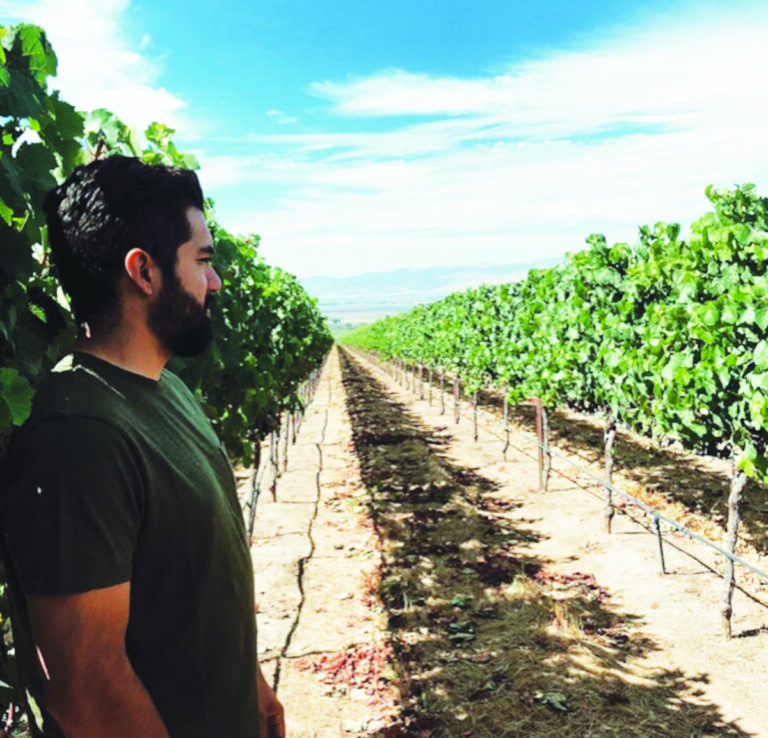
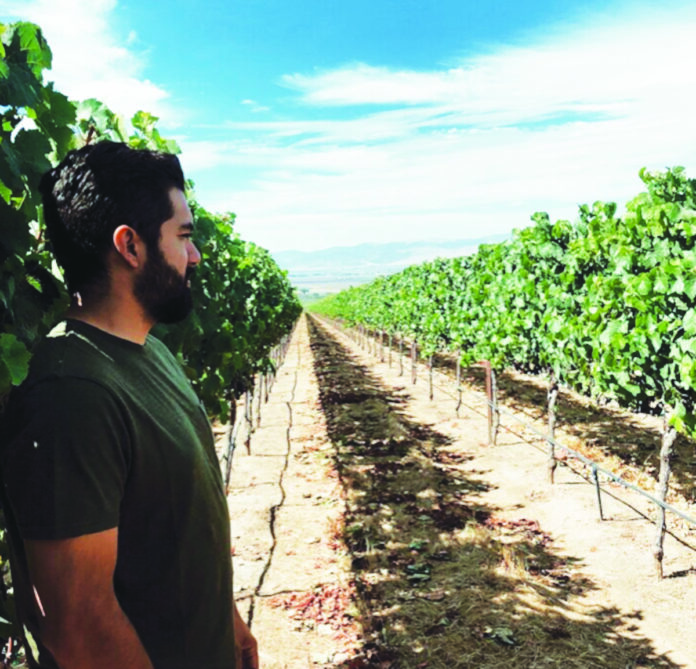
Sling & Stone Wines is an up-and-coming winery that is already making high-quality vino and scoring high ratings from Wine Enthusiast. When I tried the 2019 Paloma Creek Vineyard Cabernet Sauvignon ($45), I was impressed by its robust, intriguing and tasty flavors. Awash with dark fruit and aromas of black currant, tobacco, cedar, toast and coffee, it’s also fermented with 4% Viognier “to enhance color and naturally balance the wine’s chemistry.” This Cab is the result of Francisco (aka Junior) Bañuelos’ hard work and dedication. Bañuelos works for Odonata Wines’ Denis Hoey (read my April 27 column for more on Odonata). In 2014, Hoey happened to stop at the Bañuelos family’s gas station, where Junior worked. Bañuelos expressed his deep interest in winemaking, so Hoey gave him a job—he also offered to teach him the art and science of winemaking. Eight years later, Bañuelos is producing wine under his own label, Sling & Stone. He still loves working at Odonata, and the learning continues. Sling & Stone Wines (inside the Odonata tasting room), 645 River Road, Salinas. slingstonewines.com.
Sones Cellars and Tanuki Cider’s Newtown Noir
Robby Honda of Tanuki Cider and Michael Sones of Sones Cellars—both in Santa Cruz—have made a vibrant apple-grape co-ferment of 71% Newtown Pippin apples and 29% Pinot Noir grapes—they call it Newtown Noir. Both the apples and grapes were grown in the Pajaro Valley in Watsonville. Newtown Noir Open House and Release Party, Sunday, May 8, 2-7pm. HOME, 3101 N. Main St., Soquel. homesoquel.com.
Mother’s Day Reminder: Sunday, May 8
Treat your mother to some local wine, or take her wine tasting. There are so many terrific wineries. Visit scmwa.com for a list. Or, buy her something beautiful and local that she’ll treasure forever, like Annieglass’ sustainable, handcrafted decor. The factory and store are located in Watsonville. annieglass.com.
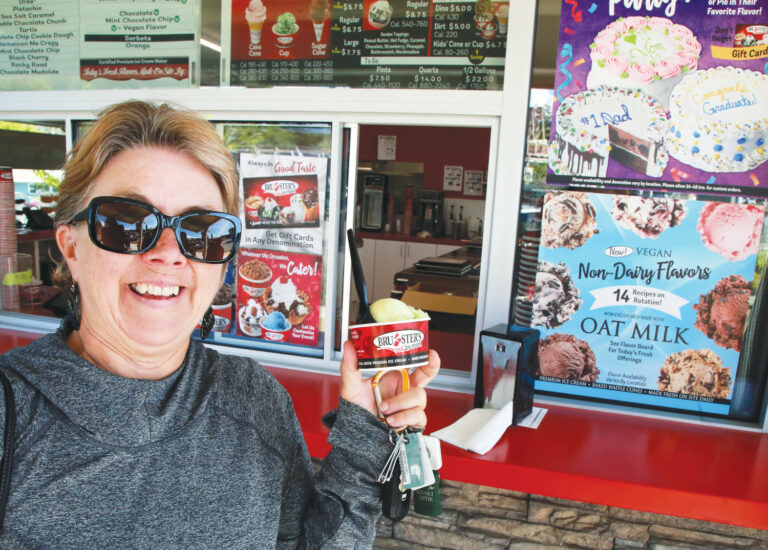
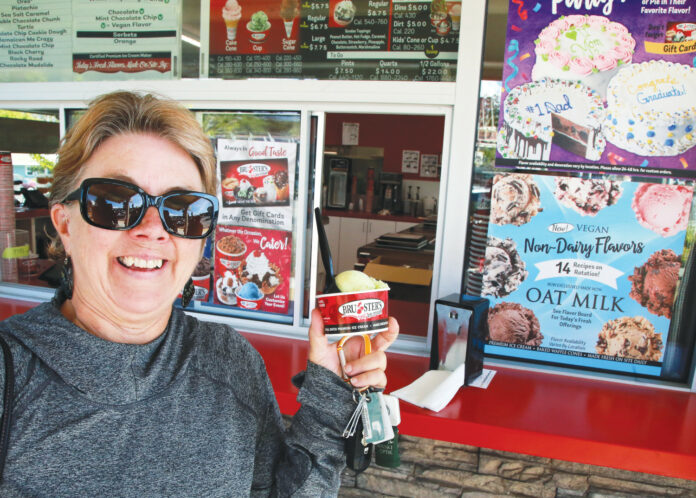
Even though Anjelica Yee graduated from Humboldt State with a degree in Wildlife Conservation, she’s running an ice cream shop that her grandfather bought on a whim. Yee has worked in the restaurant industry since she was 16, so she makes an ideal GM for Bruster’s Real Ice Cream, which opened a couple months ago in Aptos. The signature ice cream made on-site daily is known for its rich and creamy texture. Also, the ice cream served is no more than six days old to ensure freshness. Yee says Cookies and Cream is the most popular flavor. Still, some of the boundary-pushing options, namely Chocolate Mudslide—with dark chocolate ripples, marshmallows and Oreo crumbles—are also crowd-pleasers. Other flavor favorites include Southern Banana Pudding (white chocolate sauce and Nilla wafers) and Jamaican Me Crazy (made with coconut ice cream, fudge ripples and buttered almonds). As a vegan, Yee takes pride in serving multiple “legitimately good” oat milk-based vegan ice cream options—they also do Italian ice and sorbet. Hours are 12-9pm every day. Yee gave GT the scoop on oat milk ice cream and how a Wildlife Conservation degree influences her work.
Tell us about your vegan ice cream.
ANJELICA YEE: It’s made with oat milk, and when I first tried it, I couldn’t believe it wasn’t made with dairy. I’ve had a lot of vegan ice creams, and I’m not biased, but our oat milk ice cream is the best I’ve ever had. It’s addicting; every day I work, I fight the urge to not eat some, but I usually give in. It’s super creamy and sweet, but not too sweet, has no weird aftertaste, and a non-vegan would probably think it had dairy.
From a Wildlife Conservation degree to ice cream is quite a switch.
Although not directly related to what I’m doing now, my education shaped my worldview of human consumption as a whole. I am seeking to reduce our waste as much as possible and hopefully eliminate single-use plastics and shipping waste. Ideally, we have the goal of sourcing more of our ingredients locally and re-thinking how we serve our product. I would even one day love to have a policy where if people bring in their own spoon and/or cup, we give them a discount. Our goal at the end of the day is to make not only our guests happy, but also the Earth.
Bruster’s Real Ice Cream, 150 Rancho Del Mar, Aptos, 831-226-1034; brusters.com
After more than 40 years of ups, downs and in-betweens, the genre-bending Brits release ‘Made of Rain,’ one of the most significant records of their career