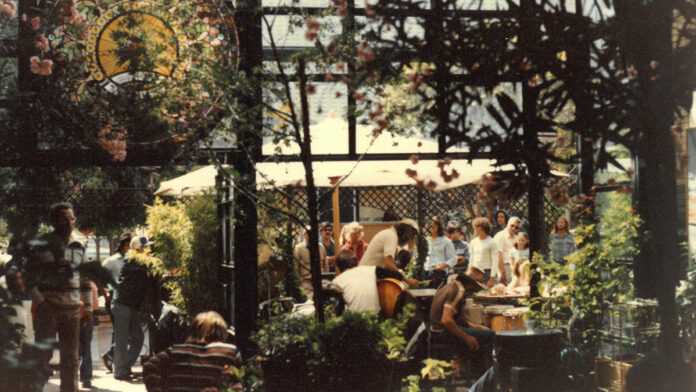
One of the most devastating earthquakes in Northern California history struck on October 17, 1989, just minutes before the first pitch of the first World Series game to be played in San Francisco since 1962. When the quake hit, the shops and sidewalks of downtown Santa Cruz were not as populated as you might otherwise expect on a warm, jasmine-scented fall afternoon.
Three people died in collapsing buildings in downtown Santa Cruz that day, far fewer than could have been expected to perish under normal circumstances. Instead, many who might have been hanging around downtown on a normal day made the trip to Candlestick Park to see the game or were already home when the quake hit, mixing up their margaritas and making their guacamole while waiting for the first pitch.
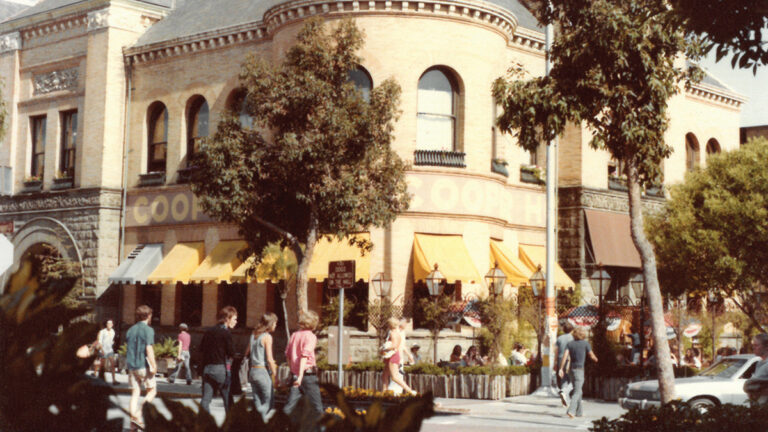
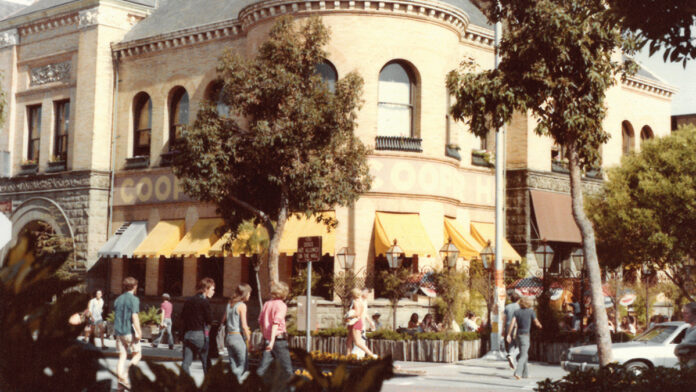
Downtown Santa Cruz was about 12 miles from the quake’s epicenter, and it was walloped as badly as any city in Northern California. More than three dozen commercial buildings were leveled by or later demolished because of the quake, including the iconic old Cooper House, the symbol of Santa Cruz. Among the crippled properties was the Bookshop building. The Loma Prieta earthquake should have destroyed Bookshop Santa Cruz, as it did many other businesses. In a physical sense, that’s exactly what happened.
Manager Tatsat O’Connell, who normally worked until five, was among many who knocked off early to catch the World Series. Once at home, he noticed that his housemate’s dog was “going crazy” in the backyard. A few minutes later, some unseen giant picked up his house and shook it.
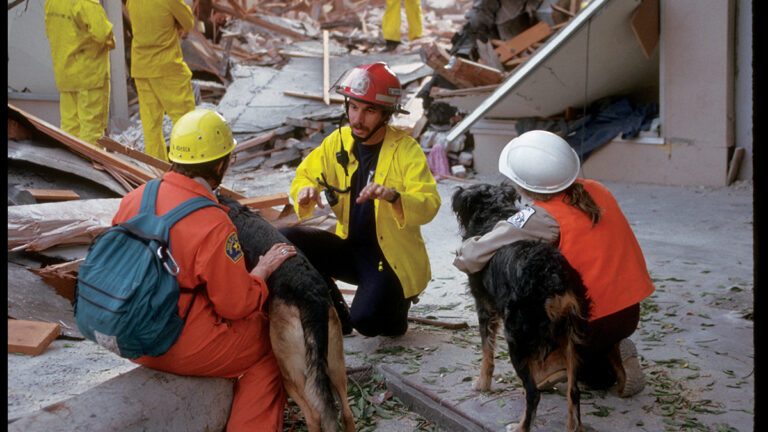
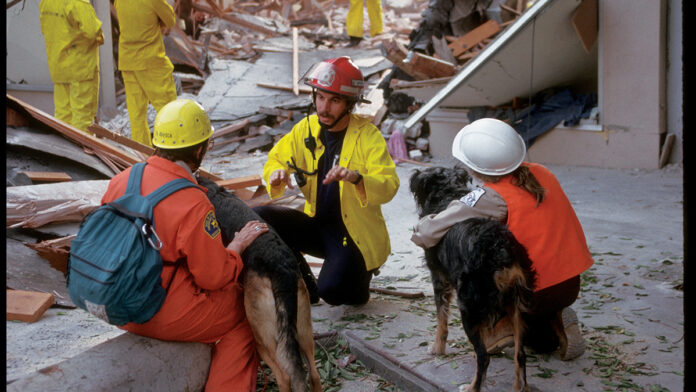
Like most native Californians, O’Connell was born factory-equipped with an intuitive inner gauge when it came to earthquakes. Right away, he knew that this one was beyond any he had ever experienced. He quickly returned to downtown Santa Cruz and parked near Mission Plaza, which is situated on a bluff overlooking the north end of downtown. From that vantage point, he could see that the second floor of the north-facing wall of the Bookshop building had peeled away. What he didn’t know yet, but was soon to learn, was the wall from the bookstore had collapsed in on the neighboring business, the Santa Cruz Coffee Roasting Company. Two of the employees working that day at Coffee Roasting were unaccounted for. By nightfall, the building would become a search-and-rescue site. O’Connell was there that night for hours, as the scene became a vigil for the missing employees.
If you were in the line of sight of downtown Santa Cruz that day, you would not have been able to see much. The area was obscured not by smoke from fires (though one house adjacent to downtown did catch fire) but from clouds of yellowish dust from so many suddenly collapsed buildings. One woman said the dust was so thick in the first few minutes, she couldn’t see her hand in front of her face. Then came the distinct mildewy smell from the trapped gases of the downed buildings. In the hours after the quake, when police had fenced off the area, a news photographer remembered the sound of falling brick and broken water mains providing an eerie soundtrack to the ruin all around him.
Ryan Coonerty, the 15-year-old son of Bookshop’s owners, was changing clothes after enduring an unusually hot day at football practice at Santa Cruz High School. He and his buddies were not yet old enough to drive legally but, as soon as the quake hit, they borrowed a car to cruise around town anyway, figuring the cops would be too busy with other things to notice them. They were right on that score.
Ryan’s dad, Neal, was nowhere near downtown Santa Cruz for reasons that had nothing to do with baseball. He had a doctor’s appointment in San Jose, part of the South Bay megalopolis beyond the Santa Cruz Mountains that Santa Cruzans tend to lump together as “over the hill.”
Neal Coonerty, a lifelong Californian, knew his earthquakes. He was a kid growing up in the San Fernando Valley north of Los Angeles when the 1952 Tehachapi earthquake struck (magnitude 7.3, the second strongest quake in California in the 20th century, behind only the epic 1906 San Francisco quake). “It was the middle of the night,” he says, “and I can remember feeling the bed moving across the floor and my dad coming in to see if I was all right.” Years later, in his early days as Bookshop’s owner, he remembers eating lunch at a downtown restaurant and watching a plate-glass window wobble ominously during a minor shaker.
What happened on Oct. 17 was of an entirely different character. He felt certain that it was epicentered in the Santa Clara Valley, where he was at the time. “My first thought was, ‘I wonder if they felt it in Santa Cruz.’” Electricity went down throughout the region immediately and phone service was spotty as well. Coonerty went to the home of his sister Roseanne in nearby Los Altos. He was finally able to connect with his wife, Candy, at the Coonertys’ Santa Cruz home, where the chimney had collapsed. As the scope of the disaster was first becoming apparent, Coonerty’s first focus was on the welfare of his family, Candy, Ryan and his middle-school daughter, Casey. His in-laws also lived in town and he was preoccupied that everyone was safe and accounted for. Highway 17, the famously treacherous connector between Santa Cruz and San Jose, was quickly closed after the quake, forcing Coonerty onto pokey, two-lane Highway 9 to get home. There wasn’t much traffic, he remembered, but the quake had thrown debris onto the roadway in several places, making it a long slog. It was while crawling home on Highway 9 that Coonerty heard a radio report from the local AM station KSCO that referenced Bookshop. Judging only by the intact façade – not even the windows were broken—the radio reporter announced that the Bookshop looked OK.
In fact, a desperate drama was unfolding on the site as first responders worked to recover the bodies of the two employees of the Santa Cruz Coffee Roasting Company who had been buried by the bricks of Bookshop’s wall. Coonerty was unaware of any of that. After he finally got home, well after dark, he was up most of the night, assessing the damage to his home and calming his daughter through the night’s many aftershocks. At first light, he made his way downtown, figuring there was inevitable damage at the bookstore, that he’d spend all day picking up and reshelving books. However, he was unprepared for what he encountered. As he approached the back door of the business, he was stopped by a Santa Cruz police officer who told him no one was allowed inside. “That told me something was very wrong,” he says.
He immediately noticed large cracks in the back of the building. He then saw an enormous U-shaped hole in the wall to his left and knew that his business had been crippled, maybe fatally so. It was only then that Coonerty became aware of the drama that had been going on at Coffee Roasting. The night before, rescue workers dug through the bricks in an effort to find the bodies of employees Shawn McCormick and Robin Ortiz, but the numerous aftershocks compelled the workers to retreat; much of the unreinforced brick wall was still standing and thus capable of collapsing, causing potentially more injury or death. Yet friends of the missing coffeehouse employees were vocally upset at the delays, and the scene became fraught with emotion and confrontation. Under the circumstances, few people were thinking about Neal Coonerty’s troubles, even if the ruins of Bookshop made it all too apparent to Coonerty himself. Given that loans on the bookstore were collateralized with his house, it appeared that he was poised to lose everything.
* * * * *
In the Hollywood movie that will surely never be made of this story, the image on the movie poster would be a bearded, burly Neal Coonerty a few days after the quake, standing on the sidewalk in downtown Santa Cruz, wearing a hardhat and two flashlights duct-taped around each forearm, looking like some lock-key 9-year-old kid pretending to be a superhero. But this was no fun and games. The stakes for Coonerty’s personal and professional life could not have been higher. The mood was tense, the crowd around him somber, emotional. Standing next to him was a sleep-deprived volunteer, acting as a city official, looking at her watch, poised to give the signal.
The fate of Bookshop quickly became a secondary concern in the quake’s aftermath. Two young lives had been snuffed out on site. Although its façade looked intact, the beloved bookstore had suffered grave damage. Indeed, it had been red-tagged for demolition by the roving band of structural engineers brought in to decide the fate of each building in the area. Red-tagged buildings had been deemed far too dangerous to enter, particularly given the frequent aftershocks, but many downtown merchants had insisted they be given a chance to retrieve some personal effects from their businesses.
The suddenness of the quake had caused people to leave behind their purses, coats, wallets and other valuables. In the days before widespread computer record keeping, many businesses, like Bookshop, also had essential records and documents in folders and file cabinets. The compromise was straightforward. The owner of each red-tagged business would be allowed access to his or her building for fifteen minutes only, for one person to collect and gather whatever they needed in a building with no light or electricity and with unknown dangers and hazards. There was a chance, who was to say how remote, that he or she would not come out alive.
Coonerty was in his mid-40s at the time. He was a bookseller with a decidedly Falstaffian physique, not some obstacle-course-running athlete. This weird stunt, which even today sounds like something from a Japanese game show, could not have been anything he thought he’d ever be called on to do. He had with him only a crude diagram that showed him roughly where to find specific items belonging to his employees. It was an absurd situation, but considering that bodies had only recently been pulled from the building and the chance that an aftershock might bring it down on his inadequately protected head, Coonerty was in no mood to laugh it off.
The moment came, and the bookseller dashed into the store. Hundreds of fallen books, Megatrends mingling with Michener, John Irving on top of Irving Wallace, covered the floor, creating a minefield of potential twisted ankles or falls, particularly for a man in a hurry not used to timed tests of physical agility. The only light in the store was the daylight streaming in through the collapsed wall, but the building had a basement. That’s where Coonerty’s office was, and where the staff kept their personal belongings. That’s where he was headed. The stairs closest to the front of the store were impassable and Coonerty had to go to the back of the store to access the only other staircase to the basement, then had to reverse course in the pitch-black basement, wielding his arm lights, to reach his office, hearing the tick-tock of his 15 minutes evaporate with every step. He retrieved what he could, stacking boxes on the sidewalk, winded and sweating, while a crowd looked on. He was even able to drag out an antique English desk that had been right by the front door.
The woman with the watch gently informed him that his time was up, although as he remembers it today, he was given more than 15 minutes. Still, he headed back in, telling her over his shoulder, “This will be a quick trip.” At that moment, Coonerty was overcome by the painful realization that he was spending his final moments inside the bookstore that he had nurtured and sustained for almost his entire adult life. He had achieved a dream, having purchased the bookstore at the age of 27. His marriage, his family, his community, his livelihood, his very purpose were all deeply entwined in Bookshop Santa Cruz. This thing is going away, he thought, and I’m not going to be able to save it.
“It was an emotional situation,” he says. “I thought, if I’m going to start over, or even if I’m not, I need to have at least one symbol of the bookstore.” He moved to the store’s children’s area and picked up a rustic wooden rocking horse. A couple of generations of Santa Cruz children, including his own son and daughter, had rocked away on that horse. This, he thought, was worth saving. When he emerged, finally, back outside carrying the rocking horse and one last box of financial records, he thought what everyone else gathered that day thought: Bookshop Santa Cruz was gone.
After his 15-minute dash through his red-tagged bookstore, Coonerty, his family, his employees and customers all had to face the reality that Bookshop Santa Cruz was gone. But Coonerty knew he had to act in some way, to exhaust all other possibilities, before he could walk off into a new life.
Coonerty carefully reviewed his options. He resisted surrendering to a circumstance that many people might chalk up to cosmic fate. A certain kind of survival instinct, familiar to most small businesspeople, kicked in. Yet he also knew that he needed to keep a cool head and develop a realistic vision of where he wanted to go. “I kept thinking, ‘I have to move forward, but I have no room to make a mistake. One error and it’s all over.’”
He found out the name of the structural engineer who was in charge of the demolition of the Bookshop building. Through a mutual friend, he was able to contact the man. Coonerty told the engineer, “Look, I know you’re going to pull down the Bookshop building. I have two things to ask. First, could you schedule it for the end of the run of the other demolitions? And two, can you do me the favor of walking through the building and then tell me if I could possibly get my inventory out? If you say it’s just too dangerous and unsafe for anyone to go in there, then I’ll accept my fate. But if you tell me it’s OK, will you allow me to tell the city manager?”
The engineer said that he would call the next day. He didn’t. At nightfall, an anxious Coonerty called him back. The engineer’s assessment gave Coonerty some breathing room. If he could prop up the roof with a beam or two and build a kind of tunnel for entrance and exit, the building would probably hold, for a while anyway. Coonerty was convinced that if he could get his books out of the building, he could somehow continue on. Even with that bit of daylight, there were still daunting logistical tasks: How to convince the city to go along with the plan, how to build a tunnel in and out of the building, how to get thousands of books out of the building and what to do with them once they were out. Still, Coonerty took the plan to Dick Wilson, Santa Cruz’s city manager. Wilson looked at the plans and, once he had made the modifications the engineer suggested, he gave Coonerty two days—daylight hours only—to get his inventory out. On top of that, every person who went into the bookstore had to sign a waiver acknowledging that entering the building was potentially fatal, and if it were to collapse, there would be no rescue efforts.
The next day Coonerty went on the air at the local public radio station in Santa Cruz to inform the community what was happening with the bookstore. Of course, he had another motive: He was looking for volunteers to help with the inventory recovery effort. Many of Bookshop’s 20 employees were hesitant to go inside the building, and Coonerty respected their choices. But even if they were all gung-ho, that still left him short-handed to carry out thousands of books, including the newly received inventory for the upcoming holiday season.
“The thinking was, ‘Let’s solve the problem that was in front of us,’” says Coonerty. “The larger concept of ‘Will we make it?’ ‘Will we survive?’ got immediately replaced by ‘What do we have to do today? What do we have to do this hour to move forward?’”
After a makeshift tunnel made from railroad ties had been constructed at Bookshop’s back entrance, the day of the big book evacuation arrived. Neal and Candy got up early and made their way to Bookshop, not knowing what to expect. Coming down the hill from their home toward downtown, they saw a huge crowd outside the store. More than 200 people—friends, readers, customers, community members—showed up willing to sign the “buried alive” waiver to help the Coonertys retrieve their books.
Those who were there that day remember a palpable sense of purpose. The sobering fact that two people had died on the site put a damper on any kind of celebratory mood. No one was certain that the crippled building would not collapse while the book rescue was going on, and the waiver was somewhat less than reassuring on that score. Yet, many people had been frustrated by a sense of helplessness since the quake. Here was something they could do to help. A task of physical labor like this one, with a patina of danger, of life-and-death seriousness, of limited time, is not something that many contemporary Americans experience much. The volunteers were motivated by that sense of mission and drama, and they got to work with enthusiasm.
Other businesses pitched in with vital help and supplies as well. A vegetable packer from the nearby strawberry-rich fields of the Pajaro Valley offered dozens of much-needed cardboard boxes. A local leather tannery loaned out an industrial roller that allowed boxes of books to be moved out of the bookstore, conveyor-belt style, more efficiently. A trucking company brought over a semitrailer in which to store the books. A friend who once ran a department store showed up with his forklift. Someone else contributed hardhats. Even Coonerty’s competitors appeared that day, including the owners and staff of the Capitola Book Café, as well as employees of the county’s library system.
A kind of bucket brigade was set up as a small number of specially designated workers inside the building would pass along the books, many of which were coated in dust and debris, to others waiting outside. Each book was assessed for damage, cleaned off as well as possible, sorted and boxed for storage in the trailer. The work was long and repetitive, but with an autumnal chill in the air (a welcome contrast to the blistering hot afternoon of the quake), the somber occasion turned to moments of levity, and the volunteers experienced a sense of meaningful camaraderie that for many ripened into elation.
Today, Coonerty still gets emotional looking back on that weekend. For years after, new hires at Bookshop would hear the story as if it were part of their orientation package. When the Coonertys say that the community saved their bookstore, they are speaking literally. “A community doesn’t come out to help a store proprietor,” says poet and teacher Patrice Vecchione, who grew up in Santa Cruz and was there moving books both days. “A community comes out to restore something that matters to them. This was our bookstore.”
By late Sunday afternoon, the bucket brigade had gotten all the inventory out of the damaged Bookshop building. The volunteers had gone home. Neal Coonerty decided to go back into his bookstore one more time. He called to his teenage son Ryan to join him. Ryan had watched dumbfounded for two days as strangers handled his dad’s books with meticulous care. In the darkness of the store as they moved downstairs, he expected his dad to say something poignant, to try to sum up his life as a bookseller or to articulate what the previous ten days had been like for him. Instead, Neal picked up a couple of bricks from the floor, handed one to his son and gestured toward the big windows in his office and Bookshop’s accounting office.
“So there we were, father and son, just throwing bricks through windows,” says Ryan, almost three decades later. “I often think about that. He was so moved by the community being there for him. His business had just been saved. I can’t imagine the emotional strain of that day and the weeks leading up to it for him. Yet he could still figure out a way to break the rules a little bit, to still be a risk-taker, to just not take it all so seriously.”
Excerpted from ‘A Light in the Midst of Darkness: The Story of a Bookshop, a Community and True Love,’ by Wallace Baine (Wellstone Books).