According to the PG&E, thousands of people across the Greater Bay Area experienced electrical outages today, with more than 10,800 customers in Santa Clara County and more than 7,000 customers in Santa Cruz County losing power.
The Santa Cruz County disruptions were weather-related primarily, including several where vegetation came into contact with power lines—such as on Smith Grade Road where a tree hit the company’s wires—PG&E spokesperson Mayra Tostado said.
And in Felton, a tree fell into power lines on Big Trees Park Road.
Meanwhile, for the 1,650 plus customers who lost power in Watsonville around 10:15am, the cause remains under investigation, according to PG&E.
The utility said the Santa Clara County disruptions since 3am today were mainly weather-related; however, one was due to a vehicle hitting a power pole on Quimby Road in San Jose.
That one affected more than 2,000 customers.
And some blackouts were intentional.
“We have a current planned outage in Los Gatos impacting more than 40 customers for upgrades to electric equipment on Glen Una Drive,” Tostado said. “On Bascom Avenue in San Jose, we have more than 100 customers out due to planned wildfire risk reduction work.”
Those improvements are meant to make the grid more reliable and resilient.
The National Weather Service has issued a wind advisory for parts of the Bay Area, including the Santa Clara hills, that extends throughout the day.
Gusts were clocked up to 45 miles an hour across the Western Sac Valley and nearby elevated terrain.
Experts warn residents of the region to expect gusts in the 30-40 mile an hour range.
And while they’ll likely lessen toward the evening, PG&E is preparing for another wind push through the night.
But that’s only anticipated to bring gusts of 25-35 miles an hour in some areas.
“PG&E crews have been working around the clock to restore power to customers impacted by outages,” Tostado said. “Never touch downed power lines because they could be energized and are extremely dangerous.”
Report downed wires to 911 and then PG&E at 1-800-743-5000, and PG&E customers can view outage information at pge.com/outage.
During the intimate and soaring performance by experimental indie band Son Lux at the Felton Music Hall on May 14, lead vocalist and synth-maestro Ryan Lott paused to give the few-dozen attendees standing in rapt attention some insight into the modern Hollywood machine.
Everything Everywhere All at Once, a movie contemplating the multiverse by directors Daniel Scheinert and Daniel Kwan, has been showing at the CineLux, just across the sandhills in Scotts Valley, and Lott shared about their own awe-inspiring experience of crafting its soundtrack.
“It’s a very crazy and beautiful movie and just an unbelievably rewarding project for us,” he said, explaining the material, for it had been germinating for years. “For our last song, we’re going to play the first piece of music that we sent the directors.”
They began by messaging fragments—raw bits and improvisations—trying to get the tone right.
The piece—which would become the endlessly complex and triumphant “Unbind” on their 2021 album Tomorrows was the perfect way to kick off their artistic back-and-forth with “the Daniels,” Lott recalled.
“We just felt like there was something about it that resonated in the same way that the movie did—full of beauty and chaos,” he said, adding they loved what they heard. “It was an early sign for us of the kind of synchronicity we were going to have as a creative team.”
And while the specific song didn’t make the final cut, its bones did.
“It went on to become a foundation of one of the main themes in the film,” he said, as they brought the house down with that alternate reality of a track. “Thank you again so much for being here.”
I have vague memories of anxiously awaiting a radio announcer’s back-announcement, following a stunning over-the-air number, on some long and rambling vehicular journey years ago. That’s how I first came to seek out Son Lux. The group is comprised of Lott, Rafiq Bhatia (guitar) and Ian Chang (drums).
And when it happened again, with an equally brilliant—yet understated—track, I filed away the group in the “quality” section of my musical brain for safekeeping. When you find a wine, no one else seems to know about that always goes down smooth with an intricate finish or a surfboard from a local shaper that works well in the range of waves that tend to hit the shores of your home break.
Every time I try to look them up online, I start by mistakenly typing “Sun Lox,” as if I were searching for a tasty bagel recipe.
During the past several months, when I looked ahead to potential shows to hit across the entire Greater Bay Area region, this one kept standing out to me.
So, after pumping up my bike tire, peddling down to the San Lorenzo River, and taking in the rise and fall of bird sounds at dusk, I headed over to the Felton Music Hall.
As soon as Son Lux’s sounds hit my eardrums, I was instantly reminded of why the group first made an impression on me.
Because what I heard from the stage might as well have been the backing track to the joyous chorus I’d just witnessed outdoors.
During a break between songs, Lott said they’d just had the good fortune to take in some of nature’s bounty here, too.
The frontman emphasized he loves this size of the show just as much as their larger gigs. And lest any of the hipster-leaning attendees wondered if the group was bothered the hall wasn’t packed to the gills, he put that notion to rest. He said—maybe more.
“We’re feeling awesome—this is an amazing place to be,” he said to a crescendo of claps and cheers as the band transitioned into their next piece. “This song is like an old friend. It’s the only old song we’re playing in this set.”
They were about to treat Felton to “Easy,” with staccato drums and a mysterious guitar line.
On the YouTube version of the track, their record label explained how the song’s elements had become interwoven into the broader popular music landscape.
“Halsey sampled Son Lux for her song. And Fall Out Boy also sampled Son Lux for one of their songs,” the pinned comment read. “Regardless of how shitty or amazing you think their songs are, both were licensed samples. Meaning no one ‘stole’ anything from anyone. But Son Lux indeed wrote this shit, and Halsey’s folks certainly paid us for the privilege of using this audio. In turn, we use the money to continue to put out amazing music, which will undoubtedly continue to be sampled in the future by less talented people.
And here, Son Lux was reimagining it, once again.
“We couldn’t help ourselves but rethink it a bit,” Lott said. “This is an old song in a new way.”
Lott’s vocals sound like the emotive murmurings of Caribou. The instrumentation is orchestral but electronic, like Max Cooper.
I imagine you might end up with something similar to Son Lux if you mixed the Grateful Dead with Refused and threw in Floating Points as the icing on the cake.
Comparisons to Jamie XX, Joy Orbison and Four Tet are not unwarranted. Chang’s crisp drumming added a rolling—almost breakbeat—aspect. Bhatia provided the sound textures to wallpaper the room and filled in the cracks of the floorboards.
The way Lott cued the glissando violin sample on the angled-down synthesizer during “Plans We Made” demonstrated precision musicianship.
He kept pushing his glasses to the bridge of his nose to keep them in place—as part of the rhythm of the performance.
At times, the space felt like a chapel, thanks to the vaulted ceiling overhead. At others, like a cozy nightclub featuring underground DJs.
And when, during one of the songs, Oakland-raised opener Nappy Nina came to perform with them on stage, it was as if we were transported to a hip-hop throwdown or spoken word competition in the East Bay.
Overall, the show was a gentle reminder to trust your instincts in music and life.
Don’t forget that everything everywhere is not necessarily as grim and tedious as you initially think.
Three years ago this week, longtime musician and music producer Steve Anderson suffered a major stroke that caused him to lose 95% of his eyesight.
While in rehab, Anderson says he began to take inventory of his life. He asked himself one simple question: “Well, what can I do now?”
“I started reaching out to all sorts of music people in the Monterey and Santa Cruz area,” he said. “I found that there wasn’t a lot for adults with disabilities—almost nothing. There are quite a few programs for students, and that’s great, but not a lot for adults. And there are not many people who have worked with blind musicians in particular.”
Anderson brainstormed and eventually came up with the idea of creating Hear See Play (HSP), a new nonprofit focusing on live performance. The organization aims to bring people together—those with disabilities and those without—to play and enjoy music.
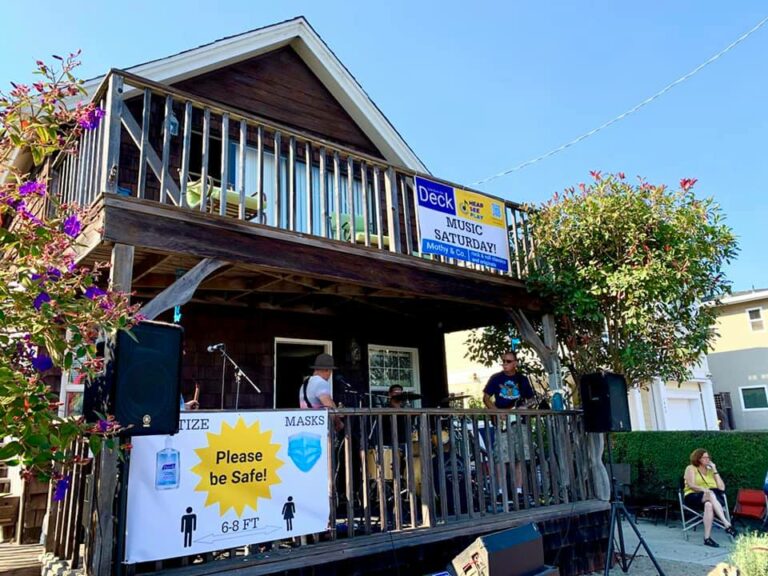
He launched a series of live performances, first on the deck outside his home and now at the VFW Hall (post 7263) in Santa Cruz. A free summer concert series will start at the VFW on June 5.
“I’m trying to create this new kind of a community and build something fun that is all-inclusive, that keeps us on a level playing field,” Anderson said. “Whether it’s playing music, singing, dancing, or just enjoying. So all of us can feel equal.”
The upcoming series will include local talent and regional and national musicians as they pass through the area. Things kick off June 5 with rockers, El Camino Revival Band. On June 19, the jazz group Los Improviders will perform, followed by Burnin Vernon and the Ted Welty Trio on July 3. John Michael and Nomad will round things out on July 17.
Live music will begin each day at 2, except on July 3 when the performance kicks off at 1pm. HSP will feature the Brothers Taco truck at every event, and the VFW will run a cash-only bar.
“Some of those closet musicians that have been pent up for two or three years,” Anderson said, “we invite to come and enjoy and not worry if they’re blind or have a bum limb. I believe music is a universal language. If we come into new events like these, with that mindset, the world is our oyster.”
Anderson says that HSP is looking to expand its reach. In the Fall, they hope to hold intermediate and professional music workshops, including individual and group lessons with top teachers and musicians worldwide.
“I’m a 10-year plan guy, not a one-year plan guy,” he said. “I hope to make this into a world-class organization.”
Creating a new organization from the ground up hasn’t been easy. Anderson thanked everyone who has supported him, especially the VFW, who he called “integral” to HSP’s mission. He encouraged anyone interested to get involved.
“We’re a nonprofit and a startup,” he said. “So, anyone who wants to volunteer their time, money, or even their dancing skills, we’d love to have them.”
VFW Hall, 2259 7th Ave., Santa Cruz. For information and updates, follow Hear See Play on Facebook.
TOP DOG FILM FESTIVAL It’s precisely the kind of medicine we could use right now: two hours of short films about dogs! Each selection features its heartwarming tale, from dancing poodles to award-winning New Zealand sheepdogs. A Canadian outdoorsman embarks on a journey to find the perfect guide dog and meet the last sled dogs in Greenland and the women committed to keeping their legacy alive. Learn about a prison program that transforms inmates’ lives with rescue dogs—inspirational and entertaining stories about dogs and their human companions from independent filmmakers around the globe. Yes, please! $18. Thursday, May 19, 7pm. Rio Theatre, 1205 Soquel Ave., Santa Cruz. Proof of vaccination or negative Covid test required. riotheatre.com.
ALICE DIMICELE Alice DiMicele’s 16th album, Every Seed We Plant, is an emotional roller-coaster with gut-wrenching twists, optimistic turns and vulnerable loops that moves at a powerful velocity. Known for sharp prose and a rich acoustic groove, DiMicele continues to deliver music independently, and those in the know are hooked for life. The singer-songwriter has performed with everyone from Joan Baez and Richie Havens to Bob Weir and Mickey Hart. “Alice’s music has that great combination of earthiness and groove that keeps it funky from the inside out,” Bonnie Raitt said. “She’s for real.” $20. Thursday, May 19, 7:30pm. Michael’s on Main, 2591 South Main St., Soquel. michaelsonmainmusic.com.
CHRIS RUEDIGER Chaminade kicks off its “Nashville Nights” series with up-and-coming singer-songwriter Chris Ruediger, whose debut EP Kid Anymore hit the streets less than a year ago. The courtyard venue boasts panoramic views of the Monterey Bay, an ideal backdrop for a wise-beyond-his-years storyteller to unleash memories through songs about his father, the girl who got away and debauchery-filled nights with his buddies. Cash bar available. $25/$30. Friday, May 20, 8pm. Chaminade Resort & Spa, One Chaminade Lane, Santa Cruz. chaminade.com.
ROBYN HITCHCOCK Robyn Hitchcock’s made over 20 records spanning more than 40 years, and the inspiration keeps on coming. The Brit describes his self-titled 2017 gem—his 21st solo album—produced by the Raconteurs’ Brendan Benson as an “ecstatic work of negativity with nary a dreary groove.” Even the musician’s descriptions of his work are poetic. Jonathan Demme made a concert film, Storefront Hitchcock, showcasing the rocker, and his work has been covered by Uncle Tupelo, the Circle Jerks, Liz Phair and other notables. Whatever comes next for the prolific silver-maned rocker is icing on the cake. $25/$30 plus fees. Friday, May 20, 9pm. Moe’s Alley, 1535 Commercial Way, Santa Cruz. Proof of vaccination or negative Covid test required. moesalley.com.
UC SANTA CRUZ FESTIVAL OF MONSTERS Presented by the UC Santa Cruz Center for Monster Studies—yes, that’s a thing—monsters and their hidden meanings are the focus of this free weekend of social events and art. Scholarly presentations are framed by a screening of the 1920 film Der Golem, a staged reading of Kristen Brandt’s Grendel’s Mother, a Monsters’ Masquerade Ball and a special performance of the multi-media show Amduat. Most festivities take place on campus. The ball will be held at The Tannery World Dance & Cultural Center. Friday, May 20-Sunday, May 22. All events, except Amduat, are free and open to the public. The Monsters’ Ball requires an RSVP. $5 parking. Complete schedule: monsterstudies.ucsc.edu/festival.
REEL ROCK 16 Absorb the adrenaline dripping from the Rio’s screen—Reel Rock features four intense climbing films. One of the odder selections, Charles Albert’s Barefoot Charles, is about an opera-singing, cave-dwelling, animal-skinning minimalist tackling futuristic boulder problems in the Fontainebleau Forest. Meanwhile, Pete Whittaker’s and Tom Randall’s Bridge Boys features a “horizontal big-wall adventure on the longest, hardest and most ridiculous crack climb ever attempted.” $22. Saturday, May 21, 7pm. Rio Theatre, 1205 Soquel Ave., Santa Cruz. Proof of vaccination or negative Covid test required. riotheatre.com.
MIGHTY MIKE SCHERMER Moe’s Sunday Blues Series features a special afternoon show outside in “The Yard” with local favorite—now living in Austin—Mighty Mike Schermer, who celebrates the release of his eighth record, Just Gettin’ Good. Schermer has earned street cred for the multiple decades he’s put in as a go-to sideman for Elvin Bishop, Bonnie Raitt, Charlie Musselwhite and Sista Monica, to name a few. But the Bay Area bluesman has the skills to deliver as a solo musician. “It ain’t gettin’ old; it’s just gettin’ good,” says the 55-year-old award-winning guitarist. Recently, Bruce Springsteen featured Schermer’s “My Big Sister’s Radio” to play on his Sirius XM channel, and it’s now in regular rotation. $18/$22 plus fees. Sunday, May 22, 4pm. Moe’s Alley, 1535 Commercial Way, Santa Cruz. Proof of vaccination or negative Covid test required. moesalley.com.
RAMBLIN’ JACK ELLIOTT WITH RAINY EYES AND ELLIOTT OK At 90 years old, Ramblin’ Jack Elliott seems just as comfortable on stage as his comfy living room chair. He’s the type of person who’d never admit a known truth that Bob Dylan may have never been Bob Dylan without his older mentor, Ramblin’ Jack. After nearly 60 LPs, reissues, rare 78s, EPs, 45s, contributions, compilations, soundtracks, festival recordings, the singer-songwriter finally received a Lifetime Achievement Award from the Folk Alliance—in 1998, he was awarded the National Medal of Arts from President Bill Clinton. The rambler still rambles and would still rather be out sailing the open seas than doing anything else. Norwegian-born Rainy Eyes (Irena Eide), who now lives in Louisiana, is one of the most extraordinary talents in the neo-Americana, singer-songwriter scene. $35/$40 plus fees. Sunday, May 22, 8pm. Moe’s Alley, 1535 Commercial Way, Santa Cruz. Proof of vaccination or negative Covid test required. moesalley.com.
ADRIAN MCKINTY This week, the best-selling author of City on Fire released what’s sure to be another hit—Hulu is already making it into an original series. McKinty’s thriller The Island centers around a vacation meant to bring a family closer. Instead, it goes horribly wrong. Free. Tuesday, May 24, 7-8pm. Bookshop Santa Cruz, 1520 Pacific Ave., Santa Cruz. bookshopsantacruz.com.
MARCUS KING Marcus King wasn’t the average blues guitar teenage phenom. He studied jazz theory and jazz performance at the Greenville Fine Arts Center before a YouTube video of King noodling on an ax at Norman’s Rare Guitars broke the Internet. Suddenly, the 18-year-old was in demand, especially within the jam band circuit. The Black Keys’ Dan Auerbach produced King’s solo debut, El Dorado, at his Easy Eye Studio in Nashville. The 2020 record earned a Grammy nod for Best Americana Album. Now 26, King is only getting better. His forthcoming record, Young Blood, comes out in August. It may earn the talented musician more than just a nomination. $25/$30 plus fees. Tuesday, May 24, 9pm. Felton Music Hall, 6275 Highway 9, Felton. Proof of vaccination or negative Covid test required. feltonmusichall.com.
MAY DAY LABOR FILM FESTIVAL The event is in honor of Daniel Young. The 20-year Reel Work volunteer who recently passed away helped organize the event. Crip Camp: A Disability Revolution has gained a lot of notoriety on Netflix. The documentary’s focus: a revolution that flowered in a dilapidated summer camp for disabled teens. Located just down the road from Woodstock in upstate New York, the lives of many of the youngsters featured were transformed at this camp, igniting a landmark movement. A discussion with one of the filmmakers, activist Jim LeBrecht, follows the screening. Free (with registration). Tuesday, May 24, 7pm. Santa Cruz Vets Hall, 846 Front St., Santa Cruz. reelwork.org.
MARCHFOURTH MARCHING BAND The self-described “kaleidoscope of musical and visual energy that inspires unabashed dancing and an atmosphere of celebration” is more like a circus than a band. The mobile big band—a 12-piece horn section, a 10-piece drum/percussion corps and a battery-powered electric bass—is an ambrosia salad of Eastern European gypsy, funk, afro-beat, jazz and rock music. That’s just the music. There are also stilt-walkers, unicycles, fire eaters, burlesque dancers, clowns and acrobatics. Don’t expect any time for a bathroom break. $22/$25 plus fees. Tuesday, May 24, 9pm. The Catalyst Atrium, 1101 Pacific Ave., Santa Cruz. catalystclub.com.
COMMUNITY
GOOD NEIGHBOR SOCIAL Housing Matters’—a nonprofit that serves Santa Cruz’s homeless population—first-ever Good Neighbor Social is more like a block party than a fundraiser. A slew of popular food trucks and local restaurant popups will offer an array of tasty dinner options—local beer and wine will be available, and the Penny Ice Creamery will be dishing out dessert. The Coffee Zombie Collective will provide live music. $60 plus fees. (Includes a drink, dinner and an ice cream cone dessert). Friday, May 20, 6-9pm. The Clubhouse at Harvey West Park, 326 Evergreen St., Santa Cruz. housingmatterssc.org.
SANTA CRUZ ASIAN AMERICAN PACIFIC ISLANDER HERITAGE FESTIVAL The inaugural annual event celebrates Asian American Pacific Islanders, “those who sustain us.” The all-day festivities include speakers, music, workshops and AAPI popup food vendors. There will also be art displays and exhibits at the Santa Cruz Museum of Art & History.Free. Saturday, May 21, 11am-5pm. The 418 Project and Galleria Plaza, 55 South River St., Santa Cruz. tm******@***il.com.
GROUPS
WOMENCARE ARM-IN-ARM This cancer support group is for women with advanced, recurrent or metastatic cancer. Meets every Monday on Zoom. Free. Registration required. Monday, May 23, 12:30pm. 831-457-2273. womencaresantacruz.org.
LAUGHTER YOGA Having fun, feeling good and relaxing. That’s what Laughter Yoga is all about. Laughing is a form of stress relief. The group laughs as a form of exercise, and through eye contact and childlike playfulness—fake laughter becomes genuine and contagious. The body doesn’t know the difference between fake laughter and the real thing, so chemicals (dopamine, serotonin) are released, easing our minds and bodies. Free. Tuesday, May 24, 3:30-4:30pm. Inner Light Ministries (Fireside Room), 5630 Soquel Drive, Soquel. sa-cc.org.
OUTDOORS
SEACLIFF STATE BEACH: HISTORY WALK During the mile-long constitutional to the Aptos Creek Bridge and back, learn about Rafael Castro, Claus Spreckels, the development of Aptos, Seacliff Park, the “Madman of Seacliff” and the story of the “concrete ship.” $10 (day-use parking fee). Friday, May 20, 11am. Seacliff State Beach, State Park Drive, Aptos. santacruzstateparks.as.me/historywalk.
GARDEN DAYS Give back to the community while getting an education in native plant landscaping—also help maintain the Reserve’s new native gardens. Every third Saturday, explore a different topic within native plant gardening, then apply that knowledge by working on a project in the gardens. All ages are welcome (a parent or guardian must accompany those under 18). Rain cancels. Free (RSVP not required). Saturday, May 21, 9:30-11:30am. Elkhorn Slough, 1700 Elkhorn Road, Watsonville. elkhornslough.org.
The sylvan wonders of the San Lorenzo Valley—from the glorious river and its tributaries that carved it to the majestic redwoods that blanket its steep and often treacherous hillsides—have long served as inspiration to regional artists.
In the late 1800s, the dean of California painting, William Keith, took the valley and the Santa Cruz Mountains as subjects for many of his tonalist masterpieces, and he was followed by a host of other fine landscape artists through the turn of the century and beyond, including the likes of Lorenzo “L. P.” Latimer, Lillian Howard, Frank Heath, Lillian Dake Heath, Louise Cunningham and Luther De Joiner.
That tradition of artistic excellence will be brought back to life this coming weekend with the inaugural San Lorenzo Valley Art Tour. Founded by a quartet of San Lorenzo creatives, the tour will be held at various locations on Saturday and Sunday, from 10am-5pm.
Fluorescent pink signage will direct visitors to participating artists.
Think of it as Highway 9 meets Open Studios, with a dash of Henflings or Ristorante Casa Nostra thrown in for kicks. The tour is free and open to everyone, and the weather promises to be delightful for a day-long sojourn from Felton to Ben Lomond to Boulder Creek.
The SLV Art Tour was first conceived by a handful of Valley artists who were experiencing a sense of regional marginalization during the country’s annual Open Studios events held in October of each year.
Three years ago, just before the pandemic, SLV artists Janet Silverglate (assemblage/mixed media) and Eileen Murray (painting) had a conversation about whether SLV artists were not being selected for Open Studios, or simply not applying because of lack of traffic during the event.
“The first year I participated in Open Studios, my tiny studio [on 17th Avenue in Live Oak] had 1200 visitors in four days,” says Murray. “When I moved my studio to my home in Ben Lomond, I had an estimated 325 visitors.”
Other SLV artists were reporting similar experiences. Due to a variety of reasons, many of them simply geographic, Santa Cruz area participants in Open Studios and those along the Highway 1 corridor were drawing much larger numbers than in the county’s more mountainous communities.
In response to a similar situation, Bonny Doon artisans started DoonArt a decade ago. It’s proven to be quite successful, and will be held again this summer. Silverglate and Murray had found their inspiration. They joined forces with another pair of accomplished SLV artists, Michael Singer (photography and woodworking) and Raf Strudley (woodturning), along with DoonArt creator Linda Levy. Once the pandemic appeared to be on the wane, they decided to launch a trial weekend event that featured artists living exclusively in the Valley.
“There are so many talented people here,” says Strudley, “much of it hidden talent—and we want to expose it. The tour organizers just want an opportunity to show what Valley artists have to offer to as many folks who are willing to venture out this way.”
Murray estimates that there are hundreds of artists creating in the San Lorenzo Valley. Should the tour prove successful this weekend, organizers are hoping to promote roughly twice as many artists next year.
“Viable communities offer various opportunities to share their attributes,” notes Strudley. “Art is just one of [them]. The Valley is a great place to live, work and play. The Santa Cruz Mountains Art Center [in Ben Lomond] has been an artistic venue in the community for years. And they are participating in the tour as well.”
Many Santa Cruz County residents never take the time to visit the San Lorenzo Valley. The inaugural Art Tour offers everyone a reason to explore the valley—its shops and restaurants, wineries and tap rooms, parks and hiking trails—while taking in some amazing regional art. Just follow the fluorescent pink signs.
The San Lorenzo Valley Art Tour, featuring 32 artists from the San Lorenzo Valley, takes place Saturday, May 21 and Sunday, May 22, 10am-5pm. Go to slvarttour.org for a map of the artists. A fluorescent pink sign directs visitors.
Re: “South Sides” (GT, 5/11): I was happy to read the interview of the two serious candidates for county supervisor in South County. I have known both Jimmy and Felipe for years. I am friends with both of them. As an elected trustee, like Felipe, of the Cabrillo Board of Trustees, and a neighbor of Jimmy, it is has been my pleasure to know both of them. What shocks me is the apparent decision of Ed Acosta to file to run for this office. Acosta misses meetings for the Santa Cruz County Board of Education without explanation. He filed at the last minute for this job.
I ask: why? You clearly don’t want to talk about issues or talk to the press. The voters should ignore his candidacy, as he seems to ignore them as well. As an elected official, we are responsible for talking to the press, answering questions about our views on issues, and showing leadership regarding south county. That is why I support Jimmy Dutra. As a proud lifelong progressive Democrat, I have seen Jimmy do just that. While I am delighted to have Felipe Hernandez as my colleague on the Cabrillo Board of Trustees, I have not seen that leadership. I, too, ran on a platform of progressive change. I want to see change—not only changing the name of the college from a despised, genocidal human trafficker and cancel culture cabron, but also change in the county.
Twelve years of Caput is 12 too many. We need a supervisor who will not be shy to assert the importance of South County to the economy of the entire county. We need to recognize we need our farmland, work to get farmers to stop spraying and go organic. Jimmy’s father was a longtime farmer in our area. Jimmy knows more about agriculture than any other potential supervisor. He recognizes the importance of building low-cost housing within our six square miles. I am happy to work with Felipe on the board. I am proud that Felipe has worked hard to improve his health. I want him to be around for a long time to come, whatever office he holds. As for Jimmy, he will lead South County in a new direction. That is, let us stop being the unwanted stepchild of Santa Cruz County. Let us get the state and federal share of money that we deserve. Jimmy will do that. I ask my south county neighbors to vote for Jimmy Dutra as our next county supervisor.
Steve Trujillo
Watsonville
These letters do not necessarily reflect the views of Good Times.To submit a letter to the editor of Good Times: Letters should be originals—not copies of letters sent to other publications. Please include your name and email address to help us verify your submission (email address will not be published). Please be brief. Letters may be edited for length, clarity and to correct factual inaccuracies known to us. Send letters to le*****@*******es.sc
We’ve logged tens of thousands of words about the rail-trail issue, but these next couple of hundred are the ones I wish I didn’t have to write.
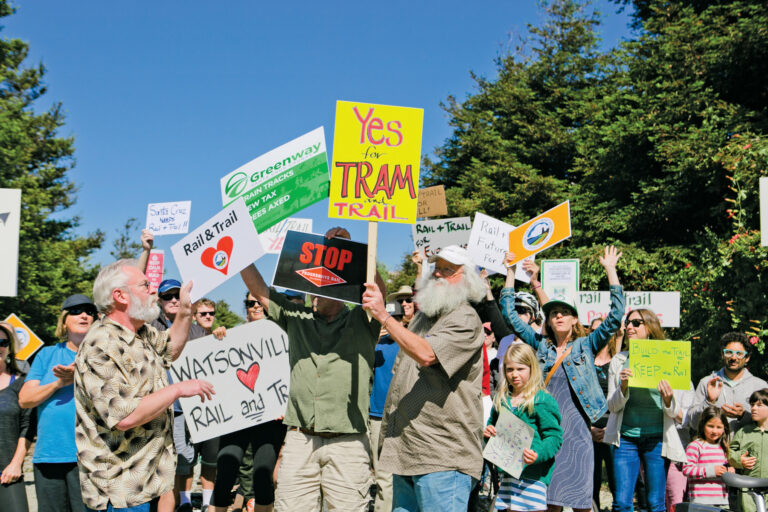
In the last several years, the debate over rail-and-trail versus trail-only has evolved from a niche discussion to a trending topic to the most contentious political issue I’ve seen in Santa Cruz County since the post-earthquake arguments over rebuilding and homelessness. That would be fine—you have to respect the passion that locals on both sides bring to it.
Except it’s gotten way too personal, and way too out of hand. The stories I’ve heard in just the last couple of months about both sides’ political snipes—including denigrating and even sabotaging those who don’t agree with them on Measure D—are disturbing. And the shortsightedness and lack of perspective at play are unbelievable.
Is the question of what kind of trail this county has along the rail corridor, and whether or not it might possibly include rail transportation in the future, really worth destroying the alliances that we depend on for any and all progress in this county? We’re in the midst of a historic water emergency, have no meaningful policy to fix our homelessness issues, can’t meet even our meager goals for affordable housing, and face the possibility of another wildfire disaster on the scale of CZU or worse—and we’re blowing up our political and personal relationships for this?
The aftermath of those 2020 fires is the time I point to when speaking about what we’re capable of doing when we work together. It was a massive effort by a huge group of people united for one purpose—to help those who needed it—with no regard for political disagreements. I wish we didn’t need a natural disaster to inspire that, and I hope that no single issue can break that community bond.
This issue contains everything you need to know when considering how to vote on Measure D, from the nuts and bolts to the arguments for and against to the possible futures after the votes have been counted. Many people have asked me if GT is going to endorse one side or the other. I’ve only got one endorsement to make: civility.
STEVE PALOPOLI | EDITOR-IN-CHIEF
ONLINE COMMENTS
RE: BEARCAT
It was useless during the hunt for murderer Carillo two years ago, when it comically scooted down the street to where a lone private citizen marital artist has already deftly (and barehanded) disarmed the shooter.
Policing by Consent. All this militarization overwhelms any concept of consent. It polarizes and divides, fearful and feared. And it really hasn’t justified its gas bill. Look at that gun turret. It’s disgusting.
— Aname
RE: TRAFFICKING CONFERENCE
It would appear that these ”traffickers” have no conscience. That being the case, does not that put this in the realm of serious evil? I know it’s not politically correct to use such terms, but that’s what it is. It is important to identify the enemy, otherwise run the risk being broadsided by this kind of thing again and again, ad infinitum.
HOOTENANNY Locals have been gathering daily to watch the owlets at Natural Bridges. Take care not to disturb them! Photograph by Sharon Hall.
Submit to ph****@*******es.sc. Include information (location, etc.) and your name. Photos may be cropped. Preferably, photos should be 4 inches by 4 inches and minimum 250dpi.
GOOD IDEA
ENCHANTING VALLEY
This Saturday, take a tour of six private, spectacular gardens in Scotts Valley. The event is the Enchanting Gardens in Scotts Valley, and visitors will see large estate gardens, an iris farm of over a thousand plants, Japanese maple tree collections, and other colorful and unique surprises. All proceeds go to Valley Churches’ food pantry. Tickets are $30. For more information, call 831-336-8258, ext. 229.
GOOD WORK
WHEEL HELPMeals On Wheels (MOW), which gives out 180,000+ meals annually to seniors, is looking for a new home. MOW has been operating out of its Live Oak location, which is leased by the Live Oak School District, for 45 years—but on May 4, the group was served an eviction notice. As it looks for a permanent location, MOW is asking the community to send a letter to Live Oak School District’s Board of Directors, sharing the importance of its services. Learn more at: actionnetwork.org/groups/community-bridges.
QUOTE OF THE WEEK
“The hardest thing about any political campaign is how to win without proving that you are unworthy of winning.”
Good Times received a letter to the editor about Measure D a few weeks ago that was not an opinion intended to sway readers, but instead an earnest request for assistance in making an informed and educated choice when casting their vote.
“It’s really difficult to sort out the different (and often contradictory) information that groups for and against Measure D are citing. Could you please do a fact-checking and vocabulary-defining piece that attempts to put us all on the same page?”
The writer of this letter isn’t alone. Measure D is arguably the most contentious issue on a Santa Cruz County ballot in the last 30 years, and unbiased information has sometimes been hard to come by. A prickly haze of fear, persecution and paranoia has built up around the rail-trail debate—as has a barrage of misinformation and rhetoric.
How to cut through all that? Let’s start by laying out what voters will actually see on the ballot. Measure D, also called the “Santa Cruz County Greenway Initiative,” asks, “Shall voters adopt the measure to amend the Circulation Element of the County’s General Plan related to use of the Santa Cruz Branch Line Rail Corridor as set forth in the Santa Cruz County Greenway Initiative Petition?”
But that phrasing doesn’t really explain what a “yes” vote or a “no” vote would mean for the hotly debated future of rail and trail in Santa Cruz County.
A deeper dig into the language of the measure provides further explanation: If Measure D passes, a halt would be placed on “all references to railroad maintenance, rail transit planning and the like from the county’s general plan.” Meanwhile, if Measure D fails, the county would be able to move forward with its general plan, which currently includes plans for both rail and trail.
For a more detailed explanation of the mechanics of Measure D, read our story on page 10. We trust that all of this information will give our letter writers, and the rest of our readers, a clear understanding of what D would do. (And for an explanation of why it might not ultimately matter, read our other story on page 10).
Beyond that, however, we want to explain what both supporters and opponents of the measure are saying. Taken together, we hope that all of this information will allow readers to make the most informed decision for themselves.
Yes on D: What Supporters Are Saying
Melody Venes lives with her dog Roxy aboard a boat called MeloDays in the Santa Cruz Harbor. The 56-year-old isn’t afraid to tell the stranger gazing over a Measure D ad in the newspaper at the bar near her floating home what she thinks of it all.
“I would love to see the current railroad system turned into a bike path that’s safe for people,” she says, explaining one of her friends was recently killed in a cycling accident. “He was one of the most joyful, pleasant people you could possibly know.”
According to California Highway Patrol data, there were about 8,800 cyclist crashes and 151 deaths in 2020—and Venes believes her friend might still be alive today if a greenway was available.
“He wouldn’t have had the obstacles,” she says.
Venes also supports Measure D because she thinks the tracks are in disrepair. Back when she lived in Seacliff, she remembers walking towards a derailed train to have a look for herself.
“It was surreal,” she says, remembering askew cars amidst the coastal landscape. “They were tipped sideways off the rail.”
Venes says she’s not anti-rail, but simply thinks a commuter rail line would make more sense next to Highway 1—not through neighborhoods.
“It would be loud; it would be too fast,” she says. “I don’t even like the idea of riding a bike next to a railroad.”
That doesn’t fit her vision for the place she moved to from Colorado.
“Santa Cruz is a small town,” she says. “We’re very nature-oriented.”
Venes says she’s given money to support Greenway, and is anxious to see Measure D pass.
Melody Venes lives (pictured with her dog Roxy, on her boat in the Santa Cruz Harbor) is organizing hikes along the rail corridor that she believes will convince more people to vote in favor of Measure D. PHOTO: DREW PENNER
So is Bud Colligan, who’s been spearheading the trail-only push for years. The former Macromedia executive says financial disclosure forms show many locals support the group’s efforts on Measure D. According to regulatory filings since the beginning of the year, the Yes Greenway campaign has brought in $317,343.92 in donations—about twice as much as the No Way Greenway campaign ($159,780.42). While some of that arrived in large amounts from wealthy individuals, Greenway has also drawn smaller contributions from people like Venes.
“I think if we had a great trail we would save a lot of lives,” says Colligan, adding he believes a recreational route would be the best use of taxpayer dollars. “We should build the simplest, least-complex thing on the rail corridor.”
According to Santa Cruz County Regional Transportation Commission Executive Director Guy Preston, while a quality trail might cost as much to build as the recent half-a-million-dollar estimate for passenger rail construction (depending on what environmental, legal and engineering challenges arise), light rail would likely come with an annual $25 million price tag for operations. If government grants are forthcoming, and locals agree to a small tax hike, that could theoretically happen, says Preston, but he adds that complicated infrastructure projects have a way of running over budget.
Santa Cruz County could end up with a situation like what’s happening in the North Bay, where Cloverdale has been paying towards a rail line it was promised before the transit authority ran out of money and voters defeated an extra sales tax proposal, he says.
Here in the Monterey Bay, the county says it could build an initial trail from 17th Avenue to State Park Drive for about $33.4 million, or a rail-and-trail option for $70.2 million. If a trail is built and a rail option is later pursued, that would bring the total to $114.6 million for that portion, known as Sections 10 and 11. Officials admit these figures leave out additional costs, such as fixing aging infrastructure.
Project Manager Rob Tidmore calls the trail-only choice an “optional first phase” that currently can’t be constructed.
“To build the interim trail, you have to remove the railroad track,” he says. “To remove the railroad tracks, you have to railbank the corridor.”
He says it’s unclear if that process would be successful. But supporters of Measure D say building a trail next to the tracks would also require feats of engineering, with new pedestrian bridges and retaining walls to tame the steep topography.
At the moment, local planners have been proceeding with the idea that electric passenger rail is the goal for the corridor, Tidmore says, adding the upcoming vote could impact that trajectory.
Measure D supporters also point to the pitfalls of dealing with landowners whose homes butt into the corridor. There are 180 known encroachments just to the east of the San Lorenzo River alone.
Mark Esquibel, chairman of the Reform Party of Santa Cruz County, says he’s familiar with complications like these. As a right-of-way specialist for Kinder Morgan, Inc, he worked on an East Bay project called the Iron Horse Regional Trail that was a rail line in its previous life.
He also served as the subject matter expert for the pipeline company during BART’s extension from Fremont to San Jose.
“They spent $750 million on nine miles of track,” he says, adding it can be time-consuming to secure property rights. “It doesn’t happen overnight.”
In the last round of Santa Cruz County elections, Esquibel ran for District 1 Supervisor; after dropping out of the race, he endorsed pro-Greenway candidate Manu Koenig, who defeated incumbent John Leopold. That helped turn the tide towards the path-only alternative in some local government circles.
Esquibel says dozens of owners would probably have to be moved—one way or another—to make way for stations and parking lots.
“Those people are going to be asked to sell, and then forced to sell,” he says. “I actually moved a lot of families on the Iron Horse Trail.”
That particular line has now become a popular recreation trail. It’s what Measure D supporters want for Santa Cruz County.
Next to the old railway depot that’s now a museum in Danville, on the Iron Horse route, area resident Melissa says the paved path works great for dogs, bikes and strollers. Another local, Marty, says he appreciates that they ripped out the tracks and put in a trail.
“People love this—they really do,” he says. “I wouldn’t like to be walking along and having a train next to me.”
Back in the Santa Cruz Harbor on the MeloDays, as two paddlers silently glide by in a kayak, Venes works on organizing a hike along the rail corridor to encourage more people to vote Yes on D.
“We don’t want to lose that greenspace to the commuter train situation,” she says. “It would be nice to have a safe bike and hike path.”
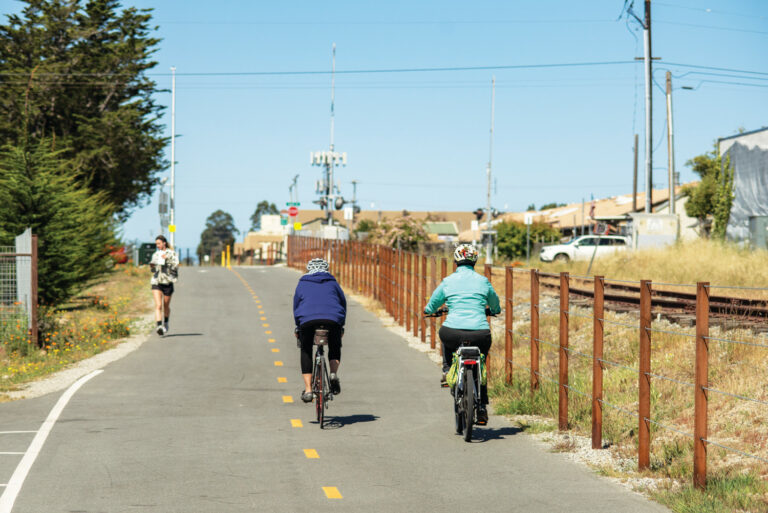
It’s a sunny Santa Cruz day near a stretch of trail behind the Santa Cruz Mountain Brewery.
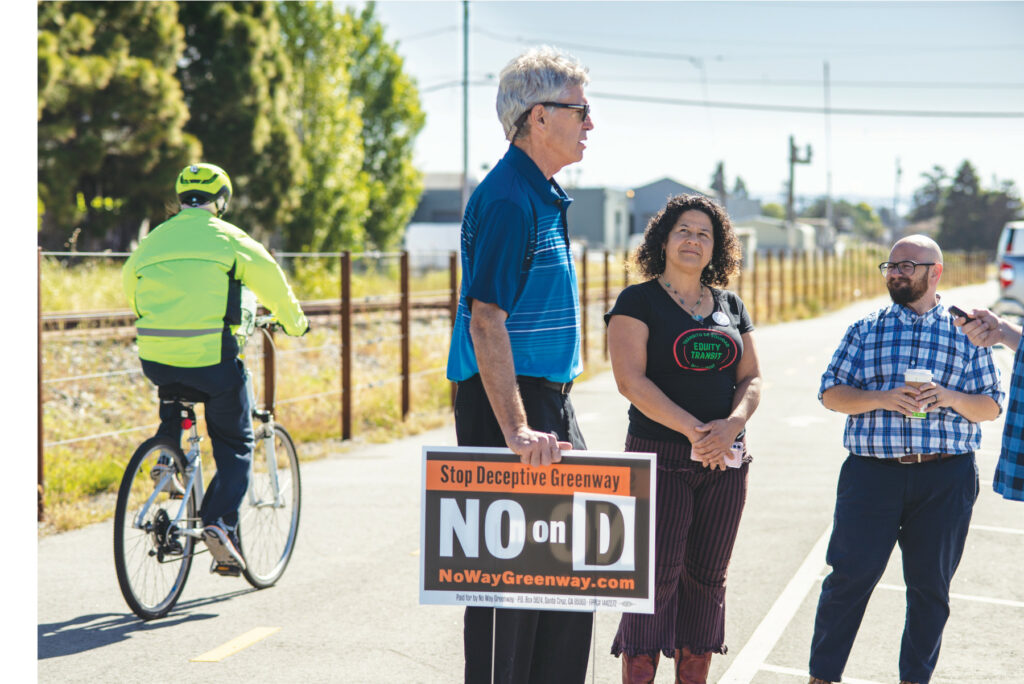
Several representatives from the No Way Greenway group that is leading the opposition to Measure D are poised to present their arguments. Sporting No Way Greenway T-shirts, buttons and holding lawn signs, an impromptu roundtable begins. Their message: Santa Cruz County’s future is dependent on the failure of Measure D.
Mark Mesiti-Miller, No on D and No Way Greenway campaign co-chair, Melani Clark, Roaring Camp Railroads CEO, Lani Faulkner, Equity Transit director, and Cabrillo College trustee Adam Spickler come from very different backgrounds, but have been brought together by their opposition to Measure D. According to No Way Greenway, Measure D would be disastrous for Santa Cruz County.
Left to right: Mark Mesiti-Miller, Lani Faulkner and Adam Spickler discuss why they’re against Measure D. PHOTO: ERIN MALSBURY
“If Measure D fails, plans that have been in the works for over two decades, that have been through the wringer of public meetings—over 100 public meetings were held to develop the master plan for rail with trail, and that plan was adopted by everyone: the California Coastal Commission, every city that the rail line runs through, the County, everybody has blessed that plan,” Mesiti-Miller says, without taking a breath. “If Measure D fails, that plan continues without interruption, without delay. And that’s the vision that everyone in this community has been working on for so long.”
The plan Mesiti-Miller refers to is at the heart of the debate: A decade ago, the RTC purchased a 32-mile segment of the Santa Cruz Branch Rail Line that extends from Watsonville up to Davenport. Since then, countless hours and millions of dollars—on top of the $14.2 million spent on the rail line—have gone into transportation studies. So, if Measure D passes, opponents argue, the tracks will be covered to build a larger trail and that plan that consultants, city planners and officials and volunteers have dedicated thousands of hours to will be all for nothing.
“We are already decades deep into moving forward on continuing electric light passenger rail, and what that means for our carbon footprint and transportation equity,” Spickler says. “I want future generations to look back and say that we did the right thing. We kept transportation options in place. We didn’t reduce them.”
Faulkner says rejection of Measure D would mean a path to empowerment for an often-overlooked segment of the population.
“For people who are disabled and elderly, people who have no other way to get around the county other than public transportation, rail in particular is such a powerful way to get around, because you don’t have to sit in traffic,” Faulkner says. “People from Watsonville sit in traffic or wait for buses for hours. The failure of Measure D allows [the County] to apply for funds that will improve both our rail and bus systems, which would serve a much wider swath of our community.”
Mesiti-Miller’s passion is as big as his six-foot, six-inch frame.
“Measure D does only two things,” he begins, “remove the railroad tracks between Santa Cruz and Watsonville and rewrite the general plan to prohibit the County of Santa Cruz from studying or planning rail transit in the rail corridor forever. Read the impartial analysis on the County’s election department website. You will see the words adopting the Greenway initiative do not guarantee a greenway will be constructed. That’s what’s at stake.”
He says the argument over Measure D has been twisted into a debate over issues the measure itself does not address.
“[Greenway] talks about the cost of a train, but the cost of a train is not even on the ballot,” he says. “What’s on the ballot is: Do we want to make sure that there’s no possibility that rail transit will ever be constructed in the rail corridor?”
Meanwhile, the RTC’s Preston is on record saying that if Measure D passes, Roaring Camp Railroad’s ability to run trains to the Boardwalk would not “directly” be jeopardized. However, language is key when discussing anything related to Measure D, whether for or against, and Roaring Camp CEO Clark believes her business would be directly affected if Measure D passes. While Roaring Camp is known for its leisurely treks to the Beach Boardwalk and back to its headquarters in the Santa Cruz Mountains, the company also has the rights to the Felton freight line. Clark says Measure D could prevent freight from ever being run on it.
“It’s important to us and the San Lorenzo Valley that we have our rail link that goes up [to the Santa Cruz Mountains],” Clark says. “We had all of the fire chiefs from San Lorenzo Valley write a letter opposing Measure D because it also plays an important role for all emergency services. If there were a fire in the Valley, the train’s ability to transport people out or transport water and resources to the firefighters would be key. If there’s ever a fire and we had to evacuate the Valley, we’d only have two or three roads. Emergency service people want to keep the rail line in because that provides another way to move people out of here. There are a lot of reasons behind [No on Measure D] that make sense.”
Clark reiterates that she’s not against having the trail.
“Both sides want the trail,” she says. “We’re just saying that it makes sense to have both trail and rail.”
All ballots must be in by the end of the day on June 7. For all the current election information, voting options and voter registration, visit the Santa Cruz County Elections Department at votescount.us.
In his book California Central Coast Railways, author Rick Hamman recounts how, in the summer of 1882, a bunch of businessmen decided to put a railroad from Aptos into the hills to get at the trees.
“Rumors were flying thick and fast that several of the officers of the Southern Pacific and the Central Pacific railroads had just completed a big deal with the Watsonville Mill and Lumber Company and the Fallon family concerning their individual timber holdings up Aptos Creek Canyon,” he writes. “By October of 1882, the Loma Prieta Railroad Company had acquired all of the necessary properties and capital such that the surveying, grading, and construction of the right-of-way could begin in earnest.”
Both sides of the Measure D fight agree on one thing—there’s no way a new train would go in that quickly now. Property rights are a big reason why, experts say.
In an interview with Good Times, Santa Cruz County Regional Transportation Commission Executive Director Guy Preston says there’s still plenty of work left to do to figure out just what agreements would need to be put in place for development on the planned—and controversial—rail corridor to proceed.
“We need to know if we need to obtain additional property rights,” he says.
That means working with an unknown number of individual landowners, each of whom could decide to frustrate plans for a trail or passenger rail.
Land Values
One of them is Cristina Locke, who recently invited a tenant to open a restaurant in the Bayview Hotel she owns. It’s situated right where the Loma Prieta line used to join up with tracks going between Santa Cruz and Watsonville.
The historic structure was built in 1878 by Basque forty-niner Joseph Arano. That was just before the forestry boom that employed around 200 Chinese graders putting tracks inland. Now there’s an orange-and-black No on D sign in front of the stately building that once housed a post office and saloon, and a sturdier one made of wood by the tracks sharing the same message.
Locke says it’s her land all the way across the tracks and halfway into Soquel Drive—unlike her neighbor to the south.
“I have this little piece extra,” she says, pointing into afternoon traffic.
The RTC believes it has rights to the portion the rails cut through, but admits the language on Locke’s deed leaves things open to interpretation.
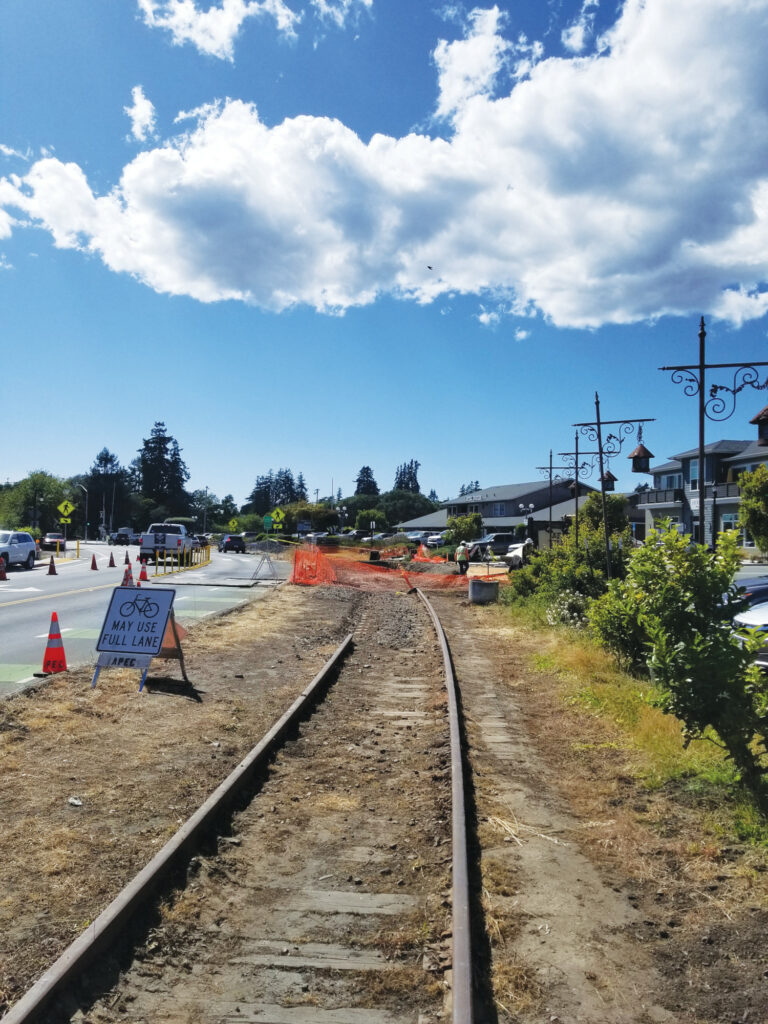
On this May afternoon, an entire section of rails and ties are gone, leaving behind a gaping hole. It’s part of the work on a mixed-use development going in nearby.
Swenson Builders can’t sell any of the 29 new housing units until it secures a certificate of completion, according to Jessie Bristow, the project manager. It couldn’t get that until Locke signed off on allowing them to move a railroad crossing.
“I made a deal with them,” Locke says, explaining that the company’s chairman, Barry Swenson, has personally been working on the deal with her for quite some time. “For years he’s been after me and after me.”
Locke says she was originally offered just $10,000, but held out for more.
She finally agreed after the company offered to pay her at least $250,000, she says. Bristow disputes the way Locke characterized the deal, but multiple sources with knowledge of the negotiations told Good Times the figure is in the correct range.
Local planners say they aren’t sure how many people hold what titles along the entirety of the rail corridor.
Luckily for them, Locke is enamored with the historic nature of having trains pass by.
“I’d be willing to sell part of my land for that,” she says.
To Bank or Not to Bank
It’s unclear if the other owners in the area would be quite so accommodating.
The County says the quarter-million-dollar payout is a unique scenario that isn’t indicative of how expensive future negotiations would be for potential passenger rail or trail construction.
But according to the RTC’s Preston, it’s not that simple. In fact, it was Swenson Builders’ challenges with Locke that opened his eyes to potential snags all along the corridor—and convinced him of the need for railbanking, he says.
Railbanking is an approach being promoted by Greenway supporters as a way to get a path built quickly while avoiding fights with homeowners and businesses.
The RTC says that if it doesn’t railbank, and the line is abandoned, it could lose its easements.
Supporters of Measure D argue that landowners like Locke could easily frustrate a rail-and-trail build, if planners don’t pursue this strategy.
It’s happened in other places. Last year, dozens of Sonoma County residents sued over a bicycle and pedestrian path next to Sonoma-Marin Area Rail Transit tracks that hadn’t been railbanked first.
Usually the rail operator would apply for abandonment, but the RTC could pursue “adverse abandonment” to force the issue.
Whether this effort succeeds or not would come down to, among other things, the viability of the existing freight line, according to regulatory officials.
The Surface Transportation Board, the federal agency that makes such decisions, notes each case is very different—and evaluated on its own merits.
The board considers if there’s a freight operator trying to make a go of the line, and looks at other factors like potential environmental harm.
STB spokesperson Michael Booth says the agency is tasked with preserving the integrity of the national rail network wherever possible, while still allowing for railbanking. That process came to be under the so-called “Rails-to-Trails” act of 1983.
“The board is primarily concerned with the network itself and making sure it’s useful for shippers and the public,” he says.
Controlling Interests
Roaring Camp Railroads has been a major force rallying people in Santa Cruz County—and beyond—against Measure D.
But Roaring Camp is the subcontractor of the actual freight operator, Twin Cities-based Progressive Rail’s St. Paul and Pacific Railroad, not the owner of the main branch.
For this reason, an attempt by Progressive to block a railbanking effort would likely carry more weight than one by Roaring Camp, analysts say.
Progressive’s CEO Lon VanGemert tells Good Times the company is firmly against the voters’ initiative—although he stopped short of saying they’d try to kill a railbanking drive.
“This poorly conceived measure aims to rip up the rail tracks,” he says. “Once that happens, there is very little chance they will ever come back.”
However, Progressive previously sent the RTC a 90-day notice of their intent to file for abandonment.
“We had concerns about it, of course,” Preston says, referring to the issues around property rights. “We could lose some of those easements.”
The company then reversed course, signaling it was no longer planning to move forward with abandonment, though it reserved the right to shut down at any point, Preston says.
VanGemert declined to comment on the about-face, saying only that if Measure D is successful, it will “seriously harm” its subcontractor.
Progressive now argues there are legitimate business prospects to be had with rail in Santa Cruz.
“We believe there is clear opportunity for growth in freight service in Santa Cruz County, as well as the future addition of passenger rail,” he says.
Progressive is still trying to get out of its freight obligations, according to Preston.
Meanwhile, the RTC is currently on the hook for millions of dollars in repairs, and hasn’t come up with the cash to hold up their end of their deal with Progressive.
The area used to be a center of profits for railroads. At one point, the Loma Prieta Lumber Company was shipping out 70,000 board-feet of wood a day. But even back then, it was hard to keep things up and running. For example, in early 1899, when bad weather severely damaged the tracks, the timber left on the mountainside wasn’t enough to justify repairs on that part of the line, according to a piece in The Mountain Echo on April 8, 1899.
Mark Mesiti-Miller of No Way Greenway says the fact that Progressive isn’t on board with railbanking means a bike-only path wouldn’t happen as quickly as Greenway suggests.
“I’ve been in this industry of public works infrastructure for more than three decades,” he says. “The idea that you could rip up the rails and put a trail down for 32 miles in four or five years is completely insane.”
It will be up to the RTC to prove to the STB the line isn’t viable for freight, if abandonment proceedings get underway, according to Mesiti-Miller.
“I think everyone would argue their case,” he says. “It becomes a long, arduous affair.”
Greenway’s Bud Colligan admits there’d be delays if Roaring Camp or Progressive opposes railbanking.
As far as the arbiters of the matter are concerned, STB spokesperson Booth says decisions are typically procedural, and the length of time they take depends on the motions that get filed. Without opposition, the process could be wrapped up in six months, but would probably still only take 2-3 years if the railroad tries to fight it, according to the RTC.
But somewhat lost among the back and forth between supporters and opponents has been what, exactly, the measure would accomplish if approved by voters, and who is funding the two campaigns.
What D Would Do
This measure, if approved, would change the county’s General Plan—the jurisdiction’s blueprint for meeting the community’s long-term vision for the future—to include the development of a multi-use bicycle and pedestrian trail between the San Lorenzo Bridge in Santa Cruz and Lee Road in Watsonville, while “railbanking” the existing rail line for future use.
The measure needs only more than 50% of the vote to pass.
Santa Cruz County Counsel Jason Heath’s impartial analysis of the measure says the plan would include the removal of the existing rail tracks.
The measure would add language to the General Plan supporting the building of the trail, while removing language that relates to rail services, both freight and passenger.
Heath wrote that Greenway’s plans hinge on the approval of railbanking, which is a lengthy process that involves the federal government, freight operators and the Santa Cruz County Regional Transportation Commission, which currently owns the 32-mile rail line.
Failing that, Heath writes, the change in language would have no real-world effect.
“The General Plan is a planning document and does not mandate that proposed infrastructure be built. Therefore, adoption of the Greenway Initiative does not guarantee that the Greenway will be constructed,” he writes.
The RTC, whose governing board is made up of local city council members, county supervisors and Santa Cruz METRO board members, has maintained that approval of Measure D would not stop the agency from studying or pursuing funds for passenger rail, or its construction.
Ultimately, that agency will have the final say on the rail line’s future. Currently, it is soliciting feedback on which option—a rail and trail option or a trail-only option—it will pursue on two segments between Santa Cruz to Aptos on unincorporated county land. Other segments in Watsonville and Santa Cruz have already been completed under the rail and trail design.
Who’s Behind D?
Proponents of Measure D—led by the organization Santa Cruz County Greenway—say the 32-mile trail is fully funded, and can be built now. It would be accessible to all county residents. They say it would reduce traffic and air pollution while giving residents a safe, healthy way to commute to work and school. It would also preserve the natural landscape of the area.
According to the most recent campaign finance reports, Greenway has raised $318,285.99 in total campaign contributions.
Many of the campaign’s significant contributions have come from Bay Area and Central Coast figures such as author and Silicon Valley venture capitalist Guy Kawasaki ($20,000), Driscoll’s CEO Miles Reiter ($20,000), philanthropists Rowland Rebele ($23,000), Karen Hargrove ($25,000) and Alec Webster ($25,000), Looker co-founder Lloyd Tabb ($25,000), Bill Simpkins ($20,000) and Monterey Bay Aquarium Director Julie Packard ($15,000).
Who’s Against D?
The opposition to Measure D—spearheaded by the group No Way Greenway—say railbanking would bring the county’s existing plans to build a combination rail/trail corridor to an indefinite halt.
According to the most recent campaign finance reports, this camp has raised $165,698.70 in campaign contributions.
Among their top individual donors are Santa Cruz residents Christine Weir ($10,000), Dan and Jill Dion ($15,000 and $10,000, respectively), Mark Mesiti-Miller ($10,000) and Greg Larson ($5,000) as well former Santa Cruz Mayor Donna Murphy ($9,999).
Other notable donors include Santa Cruz City Council members and candidates for 4th District County Supervisor Justin Cummings ($250) and Shebreh Kalantari-Johnson ($100). County Superintendent of Schools Farris Sabbah ($100), former Santa Cruz Mayors Michael Rotkin ($100) and Cynthia Matthews ($100), Monterey Bay Central Labor Council Political Coordinator Glen Schaller ($100) and Santa Cruz County Democratic Party Chair Andrew Goldenkranz ($100) have also donated.
In addition, Fred Keeley, a former member of the state legislature who represented Santa Cruz, also made a $2,608 “nonmonetary” contribution in the form of event services.
No Way Greenway also received donations from the following committees: Democratic Women’s Club of Santa Cruz County ($475), Monterey/Santa Cruz Building and Construction Trades Council ($500) and Santa Cruz for Bernie PAC ($2,000.71).
The last day to register to vote in the June 7 election is May 23. Voters can register online atregistertovote.ca.gov or pick up a card at any post office, library, city hall or county elections office. There are 17 ballot drop boxes installed throughout the county. Ballots postmarked on or before June 7 and received by June 14 will be considered received on time under California state law. For information, call 454-2060 or visitvotescount.us.